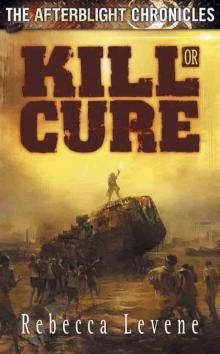
Kill or cure ac 2, p.14
Kill or Cure ac-2,
p.14


"Jesus," Haru said. "What have you done to her?"
"Allowed her to feel again." I said flatly. "Who's Jorge?" I asked the woman, but I wasn't sure that I wanted to know what it was that had happened, that was pulling the terrible sound out of her. There was no reply anyway, just more piercing screams. Haru scurried out of the room as fast as he'd entered it, but Ingo stayed, staring at her. I wondered if there was anything hidden away inside him, some secret that made him want to scream the same way. There sure as hell was inside me.
I turned to Kelis, meaning to tell her to put the old woman out of her misery. But I closed my mouth as soon as I'd opened it. What, so I could keep my hands clean and keep kidding myself that I was someone who saved lives and didn't take them? No. I pulled out my own gun, turned my face away and put a bullet through the old woman's skull. There was only a very little blood.
We set out for the palace three hours later. The Leader wanted to cure everyone? That wasn't something even Haru thought we could ignore.
The walk through the streets of Havana was nerve-wracking. One of us might have hoped to slip through the shadows and side-streets unnoticed. Five of us? No chance. So we walked, calmly and quietly, as if we had every right to be there and knew exactly where we were going.
The first time we passed a cluster of the Infected I expected it all to fall apart. Surely they'd found out what we'd done to the old woman? But they just passed us by, not even sparing us a glance. Kelis let out a little huff or relief. Haru shuddered and wrapped his arms protectively around himself.
Next were the cameras, silent silver eyes on every street corner. All it would take was some simple face-recognition software. Soren ducked self-consciously as we walked past but I yanked on his arm and forced him to face forward. Conspicuously hiding from the cameras – there was software that could pick that up too. Either they'd recognise us or they wouldn't. My hand drifted down to the gun hidden beneath my baggy t-shirt.
All we could be was ready.
But all around us, the world carried on as if we weren't in it. The streets were dusty with ragged fragments of cloth and paper blowing down them in the hot wind. The Infected seemed to be in no hurry, walking slowly down the narrow streets to nowhere in particular. Bloody remnants of wounds stood out stark red on their faces, hands and legs; but no one seemed to care. Once, as we walked past, a man with a seeping sore over his left eye fell down on the pavement and didn't get back up. No one reacted, they just adjusted their paths round his body and carried on walking.
For the first time, I realised that some of the piles of cloth on the pavement had once been people, worn away by time. Dead and left to rot where they fell. Why bother to bury your dead when you just don't care that they're gone?
After thirty minutes walking the scruffy residential streets gave way to broader, bleaker roads with the concrete hulks of government buildings squatting on either side. Barbed wire lined the tops of tall fences but there was nothing to keep out any longer. The streets were deserted, none of the Infected in sight. The buildings too had the unmistakeable look of desertion about them. Only the every-present cameras peered out from their walls. Within there was an echoing emptiness which was evident even fifty feet away.
We walked on. The sky was hazy above us, caught between sunshine and rain. No shadows anywhere, just a pervasive muted light. Another fifteen minutes and we were there.
The street outside was entirely empty. There was a tall fence, security gates, cameras, guard towers. But again, that air of desertion.
"You're sure he's here?" Kelis asked.
I shrugged. "That's what the old woman said."
"Yeah," Soren said dryly. "And why would she ever want to lie to us?"
I saw Haru swallow hard, then square his shoulders. "Well, we're here now. And look…" he pointed over the gate, deep inside the palace complex. "There's light in there. There must be power. Why would they waste electricity on a place that was empty?"
The cameras to each side watched us blankly. There was no question that whoever was inside knew we were there.
"So…" Kelis said. "Do we go in?"
I looked at the cameras again. "Nothing to lose now. I guess we climb."
Kelis boosted each of us over the high fence, using that deceptive strength of hers. Soren went last, pulling her up and over as if she weighed nothing at all. His hand lingered on hers before he let it go. I saw her notice it, the slight unease as she finally pulled her fingers free. That was never going to end well.
Inside we all paused a moment – waiting for the other shoe to drop, I guess. But no guards came pouring out, no sirens started blaring and after a moment we got moving deeper into the silent concrete complex.
When I was a kid, no older than nine or ten, I read The Day of the Triffids. I remember having to sneak it past my parents, because they would have thought it was too scary for me. But it didn't scare me at all. The image that stuck in my mind, the one I absolutely loved, was of the hero wandering through a deserted London, where everybody else was dead.
I remember finding that an incredibly seductive idea. To be able to wander into everybody's houses, see what went on behind doors that were usually closed. To have it all to yourself. Maybe it was a legacy of that time I'd spent in hospital when I was very young and I had no privacy at all: even the inside of my body became public property then. Maybe that was why I could imagine being so alone without finding it lonely.
Wandering through those echoing, empty rooms made me think of that with a sudden sharp stab of nostalgia for a childhood that could never be relived, not even through children of my own. There wasn't a soul in the place. No bodies, even. Nothing. We passed through living quarters, utilitarian barracks, plush sleeping chambers, impersonal guest rooms, through offices and eventually through labs. Three of them, fully equipped but not purpose built. These had been offices once, I guessed, before Ash put them to better use. There was no sign that they'd been left in a hurry, or during any kind of emergency. No signs of flight, or disaster. The people who'd once occupied them were just… gone.
"OK," Kelis said as we looked around at the benches, Bunsen burners, pipettes and all the usual apparatus of a working lab, "I guess this is just a front. He must have his real base somewhere else."
"It could be anywhere," Haru said. "How will we ever find it?"
"But you were right to begin with," I told him, "the power's still on. Something's still happening here." Halogen light shone down from the ceiling, flattening our features.
"A relay station," Ingo said. His voice was soft but startling, because it was always so easy to forget that he was there. "Remote control. There were satellite dishes on the roof, transmitters. The feed from the cameras goes out, the signal for the loudspeakers comes in."
"Goes out where?" Soren said. "Comes in from where?"
"Off the island," I said with sudden certainty.
Kelis raised an eyebrow. "You think?"
I gestured around me, at the carefully abandoned lab. "This was his headquarters. He was doing whatever he was doing here. Why would he bother to pack it all up just to shift somewhere else on Cuba? The only reason to leave would be to go somewhere else entirely."
"OK, I buy that," Kelis said. "So what was he doing in this place? This lab – it's not original is it? He built it, just like Queen M built hers."
"Yeah," I said. Only he built it better, because Ash was a real scientist, not a social one. I walked away from the others, along the length of the benches, scavenging for any clues. They weren't hard to find. I don't think when he'd left here he'd meant to erase his traces. He'd just taken what he still needed and left the rest behind.
It was all very familiar looking, and no wonder. The same set-up we'd had back at the base. I recognised the Petri dishes with carefully cultivated cultures, left to die or breed alone. In the furthest corner of the room there was a laptop, plugged in but switched off.
"Paydirt," I told the others as I booted it up.
"Why did they leave it behind if it's still working?" Haru said dubiously.
I shrugged. "Because they didn't need it anymore and they didn't expect anyone to find it."
I was right, though a part of me knew that Haru was right as well. This was all just too convenient. Did Ash want me to find it? Why? But even if he'd meant me to have this information, for whatever twisted game he was playing, it didn't mean it wasn't worth having.
"Anything?" Kelis asked.
I nodded as I skimmed through the directory before I delved deeper, because you'd be amazed how much people give away just in the way they name things. "Definitely something."
Thirty minutes later I could tell her exactly what. It wasn't a surprise, not after everything else I'd seen, but the certainty still sat like a sour lump in my gut. Guilt too, because a part of me had suspected all along, even back when there was still something I could have done to prevent it. Memory again, sharper than pain.
Ash out of the lab, taking one of the few sleeps we allowed ourselves back in those frantic days when it still seemed possible that we could stop it all, if only we could do it in time.
I was feeling wired that night, I remembered that. I wasn't sure why, maybe it was the message I'd had from him, a quick email which had taken three days to reach me. It must be getting bad out there, I knew, if information itself was beginning to sicken and slow. He hadn't been able to say much, with the security checks at his end and ours. But I could hear his voice saying every line and it had left me itchy to see him, to hear his voice for real. I knew that I probably never would again and it was almost unbearable. When you love someone like that it seems impossible that the love itself can't overcome every obstacle between you. If love can't do that, then what's the point of it?
So I was restless and unhappy and, as I usually did, I chose to sublimate it in work. My computer was slow to boot, some bug the techies hadn't been able to fix, so I switched on Ash's instead, unthinkingly using the password he'd told me long ago when we were students together and the only thing he had to hide was the fact that he'd been cheating on his girlfriend for the last three months.
I was planning on logging onto the shared drive, not even looking at his private files. I didn't expect there to be any private files. When would he have time to do anything but work?
Except there were private files – and they were to do with work. Not our work, the job I thought he'd left behind him when he came here. I knew, of course, that for the last few years he'd been employed by the Department of Defence. There hadn't seemed anything sinister about it, there were plenty of reasons why the DoD might want to employ a virologist. Defensive reasons.
I'd known, too, that some of the ingredients we'd been mixing into this 'Cure' we were creating came from classified sources. The cutting edge gene therapies, the more esoteric retroviruses, borderline unethical stem cell research. These weren't things available to the general public. But here they were in Ash's files, files with dates going back months, years; long before he knew we were going to use them. This was the stuff Ash had been working on before the Cull struck. Wasn't it just the mother of all coincidences that it turned out to be exactly what we needed to make the Cure?
No, I told myself, as my heart raced. It was just Goldilocks Syndrome. We live in the only possible universe that can support human life because if it couldn't, we wouldn't be here to marvel at it. And Ash had been recruited into the project precisely because his experience was so exactly what we needed.
Except. Except… here was a file on gene-therapy for sickle cell anaemia. There was another on the use of stem cells in adult neural rewriting. It was now obvious to me that the RNA we were carefully sculpting to change A and B to O-neg was a mash-up of both of these. But why the second? As far as we knew, the Cull wasn't neuro-active.
"What are you doing?" Ash asked from right over my shoulder.
"Snooping through your files," I told him, because he and I had never been able to lie to each other. Or at least I hadn't. For the first time, I was beginning to wonder about him.
"Find anything interesting?" he asked, so nonchalantly that I instantly relaxed.
"Yeah, highly classified defence department files. It said something about killing anyone who read them – but they were just kidding, right?"
He smiled and we got back to work and I never did ask him what exactly that research had been about, and why exactly it had fitted our needs so precisely. I never asked – but sometimes, late at night, I wondered.
"Find anything interesting?" Kelis asked me now, and I knew that I was pale when I turned from the laptop's screen to face her.
"Yeah, I guess interesting is one word for it."
"And what would be another word?" Ingo asked, as literal as ever.
"Terrifying."
"It's the Infected, isn't it?" Haru ran a hand nervously through the dark spikes of his hair. "This was done deliberately. The Infection – it was designed, not accidental."
I nodded and Haru grimaced and turned away.
Kelis was still studying me carefully, her intense brown eyes narrowed. "That's not everything, is it?"
"No, it isn't. The thing is, he did create the Infection deliberately." A perversion of the Cure I was carrying in my own blood, but I wasn't ready to tell her that yet. "He deliberately made it contagious. Blood-borne at the moment."
"At the moment?" Haru's eyebrows were so high they were lost in his hairline.
"That was the best he could do to begin with. But he was researching other forms of transmission."
"Airborne?" Ingo asked, and even he sounded hushed. Everyone knew that the Cull had been airborne too. It couldn't have done what it did otherwise.
"Maybe. But the trail here had reached a dead end, and he abandoned it about six months ago. That's the date of the last update to any of the files." And that really was as much as I could tell from the fragments of half-finished research on the abandoned laptop.
"We need to find him, wherever he is now," Kelis said and I felt a warm rush of relief because I didn't want to be the one who had to suggest this.
"How?" Haru asked.
Ingo held up his hand, like a child in class asking for permission to speak. "Somewhere in here there must be a central computer co-ordinating the information going in and out. If we can find that, I can tell you where the transmission is being sent."
"Good," I said. "When you find it, there's one other thing I need you to do."
Have you ever watched a whole city burn? There's a wild kind of pleasure in it, giving free reign to a force of nature that we're more often trying to contain. The truck we'd commandeered raced over the cracked tarmac of the road, but the heat travelled faster, clasping at our throats as we tried to outrun what we'd done.
All around us, the loudspeakers were still blaring the same message: "Everyone must come to Havana immediately. Come to the centre of Havana and await further instructions." They'd been saying the same thing for the last two days. We hadn't been able to wait any longer, but it hadn't been quite long enough. All around us, Infected were still flooding into the city, calmly walking into the flames which had already consumed thousands, tens of thousands, of lives. The fire wouldn't get all of them, there'd still be pockets of them in the furthest reaches of the island. But still, it would get enough.
So I was a mass murderer now. And in the end it had been so easy. All it needed was for Ingo to splice together audio tracks from a few of Ash's previous messages. The words didn't sound quite right, the emphasis in the wrong places, elision between syllables which didn't belong together. But the Infected didn't seem to care. It was their master's voice, and they had no choice but to obey it. The cameras were put on a loop, so Ash wouldn't be able to see what we'd done, while his own audio feed had been cut. We'd left him no way to save this terrible experiment of his, we were putting the Petri-dishes in the furnace and burning the cultures away for good.
After that, it was just a few cans of petrol over some central buildings, a hot day and a strong wind. Fire is endlessly hungry – it doesn't need much of an invitation to consume everything. I leaned against the cab of the truck and looked back, like Lott's wife, knowing there was a price to pay but helpless to avoid seeing for myself what we were leaving behind.
There's a Pink Floyd album cover: a burning man shaking hands with another, oblivious to the fire which is eating him alive. It's almost funny, the way he just doesn't seem to care. There were hordes of them, all walking into the furnace, on and on as their flesh blistered and burned, red fissures opening in skin like the cracks in the surface of a volcano that tell you another eruption is due. The smell was overwhelming. The meaty, porky smell of human beings burning.
I saw a girl no older than eight walk calmly down the narrow alley between two buildings. The doorways of the buildings belched yellow fire at her, little sparks of it drifting ahead of the body of the flame. Her hair caught first, burning a bright orange against her skull, but she kept on walking. She kept walking until her legs gave way, the bones snapping in the heat.
Finally, when the girl's body was lost to sight and the crowds on the streets had begun to thin and the flames receded into the distance, I looked away.
Kelis caught my eye. "We had no choice," she told me in a voice that said even she didn't believe it.
"It's done now," I said. "They won't be going out recruiting for a while. And they won't be trying to stop us from leaving."
"So now we find the dear Leader and stop him doing anything worse," Kelis said, offering a sort of comfort.
I looked ahead in my mind to the ocean fast approaching, and beyond to our destination, across the waters and most of the way across a continent. All the way to Las Vegas where, one day soon, I'd look Ash in the eye and make him pay. Not so much for what he'd done, but for what he'd turned me into.
CHAPTER SIX
It was ninety miles to Miami by boat. We'd found a light aircraft on the island but since none of us could fly it, it looked like we'd be going to Vegas the long way. I didn't look at Cuba as it receded into the distance behind us, just took the wheel and looked forward over the calm seas. As we'd sat on the shore and waited for the world to turn and the sun to rise, I'd decided that I was done with regrets.