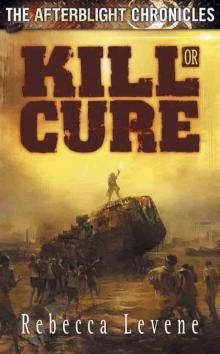
Kill or cure ac 2, p.2
Kill or Cure ac-2,
p.2


I watched his eyes as they tracked the blood still dripping from my arm to the floor, the unplugged IV, the dead heart monitor. "No," he told me. "Dr Kirik, you're not well at all."
A sudden flash of the present intruded, and I opened my eyes for a moment to see a sickening, vertiginous view of trees and water far below. The base was receding, just a grey dot on the horizon. My mind floated above it for a moment, trying to cling on to the past, but then it tore away and for a while there was no coherence to my fever dreams, just fragments of images as jagged as pain.
The plane landed at some point, a sickening lurch and then a nauseating sway on water. I was shaken by rough hands and then kicked, but no force on earth could get me to my feet, and eventually I was carried out of the plane and onto the large pontoons that held it over the shifting surface of the waves. A wash of warm saltiness revived me and I saw that they were carrying me towards a boat, a big one. A yacht, sails snapping in the wind.
Faces watched me from the deck as I was hauled up the side like a sack of potatoes. I watched them for a moment, round circles of brown and black and pink. There were black gashes in their centre, mouths open in smiles or grimaces, it was hard to tell. My eyes drifted away and, instead, I watched the sweat which was pouring off me as it dripped and fell into the ocean below. Salt into salt.
After a few minutes I sprawled on the deck. The sun blazed down on me but I felt cold, drawing my knees and elbows in to shape myself into a foetal ball. The faces blinked above me, watching.
"This is what you bring me?" one of them said. I thought I recognised the accent as Eastern European.
I saw one of my rescuers shrug. Seemed to feel it too, as if my skin was now so hypersensitive that the slightest shift in the air moved agonisingly against it. The Voice was screaming at me to get away, but the pain was screaming louder and I put all my energy into ignoring them both.
"She's a scientist, a doctor. Last survivor of the research centre. That's got to be worth something," my rescuer said.
"She's a junkie."
I couldn't argue with that. The junk was flushing itself out in my sweat as they spoke, leaving a hungry void behind.
I felt them stop and look at me. "So," my rescuer said, "she'll live or she'll die and then we'll know if she's any use. All we need to do is wait."
So, she'll live or she'll die… The words echoed hollowly in my head, banging against other memories, knocking them loose.
"So," I said, right back when this all first began, "either we'll live or we'll die, but at least we'll know. We know we won't be safe here forever. No matter how careful we are, or how airtight we think this place is, the virus is going to get in eventually. I'll take a punt on a zero-point-one per cent chance of survival over no chance at all."
The others nodded. They knew I was right. And sitting there, safe with their O-neg blood, they were in no position to be giving lectures on safety to someone sitting right in the crosshairs of the virus. The room was crowded, the top brass of the base all gathered together. This, after all, was what it had all been about. Why we'd all been brought here in the first place, safe from the savage fate of the rest of the world. There was a thick smell in the room, too many people who got to wash too infrequently. Put us all in one place and the stench reached a critical mass.
I saw Corporal Wetlock, brown face washed pallid by too long spent underground, staring at a speck of dirt on the wall as if it might hold some sort of answer. I'd noticed that a lot over the last few weeks. The saved unable to look the damned in the eye. Not often, I guess, that you get to work up close and personal with real-life walking corpses.
But maybe not. Not anymore – not if Ash and I had got it right.
"Zero-point-one per cent?" General Hamilton asked. "That's all you can offer me – after all this time?" Her chest was a mosaic of medals. I wondered when she'd had the time to earn them all.
We all knew that time was running out. Deaths were in the millions worldwide, maybe hundreds of millions already beyond saving. No point getting angry at her impatience.
"I don't see any other project offering you odds at all," Ash said, pissed off nevertheless. He glared around the table, over the proud arch of his nose. Several more eyes dropped. There were seven separate research programmes going on here, coming at the problem from every sensible angle and a couple of straight-out crazy ones. The nearest anyone else had got to a vaccine was something that gave lab rats intestinal cancer within two days of injection. Nothing else had even progressed to in-vivo testing.
"OK," Hamilton said. "But testing on yourselves? You're the last people we can afford to lose in the ninety-nine point nine per cent likelihood that all it does is give you pancreatic cancer or cause your brain to bleed out your goddamn ears."
The bleeding out the ears had been one of our earlier attempts. Poor rats.
"General," I said, "If it doesn't work, if this avenue's a dead end, we're useless to you anyway. By the time we've started a new line of research…" I shrugged. "We'll be bleeding out of pretty much every part of our body."
"Fine," she said. "Try it."
And that, right there, was the single worst decision anyone could have made.
CHAPTER ONE
Going cold turkey is no one's idea of fun. It's a private kind of hell. What can I say about it that hasn't been said already? Just sobbing and puking and sometimes fitting and nearly dying. I didn't know where I was – but I was somewhere. We'd arrived. The visions of my past eased up after that first rush, leaving nothing to relieve the monotony. That's the biggest secret about illness and pain. How monumentally fucking boring it is.
People drifted in and out, shot things into my arm and sometimes forced them down my throat. Some of those things must have been anti-psychotics, because after a while the Voice faded into silence. My mind felt clearer than it had in five years. When I'd stopped screaming in agony, I guessed I'd be grateful for that.
On the fourth day, I realised that the rocking sensation I was feeling had nothing to do with drug withdrawal. I was still on a boat. Something about the motion told me it was a big one, an order of magnitude above the yacht which had brought me here. I spent ten minutes lying there wondering if it was worth the effort to get up and walk towards the port hole I could see to my left. The shutters were closed over it, a relic of the stage when any light stabbed into my eyes like a knife, but the diamond splinter pain behind my temples had faded to a dull ache, and I thought I could risk a look.
If I could make it the five paces across the floor to the porthole… my knees buckled the instant I stepped out of bed. My joints felt like they were held together with weak glue. I caught a glimpse of myself in a mirror against one of the dark-stained wooden walls. Dark shadows circled my eyes like bruises and my hair hung lank and unwashed around my face, grease turning the vivid red of it almost brown. My skin was so white it looked translucent, a spider's web of blue veins beneath it. I realised that this was the first time I'd seen myself in years. I'd deliberately smashed the one mirror in the base after the first few months of staring at my blank, desperate eyes. I'd hidden the fragments of glass in the closet along with my colleague's corpses.
The catch on the porthole was tight. I had to stop to gather my breath four times before I finally managed to twist it open. I flinched from the light that poured in when I finally did, but my eyes adjusted without problem. I suddenly realised that I felt alive, really alive. It was a weird sensation.
The sky was only a little paler than the sea, a brilliant, tropical blue. The water was far below, fifty feet or more, the waves smacking against the hull in sharp little peaks and troughs. The ship was even bigger than I'd realised. There was a coastline ahead of us, a crescent of pure white sand leading back to dark trees then rising into jagged volcanic peaks. Almost certainly the Caribbean.
A long way from Lake Eerie. I wondered what the people who'd found me had been searching for, all that way from home. And I wondered why they'd bothered to bring me all the way back here, when they hadn't thought I was worth the trouble of saving. Had I said something in my delirium that had made me sound valuable? But what use was an expert in a virus that had killed everyone already?
I heard the sound of a key turning in the lock of my door and realised for the first time that I had been a prisoner. The man who stepped through was big, blond and handsome in the kind of way that just wasn't very interesting to look at.
"Dr Kirik?" he said. He had a faint Scandinavian accent and a lighter voice than I'd expected from such a large man.
I nodded, and a wave of dizziness washed through me. I leaned an unsteady hand against the porthole for support, feeling like I'd been on my feet for ten hours, not ten minutes.
The man seemed to realise what was up because he strode over in two long paces and carefully supported my arm under the elbow. Or maybe he just wanted to make sure I wasn't going to make a run for it.
"I have a lot of questions," I told him.
"Yes, I guess so." It was immediately apparently that he wasn't going to be the man to answer them. "Are you well enough to…?" he nodded at the door.
I wasn't, but I couldn't stand the thought of spending a moment longer in that room. A waft of cool, fresh air was drifting in through the door and I realised for the first time that it stank in here. I reeked of old sweat and the toxins that had washed out of my body along with it. "Yeah, I think so," I told him. "Maybe I could take a shower first."
"After," he said.
I wasn't going to argue with him, I'd just noticed the handle of the semi-automatic poking out of the waistband of his jeans.
There was another person waiting outside the room – a tall woman with olive skin and a face as elegantly carved and impassive as a mask. She didn't say anything, just fell into step behind me as the man led me forward. The ship was a warren, corridors snaking fore and aft with cabin after cabin leading from them. The carpet underfoot had once been expensive but was now frayed and a little threadbare. The chandeliers hanging from the ceiling were covered in grime. I was almost certain now that I was on board a commercial cruise liner. It seemed so improbable, a relic of a time before the world had sickened and died.
We passed other people, some of whom nodded greetings to my two guides. No one ethnic group seemed to predominate; a mixture of brown, black and white faces. They were all dressed colourfully, many of them in leather and silk, and there was something old-fashioned… a little studied about their clothes. They almost looked like costumes, or a bizarre sort of uniform. I felt their curious eyes following me as I passed. So, a big ship but not that big a crew – small enough, anyway, to recognise a stranger among them.
At the end of one seemingly endless corridor we came to a lift. The walls were entirely covered in mirrors, dusty but clear enough to give me an unwelcome view of myself. I'd seen homeless junkies on the streets of London who looked more promising. No wonder no one wanted to talk to me.
The lift seemed to go up a very long way. I felt the sea-breeze the moment I stepped out, tasted the salty tang of it. Five paces and we were out in the open. The sun deck of a ship, even larger than I'd guessed – a floating city.
And here, at last, was a crowd. They were as colourful as the people on the lower decks, and far noisier. The babble of talk hit me the moment I stepped out and I found myself physically recoiling from it. People are a habit it's easy to lose. I felt like a wild animal encountering humanity for the first time.
In the centre of the deck was a big rectangular pit which I realised after a moment was a dried-up swimming pool. An over-sized wooden chair had been placed at one end of it, and though not everyone was facing it, I could tell that it was the centre of the gathering.
I realised that I'd stopped short when I felt something pressing into my back, nudging me forward. It might have been my escort's finger, or maybe her gun, but either way I wasn't arguing.
The woman on the chair watched me all the way. Her eyes were brown and cynical, a shade darker than her coffee-coloured skin. Mixed race I guessed, and definitely part Afro-Caribbean. Her hair clung to her head in tight cornrows, then hung down her back in a long cascade, stiff with beads. I could feel the power emanating from her. This was a woman who ruled – and these people were her subjects.
She smiled, finally, when I was only a few paces away from her. The expression was startling, suddenly making her seem entirely normal, like someone you'd be introduced to at a friend's party who turned out to work for the local council. She was quite young, maybe in her late thirties. But the lines around her mouth told me that she didn't smile very often. She was dangerous, however friendly she seemed.
"Thank you Soren, Kelis," she said to the two who'd accompanied me. I was surprised to find that she had a British accent, an upper-class one. I don't know what I'd expected but it wasn't that.
Soren nodded and fell back to the side of the woman's chair. Behind me I felt Kelis shift, but I knew that she hadn't gone far. And everywhere around me there were guns. Knives too. And the brightness on some of the clothes was blood.
I looked back at the leader of this informal army. "Thank you for rescuing me."
She shrugged. "It wasn't intentional. We were just scavenging and there you were."
"Still," I said. "I'm grateful."
"Are you?" she studied me closely. "You'd been taking industrial quantities of opiates and benzoids." I noticed that she used the correct medical term. So, educated too.
"Yeah. The time in that bunker just flew by."
She smiled slightly at that. "How much time, exactly?"
"Five years. Give or take."
"Since it started."
I nodded. "We were a government research project but – the shit hit the usual apparatus. There was an explosion and half the place collapsed with me on the wrong side of the rubble." It was close enough to the truth.
She seemed to accept it. "And what were you researching?"
"The cure."
I felt a buzz pass through the crowd like an electric current. The woman's face remained unreadable, though. "Did you find it?"
I crooked an eyebrow and looked around me.
"I guess not," she said. "But you – you told us you needed anti-psychotics. Those aren't usually needed for opiate detox."
"I have mild schizophrenia," I told her. "Totally controllable, with the right medication."
She seemed to take a little longer to accept this half truth. Or maybe she was just wondering what the hell kind of use a head-case like me was going to be to her. Some, she must have decided, because then she asked, "You're a doctor, right?"
I nodded.
"Academic?"
"And practical. I was a haematologist before." I already knew that I didn't need to say before what. Time was now divided into 'Before' and 'After'.
"Can you set a broken limb? Sew up a cut or take down a fever?"
"Yeah," I told her. "Give me the right equipment and I can do all that." I glanced over the deck to the distant shoreline, palm trees leaning over the pure white beach. "I know my stuff when it comes to tropical diseases, too."
She smiled fully and stood up. She was exactly my height, our shoulders level as she reached out to embrace me in a hug that I sensed was more ritual than emotional. "Then welcome to my kingdom," she said. "I used to have another name, but now people just call me Queen M." She smiled, as if it was a big joke. But I knew damn well that she was a queen, and I'd better be sure to treat her like one.
Queen M took me on the tour herself. The flagship was just what I'd thought: a luxury cruise liner which had been stranded off the coast of St Martin when the Cull struck and its crew were too sick to think about anything but dying.
"We threw off the corpses, scrubbed down the decks and took her over," Queen M told me. She was standing at the prow of the small catamaran they'd launched from the belly of the cruise ship, the wind rattling through the beads in her hair.
"Where do you get the fuel to move her?" I asked.
Queen M looked at me, judging the question. Why did I want to know? Was I figuring out their weaknesses? "We don't very often," she told me eventually. "But it's useful to know that we can if we need to."
The catamaran circled the prow of the boat and I got my first view of the rest of the fleet. Hundreds of vessels, almost all of them sailboats, some big enough to carry a crew of fifty, others barely big enough for one. There were fishing boats as well as luxury yachts, and somewhere in the middle I saw the flying boat which had taken me from the compound. After a second I noticed that all the vessels were all flying the same flag: a stylised drawing of a red blood cell – the outline of the platelet picked out on red against a white background. A survivor's celebration. And also a subtle sort of warning.
"All following you?" I asked, watching one ship hove away from the fleet, the wind billowing its sails.
"I brought them together," she said, a non-answer.
"And the rest of the world?" In the back of my mind, always, were the thoughts of him. Of what had happened back in London and whether there was any chance he might have survived it.
She looked at me almost with pity. "You don't know?"
I looked away, not liking what I was reading in her eyes. "I can guess, but…"
"Yes," she said. "Everything you've guessed, and worse. There's no government left in Europe or America. The Cull took most people, but other illnesses and fighting and just outright stupidity took an awful lot more. Infrastructure broke down. The rule of law. There are crops rotting on the plains of America while the people of New York starve. You wouldn't believe, would you, that civilization could fall apart so quickly?"
I shook my head. But I saw in her face that she'd believed it – and prepared for it.
After that, the catamaran headed for one of the more distant islands, a small hump on the horizon. We passed more ships as we travelled, some with long thin lines stretching into the water from their bows, trawling the deep waters for fish.