Act of oblivion, p.13
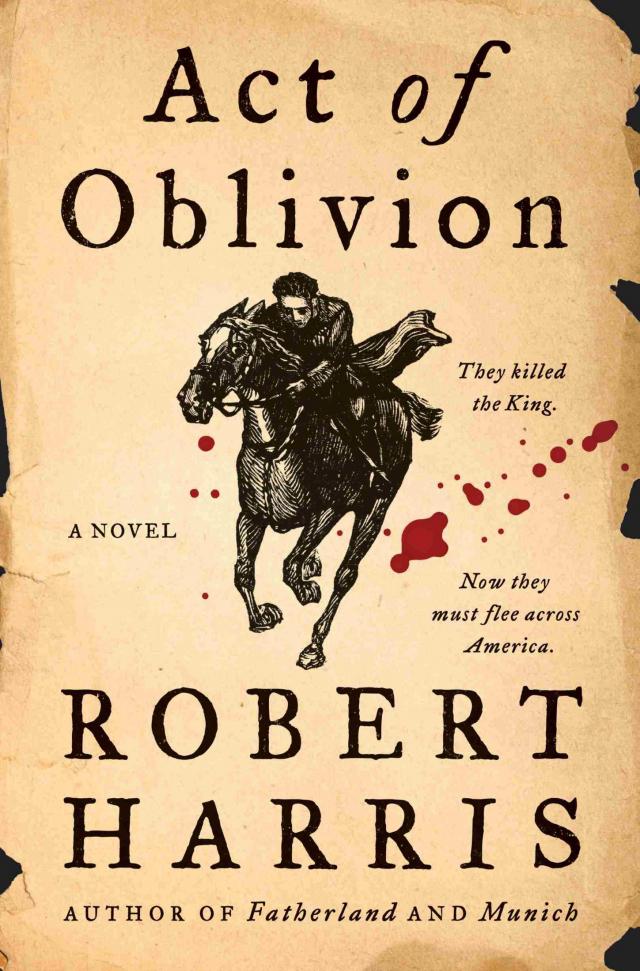
Act of Oblivion,
p.13


‘Fifty men to fetch back two?’ Hyde shook his head. ‘That would make us look weak, not strong. It would lend Whalley and Goffe an importance they don’t deserve.’
Annesley said, ‘Also, if the situation is as difficult as the captain describes, might it not provoke some reaction against His Majesty that could require yet more soldiers to deal with? Before we know where we are, a fight that has been settled in England will be raging again on the other side of the world.’
‘Mr Nayler,’ said Hyde, ‘what is your opinion?’
‘I am not a diplomat, my lord, but it would seem to me that officers of the Crown must obey the orders of the Crown or else be removed.’
‘Exactly,’ said Morice. ‘A show of force.’
‘Perhaps,’ suggested Nayler gently, ‘before that stage is reached, we should impress upon the authorities in America the risks they run if they fail to arrest the regicides.’
‘And how are we to do that?’
He hesitated, as if the idea was only just occurring to him. ‘What if His Majesty himself were to issue a direct order to Endecott and the other officials in New England, naming Whalley and Goffe, and commanding they be taken into custody immediately and sent back to England? Should they fail to obey, it would be clear to everyone that the governors themselves are guilty of treason – and at that point force could be sent.’
There was silence while this was considered. Eventually Hyde said, ‘That is feasible.’
‘But how would we know whether they were obeying the King’s order or not?’ objected Morice. ‘They have harboured these men for half a year. For all we know, they could do the same for another half-year, while pretending to us they are searching for them.’
Nayler said nothing. He waited. They would arrive at the solution themselves.
It was Ashley-Cooper who reached the obvious conclusion. ‘Could we not send an officer of the Crown to convey the King’s order to the authorities in person? He would then be on hand to ensure that it was carried out.’
There was another pause, then Hyde laughed. ‘Ah, now I see!’ He stared down the table at Nayler. ‘And pray who might this officer be?’ He was impossible to fool.
Nayler stared him out. ‘Anyone with some knowledge of the case could go, my lord. My secretary, Mr Nokes, for example.’
‘Nokes?’ scoffed Morice. ‘Who is Nokes? Who would take notice of Nokes?’
Hyde said, ‘I believe Mr Nayler is actually proposing himself.’
‘Not at all, Sir Edward,’ Nayler protested. ‘Whoever goes will be away six months at least. There are still the regicides in Europe to be dealt with. My duties compel me to remain here.’
‘Really, sir, don’t oblige us to beg you to do it!’ Hyde sounded more amused than angry. ‘I’m sure you already have a draft of the King’s order prepared and know the name of the next ship departing to Boston.’
Nayler did not reply. He had both on the desk in his office.
Annesley said, ‘I must say it seems the best plan, if Mr Nayler is willing to undertake the mission.’
Nayler bowed humbly. ‘I will do whatever the Council commands me.’
And so the matter was settled: Nayler would sail to America as soon as possible and deliver the King’s order to Governor Endecott, and would then remain in New England to make certain it was carried out.
Hyde asked him to wait behind after the others had gone.
‘You have some particular animus against these men, Whalley and Goffe.’
‘No, Sir Edward.’
‘But you do, Mr Nayler, you do. I have watched your face whenever their names are mentioned. I shan’t press you on the matter – merely advise you, from long experience, that obsession and good judgement seldom sit well together.’
Over the next few days, Nayler busied himself with preparations. He tried to persuade Captain Breedon to travel with him to Boston, but Breedon had business to do in London; even the prospect of earning the two hundred pounds’ reward was not sufficient to induce him to make another voyage across the Atlantic so soon after the last. Instead, he gave Nayler the names of ‘two good men, loyal to the King’ resident in Massachusetts, whom he might rely upon for help. Nayler booked a single passage on the King Harry, due to sail from Gravesend on Thursday 7 March. He packed a trunk with clothes, some good hard cheese, three bottles of French brandy, Sir Walter Raleigh’s History of the World, and two pistols with pouches of bullets and powder. From the Treasury he drew two hundred pounds in gold and a promissory note that any expenses incurred by the bearer would be paid by His Majesty’s government.
All he lacked was the mandate from the King. Unfortunately, the court had transferred to Hampton Court for a week’s hunting and His Majesty did not wish to be disturbed. On the night of Tuesday the fifth, the King returned to Whitehall. All the following day, Nayler lingered outside the royal apartments waiting for the mandate to be drawn up, signed and sealed. He allowed himself a fantasy that he might be summoned for a word of good wishes. But when Hyde emerged from his audience, he told him that His Majesty had just now gone to King Street to visit Mrs Palmer.
Eventually the document was delivered to him by a junior clerk from the Secretary of State’s office. It was addressed To our trusty and well-beloved the present governor, or other magistrate or magistrates of our plantation in New England.
CHARLES R. Trusty and well-beloved – We greet you well. We being given to understand that Colonel Whalley and Colonel Goffe, who stand here convicted of the execrable murder of our royal father, of glorious memory, are lately arrived at New England, where they hope to shroud themselves securely from the justice of our laws; our will and pleasure is, and we do hereby expressly require and command you forthwith upon the receipt of these our letters, to cause both the said persons to be apprehended, and with the first opportunity sent over hither under a strict care. We are confident of your readiness and diligence to perform your duty; and so bid you farewell. Given at our court at Whitehall, the fifth day of March . . .
Nayler barely glanced at it before he slid it into its leather case. Remember it is the office you serve and not the man. He left the palace without saying goodbye.
That night, he slept badly. The following morning, after he had dressed, he unhooked the miniature of Sarah and held it in his palm. He weighed whether to slip it into his pocket. But Hyde’s words had struck home. Perhaps his judgement was becoming clouded. That would never do. This was an official mission, not a voyage of personal revenge. He replaced the portrait on the wall.
His servant was waiting in the passage with a boy to carry out his trunk. Nayler locked his apartment and followed them through the garden to the Thames, where a boat was moored at the pier to take him downriver to Gravesend. It was a fair day for a voyage – some warmth in the breeze, a hint of spring. As they rowed into the middle of the river and caught the current, the city gave way to open country, and he felt his spirits lift.
By mid afternoon, he was aboard the Prince Harry, in his tiny forward cabin just above the hold, watching the sailors stow his trunk beneath his hammock. They treated him with great politeness – to have a rare private cabin was proof that he must be important – and the first officer relayed an invitation to dine with the captain, which he declined. After they had gone, he found that his chest made a useful step to climb up into his hammock. The deck was barely a foot above his head. He could hear passengers coming aboard, crewmen shouting to one another, barrels being rolled across the planks. The ropes of the hammock tautened against his back and the sides of his body, the canvas enfolded him; he closed his eyes and fell immediately asleep.
He awoke many hours later to darkness. Rocking in his cradle, he listened to the creaking timbers. He had no notion of time.
He had to twist his body to escape the hammock, dangling one leg at a time, lowering his feet until he stood swaying with the motion of the ship. They were at sea. High tide must have risen along the Thames estuary. The ship had cast off while he was still unconscious.
He opened his cabin door and lurched along the gangway. He had to crouch. There was barely five feet of space. From either side came heavy snoring. He had a vague impression of long white bundles suspended in the shadows, like giant chrysalises waiting to mutate. He reached the ladder and grabbed hold of it to steady himself. Looking up through the hatch, he saw a square of stars. Carefully he climbed the rungs to the deck – to the cool night and the wind and the dark: no lights, no trace of land, no crew that he could see, just a sensation of movement as they ploughed their way westwards through the void towards the edge of the world.
Part Two
Chase
1661
Chapter Fourteen
EVEN ON THAT first morning, when their route led straight across the snowbound Massachusetts plain – flat country dotted with great oaks and beeches, terrain no more arduous than an English park in midwinter – Ned struggled to keep pace with the two younger men. His legs ached from pushing through the drifts; sweat froze clammy on his face; his beard became rimed with frost; his heart was an iron ball pounding in his breast. At noon, when they reached the edge of the forested mountain, the going became much harder, the path climbing between tall pines whose bare trunks towered like pillars to a gloomy canopy as high as a cathedral roof.
Gookin entered the forest first, leading their horse. Will followed. Ned lagged in the rear, treading in their footsteps. Every so often they had to stop and wait for him to catch up. As soon as he drew level, he would wheezily assure them he was experiencing no difficulty. The fourth time it happened, he gave up the pretence and accepted Will’s suggestion that he should ride. The other two shouldered the extra bags while he swayed in the saddle, humiliated and cursing his old bones.
The path was narrow, not wide enough for a wagon. Occasionally, somewhere in the silent forest, snow dislodged from the high branches and crashed to earth in heavy waterfalls of crystal. Although Gookin had assured them they were following the ancient Indian trail from Boston Bay to the interior, a route he claimed to know well, they seemed to keep doubling back on themselves, and Ned suspected they were lost. But gradually the old soldier in him grasped the cunning of it – how they followed the bank of a river for what seemed a pointless distance until they came to a spot where a tree had been felled to make a bridge across it, or the way huge boulders had been rolled into position to form stepping stones over low-lying land that would be a swamp when it wasn’t frozen. The wisdom and labour of hundreds of years – thousands, maybe – was collected in that tortuous negotiation with the obstacles of nature.
Once the light started to fade, Gookin called a halt beside a lake. While the colonels collected firewood, he unpacked a net, found himself a stout branch, and ventured carefully out onto the ice. They stopped their work to watch. As soon as the ice began to crack, he took half a pace backwards and used the branch to smash a wide hole, then cast his net. Ten minutes later, he was on the bank with six fish, writhing against the thin mesh, silvery in the gathering dark. He held his catch aloft in triumph. ‘God has created a land of such plenty, a man need only reach out a hand and he will provide.’
They lit a fire, and Will, inspired by the lake and the emptiness, led them in a meditation on the story of Jonah, three days entombed in the stomach of a whale. ‘“Then Jonah prayed unto the Lord his God out of the fish’s belly, and said, ‘I cried by reason of my affliction unto the Lord, and he heard me; out of the belly of hell cried I, and thou heardest my voice.’”’
‘Amen.’
‘Amen.’
Out of the belly of hell cried I . . . That was right, thought Ned. For all its beauty, that was how it felt to struggle through this cold, unpeopled country.
They wrapped the fish in leaves and stewed them on the hot embers of the fire, and agreed that nothing had ever tasted so delicious. Afterwards, they shared a pipe of tobacco, then Gookin showed them how to make a bed in the Indian way, gathering dead leaves and moss, spreading a layer across the forest floor and stuffing the rest into the net so that it became a thick blanket under which they could all lie close together, to share their bodies’ heat. It was surprisingly warm and dry. The fire floated red sparks towards the sky. Animals cried out, invisible in the darkness. They heard a wolf howl, and something large moving through the trees that Gookin said he thought might be a bear. They kept their guns close.
That was the first day.
The morning of the second was mostly spent skirting around the lake. They climbed to the summit of a ridge and descended the other side, emerging from the forest in the middle of the afternoon to discover another great parkland plain. Ned was on the horse again, the other two hunched under the weight they carried. The cloud had not lifted since first light – the sky grey and immense, the wind sharp and cold from the north-west, the flat land silent, like a calm white sea extending miles into the distance, criss-crossed by animal tracks.
Gookin set down his baggage, took out his compass, gestured to his left and set a course due west. The wind began to blow more strongly. After an hour or so, a dark smudge appeared in the snowy landscape a few miles ahead. They halted. Ned drew his telescope from inside his coat and the apparition resolved into what looked to be three long thatched barns. From the roof of each arose a curl of smoke. He dismounted and offered the spyglass to Gookin.
‘Indians,’ said Gookin, peering at the image. ‘Camped in their wigwams beside the river for the fish that rise at the end of winter.’
‘Should we change our direction?’
‘On the contrary: it was my intention that we should find them.’ He handed back the telescope. ‘We shall seek shelter with them for the night.’ He laughed at Ned’s expression. ‘Don’t look so troubled! They are just as much a part of God’s creation as you or I, and in need of our compassion to rescue them from their present state of barbarism and bring them to salvation.’
Still, Ned insisted he would walk the rest of the way, the easier to use his sword and pistols if necessary.
‘How did such a savage race come to be in America?’ mused Gookin, as they trudged three abreast towards the camp. ‘That is the mystery for which I have searched the Scriptures for an answer. Their own legends tell of two young women who waded ashore a thousand years ago, and that the froth or foam of the water touched their bodies, causing them to become with child, that one brought forth a male and the other a female, that the two women died and left the earth and that the son and daughter were the first progenitors of their race.’
Will said, ‘What heathen superstition.’
‘Indeed. But then the question arises: from which of the sons of Noah are they descended? My own conception is that they are the descendants of one of the ten tribes of Israel we read of in the Book of Kings, whom the Assyrian tyrant Salmanasser expelled as captives from Samaria and transported to Asia. The truth will be revealed on the Day of Judgement, when all the hidden things will be made plain to the glory of God. In the meanwhile, we have made good Christians out of many Indians already, and in time we shall make many more. My friend John Eliot, the minister of Roxbury, is even now translating the Bible into Wampanoag, the language of the Massachusetts tribe.’
‘That is a mighty task you have set yourselves.’
‘Still, we must work to bring them to Christ, as the psalm exhorts us: “Ask of me and I will give thee the heathen for thine inheritance, and the uttermost parts of the earth for thy possession.”’
‘But you have left out the next verse,’ said Will. ‘“Thou shalt break them with a rod of iron; thou shalt dash them in pieces like a potter’s vessel.”’
‘I don’t hold with that at all,’ said Gookin, ‘although I know some who take such a view.’
With that, he strode on, and no more words were spoken between them until they were almost at the Indians’ camp.
The wigwams were surprisingly big, perhaps thirty feet long by fifteen high, and of a rounded elongated shape, like the keel of a ship turned upside down. But they were wretched-looking, Ned thought: bleak, windowless hovels clad in greyish strips of weathered bark, the snow around them melted into filthy slush. The Englishmen’s approach had set the camp dogs barking. A pair of scrawny hounds came loping through the snow towards them, and crouched down in their path, growling. The horse shied, forcing them to a halt.
An animal skin covering the entrance to one of the huts was lifted, and half a dozen men dressed in furs filed out, carrying bows and arrows. They stood in a line, motionless, bowstrings drawn back, arrows pointed at the three travellers.
‘God help us,’ said Ned. ‘Look at that.’
Gookin said, ‘Wait here. I shall go and speak with them.’
He took one of his bags from the horse and set off towards the encampment, his hand held up in greeting. Ned felt under his coat for his pistol.
‘Don’t,’ said Will. ‘We cannot fight them off. There are too many.’
Gookin reached the Indians, set down his bag and raised both hands. He spoke to the tallest of the natives. The bows were lowered. He picked up his bag and followed the men inside.
Ned let go of his pistol. He turned around, scanning the terrain. The contrast with the darkening sky made the snow seem luminous, unearthly. He could hear a river flowing somewhere behind the trees that lay just beyond the camp – in full spate by the sound of it, too fast to freeze. There was nowhere they could run. ‘Dear Will,’ he muttered, ‘what is this land to which I have brought us?’
They waited a long while in the biting wind, and by the time the flap opened again, it was almost too gloomy to make out Gookin. Silhouetted by the red glow of the fire behind him, he beckoned and shouted to them that it was safe. They walked towards him.
‘It is all arranged. I have bought us grain for the horse, and two days’ food for the journey. We can have shelter and a meal for tonight. Come in out of the cold.’