Act of oblivion, p.41
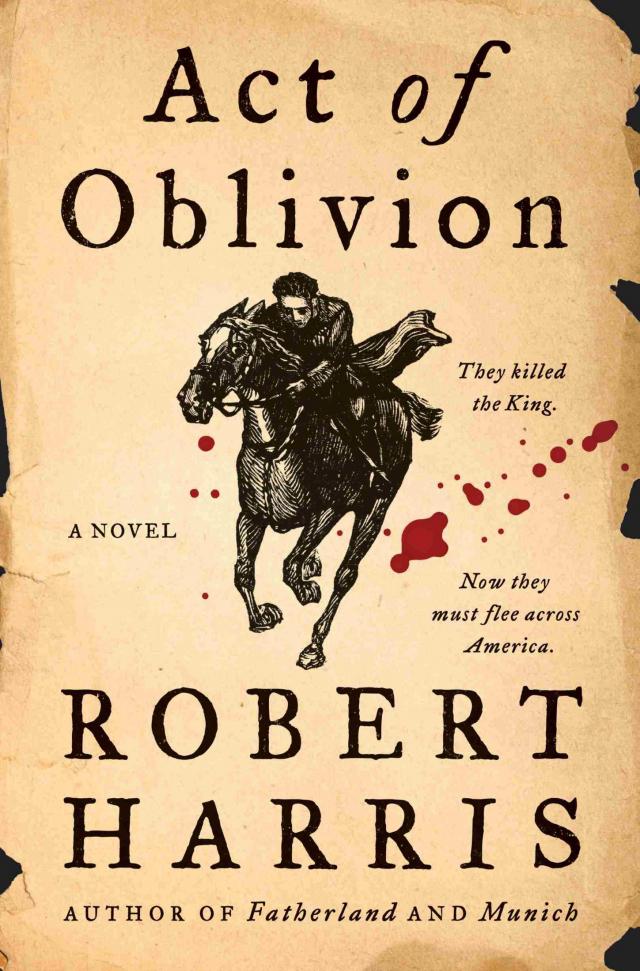
Act of Oblivion,
p.41


They dragged the corpse across the road and heaved it into the ditch. Will clambered down and covered it as best he could with leaves and a few branches. It would suffice for a day or two, with luck. He had to hurry. They didn’t have long before the church meeting ended.
He left all the money he could afford on the kitchen table, then went up to the attic and gathered his belongings, carrying them down to the stable, where there was a little two-wheeled buggy the Bulls used for visiting their neighbours. He hitched it to the horse and led it into the yard. He threw in Frances’s bag as well as his own, helped her up onto the seat and opened the gate.
A minute later, they were on the road heading into open country. She had her hands around his waist. Whatever happened, she would never be parted from him now.
He had no idea where they would go, or what they would do, or what dangers lay ahead. But with their love, and their Bible, with their absolute certainty in the power of the Lord and the protection of their guns, and with the plentiful vastness of America spread out before them like God’s table – see Corinthians, 10:21 – he had faith that they would make a future.
Author’s Note
This novel is an imaginative re-creation of a true story: the tracking down of the ‘regicides’, the killers of King Charles I, the greatest manhunt of the seventeenth century – in particular, the pursuit of Edward Whalley and William Goffe across New England. The events, dates and locations are accurate, and almost every character is real, apart from Richard Nayler. I suspect there must have been such a person – you cannot sustain a manhunt without a manhunter – but whoever he was, his identity is lost to history.
Otherwise, I have tried to stick to the known facts, and even discovered a few that were previously unknown, such as the date and place of Goffe’s birth and the identity of Whalley’s second wife. But it is a novel, and readers who want to investigate the story further will find a list of sources in the acknowledgements.
Robert Harris
20 June 2022
Acknowledgements
Edward Whalley suffered a stroke and lingered in a twilight state for a number of years, nursed by his son-in-law, before dying in the Russells’ house, probably some time towards the end of 1674. The eventual fate of William Goffe is unknown. Following the attack on Hadley in 1675, and his removal to Hartford, he was still desperately trying to make contact with his wife in April 1679, and a letter was written to him by Peter Tilton from Hadley in July of that year. Thereafter, all trace of him vanishes. He may have died soon afterwards. He may have decided to take the chance of returning to England. Or perhaps Frances really did come out to join him and they disappeared together. Like so much else in this novel, I can’t say it happened as I describe it. The best I can say is it might have happened.
There are two excellent general histories of the hunt for the regicides, Killers of the King by Charles Spencer and The King’s Revenge by Don Jordan and Michael Walsh. There are also two specific recent studies of the regicides in New England, Charles I’s Killers in America by Matthew Jenkinson and The Great Escape of Edward Whalley and William Goffe by Christopher Pagliuco. Long before these, there was A History of Three of the Judges of King Charles I by Ezra Stiles, published in 1794 but still very useful.
I was fortunate in being able to track down an unpublished MPhil dissertation submitted to Southampton University in 1973 by Geoffrey Jaggar, ‘The fortunes of the Whalley family of Screveton, Nottinghamshire’. His widow, Mrs Margaret Jaggar, was kind enough to lend me the only extant copy. My thanks to her for her generosity, and to her late husband for his scholarship.
In the course of my research, I read scores of books and articles on the Civil War and its aftermath, some very old, others published while I was writing. This is by no means an exhaustive list, but those I found most useful include:
W. C. Abbott, The Writings and Speeches of Oliver Cromwell (four volumes)
G. E. Aylmer, The King’s Servants; The State’s Servants; The Crown’s Servants
Harral Ayres, The Great Trail of New England
Michael Braddick, God’s Fury, England’s Fire
Francis J. Bremer, Building a New Jerusalem: John Davenport, a Puritan in Three Worlds
Lisa Brooks, Our Beloved Kin, A New History of King Philip’s War
Edward Clarendon, The Life of Edward, Earl of Clarendon
C. H. Firth, Memoirs of Colonel Hutchinson (editor); Ludlow’s Memoirs (editor); Cromwell’s Army; The Last Years of the Protectorate
Antonia Fraser, Cromwell, Our Chief of Men
S. R. Gardiner, History of the Great Civil War (four volumes)
Malcolm Gaskill, The Ruin of Witches
Peter Gaunt, The English Civil War, A Military History
Ian Gentles, The New Model Army
Richard L. Greaves, Deliver us from Evil: The Radical Underground in Britain, 1660–1663
Ronald Hutton, The Making of Oliver Cromwell
Sylvester Judd, History of Hadley
Anna Keay, The Restless Republic
Paul Lay, Providence Lost, The Rise and Fall of Cromwell’s Protectorate
Margarette Lincoln, London and the 17th Century
Alan Marshall, Intelligence and Espionage in the Reign of Charles II
David Masson, Life of John Milton (six volumes)
J. G. Muddiman (editor), Trial of Charles I
Richard Ollard, Clarendon and his Friends
Rebecca Rideal, 1666: Plague, War and Hellfire
Geoffrey Robertson, The Tyrannicide Brief
Ruth Spalding (editor), The Diary of Bulstrode Whitelocke, 1605–75
Simon Thurley, Palaces of Revolution
John Thurloe, State Papers (seven volumes)
C. V. Wedgwood, The King’s Peace; The King’s War; The Trial of Charles I
Blair Worden, God’s Instruments; A Voyce From the Watch Tower (editor)
I would like to thank those who read and commented on the manuscript and helped make this novel possible: my wife, Gill Hornby, to whom it is dedicated with love; Venetia Butterfield, Helen Conford and Gail Rebuck of Penguin Random House in London; Deirdre Molina of Penguin Random House Canada; Noah Eaker of Harper in New York; Jocasta Hamilton, who read this one as a friend rather than an editor; my American agent, Suzanne Gluck; my foreign rights agent, Nicki Kennedy; and my film agents, Anthony Jones and Bob Bookman.
About the Author
ROBERT HARRIS is the author of Pompeii, Enigma, and Fatherland. He has been a television correspondent with the BBC and a newspaper columnist for the London Sunday Times and the Daily Telegraph. His novels have sold more than ten million copies and been translated into thirty languages. He lives in Berkshire, England, with his wife and four children.
Discover great authors, exclusive offers, and more at hc.com.
Also by Robert Harris
FICTION
Fatherland
Enigma
Archangel
Pompeii
Imperium
The Ghost
Lustrum
The Fear Index
An Officer and a Spy
Dictator
Conclave
Munich
The Second Sleep
V2
NON-FICTION
Good and Faithful Servant: The Unauthorized
Biography of Bernard Ingham
Selling Hitler
The Making of Neil Kinnock
Gotcha: Media, the Government and the Falklands Crisis
A Higher Form of Killing (with Jeremy Paxman)
Copyright
This book is a work of fiction. References to real people, events, establishments, organizations, or locales are intended only to provide a sense of authenticity, and are used fictitiously. All other characters, and all incidents and dialogue, are drawn from the author’s imagination and are not to be construed as real.
ACT OF OBLIVION. Copyright © 2022 by Canal K. Ltd. All rights reserved under International and Pan-American Copyright Conventions. By payment of the required fees, you have been granted the nonexclusive, nontransferable right to access and read the text of this e-book on-screen. No part of this text may be reproduced, transmitted, downloaded, decompiled, reverse-engineered, or stored in or introduced into any information storage and retrieval system, in any form or by any means, whether electronic or mechanical, now known or hereafter invented, without the express written permission of HarperCollins e-books.
Originally published in the United Kingdom in 2022 by Hutchinson Heinemann.
Cover design by Milan Bozic
Cover photographs © Bridgeman Images (man on horse); © Getty Images
Map by Neil Gower
FIRST U.S. EDITION
Digital Edition SEPTEMBER 2022 ISBN: 978-0-06-324802-1
Version 08162022
Print ISBN: 978-0-06-324800-7
About the Publisher
Australia
HarperCollins Publishers Australia Pty. Ltd.
Level 13, 201 Elizabeth Street
Sydney, NSW 2000, Australia
www.harpercollins.com.au
Canada
HarperCollins Publishers Ltd
Bay Adelaide Centre, East Tower
22 Adelaide Street West, 41st Floor
Toronto, Ontario, M5H 4E3
www.harpercollins.ca
India
HarperCollins India
A 75, Sector 57
Noida
Uttar Pradesh 201 301
www.harpercollins.co.in
New Zealand
HarperCollins Publishers New Zealand
Unit D1, 63 Apollo Drive
Rosedale 0632
Auckland, New Zealand
www.harpercollins.co.nz
United Kingdom
HarperCollins Publishers Ltd.
1 London Bridge Street
London SE1 9GF, UK
www.harpercollins.co.uk
United States
HarperCollins Publishers Inc.
195 Broadway
New York, NY 10007
www.harpercollins.com
Robert Harris, Act of Oblivion