Schwartz between the gal.., p.1
Schwartz Between the Galaxies,
p.1
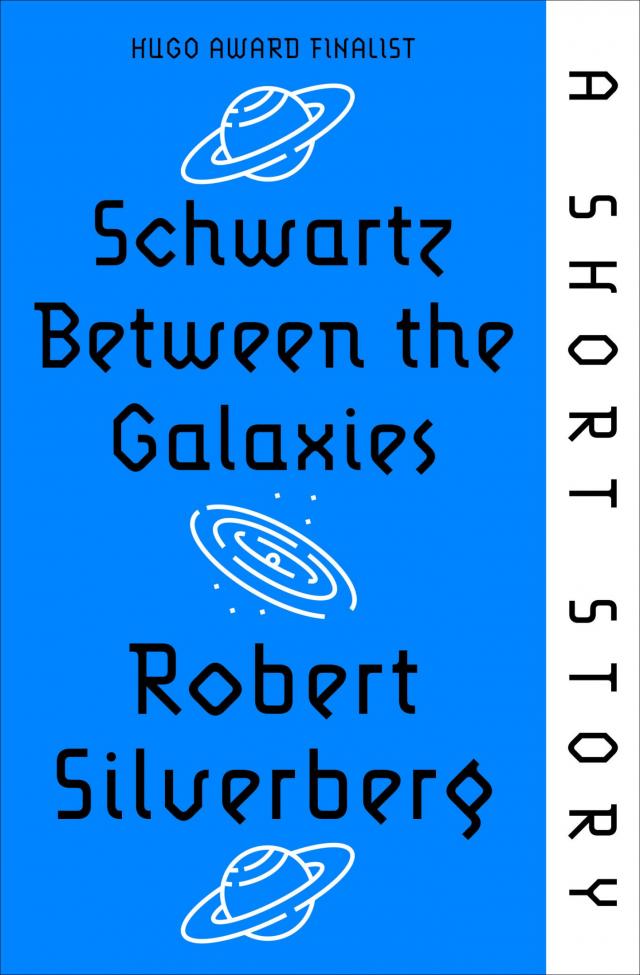


Schwartz Between the Galaxies
A Short Story
Robert Silverberg
Introduction
Judy-Lynn del Rey, the editor of the Ballantine Books science-fiction line (which was eventually renamed Del Rey Books in her honor) was one of the most significant figures in the history of science-fiction publishing. It was she who initiated a line of novels based on the wildly successful movie Star Wars, thus bringing hundreds of thousands of new readers into the field whose insatiable taste for space opera came to create a dominant demand for the stuff. At the same time she launched a series of Tolkien-influenced fantasy novels that became an immense commercial force. As a writer I was swimming against these two powerful currents, with such work as Dying Inside, The Book of Skulls, and the novella “Born with the Dead” exploring a dark literary side of science fiction; and so I felt uncomfortable with what my old friend Judy-Lynn was doing, and I think she was uneasy about the direction I was going in.
Nevertheless, when her company launched an original-fiction anthology called Stellar in 1973, she asked me—virtually commanded me—to write a story for her. Her stated policy was a reversion to the good old kind of s-f storytelling, as exemplified in the magazines of the 1950s. “I don’t want mood pieces without plots,” she warned. “I don’t want vignettes. I don’t want character sketches … These yarns should have beginnings, middles, and ends.” I too believed that stories should have beginnings, middles, and ends, though not necessarily in that order, and I liked to think that what I was writing would have fit into the best of those 1950s magazines. But I could tell, when I did “Schwartz Between the Galaxies” for Judy-Lynn, that it didn’t quite have that pulp-magazine flavor she was looking for. She grumbled, but she bought it anyway, having pressed me so hard for a story, and she ran it in the first issue of her anthology despite its somewhat highbrow tone. It proceeded to be nominated for a Hugo for that year’s best short story, and came close to winning the award, and went into a number of anthologies afterward. Judy-Lynn, bless her, never complained about the story again.
Schwartz Between the Galaxies
This much is reality: Schwartz sits comfortably cocooned—passive, suspended—in a first-class passenger rack aboard a Japan Air Lines rocket, nine kilometers above the Coral Sea. And this much is fantasy: the same Schwartz has passage on a shining starship gliding silkily through the interstellar depths, en route at nine times the velocity of light from Betelgeuse IX to Rigel XXI, or maybe from Andromeda to the Lesser Magellanic.
There are no starships. Probably there never will be any. Here we are, a dozen decades after the flight of Apollo 11, and no human being goes anywhere except back and forth across the face of the little O, the Earth, for the planets are barren and the stars are beyond reach. That little O is too small for Schwartz. Too often it glazes for him; it turns to a nugget of dead porcelain; and lately he has formed the habit, when the world glazes, of taking refuge aboard that interstellar ship. So what JAL Flight 411 holds is merely his physical self, his shell, occupying a costly private cubicle on a slender 200-passenger vessel which, leaving Buenos Aires shortly after breakfast, has sliced westward along the Tropic of Capricorn for a couple of hours and will soon be landing at Papua’s Torres Skyport. But his consciousness, his anima, the essential Schwartzness of him, soars between the galaxies.
What a starship it is! How marvelous its myriad passengers! Down its crowded corridors swarms a vast gaudy heterogeny of galactic creatures, natives of the worlds of Capella, Arcturus, Altair, Canopus, Polaris, Antares, beings both intelligent and articulate, methane-breathing or nitrogen-breathing or argon breathing, spiny-skinned or skinless, many-armed or many-headed or altogether incorporeal, each a product of a distinct and distinctly unique and alien cultural heritage. Among these varied folk moves Schwartz, that superstar of anthropologists, that true heir to Kroeber and Morgan and Malinowski and Mead, delightedly devouring their delicious diversity. Whereas aboard this prosaic rocket, this planet-locked stratosphere needle, one cannot tell the Canadians from the Portuguese, the Portuguese from the Romanians, the Romanians from the Irish, unless they open their mouths, and sometimes not always then.
In his reveries he confers with creatures from the Fomalhaut system about digital circumcision; he tapes the melodies of the Achernarnian eye-flute; he learns of the sneeze-magic of Acrux, the sleep-ecstasies of Aldebaran, the asteroid-sculptors of Thuban. Then a smiling JAL stewardess parts the curtain of his cubicle and peers in at him, jolting him from one reality to another. She is blue-eyed, frizzy-haired, straight-nosed, thin-lipped, bronze-skinned, a genetic mishmash, your standard twenty-first-century-model mongrel human, perhaps Melanesian-Swedish-Turkish-Bolivian, perhaps Polish-Berber-Tatar-Welsh. Cheap inter-continental transit has done its deadly work: all Earth is a crucible, all the gene pools have melted into one indistinguishable fluid. Schwartz wonders about the recessivity of those blue eyes and arrives at no satisfactory solution. She is beautiful, at any rate. Her name is Dawn—O sweet neutral nonculture-bound cognomen!—and they have played at a flirtation, he and she, Dawn and Schwartz, at occasional moments of this short flight. Twinkling, she says softly, “We’re getting ready for our landing, Dr. Schwartz. Are your restrictors in polarity?”
“I never unfastened them.”
“Good.” The blue eyes, warm, interested, meet his. “I have a layover in Papua tonight,” she says.
“That’s nice.”
“Let’s have a drink while we’re waiting for them to unload the baggage,” she suggests with cheerful bluntness. “All right?”
“I suppose,” he says casually. “Why not?” Her availability bores him: somehow he enjoys the obsolete pleasures of the chase. Once such easiness in a woman like this would have excited him, but no longer. Schwartz is forty years old, tall, square-shouldered, sturdy, a showcase for the peasant genes of his rugged Irish mother. His close-cropped black hair is flecked with gray; many women find that interesting. One rarely sees gray hair now. He dresses simply but well, in sandals and Socratic tunic. Predictably, his physical attractiveness, both within his domestic sixness and without, has increased with his professional success. He is confident, sure of his powers, and he radiates an infectious assurance. This month alone eighty million people have heard his lectures.
She picks up the faint weariness in his voice. “You don’t sound eager. Not interested?”
“Hardly that.”
“What’s wrong, then? Feeling sub, Professor?”
Schwartz shrugs. “Dreadfully sub. Body like dry bone. Mind like dead ashes.” He smiles, full force depriving his words of all their weight.
She registers mock anguish. “That sounds bad,” she says. “That sounds awful!”
“I’m only quoting Chuang Tzu. Pay no attention to me. Actually, I feel fine, just a little stale.”
“Too many skyports?”
He nods. “Too much of a sameness wherever I go.” He thinks of a star-bright, top-deck bubble dome where three boneless Spicans do a twining dance of propitiation to while away the slow hours of nine-light travel. “I’ll be all right,” he tells her. “It’s a date.”
Her hybrid face flows with relief and anticipation. “See you in Papua,” she tells him, and winks, and moves jauntily down the aisle.
Papua. By cocktail time Schwartz will be in Port Moresby. Tonight he lectures at the University of Papua; yesterday it was Montevideo; the day after tomorrow it will be Bangkok. He is making the grand academic circuit. This is his year: he is very big, suddenly, in anthropological circles, since the publication of The Mask Beneath the Skin. From continent to continent he flashes, sharing his wisdom, Monday in Montreal, Tuesday Veracruz, Wednesday Montevideo, Thursday—Thursday? He crossed the international date line this morning, and he does not remember whether he has entered Thursday or Tuesday, though yesterday was surely Wednesday. Schwartz is certain only that this is July and the year is 2083, and there are moments when he is not even sure of that.
The JAL rocket enters the final phase of its landward plunge. Papua waits, sleek, vitrescent. The world has a glassy sheen again. He lets his spirit drift happily back to the gleaming starship making its swift way across the whirling constellations.
He found himself in the starship’s busy lower-deck lounge, having a drink with his traveling companion, Pitkin, the Yale economist. Why Pitkin, that coarse, florid little man? With all of real and imaginary humanity to choose from, why had his unconscious elected to make him share this fantasy with such a boor?
“Look,” Pitkin said, winking and leering. “There’s your girlfriend.”
The entry-iris had opened and the Antarean not-male had come in.
“Quit it,” Schwartz snapped. “You know there’s no such thing going on.”
“Haven’t you been chasing her for days?”
“She’s not a ‘her’,” Schwartz said.
Pitkin guffawed. “Such precision! Such scholarship! She’s not a her, he says!” He gave Schwartz a broad nudge. “To you she’s a she, friend, and don’t try to kid me.”
Schwartz had to admit there was some justice to Pitkin’s vulgar innuendos. He did find the Antarean—a slim yellow-eyed ebony-skinned upright humanoid, sinuous and glossy, with tapering elongated limbs and a seal’s fluid grace—powerfully attractive. Nor could he help thinking of the Antarean as feminine. That attitude was hopelessly culture-bound and s
pecies-bound, he knew; in fact the alien had cautioned him that terrestrial sexual distinctions were irrelevant in the Antares system, that if Schwartz insisted on thinking of “her” in genders, “she” could be considered only the negative of male, with no implication of biological femaleness.
He said patiently, “I’ve told you. The Antarean’s neither male nor female as we understand those concepts. If we happen to perceive the Antarean as feminine, that’s the result of our own cultural conditioning. If you want to believe that my interest in this being is sexual, go ahead, but I assure you that it’s purely professional.”
“Sure. You’re only studying her.”
“In a sense I am. And she’s studying me. On her native world she has the status-frame of ‘watcher-of-life,’ which seems to translate into the Antarean equivalent of an anthropologist.”
“How lovely for you both. She’s your first alien and you’re her first Jew.”
“Stop calling her her,” Schwartz hissed.
“But you’ve been doing it!”
Schwartz closed his eyes. “My grandmother told me never to get mixed up with economists. Their thinking is muddy and their breath is bad, she said. She also warned me against Yale men. Perverts of the intellect, she called them. So here I am cooped up on an interstellar ship with five hundred alien creatures and one fellow human, and he has to be an economist from Yale.”
“Next trip travel with your grandmother instead.”
“Go away,” Schwartz said. “Stop lousing up my fantasies. Go peddle your dismal science somewhere else. You see those Delta Aurigans over there? Climb into their bottle and tell them all about the Gross Global Product.” Schwartz smiled at the Antarean, who had purchased a drink, something that glittered an iridescent blue, and was approaching them. “Go on,” Schwartz murmured.
“Don’t worry,” Pitkin said. “I wouldn’t want to crowd you.” He vanished into the motley crowd.
The Antarean said, “The Capellans are dancing, Schwartz.”
“I”d like to see that. Too damned noisy in here anyway.” Schwartz stared into the alien’s vertical-slitted citreous eyes. Cat’s eyes, he thought. Panther’s eyes. The Antarean’s gaze was focused, as usual, on Schwartz’s mouth: other worlds, other customs. He felt a strange, unsettling tremor of desire. Desire for what, though? It was a sensation of pure need, nonspecific, certainly nonsexual. “I think I’ll take a look. Will you come with me?”
The Papua rocket has landed. Schwartz, leaning across the narrow table in the skyport’s lounge, says to the stewardess in a low, intense tone, “My life was in crisis. All my values were becoming meaningless. I was discovering that my chosen profession was empty, foolish, as useless as—playing chess.”
“How awful,” Dawn whispers gently.
“You can see why. You go all over the world, you see a thousand skyports a year. Everything the same everywhere. The same clothes, the same slang, the same magazines, the same styles of architecture and décor.”
“Yes.”
“International homogeneity. Worldwide uniformity. Can you understand what it’s like to be an anthropologist in a world where there are no primitives left, Dawn? Here we sit on the island of Papua—you know, headhunters, animism, body-paint, the drums at sunset, the bone through the nose—and look at the Papuans in their business robes all around us. Listen to them exchanging stock-market tips, talking baseball, recommending restaurants in Paris and barbers in Johannesburg. It’s no different anywhere else. In a single century we’ve transformed the planet into one huge sophisticated plastic western industrial state. The TV relay satellites, the two-hour intercontinental rockets, the breakdown of religious exclusivism and genetic taboo have mongrelized every culture, don’t you see? You visit the Zuni and they have plastic African masks on the wall. You visit the Bushmen and they have Japanese-made Hopi-motif ashtrays. It’s all just so much interior decoration, and underneath the carefully selected primitive motifs there’s the same universal pseudo-American sensibility, whether you’re in the Kalahari or the Amazon rain forest. Do you comprehend what’s happened, Dawn?”
“It’s such a terrible loss,” she says sadly. She is trying very hard to be sympathetic, but he senses she is waiting for him to finish his sermon and invite her to share his hotel room. He will invite her, but there is no stopping him once he has launched into his one great theme.
“Cultural diversity is gone from the world,” he says. “Religion is dead; true poetry is dead; inventiveness is dead; individuality is dead. Poetry. Listen to this.” In a high monotone he chants:
In beauty I walk
With beauty before me I walk
With beauty behind me I walk
With beauty above me I walk
With beauty above and about me I walk
It is finished in beauty
It is finished in beauty
He has begun to perspire heavily. His chanting has created an odd sphere of silence in his immediate vicinity; heads are turning, eyes are squinting. “Navaho,” he says. “The Night Way, a nine-day chant, a vision, a spell. Where are the Navaho now? Go to Arizona and they’ll chant for you, yes, for a price, but they don’t know what the words mean, and chances are the singers are only one-fourth Navaho, or one-eighth, or maybe just Hopi hired to dress in Navaho costumes, because the real Navaho, if any are left, are off in Mexico City hired to be Aztecs. So much is gone. Listen.” He chants again, more piercingly even than before:
The animal runs, it passes, it dies. And it is the great cold.
It is the great cold of the night, it is the dark.
The bird flies, it passes, it dies. And it is—
“JAL FLIGHT 411 BAGGAGE IS NOW UNLOADING ON CONCOURSE FOUR,” a mighty mechanical voice cries.
—the great cold.
It is the great cold of the night, it is the dark.
“JAL FLIGHT 411 BAGGAGE …”
The fish flees, it passes, it dies. And—
“People are staring,” Dawn says uncomfortably.
“—ON CONCOURSE FOUR.”
“Let them stare. Do them some good. That’s a Pygmy chant, from Gabon, in equatorial Africa. Pygmies? There are no more Pygmies. Everybody’s two meters tall. And what do we sing? Listen. Listen.” He gestures fiercely at the cloud of tiny golden loudspeakers floating near the ceiling. A mush of music comes from them: the current popular favorite. Savagely he mouths words: “Star … far … here … near. Playing in every skyport right now, all over the world.” She smiles thinly. Her hand reaches toward his, covers it, presses against the knuckles. He is dizzy. The crowd, the eyes, the music, the drink. The plastic. Everything shines. Porcelain. Porcelain. The planet vitrifies.
“Tom?” she asks uneasily. “Is anything the matter?”
He laughs, blinks, coughs, shivers. He hears her calling for help, and then he feels his soul swooping outward, toward the galactic blackness.
With the Antarean not-male beside him, Schwartz peered through the viewport, staring in awe and fascination at the seductive vision of the Capellans coiling and recoiling outside the ship. Not all the passengers on this voyage had cozy staterooms like his. The Capellans were too big to come on board, and in any case they preferred never to let themselves be enclosed inside metal walls. They traveled just alongside the starship, basking like slippery whales in the piquant radiations of space. So long as they kept within twenty meters of the hull they would be inside the effective field of the Rabinowitz Drive, which swept ship and contents and associated fellow travellers toward Rigel, or the Lesser Magellanic, or was it one of the Pleiades toward which they were bound at a cool nine lights?
He watched the Capellans moving beyond the shadow of the ship in tracks of shining white. Blue, glossy green, and velvet black, they coiled and swam, and every track was a flash of golden fire. “They have a dangerous beauty,” Schwartz whispered. “Do you hear them calling? I do.”
“What do they say?”
“They say, ‘Come to me, come to me, come to me!’”