Hidden faces, p.1
Hidden Faces,
p.1


HIDDEN
FACES
SALVADOR DALÍ
TRANSLATED FROM THE FRENCH
BY HAAKON CHEVALIER
PUSHKIN PRESS CLASSICS
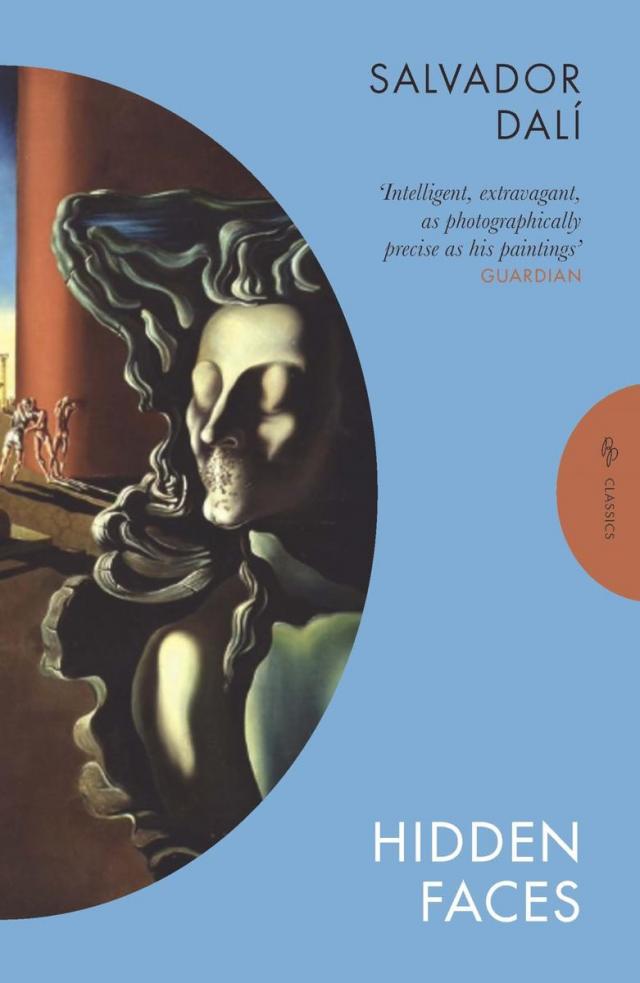
Cover art for the original edition of Hidden Faces.
© Salvador Dalí, Fundació Gala-Salvador Dalí 2023
Le rêve by Salvador Dalí. Reproduced in black and white from colour original.
© Salvador Dalí, Fundació Gala-Salvador Dalí, DACS 2023
Contents
Title Page
Epigraph
Translator’s Foreword
Dedication
Author’s Foreword
PART ONE· The Illuminated Plain
1· The Friends of Count Hervé de Grandsailles
2· The Friends of Solange de Cléda
PART TWO· Nihil
3· Postponement of a Ball
4· The Night of Love
5· War and Transfiguration
PART THREE· The Price of Victory
6· ‘La Forza del Destino’
7· Moons of Gall
8· Chimera of Chimeras, All Is Chimera!
EPILOGUE· The Illuminated Plain
Epilogue
The Story of Peter Owen Publishers
Available and Coming Soon from Pushkin Press Classics
About the Authors
Copyright
Larvatus prodeo
(I advance masked)
descartes
Translator’s Foreword
When this book first appeared in the United States nearly thirty years ago, Dali’s admirers and the many who knew him only from having seen his paintings and having heard, perhaps at second hand, of his eccentricities and his antics in the Paris of the twenties and thirties greeted the announcement of its publication with incredulity. He had a prodigious gift, they recognized, when it came to projecting his vision of the world in form and colour. But what impelled him, what qualified him, to venture into the realm of fiction, to build an imaginary world through the medium of words?
The novel was written in 1943 when the world was still plunged in the most destructive and lethal war in history, with battles raging on many fronts, from Russia, across Europe and North Africa to the Far East. It is, in the perspective of Dali’s own development, an epitaph of pre-war Europe and reads like a period piece, its stylized characters reliving scenes that are bathed in an aura of decadent romanticism reminiscent of Barbey d’Aurevilly, of Villiers de l’Isle-Adam and of Huysmans, taking the English reader back to Disraeli, Bulwer-Lytton and Ouida with its ringing aristocratic names, its men and women of resplendent beauty, its luxury and extravagance. The action of the novel, with the scene shifting from France to North Africa, Malta, United States and back to France, roughly covers the period of the war, anticipating its end with the inclusion of a hallucinatory scene in which we see Hitler, against a background of Wagnerian music, awaiting his imminent doom with mingled fascination and horror.
Dali has always envisaged the world, his art and himself in cosmic terms, with God ever-present, whether as myth or as reality. It is a tormented world, with apocalyptic overtones, in which passions, elemental and perverse, strain the human psyche to the limit. This world, with which his paintings have made us familiar, has its own laws, its own monsters, chimeras and myths. It is a world of desolate mineral landscapes, centuries-old ruins and blanched Spanish villages beneath skies of infinite aspiration, peopled with figures caught in expressions and postures of anguish or ecstasy; a world obsessively strewn with fetichistic objects – bedside tables, sometimes cut out of the plump flesh of nurses sitting on the seashore, fried eggs slithering down banisters, dripping telephones, kidneys, beans, limp watches, crutches; a world of metamorphoses in which phenomena are constantly subject to strange deformations, shapes and contours repeating one another in a dynamic imitative interplay. There is in Dali a fascination with magic, necromancy, spells, incantations, superstition, ritual and pageantry. He is haunted by what lies beyond the limit of the conceivable. It is hardly surprising that his fertile genius should have sought to encompass a new dimension in the form of a novel.
The basic theme of Hidden Faces is love-in-death. We here have a treatment in modern dress of the ancient and perennial Tristan and Isolde myth. Nothing gives greater intensity to love than the imminence of death, and nothing gives greater poignancy to death than its irremediable severing of the bonds of love. The motif of death, however, is balanced by its counterpart: resurrection. This secondary but pervasive theme of new life emerging out of decay and destruction runs through the whole novel, and it is symbolized from the first page to the last by the forest of cork-oaks which pushes forth tender yellow-green shoots every spring in the plain of Creux de Libreux.
But perhaps the chief interest of this novel lies in the transposition that the author makes from the values that are paramount in the plastic arts to those that belong to literary creation. For if it is true that Dali’s painting is figurative to the point of being photographic, and is in that sense ‘old-fashioned’, his writing is above all visual, although as in his painting the images shown and evoked are enhanced by a stimulation of all the other senses – sound, smell, taste, touch – as well as by adumbrations of the ultra-sensory, the irrational, the spiritual and the other-worldly that are interwoven in the warp and weft of human life as reflected in a hypersensitive consciousness. The story of the tangled lives of the protagonists – Count Hervé de Grandsailles, Solange de Cléda, John Randolph, Veronica Stevens, Betka and the rest – from the February riots in Paris in 1934 to the closing days of the war constitutes a dramatic and highly readable vehicle for the fireworks of Dali’s philosophical and psychological ideas and his verbal images.
Have I succeeded in carrying over the flavour and texture of Dali’s style into our alien English tongue? I cannot claim to have done more than approximate it. I spent several weeks with him and his wife Gala in Franconia, New Hampshire, on the estate of the Marquis de Cuevas, when he was writing Hidden Faces in the late fall of 1943. The leaves of the maple trees on the mountain slopes all around us were turning from yellow to glowing orange to fiery red and then russet, and it was there that I drafted the first hundred or so pages of my translation. Dali speaks a rich, colourful French that is neither too idiomatic nor too correct, full of Spanish spice and thunder. As is usually the case with people who are not primarily writers, the peculiarities of his spoken language tend to become exaggerated in writing, as if to compensate for the absence of vocal modulations, facial expression and gesture. My problem was to temper the native exuberance of his expression and reduce it to written language without losing its essential qualities. Sometimes, exhausted from hours of ploughing through the lush jungle of his prose, I would turn to him in exasperation and say, ‘You never use one word where two will do. You are a master of the mixed metaphor, of the superfluous epithet; you weave elaborate festoons of redundancy round your subject and illuminate it with glittering fireworks of hyperbole….’ To this he would smile with apologetic self-assurance, a diabolical glint would come into his eyes and balance on the waxed tips of his mustache, and with great gentleness he would improvise a little piece on the violence of his Spanish temperament and the volcanic excesses of his imagination.
Whether or not Dali paints as effectively with words as he does with brush and paint, those who have been fascinated by his pictorial creations cannot fail to find his venture into this new medium absorbing.
haakon chevalier
I dedicate this novel to Gala, who was constantly by my side while I was writing it, who was the good fairy of my equilibrium, who banished the salamanders of my doubts and strengthened the lions of my certainties…. To Gala, who by her nobility of soul has inspired me and served as a mirror reflecting the purest geometries of the aesthetic of the emotions that has guided my work.
Author’s Foreword
Sooner or later everyone is bound to come to me! Some, untouched by my painting, concede that I draw like Leonardo. Others, who quarrel with my aesthetics, agree in considering my autobiography one of the ‘human documents’ of the period. Still others, questioning the ‘authenticity’ of my Secret Life, have discovered in me literary gifts superior to the skill which I reveal in my pictures, and to what they call the mystification of my confessions. But as far back as in 1922 the great poet Garcia Lorca had predicted that I was destined for a literary career and had suggested that my future lay precisely in the ‘pure novel’. Also, those who detest my painting, my drawings, my literature, my jewels, my surrealist objects, etc., etc., proclaim that I do have a unique gift for the theatre and that my last setting was one of the most exciting that had ever been seen on the Metropolitan stage…. Thus it is difficult to avoid coming under my sway in one way or another.
Yet all this has much less merit than it seems to have, for one of the chief reasons for my success is even simpler than that of my multiform magic: namely, that I am probably the most hard-working artist of our day. After having spent four months in retirement in the mountains of New Hampshire near the Canadian border, writing fourteen implacable hours a day and thus completing Hidden Faces ‘according to plan’ – but without ever retreating! – I came back to New York and again met some friends at El Morocco. Their lives had remained exactly at the same point, as though I had left them but the day before. The following morning I visited studios where artists had for four months been patiently waiting for the moment of their inspiration…. A new painting had just been begun. How many things had happened
in my brain during that time! How many characters, images, architectural projects and realizations of desires had been born, lived, died and been resuscitated, architectonized! The pages of my novel form only a part of my latest dream. Inspiration or force is something one possesses by violence and by the hard and bitter labour of every day.
Why did I write this novel?
First, because I have time to do everything I want to do, and I wanted to write it.
Second, because contemporary history offers a unique framework for a novel dealing with the development and the conflicts of great human passions, and because the story of the war, and more particularly of the poignant post-war period, had inevitably to be written.
Third, because if I had not written it another would have done it in my place, and would have done it badly.
Fourth, because it is more interesting, instead of ‘copying history’, to anticipate it and let it try to imitate as best it can what you have invented…. Because I have lived intimately, day by day, with the protagonists of the pre-war drama in Europe; I have followed them in that of the emigration to America, and it has thus been easy for me to imagine that of their return…. Because since the eighteenth century the passional trilogy inaugurated by the divine Marquis de Sade had remained Incomplete: Sadism, Masochism…. It was necessary to invent the third term of the problem, that of synthesis and sublimation: Clédalism, derived from the name of the protagonist of my novel, Solange de Cléda. Sadism may be defined as pleasure experienced through pain inflicted on the object; Masochism, as pleasure experienced through pain submitted to by the object. Clédalism is pleasure and pain sublimated in an all-transcending identification with the object. Solange de Cléda re-establishes true normal passion: a profane Saint Teresa; Epicurus and Plato burning in a single flame of eternal feminine mysticism.
In our day people are afflicted with the madness of speed, which is but the ephemeral and quickly dissipated mirage of the ‘humorous foreshortening’. I have wished to react against this by writing a long and boring ‘true novel’. But nothing ever bores me. So much the worse for those who are moulded of boredom. Already I wish to approach the new times of intellectual responsibility which we will enter upon with the end of this war…. A true novel of climate, of introspection and of revolution and architectonization of passions must be (as it always has been) exactly the contrary of a five-minute Mickey Mouse film or the dizzy sensation of a parachute-jump. One must, as in a slow travel by cart in the epoch of Stendhal, be able to discover gradually the beauty of the landscapes of the soul through which one passes, each new cupola of passion must gradually become visible in due time, so that each reader’s spirit may have the leisure to ‘savour’ it…. Before I had finished my book it was claimed that I was writing a Balzacian or a Huysmansian novel. It is on the contrary a strictly Dalinian book and those who have read my Secret Life attentively will readily discover beneath the novel’s structure the continual and vigorous familiar presence of the essential myths of my own life and of my mythology.
In 1927, sitting one day in the spring sunshine on the terrace of the café-bar Regina in Madrid, the greatly lamented poet Federico Garcia Lorca and I planned a highly original opera together. Opera was indeed one of our common passions, for only in this medium can all existing lyrical genera be amalgamated in a perfect and triumphant unity, in their maximum of grandeur and of required stridency, which was to permit us to express all the ideological, colossal, sticky, viscous and sublime confusion of our epoch. The day when I received news in London of the death of Lorca, who had been a victim of blind history. I said to myself that I would have to do our opera alone. I have continued since in my firm decision to bring this project to realization some day, at the moment of my life’s maturity, and my public knows and is always confident that I do approximately everything that I say and promise.
I shall therefore make ‘our’ opera…. But not immediately, for as soon as I have finished this novel, I shall retire again for a whole consecutive year to California, where I want to devote myself again exclusively to painting and put my latest aesthetic ideas into execution with a technical fervour unprecedented in my profession. After which I shall immediately begin patiently to take music lessons. To master harmony thoroughly, two years is all I shall need – have I not indeed felt it flowing through my veins for two thousand years? In this opera I plan to do everything – libretto, music, settings, costumes – and moreover I shall direct it.
I cannot guarantee that this fragment of a dream will be well received. But one thing is certain: with the sum total of my phenomenal and polymorphous activity I shall have left in the hard skin of the bent and lazy ‘artistic back’ of my epoch the unmistakable mark, the anagram sealed in the fire of my personality and in the blood of Gala, of all the fertilizing generosity of my ‘poetic inventions’. How many there are already who are spiritually nourished by my work! Therefore let him who has done ‘as much’ cast the first stone.
salvador dali
PART ONE
The Illuminated Plain
1
The Friends of Count Hervé de Grandsailles
For a long time the Count of Grandsailles had been sitting with his head resting on his hand, under the spell of an obsessing reverie. He looked up and let his gaze roam over the plain of Creux de Libreux. This plain meant more to him than anything in the world. There was beauty in its landscape, prosperity in its tilled fields. And of these fields the best was the earth, of this earth the most precious was the humidity, and of this humidity the rarest product was a certain mud…. His notary and most devoted friend, Maître Pierre Girardin, who had a weakness for literary language, liked to say of Grandsailles, ‘The Count is the living incarnation of one of those rare phenomena of the soil that elude the skill and the resources of agronomy – a soil moulded of earth and blood of an untraceable source, a magic clay of which the spirit of our native land is formed.’
When the Count went down toward the sluice-gates with a new visitor on a tour of the property he would invariably stoop to the ground to pick up a muddy clod and as he showed it, modelling it with his aristocratic fingers, he would repeat for the hundredth time in a tone of sudden improvisation, ‘My dear fellow, it is undoubtedly the somewhat rough ductility of our soil that accounts for the miracle of this region, for not only is our wine unique, but also and above all we possess the truffle, the mystery and treasure of this earth, on whose surface glide the largest snails in the whole of France, vying with that other oddity, the crayfish! And all this framed by the most noble and generous vegetation, the cork-oak, which treats us to its own skin!’
And in passing he would tear off a handful of cork-oak leaves from a low branch, squeeze them tightly and roll them in the hollow of his hand, enjoying the sensation against his fine skin of the prickly resistance of their spiny contact whose touch alone sufficed to isolate the Count from the rest of the world. For of all the continents of the globe Grandsailles esteemed only Europe, of all Europe he loved only France, of France he worshipped only Vaucluse, and of Vaucluse the chosen spot of the gods was precisely the one where was located the Château de Lamotte where he was born.
In the Château de Lamotte the best situation was that of his room, and in this room there was a spot from which the view was unique. This spot was exactly limited by four great rectangular lozenges in the black-and-white tiled floor, on whose four outer angles were exactly placed the four slightly contracted paws of a svelte Louis XVI work-desk signed by Jacob, the cabinet-maker. It was at this desk that the Count of Grandsailles was seated, looking through the great Regency balcony at the plain of Creux de Libreux illuminated by the already setting sun.
There was nothing that could so lyrically arouse the fervour of Grandsailles’ patriotic feelings as the unwearying sight constantly offered him by the changing aspect of this fertile plain of Creux de Libreux. Nevertheless one thing egregiously marred for him the perennial harmony of its landscape. This was a section about three hundred metres square where the trees had been cut away, leaving a peeled and earthen baldness which disagreeably broke the melodic and flowing line of a great wood of dark cork-oaks. Up to the time of the death of Grandsailles’ father this wood had remained intact, affording to the vast panorama a homogeneous foreground composed of the dark, undulating and horizontal line of oaks, setting off the luminous distances of the valley, likewise horizontal and gently modulated.