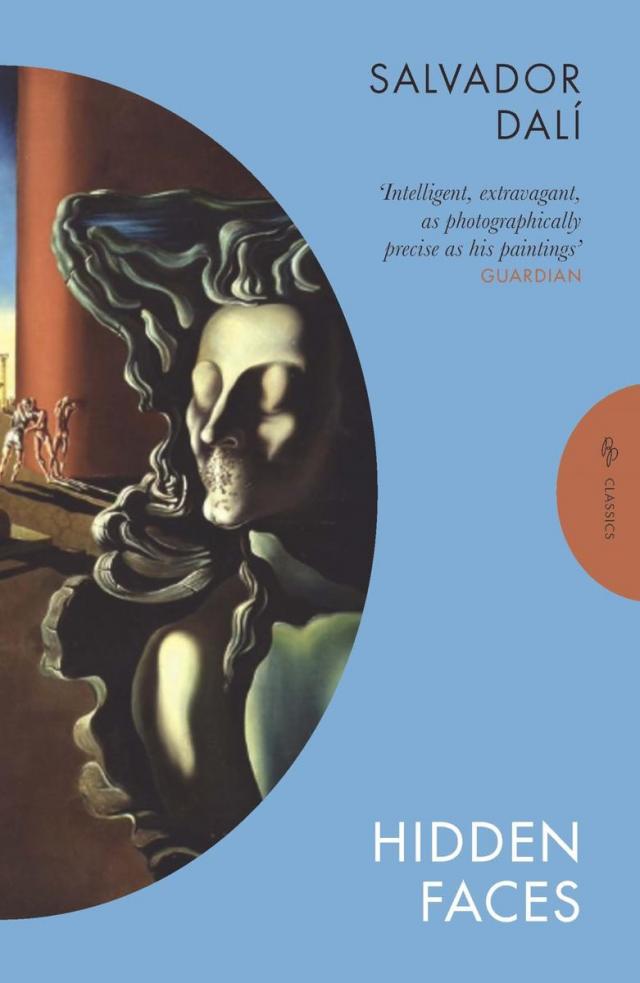
Hidden faces, p.38
Hidden Faces,
p.38


Betka, a very different Betka from the one he had known that night at the Hotel Avenir Marlot, appeared now before Randolph’s eyes as a creature invested with sublimity. Over the copper of her flaming hair the passage from adolescence to womanhood had scattered the ashes of several prematurely whitened strands, between which the coals seemed to burn with even greater passion. Her large mouth, in turn, as if spiritualized by resignation, had kept only the tender grimace of the vestiges of her aching sensuality which was perhaps as ardent as before. She had become in Randolph’s eyes a body as transparent as brandy, in which only the suspended aromatic herbs of her former vices were visible…. He looked at her, and he scarcely saw her. He saw only through her. And through her he saw only Veronica for whom he was waiting, paralysed with anguish. She would arrive at any moment! As he waited for the sound of her horse’s gallop, Randolph kept asking Betka, with the insistence of a fretful child. ‘You are sure Veronica is happy? You are sure Veronica is happy? With what’s his name, Nodier? And who is Nodier?’
‘You’ll judge for yourself if she is happy,’ Betka answered. ‘You’ll see it with your own eyes, if they are not too dazzled by Veronica’s enhanced beauty. But you have no right to cloud this happiness by reviving a distant memory. I love Veronica too much to allow you to do that. And it was only on your accepting this condition that I agreed to let you meet her.’
‘I shall keep my word,’ said Randolph with melancholy, ‘I shall not make love to her.’
‘But why shouldn’t you try to make love to me?’ Betka asked. ‘We two have at least had one night of love together, haven’t we?’
‘And if I told you that I love you too?’ he said suddenly, sitting down on the arm of her chair and putting his arms around her – but with his eyes lost in the darkness of the windows and visibly thinking of something else.
She lifted her face to him, bringing her lips close to his and said laughingly, ‘I wouldn’t in the least believe you!’
‘And how right you would be,’ said Randolph, kissing her between the eyebrows with tender friendship. But he added, ‘Yet I could love you more and better than I did at our first meeting. It was your fault…. You were dead drunk – do you remember?’
He never found out that I wanted to kill myself that night, Betka reflected, and answered, ‘Yes! I remember!’
It struck her that this was all like a dream, and Randolph as if continuing her thoughts aloud exclaimed, ‘More and more I think I am the victim of my illusions, of an impenetrable dream. Sometimes I force the skin back from my orbits to try to make my eyes open to reality, to find out where I stand in life. It’s not so long since I was officially reported dead on the casualty lists, but I was only a prisoner of the Italians, and on my return to Africa I found out that the Count of Grandsailles had blown himself up with the Prince of Orminy’s yacht. It so happened that I flew the Count of Grandsailles to Malta before I was shot down in Calabria. I immediately began looking for Cécile Goudreau to find out details, but she had gone back to Paris. Did you know the Count of Grandsailles in Paris?’
‘No, never, but I knew Solange de Cléda. She was a love, that woman!’
‘Her adoration for the Count became a legend,’ said Randolph.
‘It seems that the Count of Grandsailles was a very intelligent man, but cold and pitiless,’ said Betka.
‘It’s funny, but I got just the opposite impression. He seemed to me a man of great passion. It’s true that I only met him for a moment on an informal occasion, and at that I only saw his eyes. We were flying very high to avoid enemy planes that might intercept us from Pantelleria, and we both had on our oxygen masks….’
‘They’re coming,’ said Betka, getting up. The galloping of their horses could be distinctly heard. ‘You have given me your word,’ said Betka, ‘but swear to me once more that you will never tell who you are!’
‘I give you my solemn word,’ said Randolph. ‘I only want to see her once more before I go back to Europe to fight again. I want to feed my dream, since it helps me to live. But don’t worry, my soul has already been burnt out!’
Veronica and the Count appeared for a moment in the drawing-room before going up to change, and Betka introduced them:
‘Veronica Nodier – Captain John Randolph – Lieutenant Nodier.’
Veronica came downstairs wearing a white moiré dress fitting closely over her hips, in which she made one think of an unruly white colt. And from her forbidding response to Randolph’s first burning glance he felt the walls of an inaccessible tower rising before him. Dinner was served almost immediately and they took coffee and liqueurs in the drawing-room. Veronica and Betka played a game of chess while the Count of Grandsailles and Randolph conversed on the subject of the Napoleonic wars, one of Grandsailles’ favourite subjects, in the course of which the writings of Stendhal and Alfred de Vigny came under discussion and the Count developed startling parallels between those wars and the present Russian-German conflict. Grandsailles could, when he wished, be a brilliant and captivating conversationalist.
‘You give the impression of having lived in that period,’ Randolph remarked.
‘That may be,’ answered Grandsailles. ‘Napoleon was frequently inspired by my ideas.’
When it was time for leave-taking Grandsailles said to Randolph, ‘I hope you’re not going to leave us any more, and during the time you have left to spend here before you go back to Europe, if you are not afraid of always finding the same three people, we shall all be delighted to have you dine with us every evening.’
On the second day Randolph was already like an intimate of the household. Grandsailles had always felt the need of masculine company, that could better appreciate his gifts of speculative intelligence, and in Randolph – silent, sensitive and distinguished – he found an ideal listener. Moreover, the Count constantly feared that the secluded life which the three of them were leading might in the long run give rise to suspicions as to his identity. This handsome captain contributed to their group the charm of naturalness and, besides, his presence brought Betka a perfect opportunity for a flirtation. She had lately been abnormally attached to her son, with whom she had been leading almost a life apart, even keeping him more and more jealously away from any contact with Veronica. Thus he believed that Randolph’s coming into their common life would normalize all their relationships and he therefore did everything to charm and make him feel at home. Nothing could have pleased Randolph more. He was madly in love with Veronica, and her coldness toward him only exasperated the growing feeling of frustration which her almost daily presence, with the torture of having to repress all his emotions at every moment, caused to break in black waves of pessimism on the very shores of delirium, spangling the churning waters of the dream of his life with the phosphorus of desire.
Veronica barely spoke to him, but if their glances crossed she would act as if she were offended, seeming to want to indicate to him his duty to be tender to Betka. Veronica’s faithfulness to Grandsailles was so complete that it embarrassed her to be admired by others than him. Even Betka’s adoration seemed to deprive her of that feeling of exclusiveness which was the very essence of her nature.
‘Are you satisfied with my behaviour?’ Randolph asked Betka on the fourth day. ‘You see that I’m keeping my word.’
‘You’re doing nothing of the sort,’ answered Betka severely, ‘you keep staring at her as if you were going to devour her. But I won’t take it upon myself to discourage you. She has a way of looking at a man that teaches him soon enough that he isn’t always irresistible. And now answer me frankly, because I have a question to ask you, too: “Is Veronica happy”?’
‘I can’t tell you,’ said Randolph, ‘but one thing is certain: she idolizes Nodier, and I have to admit he has every fascination – a unique mind…. He is mystery itself. I give you my word that I have no intention of coming between them. Besides, I wouldn’t have a chance, no matter how hard I tried,’ he said in a tone of utter dejection, and he added, ‘if only I could get Veronica to stop looking at me with her hard expression of reproach, if only she would show me a little friendship and warmth!’
‘She has given you only what you deserve. Stop wanting her, try to be more attentive to me. When you have gone you will miss me. Besides, I am not so easy as that. I am no longer – polysexual, I believe was the word you used. There are only two beings in my life: Veronica and my son – and you, a little.’
‘A little more or a little less?’ asked Randolph.
‘Just a little more – but you could never make me do anything foolish now.’
‘I have better plans for the two of us than something foolish,’ Randolph answered enigmatically.
Time flowed by peacefully and monotonously in the house of the Nodiers – of the Count of Grandsailles. Randolph was there continually now, and went with them to the oasis, and in the evening Veronica would sometimes play a single game of chess with him, which she almost always won; after which she would immediately go up to bed before Grandsailles who liked to drag out his conversations with Randolph and Betka, sometimes till three o’clock in the morning, when they would take their last Scotch, their ‘night-cap’.
But now for two days the Count of Grandsailles had not come down into the dining-room, and neither had he gone to inspect the work on the tower in the oasis. He had buried himself in his new readings, and he himself said that on such occasions he was rabid as a dog with a bone and was apt to bite if anyone came and disturbed him. But this time he had reasons other than his speculative passion for retiring within himself. Again, more unmistakably than before, he had felt the recurrence of suffocating palpitations and other unequivocal symptoms of an incipient heart ailment. For nothing in the world would he have consulted a doctor, for he considered his own medical knowledge sufficient for his treatment. Besides, it was not his physical condition that concerned him most. For in the last few days he had been the prey to sudden dreadful headaches which seemed to pierce the back of his head as with a corkscrew, and these pains were accompanied by a whole cortège of bizarre psychological phenomena, elusive though quite unmistakable, and he knew that for these no doctor could be of the slightest assistance.
In the last analysis he was perfectly aware of what was wrong with him. Everything stemmed from the same source: his unsated passion for Solange de Cléda, which sooner or later must end by affecting his very reason.
Solange’s letter finally arrived. He had begun to despair of ever getting an answer. But far from affording him relief, this letter only obsessed him the more, aggravating his pathological craving for seclusion. The thought of going downstairs and chatting with Veronica, Betka and Randolph was now almost more than he could bear.
‘Randolph is keeping them company,’ he would say to himself, ‘and I really feel ill.’
Thus he spent day after day without being able to resolve to go downstairs. For a whole day he pondered his answer to Solange, and at about half-past five the following morning, no longer able to sleep, he got up from his bed and wrote:
‘My beautiful, cherished, adored Solange,
‘To what could I possibly dedicate the rest of my life if not to repeating to you constantly, each time with a different shade of feeling, that my love is even greater than my gratitude, which in all justice should at this moment be limitless, since you have expressed your willingness to grant me not only the mite of esteem which I dared beg of you, but also to continue to favour me with your passion. For if I had never received an answer to my letter, my gratitude might perhaps have diminished, but never my love which constantly grows. Now, though this gratitude is of the highest, it is nevertheless far from reaching the heights of my love for you, so inaccessible will this feeling always remain to all others, including pity! I feel awkward and inept in my attempts to communicate with your heart through my poor love-letters. But with each passing day and in spite of the distance it seems to me more certain that my continual dreams of you cannot fail to pass into your spirit and take possession of your dreams. The magic of the science of incubi and succubi to which I have been subjecting all the disciplines of my mind in order to draw close to your spirit is none other than the science of dreams of ancient Egypt, the science of the real and tangible incarnation of the flesh-and-blood desires of dreams which end by covering the heart with “tissues of asphyxiation”… and paralysing it. Periodically, and quite beyond the control of my will, I feel as if all the convergent forces of my most secret organic being were gathering in my brain, provoking frightful headaches accompanied by bleeding of the ears as if, without moving, I were being subjected to unusual atmospheric pressures. As these symptoms multiply I begin to perceive images with phenomenal visual acuteness, while the area around my orbits begins to ache, as though they were being immersed in boiling water. Finally I see you as clearly as though you were standing right in front of me.
‘I see you in instantaneous flashes, always outdoors and lighted by a bright winter sun, and these images are all the clearer if, at the moment when they occur, I press my shut eyelids with my handkerchief. I see you going down a ravine, wearing a bright red dress, near the newly planted grove, accompanied by the two Martin brothers. I see you leaning over to open the little wooden gate that leads to the back road, near the wash-houses. Titan watches you, motionless, and one of the brass studs on his collar suddenly flashes for a moment like a signal-light. Each of these images is accompanied by the sound of dear voices that talk to you respectfully, that of Pierre Girardin whom I assume to be your guardian-angel. Though I have a heart of stone, I am reduced to tears by the flash of a brass stud – because it belongs to the collar of a dog who looks at you – tears all the more burning because my eyes ache with the vision of you. And always at the end of this hallucinatory period I perceive of you the same final image – the most disturbing one – your face convulsed in a strange expression of ecstasy which is not solely that of pleasure, since it combines with one of anguishing and mortal terror which, I am sure, is but the subjective one of my own spirit trembling at having lost you, the wretched fear of my damnation alone bestially wrenching from me the pleasure you might graciously have offered me as the noblest of ladies that you are. My beloved Solange de France, lips of jasmine, my lovely, fragile young tree, I can feel each of your new leaves growing and pricking within the genealogical tree of my veins. If at least we could have had a son together! My thoughts are my hands placed like a crown round your brow, my memory is my mouth on yours, my desire the tissues of your entrails, my tenderness my arms! I kiss you all over, and I shall live only in expectation of your answer.
Your
hervé de grandsailles.’
In the days that followed Grandsailles obstinately continued his seclusion, and Veronica and her friends were beginning to be concerned, Nevertheless Veronica each morning received a few scribbled words from her husband, always with some lovely surprising thought on the subject of their love, which enabled her to live through the rest of the day and wait with resignation for the next. Each evening the game of chess between Veronica and Randolph seemed to be played by two phantoms. And seeing them so quiet, so close, facing each other, their heads slightly bent over the chessboard, like the couple in Millet’s ‘Angelus’ in a sitting posture, Betka found it hard to believe that this simple scene was an authentic bit of reality. For Randolph, tall and melancholy, accustomed to setting planes afire, to flying beneath a shower of ashes and piercing through flaming clouds, now trembled with pent-up passion, with martyred desire, his heart impotent before her who without knowing it – even as he was unaware of it – obstinately rejected him precisely in order to remain faithful to him!
Veronica had loved Grandsailles, dedicating her life wholly to him, solely out of faithfulness to her delirious memory, that of the man with the hidden face in the depth of the cellar of the house on the Quai des Orfèvres; now this man whom she had waited for so long and so mortally was there, sitting before her, real – and precisely because he was visible she could not see him! Both of them were like pawns facing each other, isolated, unable to advance or retreat and as distant as two stars that seem to touch. But this was another game, and with a queen and a knight Veronica declared ‘Checkmate!’ Then she went up to bed. In passing the Count of Grandsailles’ door she stopped and drew close for a moment. Above the door a streak of light showed that the Count was awake. She did not dare to knock.
‘It’s curious,’ it suddenly occurred to her,’ Randolph’s face is covered with very fine, almost invisible scars. It’s rather attractive, but why do I find it strange all at once?’ She went and shut herself up in her room and no longer gave it a thought.
For weeks Randolph had spent several hours almost daily in Veronica’s presence. His furlough would end and he would return to Europe without their having given any utterance to their emotions. There had been only that stubborn and merciless battle of eyes. And now that the time for leave-taking began to loom before him it seemed to Randolph that he noticed a change of expression in Veronica – a look, if not of acceptance, at least of compliance. Was it habit, or leniency inspired by the imminence of his departure? Probably both, and the first hypothesis displeased him as much as the second. Nevertheless the lack of charitable softness in Veronica’s pitiless eyes had already upset him so much that he was ill from it. How could he resign himself to leaving her, perhaps for ever, without trying to obtain from her one single look of passion that he could carry away with him in his heart into the skies of war, like a shield for his wings? His furlough was shrinking like the famous wild-ass’s skin described by Balzac and he superstitiously believed that if he were to try to snatch the slightest pleasure beyond what was strictly due him, if he did not preserve his silence before Veronica, the happiness of seeing her which had become the sole reason for his being would be brought to a premature end.