

Arabella, p.1
Arabella,
p.1
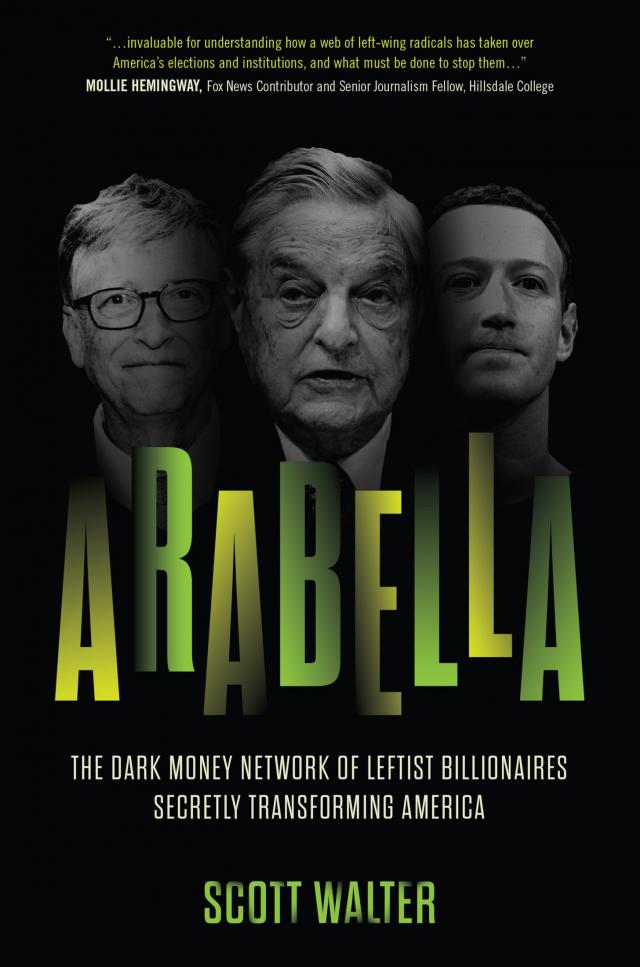


ARABELLA
THE DARK MONEY NETWORK OF
LEFTIST BILLIONAIRES SECRETLY
TRANSFORMING AMERICA
SCOTT WALTER
© 2024 Scott Walter
All rights reserved. No part of this publication may be reproduced, stored in a retrieval system, or transmitted, in any form or by any means, electronic, mechanical, photocopying, recording, or otherwise, without the prior written permission of Encounter Books, 900 Broadway, Suite 601, New York, New York, 10003.
First American edition published in 2024 by Encounter Books, an activity of Encounter for Culture and Education, Inc., a nonprofit, tax-exempt corporation.
Encounter Books website address: www.encounterbooks.com
Manufactured in the United States and printed on acid-free paper. The paper used in this publication meets the minimum requirements of ANSI/NISO Z39.48‒1992
(R 1997) (Permanence of Paper).
FIRST AMERICAN EDITION
LIBRARY OF CONGRESS CATALOGING-IN-PUBLICATION DATA IS AVAILABLE
Information for this title can be found at the Library of Congress
website under the following ISBN 978-1-64177-381-2 and LCCN 2024002926.
CONTENTS
Acknowledgments
Introduction
CHAPTER ONE
Excavating Arabella’s Origins
CHAPTER TWO
The $1.6-Billion-Pound Gorilla: Today’s Arabella Advisors
CHAPTER THREE
Case Study: Health Care for America Now
How the New Venture Fund and the Sixteen Thirty Fund Collaborate on Legislative Campaigns
CHAPTER FOUR
Case Study: Center for Secure and Modern Elections
Funding Election Administration or Changing Election Outcomes?
CHAPTER FIVE
Case Study: Hopewell Fund
How Warren Buffett’s Wealth Funds the Nation’s Abortion Infrastructure
CHAPTER SIX
Case Study: Co-Equal
Funding Congressional Staff to Attack Their Environmental Opponents
CHAPTER SEVEN
Case Study: The Hub Project
How a Foreign Billionaire Uses Front Groups to Intervene in Elections
CHAPTER EIGHT
Case Study: North Fund
Birth of Another Massive Political Pass-Through
CHAPTER NINE
Case Study: Democracy Alliance Funds
How Soros and Other Billionaires Pool Money for Politics
CHAPTER TEN
Case Study: Governing for Impact
Darkness within Darkness to Shape the Biden Administration and America’s Schools
CHAPTER ELEVEN
The End of Anonymity: Exposure and the Organizational Fallout
CHAPTER TWELVE
Can the Arabella Problem Be Solved?
Endnotes
Index
ACKNOWLEDGMENTS
THIS IS NOT MY BOOK. It is much more a book by my colleagues, especially Kristen Eastlick and Hayden Ludwig, who have worked alongside me at the Capital Research Center, the institution that deserves the byline for this tome. But books must have a person for an author, so I enjoy here, as so often, the privilege of bragging about the work of the Capital Research Center, America’s investigative think tank.
Kristen did more than anyone to assemble and improve the existing research that went into this book, as well as supplying new research that filled in gaps. Hayden was the original investigator who produced more of that research than anyone else, though many other colleagues also produced original investigations into and analysis of the Arabella empire, including Parker Thayer, Ken Braun, Robert Stilson, Michael Watson, Michael Hartmann, and Jonathan Harsh. Sarah Lee and Katie Cook are our excellent communications staffers who so effectively publicized this work, and CRC editor Jon Rodeback improved much of the original material as it was published. Indeed, all of my Capital Research Center colleagues have made important contributions without which the book could not appear, such as Dan Thompson, Beth Bottcher, and Madeline Matney, who raised money to fuel Capital Research Center; and Chris Krukewitt and Catherine Heravi, who watched over and channeled that fuel in the finance department; and especially our chief of staff, Laura Elliott, who holds us all together and keeps me out of many troubles. An old friend, outside editor Ellen Wilson Fielding, once again helped me edit a book for publication.
A special word of thanks is due to the sharp local journalist who, first in the world, discovered Arabella’s meddling in Americans’ lives: Dave Skinner of Montana. He kindly contacted us when we began following in his footsteps, and we commissioned him to write the original version of chapter 1. Many of the other chapters also began life in somewhat different form, written by others. The most I can say for myself is that I often shaped these essays’ commissioning and joined in their original editing before first Kristen and then I reworked them for this book.
I also owe major debts to Roger Kimball and all his colleagues at Encounter Books, including Sam Schneider, Julie Ponzi, and Elizabeth Bachmann. As someone who’s been involved in the gestation of many books, I recognize how far above average they are in the midwifery required to put pages between covers. Roger’s own intellectual jousting against the hydra-headed Left has been an inspiration for decades, and Julie’s editorial judgment shaped what you’re reading into something much stronger and sharper than would otherwise have appeared.
Older debts are owed to the men and women who strengthened and sharpened what passes for my thinking over the years: professors like Fr. James Schall, S.J.; Walter Berns; Hadley Arkes; Richard Stevens; Diane Yeager; and George Carey; and colleagues at AEI like Karl Zinsmeister, Karlyn Bowman, Chris DeMuth, Bill Schambra, Robert Bork, Leon Kass, Bill Kauffman, and Gayle Yiotis, as well as Adam Meyerson, late of the Philanthropy Roundtable.
I should perhaps thank Arabella and its founder, Eric Kessler, for providing such a target-rich environment for critique. But my deepest debts are owed to my wife, Erica—the true intellectual in the family—and our four children, though I must steal a line from Walter Berns and say I owe them “more than I am willing to express here.” To steal a closing line from George Carey, let me add that everyone mentioned “must bear some part of the responsibility” for any errors and inadequacies in the book, but the lion’s share of the responsibility lies with me.
INTRODUCTION
How Demand Justice Revealed the Left’s ‘Dark Money’ ATM
THE ORIGINS of this Arabella exposé began with a simple question from an old friend on Capitol Hill who was already in the midst of another fierce fight over a Supreme Court nominee. It was the summer of 2018, and my friend worked on the Senate Judiciary Committee. Justice Anthony Kennedy had just announced his impending retirement.
“We don’t even have a nominee yet,” my distraught friend said over the phone, “and already Chairman Grassley, the committee, and the president are being trashed online and on TV and radio—by something called ‘Demand Justice’? Nobody’s ever heard of it, and we can’t find anything out about it. What is Demand Justice, and what can we do?”
“Well,” I replied, “I’ve never heard of it either, but Capital Research Center”—where I work—“can do something. I’ll be back in touch soon.” I clicked off the call and immediately rang one of our top investigators, Hayden Ludwig, and told him to start digging. Two hours later, he emailed me a dossier that explained a lot.
No one had ever heard of the group because it had only sprung into existence a few months before, after Brian Fallon, a Democratic operative, spoke to a left-wing donor cabal co-founded by George Soros (see chapter 9 for more on the Democracy Alliance). Fallon pitched the donors on helping him launch Demand Justice, which was to be a new group focused on attacking and blocking, if possible, every Trump judicial nominee, from the Supreme Court down to the humblest district court in the boondocks. Ludwig’s dossier showed that Soros had written a seven-figure check to the cause, and it also showed the backgrounds of all the staff involved, where the headquarters was located, what strategies they’d announced, and more.
I forwarded this to my Capitol Hill friend, saying I hoped it was helpful and apologizing that I couldn’t talk because I was sitting down with a donor. She wrote back one line: “Tell them you’re invaluable.”
But the story doesn’t end there. By that afternoon, still before Brett Kavanaugh was nominated to fill Kennedy’s seat on the high court, Ludwig had turned his dossier into an entry on our website InfluenceWatch.org. For the rest of that grim Kavanaugh summer, as the Left waged the ugliest Supreme Court brawl of all time, Ludwig’s InfluenceWatch write-up on Demand Justice was the top entry for Google searches of the group, ahead of their own website. (These days we typically come in third or fourth.)
Yet that’s not the end of the story either, as we’ll see.
The Birth of Demand Justice
Born in early 2018, Demand Justice was originally nothing more than a website and a glowing New York Times article.1 It was led, as noted, by Brian Fallon, former press secretary for Hillary Clinton’s failed 2016 presidential campaign, former aide to Senator Chuck Schumer (D-NY), and a partisan to his marrow.
After Fallon launched the group with millions from the shadowy Democracy Alliance, Demand Justice led the Left’s unsuccessful campaign to smear Brett Kavanaugh as a gang rapist during his Supreme Court confirmation. Demand Justice protested against the nominee’s “extremism” outside the Supreme Court before Kavanaugh’s name was even announced, wielding pre-printed signs
opposing all possible picks from Trump’s shortlist (“Stop Kethledge,” “Stop Hardiman,” “Stop Barrett,” “Stop Kavanaugh”).2
Signs prepared shortly before Brett Kavanaugh was nominated to fill the Supreme Court seat vacated by Justice Anthony Kennedy. Credit: Hayden Ludwig. License: Capital Research Center.
Demand Justice even purchased the website StopBarrett.com in 2018 (two years before Amy Coney Barrett was nominated) and spent $317,000 in electioneering communications to block Kavanaugh’s confirmation.
At a glance, Demand Justice appeared to be an activist group like any other. But closer inspection of its website by my Capital Research colleague Ludwig showed the group was really a front for the Sixteen Thirty Fund, a 501(c)(4) nonprofit, the kind that is typically referred to as “dark money.” Only a few news outlets that summer began to realize that Demand Justice didn’t exist as a normal nonprofit. It differed dramatically, for example, from the 501(c)(4) nonprofit that was the main group supporting Brett Kavanaugh’s nomination, which had long been an independent nonprofit that publicly disclosed its expenditures, lobbying, vendors, and more. No news outlet reached all the way to the bottom of the Demand Justice story, as Ludwig and Capital Research Center would do, uncovering its life inside the Arabella empire.
One outlet that at least began to comprehend the story was the left-leaning OpenSecrets. It reported that the Sixteen Thirty Fund was Demand Justice’s “fiscal sponsor.” That is to say, Sixteen Thirty is a nonprofit that allows start-up groups like Demand Justice to come into existence and take advantage of their sponsor’s nonprofit status and administrative expertise. (Lobbying filings posted by the Federal Election Commission later confirmed the relationship.) OpenSecrets went on to explain how this arrangement helps a group like Demand Justice remain much more hidden from public view than most Washington nonprofits.
I will quote OpenSecrets’ report at length to assure readers on the left that I am truthfully describing exactly how this major left-wing effort operates.3 No right-wing conspiracy theories here.
Following the practice of nearly all such nonprofits, neither Demand Justice nor its comparable group on the right, observed OpenSecrets, discloses its donors. But unlike its counterpart, which
follows the well-established “dark money” model of incorporating as a tax-exempt nonprofit organized under section 501(c) of the Internal Revenue Code that is required to file annual 990 tax returns, Demand Justice is a non-tax-exempt entity organized by a fiscal sponsor—making their finances even more opaque.
OpenSecrets confirmed that the Sixteen Thirty Fund had recently added Demand Justice to its long list of trade names (also known as “doing business as” names) that it fiscally sponsored. As fiscal sponsor of Demand Justice, the Sixteen Thirty Fund was lending the group its legal status as a 501(c)(4) nonprofit, which in turn means that “Donors who steer money to Demand Justice would report donations to the fiscal sponsor rather than Demand Justice itself, adding an extra layer of secrecy that further obscures the source of funds.” In other words, no donor need ever disclose donations to Demand Justice.
Under this secretive arrangement, “Demand Justice is not required to file annual 990 tax returns with the IRS,” which gives Demand Justice advantages over its opponents: “Although tax-exempt nonprofits are required to disclose spending on lobbying and grassroots operations, Sixteen Thirty Fund merely discloses lobbying spending totals for all of the sponsored initiatives collectively,” which number in the dozens, “without parsing out which portions of that money were directed through each initiative. This arrangement makes it virtually impossible to determine who funds the group and how that money is being spent.”
Having explained how Demand Justice was much more “dark” than its “dark money” opponents, OpenSecrets went on to reveal more about its parent, the Sixteen Thirty Fund, which in 2018 was sending dozens of these super-dark groups into political battle on all sorts of controversial issues. “Sixteen Thirty Fund acts as a fiscal sponsor for over 45 initiatives that lack tax-exempt status or do not exist as separately incorporated entities,” OpenSecrets explained, so Sixteen Thirty Fund “consolidates all of its fiscally sponsored projects into a single tax return.” In this way, if the public seeks information about a particular project like Demand Justice, it will find “the project’s activities, funding, and spending remain largely hidden among all of [Sixteen Thirty’s] other projects.”
This OpenSecrets report was the most informative of the non–Capital Research Center sources, although the Associated Press around the same time at least reported that Demand Justice was a fiscally sponsored project of the Sixteen Thirty Fund and that Sixteen Thirty had “nearly 40” other such projects.4 Politico, a publication for the inside-the-Beltway crowd, was much less scrupulous. It mentioned Demand Justice’s birth and its haste to buy ads that attacked various Trump judicial nominees, but it failed to mention the group’s sponsorship by the Sixteen Thirty Fund. During the Kavanaugh controversy all of these outlets failed to recognize that just as Sixteen Thirty had dozens of secretive “projects” like Demand Justice, Sixteen Thirty itself was only one of (then) four umbrella nonprofits that were created by one “Beltway bandit” firm, Arabella Advisors LLC, a for-profit consulting firm.
Just as Sixteen Thirty spun into existence dozens of groups like Demand Justice to wage political war, simultaneously lending its nonprofit status to those pop-up groups and cloaking their donors more darkly than any normal nonprofit group could hope to do, the three “sister” umbrella nonprofits to Sixteen Thirty—the New Venture Fund, Hopewell Fund, and Windward Fund—likewise launched dozens, nay hundreds, of not-quite-real groups into the fray.
In reality, each of these groups was little more than an accounting code at one of the sister nonprofits and (usually) a website on the same server. But in the unreality of our current politics, policed by media that are sympathetic to the goals pursued by the Arabella empire and ignorant of the means it employs, these groups could pretend to be grassroots Americans demanding “justice” on all kinds of issues, from climate change to abortion to Obamacare to the election process. Whatever the issue, Arabella Advisors used these in-house nonprofits to pop groups like Demand Justice into and out of existence as political situations—and fat-cat donors—demanded.
Unlike the mainstream media, Capital Research Center refused to stop digging into all this amazing political architecture.
Arabella Comes to Light
Founded in 1984, Capital Research Center originated as a “philanthropic watchdog,” created to investigate and expose the activities and financing of public policy groups, foundations, and other special interests. Since then, we’ve investigated tens of thousands of think tanks, advocacy groups, unions, trade associations, political action committees, activists, and more to help the public understand which special interests are being protected by what means. That explains why we kept digging into the Demand Justice question, especially as the Kavanaugh hearings intensified.
Searches of the IRS nonprofit database showed Demand Justice wasn’t listed. What did turn up in an online search was a downtown address on Connecticut Avenue shared by dozens of other groups, including Sixteen Thirty Fund. Other organizations based at that address included Arabella Advisors, the New Venture Fund, Hopewell Fund, and Windward Fund. Since we made this discovery, we’ve continued researching the complexities of the Arabella network, a puppet-master-like group that likes to describe itself as providing “support services to changemakers who are dedicated to achieving social and environmental impact.”
At its helm is Arabella Advisors, an influential philanthropic consulting firm in Washington, D.C., catering to donors like the Rockefeller Family Fund, the Ford Foundation, and George Soros’s Open Society Foundations. The firm belongs to Eric Kessler—Arabella’s founder and chief string-puller—a child of wealth turned environmental activist and Clinton administration staffer who now operates in the highest echelon of Democratic Party politics.


