Spelunking through hell, p.39
Spelunking Through Hell,
p.39
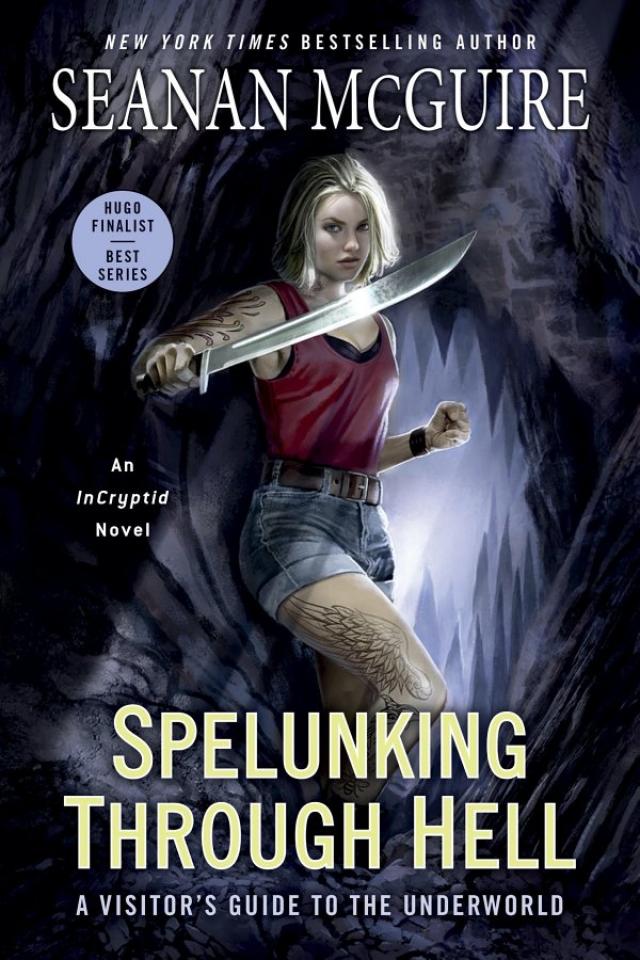


It took the better part of a week to clean out the barn. She baled hides, filled jars with scales, teeth, and claws, and labeled the various canning jars of organs and fluids that had been accumulating around the place for the past several decades. When the representatives of the Covenant arrived to clean up the family affairs, she didn’t want them to think the Healys had turned into barbarians. She polished the tools and sharpened the knives, and she planned.
The books all agreed that burning wouldn’t destroy the eggs, but none of them claimed that the adult wasps were fireproof. She could probably rig some sort of flamethrower, assuming she didn’t mind setting her own hair on fire. Start with bullets to pick off as much of the early waves as she could manage, move on to flame when they started to outnumber her, and then, if that worked, she could go back to bullets for the stragglers. All she had to do was keep them from escaping, and from stinging her again.
Maybe there was a chance that she’d be able to . . .
“Don’t be a fool, Alice,” she said aloud. “Kill them all, but don’t start planning on staying alive.” It seemed better not to start down that path. Hope makes you worry about how much you’re bleeding. Fatalism makes you do more damage before you die. Given the options, and what the Apraxis could do to the town if they managed to get loose, she knew which she was going to choose.
It took another two days to clean the downstairs, with the mice watching raptly all the while. The old priest came down to observe her as she cleaned out her father’s study. After an hour, he sat down on the blotter, regarding her steadily.
“You are preparing for a journey,” he accused.
“I suppose that’s true,” she said, wiping the dust off a mounted cockatrice.
“Will we be accompanying you?”
“Not this time.”
“We accompanied those who came before you across the Great Water,” the priest said solemnly. “We will gladly go with you on this journey.”
The image of arriving at the Pearly Gates with an honor guard of cryptid mice who worshipped her as a demi-goddess arose before Alice could smother it, and she smiled, putting a hand over her mouth to muffle the expression. “I’m sorry, but you really can’t come with me this time.”
“I see.” The priest continued studying her. “You go to follow those who came, and went, before you.”
Alice hesitated before nodding, very slowly. “I suppose I do, yes.”
“And there is need for this thing?”
“There’s great need. I wouldn’t . . . I wouldn’t go if there wasn’t great need. I’m sorry.”
“You do not need to offer apologies, Priestess. What you will do is what must be done. So it has always been.” The priest shook his head, reaching up to remove the ceremonial headdress. “My time as priest grows short. Soon, I too will take that journey.”
The admission sent a pang through Alice’s heart as she realized what the tiny priest meant. “I’m so sorry to hear that.” It had always been hard for her to tell the ages of individual mice. She knew from the bestiaries that Aeslin could live fifty years or more, but in the end, age came for them just like it came for everything else. “Maybe we’ll see each other at our destination.”
“The Gods have always been kind,” the priest replied. “We will all be joined, and gladly, in that place.”
Alice shook her head. She couldn’t help envying his certainty. Maybe she wasn’t a cryptid mouse worshipping a family of slightly off-kilter cryptozoologists, but she’d never really believed in an afterlife beyond Mary’s twilight, either. “I won’t leave you alone here. I . . . I’m leaving a message for Naga. He’ll come and get you and take you wherever you want to go.”
The priest held up a paw in negation. “If you go and do not return for seven days, or if others come in your stead, we will make our own way. There are places which will welcome us.”
“I see.” Alice leaned down to put her hand in front of him. The old priest rose slowly, stepping onto her palm, and leaned on his staff as she lifted the hand to eye level. “This is one of those times when I shouldn’t ask, isn’t it?”
“It is so, Priestess.”
“All right, then; I won’t.” She moved the hand to her shoulder, holding it there as he stepped off and settled in her hair. “I need to clean the pantry. Come with me?”
“I would be honored, Priestess.”
“I’m glad.” She turned off the light and closed the door, asking as she did, “Will you tell me one of the stories about my mother?”
“Of course, Priestess.” The old mouse cleared his throat, and began to solemnly recite: “It was in the year of the great dryness, when the Patient Priestess did shout No, No, That Is Not the Way to Dig a Well . . .”
Sometimes the only thing to do is prepare.
11.
* * *
The world ends every time a person dies, because for them—unless they manage to come back as some sort of unquiet ghost, which had always struck Alice as being something uncomfortably like cheating—everything is over. Die, and even though the world may keep on turning, it no longer turns in a way that you’re ever going to see.
Keeping that in mind, it struck her as vaguely improper for the world to be ending on a Wednesday. It should have been a Monday, at the very least; some sort of day that was suited to a suicide. Ah, well. The dying don’t get to be picky.
She spent the morning loading the back of the truck, pausing between loads to write the letters she’d been putting off since the day she realized what she’d need to do. One was for Naga, explaining exactly what she wanted done with the few things in the house that she considered truly hers. One was for Clark, her only college boyfriend, who would have been her college fiancé, if things had gone just a little differently. One for the men from the Covenant, telling them where the traps were. One for Mary, asking where she’d been when Alice needed her, why she hadn’t been there in the end.
Maybe that letter was a little bit cruel. But sometimes the truth was a cruel thing.
And one for Thomas Price, explaining absolutely everything else that needed to be explained. “We only get to do this once, Alice,” her grandfather used to say. “Oh, sure, there’re souls, and maybe they come back around again, but they don’t come back as us, now, do they? And ghosts aren’t the same as living people. Ghosting’s not a way to settle your affairs from the grave. You make sure you tie all your knots just as tight as you can, because no one’s going to batten down the hatches for you when you go.”
She was tying knots. She was taking down the sails and battening the hatches because that was what a person did when they knew they were going to die; they made sure the dishes were clean and dry, that the towels were folded neatly in their chests, and that the library was properly indexed.
They also filled the truck with cans of jellied gasoline, accelerants, butane torches, ammunition, and any convenient sniper rifles that happened to be lying around the house. As a last resort, she threw a belt of concussion grenades that had been in the attic since the family moved over from England into the passenger seat and closed the truck’s back gate. If everything else failed, she could blow herself to Kingdom Come, and take as many of the bastards as possible along with her for the ride.
It was almost funny, Alice thought grimly. She was getting ready to go and commit suicide—there was no other term for facing a swarm of cryptid wasps on your own in a graveyard without backup on the way—but she’d be damned before she’d be quiet about it.
There was only one thing left for her to do by three o’clock on the afternoon of the last day of her life, and it wasn’t something she could handle at the house. She walked through the halls one last time, looking at the carefully dusted shelves and the carefully straightened pictures. It looked almost like a museum; a memorial to something that was long since dead and gone. Maybe, in a way, that’s what it was.
The high priest and a small band of acolytes waited for her on the kitchen counter, their tails coiled tight and anxious around their legs. “Have you come for the taking of leave?” he asked, leaning heavily on his kitten-bone staff.
“I have,” she said, walking over to the counter and kneeling to put the mice at the level of her eyes. “I’m sorry. I wish . . .”
“Wishes Are For Fools and Madmen; Actions Are For the Brave,” intoned the priest, with that particular stress on the first letters of each word that told her he was reciting. The mice were the only creatures Alice had ever met who could actually pronounce capital letters.
“Who said that?” she asked.
“The Patient Priestess, Enid Healy, who begat—”
“I know who Grandma Enid begat. But thank you for making sure.” Alice smiled, offering her hand toward the mice, palm upward. “Thank you for everything.”
“We will see you again, Noisy Priestess,” said the priest, putting his free paw lightly on the tip of her index finger. “We have always had one blessing that was denied to you and yours, for you are of the divine, and have needed it not.”
Alice blinked. “What blessing is that?”
The mice weren’t built to smile, but they could still show amusement. The mouse priest did so, flattening his whiskers and twitching his tail at her as he replied, solemnly, “We have faith.”
PART THREE:
Trade Today For Tomorrow
1.
* * *
The last thing Alice did before leaving the house for what she assumed would be the final time was go into the room that had belonged to her parents and open her mother’s jewelry box. It was sitting on the dresser, where it had been untouched for over seventeen years. The last time it had been opened was the day after Frances Healy walked into the woods and didn’t come back out, when her grieving husband put her jewelry away for the last time.
Alice picked through the jumble of bracelets and earrings without partners, finally extracting the prize she had come to find: her mother’s engagement ring. The silver had tarnished, but the diamond still glittered as brightly as she remembered. Most engagement rings are made of gold. Frances Healy’s was made by melting down a silver bullet dredged from the corpse of the first werewolf she ever shot. And that, in a way, says everything anyone will ever need to know about the Healys.
Carefully, Alice strung the ring on a plain gold chain from her own jewelry box, fastening the clasp at the nape of her neck. She sat there for a few minutes, resting on the edge of her parents’ bed, fighting back the urge to cry. Finally, quietly, she said, “Meet me at the door, Mama. I’m scared.”
Then she stood, turning off the lights as she walked first out of the room, and then out of the house itself. Seven hours to moonrise, when the nymphs would begin emerging from her father’s body.
Time to go.
2.
* * *
If Thomas Price was surprised to find Alice on his doorstep wearing jeans, a blood-stained white tank top, hiking boots, and an olive-green vest that started life as military surplus, he didn’t show it. If the gun belt strapped low around her hips was unexpected, he didn’t show that, either. He just held the door a little further open, saying, “Miss Healy. I wasn’t expecting you this evening. Would you care to come inside, or is this intended as strictly a brief visit?”
“It’s actually more of a social call,” replied Alice, offering a strained smile as she stepped past him into the house. “I hope I’m not interrupting anything?”
“Nothing of any real importance,” he said as he closed the door behind her.
She flashed him a briefly amused look, taking in his damp, uncombed hair, and the somewhat undone state of his shirt. “You missed a button,” she said. Then the reality of the statement sunk in, and her cheeks flushed.
“That’s been known to happen from time to time,” said Thomas slowly. “Usually when I’m not expecting company. How have you been, Miss Healy? I’ve been worried since I heard . . .” He stopped, not quite certain how to proceed.
“Better than I expected, not as good as I might have hoped,” Alice said, blush fading as she ducked her head. “I’m sorry I didn’t tell you myself.”
“You’ve been busy.” She’d been busy, and there hadn’t been a damn thing he could do to help her. Maybe if he’d been able to leave the house . . . but that door was closed, had been closed for years, and he had no one but himself to blame for it.
Himself, and the woman standing in front of him, alive and breathing. Maybe it hadn’t been a fair exchange, his freedom for her life—an exchange she still might not know the terms of—but it was done, and even now, he couldn’t find it in himself to regret it.
Alice squared her shoulders, seeming to make a decision as she straightened up and met his eyes full-on, with no polite attempts at glancing away. “I know I didn’t call ahead, but it seemed important that I come tonight. You see, Father’s death, it . . . put some things into perspective for me, some things I’d been thinking about for an awfully long time. And I felt that, since we’ve known each other for so long, I owed it to you to come over here and . . . and let you know.”
Thomas frowned, looking from the guns belted at her hips back to her face. She looked tired. More accurately, she looked like she hadn’t slept for over a week. There were dark circles beneath her eyes, not even cursorily covered with foundation powder, and her normally bright hair was dull from insufficient care. It fell in soft, uneven waves, rather than holding together in her customary, overly-careful curls. He thought it looked better this way, but much as he wanted to be distracted by her hair—by the idea of burying his fingers in it and finally saying the things he’d been trying not to say for years—something about her words was making him uneasy.
“Let me know what?” he asked.
“I’m . . .” I’m stupidly in love with you, Thomas, I have been since I was a teenager, and we have six hours before I go to the graveyard and don’t come back because nobody’s luck can last forever. So I came here because I didn’t want to die without saying it to your face, and there just isn’t time to play around anymore. We used all the time up on . . . on gingham dresses and upside-down cakes and being polite with one another. I’m here to ask you not to be polite to me, just for tonight. Because I won’t be here tomorrow.
“Miss Healy? Alice?”
Alice shook her head, smiling slightly as she came out of her fugue. “I’m sorry. I’m still a little distracted, I suppose. Forgive me?”
“Always,” said Thomas, with complete sincerity. “You were saying?”
“I was saying . . .” I love you. “I’m leaving Buckley forever, Mr. Price. I’m being picked up tonight by an old friend of my mother’s on his way through town, and he’s going to give me a ride to Ann Arbor.” She hadn’t intended to lie, but it rolled easily off her tongue. “I’m just here to say goodbye.”
Something in her words didn’t ring right. Thomas indicated the gun belt. “Do you customarily go fully armed when you’re getting rides from friends of the family? I wasn’t aware that was an American custom.”
“Didn’t Grandma ever tell you that Momma was carnie folk? I know you remember me going off to spend summers with the carnival.”
“She did, yes, and I remember. I’ve met your aunt Juniper. Still, it seems a little odd.”
“Believe me, the guns won’t be a problem. I think they’re pretty much expected with this crowd. Like wearing calico to the first spring picnic.”
“I’ll bow to your expertise in this matter. Will you be . . . returning any time soon, Miss Healy?”
“No. No, I really don’t think so.” Alice smiled again, glancing down to keep him from seeing the way the expression didn’t reach her eyes. “I’m leaving for good this time.”
“I see,” he said neutrally. What are you going out there to kill, Alice? Why are you so sure that it’s going to kill you? You were supposed to be retired. Your father told me that you were. Why are you finally looking at me like you’re a real person again, and lying when you tell me where you’re going? “I’m very sorry to hear that.”
“I’m afraid it can’t be helped. This is something I need to do.”
“There’s nothing I can say to change your mind?”
“No, there isn’t,” she said. She didn’t have to feign the regret in her voice. That, at least, was entirely honest. “I have a few hours before my ride gets here, and then I guess it’s time to get on the road.”
“Will you write this time?”
Alice hesitated. The resignation in his voice hadn’t sounded forced; it sounded as real and as complete as her own regret. “If I can,” she said.
“I’ll miss you.” The admission was softly made. It had the weight of years behind it.
“I’ll . . . I’m going to miss you, too.”
He watched her for a few moments, waiting for her to say something—anything—more. She looked away without speaking. With a sigh, he did the same.
“Well. I suppose you have things to do before you go. Other calls to make, other recluses to see,” he said, beginning to carefully redo the buttons on his shirt. He didn’t have to look at her if he kept his eyes on his hands. “Please do take care out there. I understand that it’s quite a large world, and it would be easy to get lost.”