Spelunking through hell, p.43
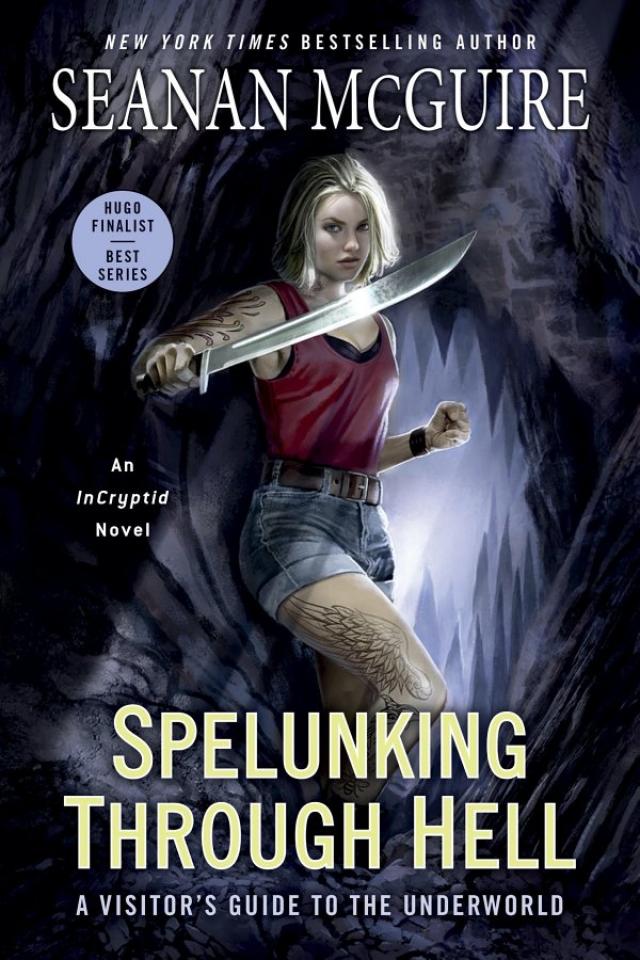
Spelunking Through Hell,
p.43


Aeslin mice (Apodemus sapiens). Sapient, rodentlike cryptids which present as near-identical to non-cryptid field mice. Aeslin mice crave religion, and will attach themselves to “divine figures” selected virtually at random when a new colony is created. They possess perfect recall; each colony maintains a detailed oral history going back to its inception. Origins unknown.
Basilisk (Procompsognathus basilisk). Venomous, feathered saurians approximately the size of a large chicken. This would be bad enough, but thanks to a quirk of evolution, the gaze of a basilisk causes petrification, turning living flesh to stone. Basilisks are not native to North America, but were imported as game animals. By idiots.
Bogeyman (Vestiarium sapiens). The thing in your closet is probably a very pleasant individual who simply has issues with direct sunlight. Probably. Bogeymen are close relatives of the human race; they just happen to be almost purely nocturnal, with excellent night vision, and a fondness for enclosed spaces. They rarely grab the ankles of small children, unless it’s funny.
Chupacabra (Chupacabra sapiens). True to folklore, chupacabra are blood-suckers, with stomachs that do not handle solids well. They are also therianthrope shapeshifters, capable of transforming themselves into human form, which explains why they have never been captured. When cornered, most chupacabra will assume their bipedal shape in self-defense. A surprising number of chupacabra are involved in ballroom dance.
Dragon (Draconem sapiens). Dragons are essentially winged, fire-breathing dinosaurs the size of Greyhound buses. At least, the males are. The females are attractive humanoids who can blend seamlessly in a crowd of supermodels, and outnumber the males twenty to one. Females are capable of parthenogenic reproduction and can sustain their population for centuries without outside help. All dragons, male and female, require gold to live, and collect it constantly.
Ghoul (Herophilus sapiens). The ghoul is an obligate carnivore, incapable of digesting any but the simplest vegetable solids, and prefers humans because of their wide selection of dietary nutrients. Most ghouls are carrion eaters. Ghouls can be easily identified by their teeth, which will be shed and replaced repeatedly over the course of a lifetime.
Hidebehind (Aphanes apokryphos). We don’t really know much about the hidebehinds: no one’s ever seen them. They’re excellent illusionists, and we think they’re bipeds, which means they’re probably mammals. Probably.
Huldra (Hulder sapiens). While the Huldrafolk are technically divided into three distinct subspecies, the most is known about Hulder sapiens skogsfrun, the Huldra of the trees. These hollow-backed hematophages can pass for human when they have to, but prefer to avoid humanity, living in secluded villages throughout Scandinavia. Individual Huldra can live for hundreds of years when left to their own devices. They aren’t innately friendly, but aren’t hostile unless threatened.
Jackalope (Parcervus antelope). Essentially large jackrabbits with antelope antlers, the jackalope is a staple of the American West, and stuffed examples can be found in junk shops and kitschy restaurants all across the country. Most of the taxidermy is fake. Some, however, is not. The jackalope was once extremely common, and has been shot, stuffed, and harried to near-extinction. They’re relatively harmless, and they taste great.
Johrlac (Johrlac psychidolos). Colloquially known as “cuckoos,” the Johrlac are telepathic ambush predators. They appear human, but are internally very different, being cold-blooded and possessing a decentralized circulatory system. This quirk of biology means they can be shot repeatedly in the chest without being killed. Extremely dangerous. All Johrlac are interested in mathematics, sometimes to the point of obsession. Origins unknown; possibly insect in nature.
Laidly worm (Draconem laidly). Very little is known about these close relatives of the dragons. They present similar but presumably not identical sexual dimorphism; no currently living males have been located.
Lamia (Python lamia). Semi-hominid cryptids with the upper bodies of humans and the lower bodies of snakes. Lamia are members of order synapsedia, the mammal-like reptiles, and are considered responsible for many of the “great snake” sightings of legend. The sightings not attributed to actual great snakes, that is.
Lesser gorgon (Gorgos euryale). One of three known subspecies of gorgon, the lesser gorgon’s gaze causes short-term paralysis followed by death in anything under five pounds. The bite of the snakes atop their heads will cause paralysis followed by death in anything smaller than an elephant if not treated with the appropriate antivenin. Lesser gorgons tend to be very polite, especially to people who like snakes.
Lilu (Lilu sapiens). Due to the striking dissimilarity of their abilities, male and female Lilu are often treated as two individual species: incubi and succubi. Incubi are empathic; succubi are persuasive telepaths. Both exude strong pheromones inspiring feelings of attraction and lust in the opposite sex. This can be a problem for incubi like our cousin Artie, who mostly wants to be left alone, or succubi like our cousin Elsie, who gets very tired of men hitting on her while she’s trying to flirt with their girlfriends.
Madhura (Homo madhurata). Humanoid cryptids with an affinity for sugar in all forms. Vegetarian. Their presence slows the decay of organic matter, and is usually viewed as lucky by everyone except the local dentist. Madhura are very family-oriented, and are rarely found living on their own. Originally from the Indian subcontinent.
Manananggal (Tanggal geminus). If the manananggal is proof of anything, it is that Nature abhors a logical classification system. We’re reasonably sure the manananggal are mammals; everything else is anyone’s guess. They’re hermaphroditic and capable of splitting their upper and lower bodies, although they are a single entity, and killing the lower half kills the upper half as well. They prefer fetal tissue, or the flesh of newborn infants. They are also venomous, as we have recently discovered. Do not engage if you can help it.
Oread (Nymphae silica). Humanoid cryptids with the approximate skin density of granite. Their actual biological composition is unknown, as no one has ever been able to successfully dissect one. Oreads are extremely strong, and can be dangerous when angered. They seem to have evolved independently across the globe; their common name is from the Greek.
Sasquatch (Gigantopithecus sesquac). These massive native denizens of North America have learned to embrace depilatories and mail-order shoe catalogs. A surprising number make their living as Bigfoot hunters (Bigfeet and Sasquatches are close relatives, and enjoy tormenting each other). They are predominantly vegetarian, and enjoy Canadian television.
Tanuki (Nyctereutes sapiens). Therianthrope shapeshifters from Japan, the Tanuki are critically endangered due to the efforts of the Covenant. Despite this, they remain friendly, helpful people, with a naturally gregarious nature which makes it virtually impossible for them to avoid human settlements. Tanuki possess three primary forms—human, raccoon dog, and big-ass scary monster. Pray you never see the third form of the Tanuki.
Ukupani (Ukupani sapiens). Aquatic therianthropes native to the warm waters of the Pacific Islands, the Ukupani were believed for centuries to be an all-male species, until Thomas Price sat down with several local fishermen and determined that the abnormally large Great White sharks that were often found near Ukupani males were, in actuality, Ukupani females. Female Ukupani can’t shapeshift, but can eat people. Happily. They are as intelligent as their shapeshifting mates, because smart sharks are exactly what the ocean needed.
Wadjet (Naja wadjet). Once worshipped as gods, the male wadjet resembles an enormous cobra, capable of reaching seventeen feet in length when fully mature, while the female wadjet resembles an attractive human female. Wadjet pair-bond young, and must spend extended amounts of time together before puberty in order to become immune to one another’s venom and be able to successfully mate as adults.
Waheela (Waheela sapiens). Therianthrope shapeshifters from the upper portion of North America, the waheela are a solitary race, usually claiming large swaths of territory and defending it to the death from others of their species. Waheela mating season is best described with the term “bloodbath.” Waheela transform into something that looks like a dire bear on steroids. They’re usually not hostile, but it’s best not to push it.
PLAYLIST:
“We Both Go Down Together”, The Decemberists
“Lovin’ Baby Girl”, Melanie
“Kate and the Ghost of Lost Love”, Dave & Tracy
“Old Soul”, Thea Gilmore
“The Horror and the Wild”, The Amazing Devil
“Won’t Want For Love”, The Decemberists
“All the Time”, We’re About 9
“Alice”, Tom Waits
“No Body No Crime”, Taylor Swift
“Almost Home”, Hem
“People Like Us”, Matt Bomer
“Come Up With Me”, Thea Gilmore
“Half Acre”, Hem
“Bury Me Standing”, Oysterband
“Better Dig Two”, The Band Perry
“Glitter & Gold”, Barns Courtney
“Hell is For Children”, Halestorm
ACKNOWLEDGMENTS:
Here we go again, and finally. You see, Spelunking Through Hell was literally the book I used to pitch this series in the first place, and everything since then has been one long con to convince you all to care about this vaguely disturbed, definitely damaged woman and her wild, possibly futile search for the man she lost fifty years before. Alice came before everything else. Given how hard she seems to be to kill, I fully expect her to be coming after everything else at this rate, and she’s going to keep stabbing, shooting, and swinging all the way down. And quite honestly, I can’t say I’m not excited to go along with her every step of the way. She’s my imaginary friend, and I love her dearly, and I hope by this point you all love her too.
I have no intention of moving any time soon, not least because as I write this, we’re still in the middle of a global pandemic, no matter how hard we may all want to pretend that it’s over. Here’s a hint: as long as we’re still fighting new variants and wearing masks whenever we enter a public place, it’s not over, and taking off your mask because you’re tired of it doesn’t end it, either. It’s the necessity, not the activity, that’s the defining factor. So I am still in Seattle, and thankfully, I still like it here, so that’s a good thing, given, again, vaguely trapped in place for the time being. I hope you’re all holding it together as well as can reasonably be expected under the circumstances.
Travel in 2021 . . . let’s see. Well, I went to Spain, for a large, mostly outdoor book festival, and now can check “travel internationally during a global pandemic” off my list of things I never really expected to be doing. I had an awesome time, and ate a lot of very interesting cheese, which did a lot to balance out the sheer stress of traveling under such non-ideal circumstances.
Thanks to Chris Mangum, who maintains the code for my website, while Tara O’Shea, who manages the graphics. The words are all on me, which is why the site is so often out of date. Something’s gotta give, and it’s usually going to be me! Thanks to everyone at DAW, the best home my heart could have, and to the wonderful folks in marketing and publicity at Penguin Random House.
Due to unexpected circumstances, my agent, Diana Fox, stepped up and did way more heavy lifting on this story than is her norm—or is technically a part of her job description. I’d still be a lot deeper in the weeds without her. So thanks to Diana, for making sure we got here.
I am so intensely pleased to have finished off this piece of Alice’s story, and moved the whole family one step closer to dealing with some of their more pressing problems. I’m hoping that Alice can get some rest now that this is out of the way. I doubt it, but a girl can dream.
Cat update (I know you all live for these): Thomas is a fine senior gentleman now, and while he has a touch of arthritis, his sweaters help to keep him warm, and I’ve set up cat stairs all over the house so he can still come and go as he pleases. Megara remains roughly as intelligent as bread mold, and is very happy as she is—this is not a cat burdened by the weight of a prodigious intellect! Elsie is healthy, fine, and very opinionated, and would like me to stop writing this and pet her. Tinkerbell is a snotty little diva who knows exactly how pretty she is, and Verity would like to speak to the manager. Of life.
And now, gratitude in earnest. Thank you to the people who kept showing up when the conventions and book events went virtual; to Kate, for being one of the rocks that keeps me solidly anchored; to Phil, for continuing to put up with me; to Michelle Dockrey, for existence and random online commentary; to Chris Mangum, for being here even when it’s inconvenient; to Whitney Johnson, for Thursday night salad runs and general sanity; and to my dearest Amy McNally, for everything. Thanks to the members of all four of my current ongoing D&D games. And to you: thank you, so much, for reading.
Any errors in this book are my own. The errors that aren’t here are the ones that all these people helped me fix. I appreciate it so much.
Let’s go home.
About the Author
Seanan McGuire is a Hugo, Nebula, and Locus award-winning author. The October Daye novels are her first urban fantasy series, and the InCryptid novels are her second series, both of which have put her on the New York Times bestseller list and the Hugo ballot. She is the first person to be nominated for five Hugo Awards in a single year.
What’s next on
your reading list?
Discover your next
great read!
Get personalized book picks and up-to-date news about this author.
Sign up now.
_139376812_
Seanan McGuire, Spelunking Through Hell