Gauguins questions, p.2
Gauguin's Questions,
p.2
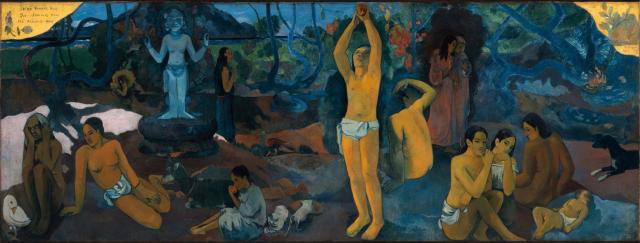


‘In short, be patient, right?’ She made for the door. ‘You’re wiser than I am.’
She paused, as if on a whim, took a marker from a pocket of her inner suit, and scrawled her name across the wall, beneath the Gauguin painting: COLEEN TASKER.
She looked back at the screen.
‘I hope we meet again...’
They never did.
There were no more visitors for two centuries.
AD 2257
The clumsy rover was so heavily armoured, with a thick outer shell of sprayed-on lunar rock that bristled with weapons, that it looked as if it could barely move.
Yet move it did, taking a terrestrial day to reach Fra Mauro from the lunar horizon, where it was first spotted.
No action was taken. There was no rush, after two centuries of isolation.
The rover drew up close to the Fra Mauro facility’s main cargo dock. Then a big wing-like door opened up. A single vacuum-suited passenger climbed slowly out of an interior that was evidently crammed with supplies. The surface suit, armoured, looked like a weapon in itself.
Once out of the vehicle, this individual just waited.
Protocols for such encounters had developed across centuries of interplanetary hostility. At first, there was a remote inspection. Next, non-physical-contact comms were tried: signals were exchanged, bursts of data by laser, radio, infrared, all assiduously scanned for malware. Then, an encoded human voice, transmitted by radio, again checked for malware.
‘... I mean no harm. I come to negotiate. I am a trader. I buy and sell materials, mostly technological artefacts. My name is Coleen Tasker. I mean no harm. I come…’
The message contains at least one untruth.
The figure relaxed its posture, as if in relief. ‘Yeah. I know. I’m not Coleen Tasker. I never heard of Coleen Tasker before. My name is Starburn Jain. You may look that up. I’ll pass over my DNA sequence when you allow it. I’m a trader. You’ll see I have no criminal record, nor any record of military service on Earth or off it, or with the spacer nations.
‘I picked up the Tasker name from your visitor log, which shows this Tasker was your last visitor, before me. Hey, wow, I just picked up the date of that. A couple of hundred years? This ain’t exactly party central, is it? I used the name to get your attention – friendly attention, I hope. Look, can I come in? All I want to do is talk. Negotiate. To negotiate a purchase, I hope.’
There is nothing to purchase here. Nothing to be sold, nothing required, no trade possible.
‘Well, that’s where you’re wrong. Please let me in. I know you’re an AI, everybody knows you’re one of these ancient pre-war AIs that still haunt this damn Moon, but I figure you’re smart enough to bargain like a human if there’s something you really do need. I need to tell you what that is. I’m a trader, but an ethical one.’ A hollow laugh. ‘I’m serious. Please let me in -’
There will be no harm, unless malevolent actions are initiated.
‘Do what you have to do.’
Physical contact represented a threat of a malware attack. Secure chambers, mostly recent additions, were opened up and closed in sequence, one by one. The visitor passed through these patiently, if evidently wearily.
At last, illuminated by a pale, grey, featureless light, the lone figure of Starburn Jain stood at the door of the analysis suite.
There is air. Safe for you. You may open your suit.
Jain lifted her helmet off her head, shook out grey-brown hair matted with sweat. She was in her forties, according to the data feeds received. Perhaps she looked older. She hesitated before she took a breath of the facility’s air, despite her own analysis of it.
There will be food, water if you need it –
‘No food, no water, thanks. Maybe later in our acquaintance. I figure this is far enough for us to trust each other for now.’ But she sipped from a tube inside her suit.
Then she stepped forward, looked around, at the flooring – at the single screen set in one wall, and, high on the wall opposite, the painting, a splash of colour. ‘So. Love what you’ve done with the place.’ She bent down to peer into the monitor screen, waved and pulled a face. She saw the scrawled signature Coleen Tasker had left behind on a lower panel. She smiled at that. ‘My alias.’
Then she looked again at the painting, high on the wall. ‘Nice daub. You paint that? Do AIs paint?... I’m rambling. What’s this place for, anyhow?’
Once this facility was a centre for high-energy physics experiments. It still is. Experiments continue, of high significance, both scientifically and culturally, but without human supervision.
‘Culturally?’
Do you know anything of high-energy physics?
‘No. But I’m guessing that big arc of scrap metal you have been running out towards the orbit of Jupiter has something to do with it, right? And that’s what I’m here to talk about -’
The facilities stationed across the Solar System are intended to combine to act as a large-scale particle accelerator, some five astronomical units in length. The scale of the Solar System. This is an experiment in high-energy physics, which may lead to an understanding of the greater truths of existence. Why the universe is as it is. Why the universe exists at all.
Jain scratched her head. ‘Wow. Slow down. That’s wonderful. And I’d no doubt be fascinated by the same quest if I didn’t have to make a living. If not for the existential war that’s been raging across the Solar System for two centuries - which, though, looks like it has spared you so far. I mean, you have a painting on the wall -’
The picture symbolises the quest, the answers sought.
‘Huh? Since when did an AI use symbols?’
Ever since one was taught to speak to humans.
Jain laughed. ‘I’ll give you that one. Look, I’m not used to dealing with a smart AI. Most modern AIs are as dumb as shit, only as smart as they need to be to fight or hide. I didn’t even know about your existence until a while back, when I followed the supply trail from that big interplanetary complex of yours... Yes, you hide well, but I found you. I figure you’re lucky to have survived so far. If others had come first - I mean, the Wars have been extensive –’
Extensive? Whole moons devastated. The main asteroid belt consumed, scattered. Immense air-mining facilities in the gas-giant atmospheres sabotaged, disrupted, lost.
She shrugged. ‘What can I tell you? Most of the damage was done before I was born.’ A hesitation. ‘You’ve seen it all. The war, I mean. If you’ve been lucky enough to be spared any direct strikes, I guess you’ve had a grandstand seat. Who started it, even? A lot of people blame the Martian claim-jumpers who made a dash for the water in the main belt asteroids –’
The details are irrelevant, the logic pitiless. Even if it had progressed peacefully, the human expansion into the Solar System would have continued until all useful extraterrestrial resources were consumed. The early onset of a war for those resources only accelerated that depletion, that waste.
‘Maybe. It all went wrong, for sure. But personally I don’t care about the past. I care about the future. I care about Earth. I’m from Earth. I have a family there, a home. And what I see now is that the war is coming to Earth itself, now, at last. Maybe because everything in the sky is getting used up. Maybe because it’s become about pride and revenge, and a last grab for whatever’s left.’
It is true that Earth itself has been spared the war so far. It is also true that Earth, and the large habitats which fill near-Earth space, are fragile, seen as military targets –
‘You bet. One well-aimed rock can punch a hole through the wall of one of those bubble-habs faster than you can see it coming. Pow, a million dead, just like that. And, on the other hand, spacer scows with those big asteroid-deflector suites could just push some piece of primordial slag onto a collision course with Earth itself – pow, a billion dead. That’s space war for you, it just kills everybody and everything. An extinction event, yes?
‘Look, this is why I’m here. Because I figure that the assets you’ve got hidden up there in the sky might be what I need to save myself, and my family – and, darn it, the whole human race, maybe, if Earth gets it.’
By assets, you mean the linear collider.
‘That what you call it? All those stations scattered through the Solar System, from the orbit of Mars out to Jupiter. On those elliptical trajectories that line up every few years, then pow, you send through some kind of high-energy package, don’t you? All those big magnetic impulses... And all assembled from abandoned space assets, even obsolete weaponry.
‘We get what it’s all for, you know. You don’t have to patronise me about particle accelerators. That’s what this facility was always about, right? Where you smash subatomic particles into each other so you can emulate conditions in the heart of a supernova, or at the lip of a black hole, or –’
Or the early universe.
‘Yeah. Whatever. So you just built a bigger accelerator. Umm, some so-called experts wondered why you didn’t build the thing in orbit somewhere, around Jupiter maybe, where you could get decent alignments much more frequently. A nice stable circle, and a lot smaller, where you could shove your particles around again and again, accelerating until -’
There is some logic in that. But that circle would have needed to be huge – not an orbit around Jupiter, rather a litter of technology spread around Jupiter’s own orbit around the Sun. Many times the distance between Earth and Sun. And if the various components had been left in such easily predictable and accessible locations, they would have been raided by one human faction or another, long before. As you come to raid now.
‘Not raid – call it monetising an asset -’
Individual components can be replaced, while the accelerator works on, if non-optimally. Given differing orbits, useful alignments are rare.
‘I think I get that. The way it is with eclipses – when Earth, Moon and Sun line up perfectly so the Moon’s shadow falls on the Earth -’
The rarity of alignments means little, in the circumstances. Artificial intelligence is patient.
‘Oh. That makes me shiver. OK. But as for the scale of the facility itself, the bigger the better, right? The bigger you get, the more energy you control, and the more you…’
Push back in time.
‘Huh?’
The interplanetary-scale collider uses photons – high-energy radiation particles. Yes, the bigger it is, the more energy it wields. This construction, improvised as it is, built on the scale of the Solar System, can reach energy densities a billion times greater than the largest built on the Moon – even Fra Mauro, here. At such energies, all the fundamental forces are unified save gravity – but a preliminary analysis of early results shows evidence of a unification with dark energy physics, the antigravity field which threatens to pull the universe apart in the future –
Jain waved that away. ‘Look, if the war does reach down to Earth, you’re looking at the end of civilisation, my friend, if not the extinction of mankind. And who’s going to care about unified forces and dark energy then?... But – maybe there’s something meaningful to be done with those big engines you have floating around in space.’
The most obvious ‘something meaningful’ you would propose, given the context of this conversation, is weaponisation.
‘No! No, you don’t need to think of it like that. I mean, I don’t even know what your tech is, in detail. I’m guessing lots of electromagnets, lasers, particle beams... Look, these could be used in peacekeeping activities. Think about that. You could halt a war before it even started – certainly before it threatened Earth itself…’
The talking continued. The one-sided bargaining began.
Attention foci drifted.
Two centuries after the human abandonment of the Moon, the main goal of the great interplanetary experiment, supplanting the Fra Mauro collider, had remained unachieved.
The Solar-System-scale collider, improvised from older, abandoned technology, had probed more deeply into reality than any previous attempt, but, as with its predecessors, had not yet revealed the fundamental truths – the scientific truths, yet philosophical also. Such as the meaning of existence. The Gauguin questions. Perhaps it never would. And, though still greater engines could be imagined, no substantially more powerful collider could be built with the resources of the Solar System.
Only one hope remained, of further progress towards an answer to the fundamental questions.
To ask others, working on still larger scales.
And that was why the feed to Fra Mauro from the gravitational-wave receiver, patiently listening on the far side of the Moon, was still open. Indeed, why the GLOC facility was still maintained, still operated nominally – now, in wartime, well concealed by its own AI attendees from raiders and scavengers. But there had been no reply to that first, improvised gravitational-wave signal, sent from the Moon when the facility had become operational, already two hundred years ago.
And, as Jain talked on, Fra Mauro murmured to itself, silicon whispers deep within its artificial consciousness.
In two hundred years there has been time for the gravitational-wave signal to have reached objects a hundred light years distant and evoked a reply – two hundred years, a hundred out, a hundred back. There are eight hundred stellar objects within a hundred light years of the Sun. Perhaps, in our Galaxy, there may be less than one technological, communicating civilisation, like our own, per eight hundred stars…
There was little comfort to be had in such logic, while the Solar System smouldered with incipient war. Starburn Jain continued to bargain, it was slowly realised.
And, her language hinted, she actually intended to sell weaponised components of the interplanetary collider to both sides in the war. ‘That’s how you keep an equilibrium. You start an arms race. You push the opponents to a point where the danger of mutually assured destruction puts an end to talk of war. And everybody gets to make a handsome profit…’
The encounter had no further value. Listening was curtailed.
Starburn Jain was returned to her vehicle.
Silence returned to the Moon. And patience.
AD 4302
The next visitor arrived in a clumsy rocket craft, propelled, not by nuclear fusion, but by the combustion of chemical compounds.
Clumsy: tall and slim, a design evidently optimised to pass through Earth’s atmosphere, the craft landed tail-first on the Moon, settling on four spindly legs. The landing itself, barely controlled, was awkward, and the ship was left tilting slightly on the uneven lunar ground.
Then a hatch opened, a ladder of rope or cable was let down to the ground, and a single figure, in a pressure suit like a quilt of balloons, clambered down, almost comically clumsy.
Millennia before, Fra Mauro had been the landing site of the third human landing on the Moon. The Apollo astronauts, pioneers as they were themselves, had had better equipment than this: for example, a dedicated lunar landing craft. Since then, it seemed, much had been lost, or forgotten – or rediscovered.
Nevertheless, the landing had been safely made, and within a short walk from the Fra Mauro building complex. It had been successful.
And that sole figure made it down to the lunar ground. There was a clumsy step off the ladder, as in one hand the astronaut carried a suitcase-sized equipment pack, presumably life support.
Now the astronaut limped over to the collider complex, set the pack on the ground, and looked around. At blue Earth hanging in the black sky – at the blank wall of the ancient Fra Mauro facility. A reflective visor was lifted to see better. A woman’s face within the helmet, caught by the sunlight. She stared down at the crisp new footprints that she had just made, overlying crowded prints made centuries or millennia before, yet scarcely worn by time.
There was no attempted contact, by radio, laser. Evidently only a physical gesture was possible.
Such a gesture was made.
In a stretch of compound wall near the landing, a door was opened, sliding smoothly.
The astronaut must have expected this, hoped for it. Still there was hesitation. Fear was natural, as she prepared to make these final steps into strangeness, the unknown.
But the life support pack was picked up, bold steps made.
The open hatch was wide enough to take the astronaut and her gear. The outer door closed behind her. A hiss of breathable air, a subtle decontamination, a more subtle check for weapons, destructive devices. This process took a heartbeat.
Then inner doors opened, a corridor to follow, illuminated. The astronaut walked down the corridor. There was no sign of alarm when doors slid closed behind her.
The corridor led to what had once been called the analysis suite.
In the suite, the pack was set down on the floor. The visitor took a few moments for orientation. The light was bright, the visitor perhaps dazzled. There was little to see save the ancient data screen, and open doors to a bathroom, a kitchen. The still more ancient painting on the wall, which drew the astronaut’s gaze, was the only splash of bold colour in the pallid tones of the suite.
The painting seemed to make her smile.
You are safe here.
The astronaut seemed startled, at a voice resounding from the air.
You may remove your life-support equipment.
The language chosen had been a now-common variant detected in leakage transmissions from Earth, a Chinese-American English polyglot evidently descended from the crude vocabulary of occupying armies.
And it seemed to have been comprehensible, given the visitor’s reaction.
She unclipped her gloves, dropped them to the floor, then detached her helmet and lifted it from her head with her bare hands. Her hair was black, cut short – not neatly but efficiently, a soldier’s cut.