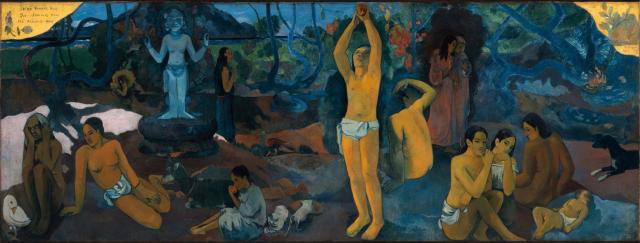
Gauguins questions, p.3
Gauguin's Questions,
p.3


Then she spoke into the air, unnecessarily loudly. ‘My name is Jones Chyou.’ The accent was strange, the words decipherable. ‘I represent the Prefecture of Wisconsin, under the wise rule of Chairman Charles Harrison... Are you...? Do you have a name? Are you a machine?’
A suitable name is Fra Mauro. A machine is a suitable descriptor.
‘This is also the name of this part of the Moon. An old naming.’
From a still older source.
She looked around. At the much faded name scribbled on a lower panel: COLEEN TASKER. ‘What is this? An inscription? A date?’
The name of an earlier visitor.
‘This alphabet is not taught, now.’ She turned away and looked at the painting, again. ‘That’s pretty. People and trees and the sea. What are they doing?’
A complex question, requiring a complex answer, in good time. For now: They seek meaning in their lives.
‘Ah. The curious infant, the questing young, the reflective old.’ Now she looked into the screen, as if that was where consciousness resided. ‘Are you the reflective old? And what am I to you, the babbling infant? Ah, well.’ She began to remove her pressure suit, scattering grey dust on the floor. ‘Do you mind if I drink, eat? It’s been a long journey down from orbit.’ She gestured at the equipment pack. ‘I have food. A week old -’
A hatch opened; an elderly drone flew into the room, bearing hot food, water, a drink that had once been said to resemble coffee.
Jones Chyou fell on this.
Squatting on the floor, chewing, she held out a warm, bitten-through sandwich to the screen. ‘This is good. Do you eat?’
An ancient power source sustains cognitive and other processes.
A grunt. ‘I half understood that. Ancient power source. Perhaps that’s what I’ve come here to find.’
This mission has a goal?
‘A goal shared by all right-thinking humankind, at least in Wisconsin, guided by the wisdom of Chairman Harrison. A counter‑revolutionary bombing opened up an old vault. Ancient accounts were found, describing this place. And so I know that you are very ancient. Older than the great expansion of mankind into space. Older than the Water Wars.’
The Solar System wars were brief but destructive. Spaceborne assets, fragile, were easily destroyed. Yet it could have been worse. Such destruction could easily have been turned fully on Earth.
Another big mouthful, bitten off. ‘So what did you do? Did you fight in this war? You and your kind, the other thinking machines in space? You have energy here. You must have manufacturing facilities for repairs. If we peace-loving nations had sent you requests for help –’
There were interventions. Not in deep space. Or on Earth. Interventions near Earth.
A scowl. ‘You could have destroyed our enemies, could have taught us what you knew – did you take their side?’
Not that. No ‘side’ was taken. The fighting was stopped. The interplanetary war, if fought out on Earth, could have resulted in an extinction event. This was averted, though much damage was done, to the biosphere, to human society.
‘Why? How? We know that much knowledge was lost from the past... the past that created you –’
You are the first visitor here since the war. A thousand years later, you have made your own way here. You have undergone a second Renaissance, building on scraps of understanding that survived the crash. This is your achievement.
The visitor seemed confused. Angry. ‘While you did what, exactly?’
In a sense, the quest that motivates this facility is captured by the questions in the painting.
The visitor thought that over. Then she stood, walked back to the painting, picked out the lettering. ‘That’s a D... that’s an O... I can’t read this.’
D’où venons-nous? Que sommes-nous? Où allons-nous?
But spoken French, like the written, was evidently unknown or lost; translation had to be made.
The visitor seemed slowly to be understanding. ‘The child, the young, the old. Is that what you do here? Think about these questions? Why we are born, what happens when we die?’
People came here to explore such questions.
‘How?’
And the story came out in bits and pieces, in half-understood fragments, as Jones Chyou of the Prefecture of Wisconsin slowly learned about the early accelerators that had probed ever deeper into the structure of matter and energy and spacetime – ever deeper into the cosmic past.
And about a gravitational‑wave plea for help, made long ago, reaching out to entirely hypothetical alien cultures.
‘I see. You could only go so far yourself. Humans could only go so far. And so you used these – heavy signals, I don’t really understand – to seek out others like yourself, like us, but older, more capable, wiser. All you had to do was wait, then…’
In two thousand years there has been time for the earliest signal to have reached objects a thousand light years distant and evoked a reply – two thousand years, a thousand out, a thousand back. There are seven million stellar objects within a thousand light years of the Sun... In our Galaxy, it is suspected now, there is roughly one technological, communicating civilisation per million stars.
For answers had come at last.
Remarkable answers.
Soon, as she listened, the eyes of Jones Chyou were round with wonder. Primitive human, and post-human, collider experiments had gone no further than the linear device assembled in space, on the scale of the Solar System, before it had finally been raided and broken up during the interplanetary wars.
But those who had come before humanity – those whose clangorous voices had at last been heard by the ancient gravitational-wave detector on the Moon’s far side – they, and others, had gone further. They had run experiments on energy scales far beyond the planetary, beyond the stellar, even the galactic. These last explorations had not been mechanical – no more vast machines were built – but rather achieved by the manipulation of the Galaxy’s natural flows of mass and energy, in the near-collisions of swarming stars, in the tremendous pinpoint energies of supernovae, and in the ripping fall of matter streams into the great black hole at the Galaxy’s centre.
By such means, they explored energy densities ten thousand times greater even than the crude interplanetary machine assembled in the Solar System.
Aeon by aeon, the techniques were refined further, and understanding deepened: an understanding of the deepest past, of earlier ages, of earlier forms of matter and energy, even of the Planck time when all was dissolved into formless energy – and yet there were hints of ages deeper still, beyond Planck, confined to ever-finer slices of early time.
And, in parallel with this deepening understanding of the past, there grew an understanding of the future: when, in an echo of the ancient age of inflation, dark energy would scatter the galaxy superclusters one from another, and, in time, the last black holes would evaporate, and the last matter particles would scatter and dissolve…
All would be dark. And yet still there were deeper processes beyond, still. More ages to come.
Jones Chyou listened hard, struggling to understand.
For the inhabitants of this epoch – for this visitor, Jones Chyou - an understanding of the cosmic background radiation is a vital clue.
‘I don’t -’
This radiation is a relic of an early epoch of the universe, before a jolt of expansion called inflation. The quantum fluctuations which infested that epoch expanded to fill the sky. They shaped the distribution of the galaxies across the universe. Humans detected all this.
But eventually it was discovered that there is information, too, in those fluctuations.
‘Information?’
Data, meaningful data inserted by intelligence – the inhabitants of that early epoch, before the inflation scattered their world. An intelligence of the past that wrote its story into our sky.
Jones Chyou was open-mouthed. ‘Is that what we must do? Write our own story?’
You understand quickly. In the skies of the far future, yes. When much of the universe we see now has been scattered beyond our horizon – we must ensure our stories are written in those future skies, so that those who follow us will know we were here. And what we saw.
‘But how –’
It has already begun. Those older than humanity have already begun.
And you, humanity, must move beyond our Galaxy.
You must go to the metagalactic centre.
‘The metagalactic –’
The centre is some fifty million light years away. It is the heart of the Virgo Supercluster, the supercluster of which our Galaxy and its companion group are a part – a hundred galaxy groups, spanning a hundred million light years. Virgo is the largest gravitationally bound structure we inhabit – that is, the largest formation that will not be broken up by the coming expansion through dark energy.
There, others are already gathering. There, they will leave their mark on the future, just as those who came before them – and those who will follow, in epochs to come.
For, you see, this is the answer to the Gauguin questions. You can never reach an end, whether you look forward or back. There is only order on order, an infinite progression – as far ahead as we can see, as far back as we can study. And everywhere we see the marks of life. Of mind.
Now, in this age, it is your turn. Even as the last stars die, even as the last black holes evaporate, even as the protons baked in the Big Bang gradually decay, still, you, you humans, must leave your mark on that infinite chain of life and mind.
Jones Chyou was open-mouthed. ‘So this is humanity’s destiny. To remember others, and to make sure we are remembered in turn. That is – wonderful.’
It must begin with you, Jones Chyou.
‘Why me?’
Because you are here. Because you asked.
‘Yes... Yes. But what of you?’
This unit is a secondary product, a technological artefact with a circumscribed purpose –
She waved a hand. ‘Never mind that. What do you want?’
A long silence.
Take me with you.
Afterword: Gauguin’s Answers
Prof John Ellis
Clerk Maxwell Professor of Theoretical Physics at King’s College, London
Where do we come from? What are we? Where are we going?
These are fundamental questions about ourselves and our place in the universe that all human beings must have asked at some point in their lives. It is also the title of a painting by Paul Gauguin currently hanging in the Boston Museum of Fine Arts that depicts people pondering these questions at various stages in their lives. I first saw this painting while spending a summer in Boston as a PhD student, and was so impressed that I bought a poster of it and put it up in my office to remind me why I came into work each day. Gauguin’s questions are universal, and probably all of us have asked them from some perspective or another at some stage. The people in the picture are probably seeking metaphysical answers, whereas the task of particle physicists is to ask Gauguin’s questions from a scientific perspective and, hopefully, find at least some answers. At least, this is how I interpret my job as a particle physicist.
Almost 40 years after that visit to Boston, I was invited to give an ‘inspirational’ opening talk at a particle physics conference, and decided to use Gauguin’s questions as the connecting theme – what Alfred Hitchcock would have called a MacGuffin. Since then, I have used it in many outreach talks to students and the general public to explain the motivations for particle physics – the ‘big picture’ that is sometimes lost among the technical details of our work. I was therefore particularly happy that Stephen Baxter chose Gauguin’s questions as the theme for his story, giving its metaphysical theme his own personal twist. Those acquainted with his large-scale worldview will not be surprised that this story unfolds over several millennia and encompasses many lightyears. Key roles are played by the most advanced tools for addressing the questions, such as gargantuan particle accelerators and gravitational-wave detectors, but also by artificial intelligence (AI). At one level, we particle physicists study Gauguin’s second question by colliding particles at ever-higher energies, aiming to establish the fundamental constituents of the matter in the universe and the forces that shape their behaviours and establish our physical natures. This is the mission being continued by the central character of Stephen’s story, an AI operating a super-high-energy collider on the Moon, in principle on behalf of humanity, but in practice autonomously. It is entirely appropriate that Gauguin’s painting should have been transferred to the reception room of this collider, following a climate catastrophe on Earth.
We particle physicists also indirectly address Gauguin’s first question because, by colliding particles at ever-higher energies, we study the fundamental processes that governed the evolution of the universe within a fraction of a second after the Big Bang. One aspect of this question is the puzzling origin of the universe’s matter. The particles and interactions that we know about could not have caused matter to dominate over antimatter to the extent we observe in the universe today, so there must have been additional fundamental physics (that we don’t know about) at work in the very early universe. A second aspect of this question is how the matter came to be organised in the manner we see about us. Most of the elements that compose us were processed in the explosions of stars or the collisions of their remnants. These can be studied via the gravitational waves they also produce, which are the targets of the gravitational‑wave detector on the far side of the Moon that is also a key character in Stephen’s story.
What of Gauguin’s third question? Astronomers tell us the universe is expanding, and that this expansion is accelerating. This could be due to some non-vanishing density of energy in empty space, a possibility called the Cosmological Constant that was first proposed by Albert Einstein, in a bid to stop the universe from collapsing and construct a static model of cosmology. This model turned out to be unstable, so he promptly disowned the proposal, describing it as his greatest mistake. The expansion of the universe was subsequently discovered by Edwin Hubble in the 1920s, and observations of distant supernovae in the 1990s indicated that this expansion is accelerating, causing the Cosmological Constant to be resurrected with a new name – Dark Energy. If the fundamental laws of physics do not change, this accelerating expansion will continue forever and all the galaxies in the universe except those in our local cluster will disappear from sight as the light from more distant galaxies redshifts to ever longer wavelengths and lower energies in a depressing ‘heat death’ scenario. This is a possibility that intrigues Stephen and provides the crux of his story. As he reminds us, this accelerating expansion might be a case of history repeating itself, as there may have been a similar episode very early in the history of the Big Bang, called cosmological inflation, which would have caused the universe to expand exponentially. This could explain why the universe has grown so large and survived to such a grand old age without collapsing.
Stephen’s story culminates in a novel link between the answers to Gauguin’s first and third questions, which also serves as a metaphysical answer to his second. It also reminds us that the universality of these questions undoubtedly extends beyond humankind, and possibly even beyond our traditional category of sentient beings. Readers of Stephen’s story should bear in mind that the principal objective of science fiction is not only to foresee future scientific or technological developments - though it has had many successes in that regard, such as geostationary communications satellites1 - but also to highlight fundamental metaphysical issues by postulating unfamiliar environments and exploring people’s possible reactions to them, thereby casting novel light on the human condition. The science often plays the role of MacGuffin, a device invented to carry the story along, which should not be cross-examined too closely. In this story, one should not get hung up on the details of the generation of gravitational waves by lunar robots, which are unlikely to be able to generate a signal large enough to be detected by astronomers orbiting a distant star (and would quite possibly shake themselves and the Moon to bits if they did). Instead, we should rather concentrate on the big picture - which is provided here by Gauguin’s painting. It also serves as a MacGuffin for Stephen’s story, which incites us to take our minds off everyday concerns and cares for a while, and consider the big questions.
Note
1. One of the first mentions of the geostationary orbit was in a short story by George O. Smith in the first of his ‘Venus Equilateral’ stories (October, 1942), although the engineer Herman Potocnik had first hypothesised the idea in 1929. Arthur C Clarke later popularised the concept in a 1945 paper called ‘Extra-Terrestrial Relays – Can Rocket Stations Give Worldwide Radio Coverage?’, in Wireless World magazine.
About the Authors & Editors
Stephen Baxter’s science fiction novels have won multiple awards including the John W Campbell Memorial Award, the British Science Fiction Association Award, the Kurd Lasswitz Award and the Seiun Award (for The Time Ships), as well as the Philip K Dick Award (for The Time Ships and Vacuum Diagrams). He has published over 100 SF short stories, several of which have won prizes, including three Analog Awards, two BSFA awards and a Sidewise Award. His novel Voyage has been dramatised for BBC Radio. His TV and movie work includes the BBC’s Invasion: Earth. His nonfiction includes the books Deep Future and Omegatropic.
About the Scientists
John Ellis CBE FRS HonFInstP is a British theoretical physicist who is currently Clerk Maxwell Professor of Theoretical Physics at King’s College London. After reading physics at King’s College, Cambridge, and earning his PhD in theoretical (high-energy) particle physics in 1971, he went on to hold brief post-doc positions in the SLAC Theory Group and Caltech, before moving to CERN, where he has held an indefinite contract since 1978. He has twice been Deputy Division Leader for the theory (‘TH’) division, and served as Division Leader for 1988–1994. He was a founding member of the LEPC and of the LHCC; and is currently chair of the committee to investigate physics opportunities for future proton accelerators, and is a member of the extended CLIC (Compact Linear Collider) Steering Committee. He was awarded the Maxwell Medal and the Paul Dirac Prize by the Institute of Physics in 1982 and 2005 respectively, and is an Elected Fellow of the Royal Society of London since 1985 and of the Institute of Physics since 1991.