The year0 edition, p.1
The Year's Best Science Fiction and Fantasy, 2010 Edition,
p.1
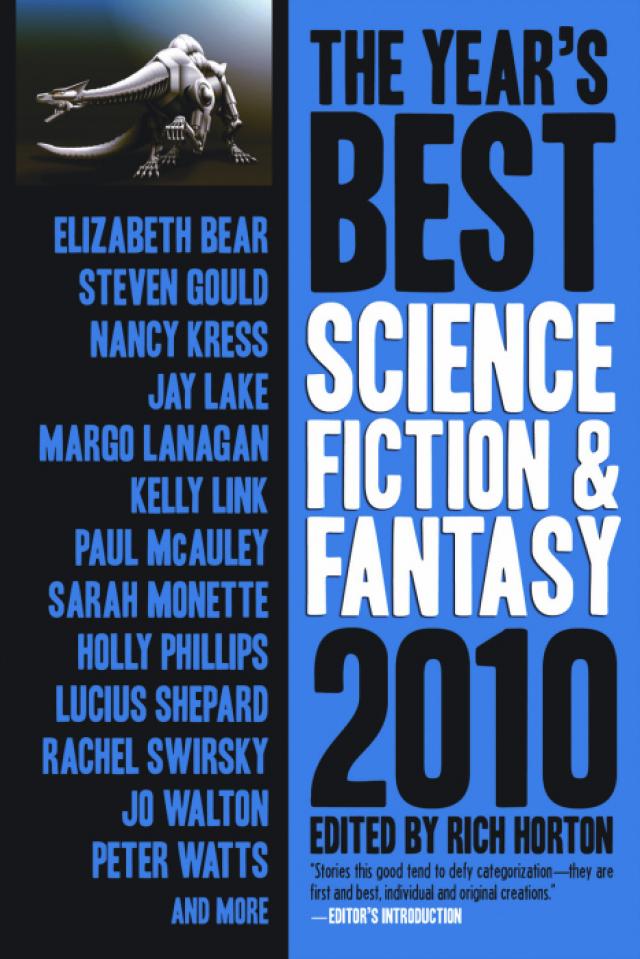


THE YEAR’S BEST SCIENCE FICTION
AND FANTASY, 2010 EDITION
Edited by
RICH HORTON
For my children, Melissa and Geoffrey
Copyright © 2010 by Rich Horton
Cover art by PAT SM / Fotolia.
Cover design by Stephen H. Segal.
Ebook design by Neil Clarke.
All stories are copyrighted to their respective authors, and used here with their permission.
ISBN: 978-1-60701-246-7 (ebook)
ISBN: 978-1-60701-218-4 (trade paperback)
Prime Books
www.prime-books.com
No portion of this book may be reproduced by any means, mechanical, electronic, or otherwise, without first obtaining the permission of the copyright holder.
For more information, contact Prime Books.
TABLE OF CONTENTS
INTRODUCTION, Rich Horton
A STORY, WITH BEANS, Steve Gould
CHILD-EMPRESS OF MARS, Theodora Goss
THE ISLAND, Peter Watts
THE LOGIC OF THE WORLD, Robert Kelly
THE LONG, COLD GOODBYE, Holly Phillips
THE ENDANGERED CAMP, Ann Leckie
DRAGON’S TEETH, Alex Irvine
AS WOMEN FIGHT, Sara Genge
SYLGARMO’S PROCLAMATION, Lucius Shepard
THREE TWILIGHT TALES, Jo Walton
NECROFLUX DAY, John Meaney
THE PERSISTENCE OF MEMORY; OR, THIS SPACE FOR SALE, Paul Park
THIS PEACEABLE LAND; OR, THE UNBEARABLE VISION OF HARRIET BEECHER STOWE, Robert Charles Wilson
ON THE HUMAN PLAN, Jay Lake
TECHNICOLOR, John Langan
CATALOG, Eugene Mirabelli
CRIMES AND GLORY, Paul McAuley
EROS, PHILIA, AGAPE, Rachel Swirsky
A PAINTER, A SHEEP, AND A BOA CONSTRICTOR, Nir Yaniv
GLISTER, Dominic Green
THE QUALIA ENGINE, Damien Broderick
THE RADIANT CAR THY SPARROWS DREW, Catherynne M. Valente
WIFE-STEALING TIME, R. Garcia y Robertson
IMAGES OF ANNA, Nancy Kress
MONGOOSE, Sarah Monette & Elizabeth Bear
LIVING CURIOUSITIES, Margo Lanagan
THE DEATH OF SUGAR DADDY, Toiya Kristen Finley
SECRET IDENTITY, Kelly Link
BESPOKE, Genevieve Valentine
EVENTS PRECEDING THE HELVETICAN RENAISSANCE, John Kessel
BIOGRAPHIES
RECOMMENDED READING
PUBLICATION HISTORY
THE YEAR IN FANTASY AND SCIENCE FICTION, 2009
RICH HORTON
In looking over the stories I chose for this year’s anthology, I noticed one possible trend. Last year about 30% of the stories were from original anthologies. This year the total is about 47%, and it could have been higher—I came very close indeed to including Maureen McHugh’s “Useless Things” (from Eclipse Three), and Andy Duncan’s “The Dragaman’s Bride” (from The Dragon Book). Does this reflect a change in the market?
Perhaps it does. In recent years, certainly, we have been gifted with a new flowering of unthemed original anthology series: George Mann’s Solaris Books of New Science Fiction, Lou Anders’s Fast Forward, Jonathan Strahan’s Eclipse, and Ellen Datlow’s Del Rey Book of Science Fiction and Fantasy (this last not yet strictly speaking a series, mind you). On the other hand, the only one of those series certain to have more entries is Eclipse. But themed anthologies continue to be very common. Thick books from major publishers seem to be successful, as with The Dragon Book (edited by Jack Dann and Gardner Dozois), The New Space Opera 2 (edited by Dozois and Strahan), and Ellen Datlow’s two fine anthologies inspired by eminent American horror writers: Poe and Lovecraft Unbound. Slimmer books from small press outfits are also thick on the ground, as with the impressive six books from Norilana this year (the best probably being Mike Allen’s Clockwork Phoenix 2, from which I chose Ann Leckie’s “The Endangered Camp” for this volume). DAW once again published an original anthology each month in 2009, and Other Earths, edited by Nick Gevers and Jay Lake, was one of the best anthologies of the year. And we should not forget the young adult market: I found excellent stories in both Geektastic (edited by Holly Black and Cecil Castellucci) and Sideshow (edited by Deborah Noyes).
If anthologies are (ambiguously) flourishing, how are the magazines doing? Not so well, alas. The operative word for the major magazines the past few years has been stagnation, at least in terms of circulation. And this year the news was if anything worse. One magazine (Realms of Fantasy) died, only to be resurrected by a new publisher after only one missed issue. Another (The Magazine of Fantasy and Science Fiction) switched to bimonthly publication (with thicker issues). The smaller zines remained volatile—we lost such often interesting publications as Fictitious Force and Paradox, while the beautiful little zine Zahir will migrate to the Web in 2010. Still, the best place to look for the best new sf and fantasy remains the top magazines: Asimov’s, F&SF, Analog, Realms of Fantasy, and Interzone. But the smaller zines are not to be missed—they publish much less frequently than the major magazines, and they tend to publish shorter work, but their best stuff is outstanding, as I hope the stories in this book from places like Electric Velocipede, Shimmer, and the once magazine now anthology Postscripts will demonstrate.
The third leg in the regular source of short fiction is online magazines. (Mind you those three legs don’t exhaust places to find new science fiction: for example some appear as original stories in story collections, or as chapbooks, or in non-genre magazines—this last example represented in this book by Robert Kelly’s “The Logic of the World,” from Conjunctions.) There is no doubt that the web (and other online sources) are now essential for any reader in the genre. But even as online fiction has grown in importance, its business models are still a work in progress. Perhaps the most promising subscription-model webzine, Jim Baen’s Universe, has announced it will close after the April 2010 issue. And the always interesting site Lone Star Stories closed in 2009. But other webzines continue strong. Strange Horizons has been around for a very long time now in web years, operating on a model based on volunteer editorial work and voluntary reader contributions—and they are better than ever these days. The much newer Clarkesworld had a very impressive 2009. A couple of former print magazines have established excellent online presences: Subterranean Magazine, and Fantasy Magazine. Fantasy is even gaining an sf companion in 2010, Lightspeed, to be edited by John Joseph Adams. And Tor.com, in its second year, has consistently published truly excellent sf and fantasy. (And unlike most online sites, Tor.com routinely features longer stories.)
So much for the industry news. What of the content? I thought to try to organize the stories here by subcategories. Maybe this would throw some light on the concerns occupying writers in 2009. One problem is of course that stories fit into multiple categories. And some are hard to place at all.
Perhaps the most obvious recent “fad” in sf and fantasy is steampunk—unusual perhaps in that it truly straddles the sf and fantasy genres. This subgenre can be traced at least to the mid-70s and such writers as K. W. Jeter and James P. Blaylock, and arguably earlier to things like M. John Harrison’s Viriconium stories, and even the TV series Wild Wild West. It’s never gone away, but in the past couple of years its popularity has shot up like a Verne spaceship from a cannon. But I don’t think any of the stories I’ve chosen this year are pure quill steampunk, though the influence of that sensibility is clear on stories like Catherynne M. Valente’s “The Radiant Car Thy Sparrows Drew,” Robert Charles Wilson’s “This Peaceable Land; or, The Unbearable Vision of Harriet Beecher Stowe,” and John Meaney’s “Necroflux Day.” But all these stories fit elsewhere in the tentative categories I suggest below.
One simple category is near-future sf. This is usually Earth-bound, and focuses on plausible technological developments and the social and personal effects of these. Oddly, I think, only three of these stories fit this category—Steven Gould’s “A Story, with Beans,” Rachel Swirsky’s “Eros, Philia, Agape,” and Damien Broderick’s “The Qualia Engine.” And these stories are strikingly different to each other.
By contrast, quite a few stories are set in the relatively far future, generally off Earth, or if on Earth, in the context of a future in which many people live or lived off Earth. These are “The Island,” by Peter Watts; “Events Preceding the Helvetican Renaissance,” by John Kessel; “Glister,” by Dominic Green; “On the Human Plan,” by Jay Lake; “A Painter, a Sheep, and a Boa Constrictor,” by Nir Yaniv; “Wife-Stealing Time,” by R. Garcia y Robertson; “As Women Fight,” by Sara Genge; “Mongoose,” by Sarah Monette and Elizabeth Bear; and “Crimes and Glory,” by Paul McAuley. Several of these are some flavor of space opera or planetary adventure. Most notable to me, considering these stories as a unit, is the way so many of them are consciously toying with the tropes of sf—Kessel is playing with space opera clichés (but rather having his cake and eating it too, as the story remains an delightful adventure), while Garcia y Robertson has fun fooling around with Edgar Rice Burroughs’ models, and Monette and Bear evoke Lovecraft, Carroll, and Kipling. Genge is the outlier here—her story is a fascinating look at gende
r in a people who can choose theirs. Lake and Watts, in very different ways, look at the very far future.
An sf category that has seemed to be undergoing a bit of a rebirth lately is time travel, and I saw several good time travel stories this year, but only one made this book: Genevieve Valentine’s “Bespoke,” which takes a different angle on the subject, dealing with people who outfit time travelers appropriately.
And of course alternate history continues fairly popular. But only one of the three in this book is very traditional: Robert Charles Wilson’s “This Peaceable Land; or, The Unbearable Vision of Harriett Beecher Stowe.” Far stranger is “The Radiant Car Thy Sparrows Drew,” by Catherynne M. Valente, with its steampunk vibes in a 1986 setting. And Ann Leckie’s “The Endangered Camp” looks much farther back: to the dinosaurs. (And perhaps its “history” isn’t meant to be “alternate.”)
I called four stories “science fantasy,” a nod to settings which combine purely fantastic notions with at least some nod to a far future or offworld setting, or with a technological grounding: Theodora Goss’s “Child-Empress of Mars,” Lucius Shepard’s Vance hommage, “Sylgarmo’s Proclamation,” Holly Phillips’s “The Long, Cold Goodbye,” and John Meaney’s “Necroflux Day.”
The more clearly fantastical stories are often very hard to classify as well. What is Eugene Mirabelli’s “Catalog”? Portal fantasy, maybe? Or Paul Park’s “The Persistence of Memory; or This Space for Sale”? Metafiction, at one level. One fantasy, “The Logic of the World,” by Robert Kelly, is perhaps fairly standard historical fantasy (set in what seems the Middle Ages of our world, with dragons), but is hardly ordinary within that template. Also not very ordinary is Jo Walton’s “Three Twilight Tales,” set in an unspecified world, with hints of metafiction and hints of fable. There is one fairly clear secondary world fantasy, “Dragon’s Teeth,” by Alex Irvine.
And finally what may be the dominant mode in fantasy these days: fantasies set in our world in more or less the present. (Some of these might be called “urban fantasies,” but not all.) Paul Park’s story, already mentioned, might qualify, and also Kelly Link’s “Secret Identity” (but with superheroes!), Margo Lanagan’s “Living Curiousities,” Toiya Kristen Finley’s “The Death of Sugar Daddy,” John Langan’s horror-tinged and Poe-derived “Technicolor,” and Nancy Kress’s “Images of Anna.”
What to make of all this in summary? Does it mean much that so many of the fantasies I chose are set in the fairly familiar present day, but so many of the sf stories are set on other worlds and far in the future? Perhaps it’s only selection bias. Noticeable at any rate is that no matter how we choose to categorize them, stories this good tend to defy categorization—they are first and best their ownselves, individual and original creations.
A STORY, WITH BEANS
STEVEN GOULD
Kimball crouched in the shade of the mesquite trees, which, because of the spring, were trees instead of their usual ground-hugging scrub. He was answering a question asked by one of the sunburned tourists, who was sprawled by the water, leaning against his expensive carbon-framed backpack.
“It takes about a foot of dirt,” Kimball said. “I mean, if there isn’t anything electrical going on. Then you’ll need more, depending on the current levels and the strength of the EMF. You may need to be underground a good ten feet otherwise.
“But it’s a foot, minimum. Once saw a noob find a silver dollar that he’d dug up at one of the old truck stops west of Albuquerque. ‘Throw it away!’ we yelled at him. Why did he think they replaced his fillings before he entered the territory? But he said it was a rare coin and worth a fortune. The idiot swallowed it.
“We could have buried him. Kept his face clear but put a good foot of dirt over him. That could’ve worked, but there were bugs right there, eating those massive hydraulic cylinders buried in the concrete floor of the maintenance bays, the ones that drove the lifts.
“We scattered. He ran, too, but they were all around and they rose up like bees and then he stepped on one and it was all over. They went for the coin like it was a chewy caramel center.”
There were three college-aged tourists—two men and a girl—a pair of Pueblo khaki-dressed mounted territorial rangers that Kimball knew, and Mendez, the spring keeper. There was also a camel caravan camped below the spring, where the livestock were allowed to drink from the runoff, but the drovers, after filling their water bags, stayed close to their camels.
There were predators out here, both animal and human.
“What happened to the noob?” the tourist asked.
“He swallowed the coin. It was in his abdomen.”
“What do you mean?”
“Christ, Robert,” the girl said. “Didn’t you listen to the entrance briefing? He died. The bugs would just go right through him, to the metal. There aren’t any trauma centers out here, you know?”
One of the rangers, silent until now, said, “That’s right, miss.” He slid the sleeve of his khaki shirt up displaying a scarred furrow across the top of his forearm. “Bug did this. Was helping to dig a new kiva at Pojoaque and didn’t see I’d uncovered the base of an old metal fencepost. Not until the pain hit. There weren’t many bugs around, but they came buzzing after that first one tasted steel and broadcast the call. I was able to roll away, under the incoming ones.”
“Why are you visiting the zone?” asked Mendez, the spring keeper. He sat apart, keeping an eye on the tourists. The woman had asked about bathing earlier and the rangers explained that you could get a bath in town and there was sometimes water in the Rio Puerco, but you didn’t swim in the only drinking water between Red Cliff and the Territorial Capitol.
“You can bathe without soap in the runoff, down the hill above where the cattle drink. Wouldn’t do it below,” Mendez had elaborated. “You can carry a bit of water off into the brush if you want to soap ‘n’ rinse.”
Kimball thought Mendez was still sitting there just in case she did decide to bathe. Strictly as a public service, no doubt, keeping a wary eye out for, uh, tan lines.
The woman tourist said, “We’re here for Cultural Anthropology 305. Field study. We meet our prof at his camp on the Rio Puerco.”
“Ah,” said Kimball, “Matt Peabody.”
“Oh. You know him?”
“Sure. His camp is just downstream from the Duncan ford. He likes to interview the people who pass through.”
“Right. He’s published some fascinating papers on the distribution of micro-cultures here in the zone.”
“Micro-cultures. Huh,” said Kimball. “Give me an example.”
“Oh, some of the religious or political groups who form small communities out here. Do you know what I mean?”
“I do.” Kimball, his face still, exchanged a glance with the two rangers.
As the woman showed no sign of imminent hygiene, Mendez climbed to his feet, groaning, and returned to his one room adobe-faced dugout, up the hill.
The woman student became more enthusiastic. “I think it’s so cool how the zone has ended up being this great nursery for widely diverse ways of life! I’m so excited to be able to see it.”
Kimball stood up abruptly and, taking a shallow basket off of his cart, walked downstream where the cattle watered. He filled the basket with dried dung: some camel, horse, and a bit of cow. He didn’t walk back until his breathing had calmed and his face was still. When he returned to the spring, one of the rangers had a pile of dried grass and pine needles ready in the communal fire pit and the other one was skinning a long, thin desert hare.
Kimball had a crock of beans that’d been soaking in water since he’d left Red Cliff that morning. Getting it out of the cart, he added more water, a chunk of salt pork, pepper, and fresh rosemary, then wedged it in the fire with the lid, weighted down by a handy rock.
“What do you do, out here?” the woman tourist asked him. Kimball smiled lazily and, despite her earlier words, thought about offering her some beans.
“Bit of this, bit of that. Right now, I sell things.”
“A peddler? Shouldn’t you be in school?”
Kimball decided he wasn’t going to offer her any of his beans after all. He shrugged. “I’ve done the required.” In fact, he had his GED, but he didn’t advertise that. “It’s different out here.”