

The amazing maurice and.., p.2
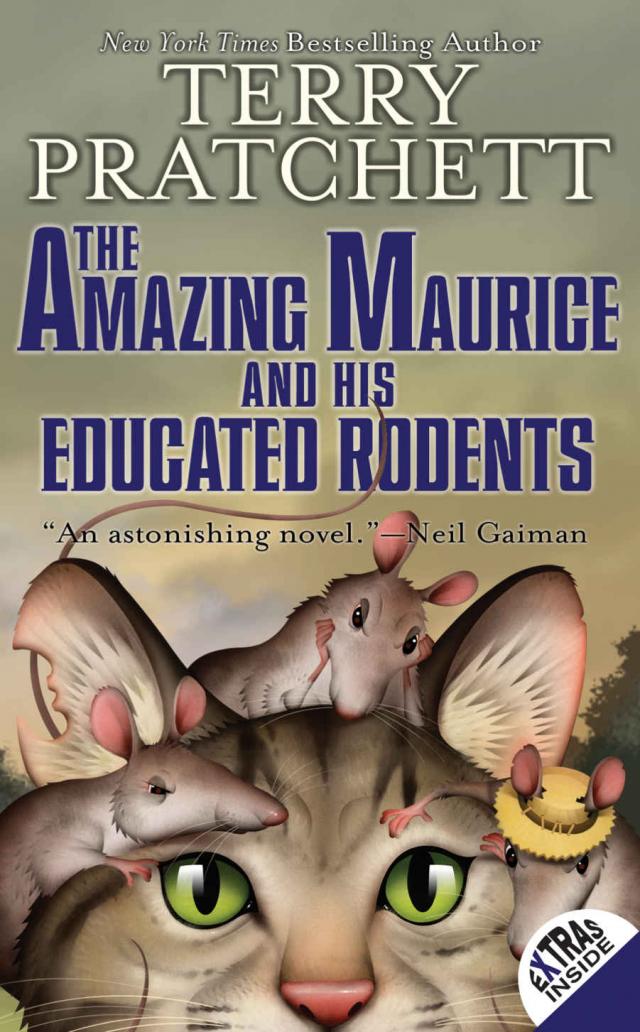
The Amazing Maurice and His Educated Rodents (Discworld Book 28),
p.2


Dangerous Beans wasn’t the head rat. That was Hamnpork’s job. Hamnpork was big and fierce and a bit scabby, and he didn’t much like having a newfangled brain and he certainly didn’t like talking to a cat. He’d been quite old when the rats had Changed, as they called it, and he said he was too old to Change. He left talking to Maurice to Dangerous Beans, who’d been born just after the Change. And that little rat was clever. Incredibly clever. Too clever. Maurice needed all his tricks when he was dealing with Dangerous Beans.
“It’s amazing, the stuff I know,” said Maurice, blinking slowly at him. “Anyway, it’s a nice-looking town. Looks rich to me. Now, what we’ll do is—”
“Ahem . . .”
Maurice hated that sound. If there was a sound worse than Dangerous Beans asking one of his odd little questions, it was Peaches clearing her throat. It meant she was going to say something, very quietly, that was going to upset him.
“Yes?” he said sharply.
“Do we really need to keep on doing this?” she said.
“Well, of course, no,” said Maurice. “I don’t have to be here at all. I’m a cat, right? A cat with my talents? Hah! I could’ve got myself a really cushy job with a conjurer. Or a ventriloskwist, maybe. There’s no end to the things I could be doing, right, ’cos people like cats. But owing to being incredibly, you know, stupid and kindhearted, I decided to help a bunch of rodents who are, and let’s be frank here, not exactly number-one favorites with humans. Now some of you”—and here he cast a yellow eye toward Dangerous Beans—“have some idea of going to some island somewhere and starting up a kind of rat civilization of your very own, which I think is very, you know, admirable, but for that you need . . . what did I tell you that you need?”
“Money, Maurice,” said Dangerous Beans, “but—”
“Money. That’s right, ’cos what can you get with money?” He looked around at the rats. “Begins with a B,” he prompted.
“Boats, Maurice, but—”
“And then there’s all the tools you’ll need, and food, of course—”
“There’s coconuts,” said the stupid-looking kid, who was polishing his flute.
“Oh, did someone speak?” said Maurice. “What do you know about it, kid?”
“You get coconuts,” said the kid. “On desert islands. A man selling them told me.”
“How?” said Maurice. He wasn’t too sure about coconuts.
“I don’t know. You just get them.”
“Oh, I suppose they just grow on trees, do they?” said Maurice sarcastically. “Sheesh, I just don’t know what you lot would do without . . . anyone?” He glared at the group. “Begins with an M.”
“You, Maurice,” said Dangerous Beans. “But, you see, what we think is, really—”
“Yes?” said Maurice.
“Ahem,” said Peaches. Maurice groaned.
“What Dangerous Beans means,” said the female rat, “is that all this stealing grains and cheese and gnawing holes in walls is, well”—she looked up into Maurice’s yellow eyes—“is not morally right.”
“But it’s what rats do!” said Maurice.
“But we feel we shouldn’t,” said Dangerous Beans. “We should be making our own way in the world!”
“Oh dear oh dear oh dear,” said Maurice, shaking his head. “Ho for the island, eh? The Kingdom of the Rats! Not that I’m laughing at your dream,” he added hastily. “Everyone needs their little dreams.” Maurice truly believed that, too. If you knew what it was that people really, really wanted, you very nearly controlled them.
Sometimes he wondered what the stupid-looking kid really, really wanted. Nothing, as far as Maurice could tell, but to be allowed to play his music and be left alone. But . . . well, it was like that thing with the coconuts. Every so often the kid would come out with something that suggested he’d been listening all along. People like that are hard to steer.
But cats are good at steering people. A miaow here, a purr there, a little gentle pressure with a claw . . . and Maurice had never had to think about it before. Cats didn’t have to think. They just had to know what they wanted. Humans had to do the thinking. That’s what they were for.
Maurice thought about the good old days before his brain had started whizzing like a firework. He’d turn up at the door of the university kitchens and look sweet, and then the cooks would try to work out what he wanted. It was amazing! They’d say things like “Does oo want a bowl of milk, den? Does oo want a biscuit? Does oo want dese nice scraps, den?” And all Maurice would have to do was wait patiently until they got to a sound he recognized, like “turkey legs” or “minced lamb.”
But he was sure he’d never eaten anything magical. There was no such thing as enchanted chicken giblets, was there?
It was the rats who’d eaten the magical stuff. The dump they called “home” and also called “lunch” was round the back of the university, and it was a university for wizards, after all. The old Maurice hadn’t paid much attention to people who weren’t holding bowls, but he was aware that the big men in pointy hats made strange things happen.
And now he knew what happened to the stuff they used, too. It got tossed over the wall when they’d finished with it. All the old worn-out spell books and the stubs of dribbly candles and the remains of the green bubbly stuff in the cauldrons all ended up on the big dump, along with the tin cans and old boxes and the kitchen waste. Oh, the wizards had put up signs saying DANGEROUS and TOXIC, but the rats hadn’t been able to read in those days, and they liked dribbly candle ends.
Maurice had never eaten anything off the dump. A good motto in life, he’d reckoned, was: Don’t eat anything that glows.
But he’d become intelligent, too, at about the same time as the rats. It was a mystery.
Since then he’d done what cats always did. He steered people. Now some of the rats counted as people too, of course. But people were people, even if they had four legs and had called themselves names like Dangerous Beans, which is the kind of name you gave yourself if you learned to read before you understood what all the words actually meant, and reading the warning notices and the labels on the old rusty cans gave you names you liked the sound of.
The trouble with thinking was that, once you started, you went on doing it. And as far as Maurice was concerned, the rats were thinking a good deal too much. It was Peaches who was the worst. Maurice’s usual trick of just talking fast until people got confused didn’t work on her at all.
“Ahem,” she began. “We think that this should be the last time.”
Maurice stared. The other rats backed away slightly, but Peaches just stared back.
“This must be the very last time we do the silly ‘plague of rats’ trick,” said Peaches. “And that’s final.”
“And what does Hamnpork think about this?” said Maurice. He turned to the head rat, who had been watching them. It was always a good idea appealing to Hamnpork when Peaches was giving trouble, because he didn’t like her very much.
“What d’you mean, think?” said Hamnpork.
“I . . . sir,* I think we should stop doing this trick,” said Peaches, dipping her head nervously.
“Oh, you think too, do you?” said Hamnpork. “Everyone’s thinking these days. I think there’s a good deal too much of this thinking, that’s what I think. We never thought about thinking when I was a lad. We’d never get anything done if we thought first.”
He gave Maurice a glare too. Hamnpork didn’t like Maurice. He didn’t like most things that had happened since the Change. In fact, Maurice wondered how long Hamnpork was going to last as leader. He didn’t like thinking. He belonged to the days when a rat leader just had to be big and mean. The world was moving far too fast for him now, which made him angry.
He wasn’t so much leading now as being pushed.
“I . . . Dangerous Beans, sir, believes that we should be thinking of settling down, sir,” said Peaches.
Maurice scowled. Hamnpork wouldn’t listen to Peaches, and she knew it, but Dangerous Beans was the nearest thing the rats had to a wizard, and even big rats listened to him.
“I thought we were going to get on a boat and find an island somewhere,” said Hamnpork. “Very ratty places, boats,” he added approvingly. Then he went on, with a slightly nervous and slightly annoyed look at Dangerous Beans: “And people tell me that we need this money stuff because, now that we can do all this thinking, we’ve got to be eff . . . efit . . .”
“Ethical, sir,” said Dangerous Beans.
“Which sounds unratty to me. Not that my opinion counts for anything, it seems,” said Hamnpork.
“We’ve got enough money, sir,” said Peaches. “We’ve already got a lot of money. We have got a lot of money, haven’t we, Maurice.” It wasn’t a question; it was a kind of accusation.
“Well, when you say a lot—” Maurice began.
“And in fact we’ve got more money than we thought,” said Peaches, still in the same tone of voice. It was very polite, but it just kept going and it asked all the wrong questions. A wrong question for Maurice was one that he didn’t want anyone to ask.
Peaches gave her little cough again. “The reason I say we’ve got more money, Maurice, is that you said what were called ‘gold coins’ were shiny like the moon and ‘silver coins’ were shiny like the sun, and you’d keep all the silver coins. In fact, Maurice, that’s the wrong way around. It’s the silver coins that are shiny like the moon.”
Maurice thought a rude word in cat language, which has a great many of them. What was the point of education, he thought, if people went out afterward and used it?
“So we think, sir,” said Dangerous Beans to Hamnpork, “that after this one last time, we should share out the money and go our separate ways. Besides, it’s getting dangerous to keep repeating the same trick. We should stop before it’s too late. There’s a river here. We should be able to get to the sea.”
“An island with no humans or krllrrt cats would be a good place,” said Hamnpork. Maurice didn’t let his smile fade, even though he knew what krllrrt meant.
“And we wouldn’t want to keep Maurice from his wonderful new job with the conjurer,” said Peaches. Maurice’s eyes narrowed. For a moment he came close to breaking his iron rule of not eating anyone who could talk.
“What about you, kid?” he said, looking up at the stupid-looking kid.
“I don’t mind,” said the kid.
“Don’t mind what?” said Maurice.
“Don’t mind anything, really,” said the kid. “Just so long as no one stops me playing.”
“But you’ve got to think of the future!” said Maurice.
“I am,” said the kid. “I want to go on playing my flute in the future. It doesn’t cost anything to play. But maybe the rats are right. We’ve had a couple of narrow squeaks, Maurice.”
Maurice gave the kid a sharp look to see if he was making a joke, but the kid had never done that kind of thing before.
He gave up. Well, not exactly gave up. Maurice hadn’t got where he was by giving up on problems. He just put them to one side. After all, something always turned up.
“Okay, fine,” he said. “We’ll do it one more time and split the money three ways. Fine. Not a problem. But if this is going to be the last time, let’s make it one to remember, eh?”
He grinned. The rats, being rats, were not keen on seeing a grinning cat, but they understood that a difficult decision had been made. They breathed tiny sighs of relief.
“Are you happy with that, kid?” said Maurice.
“I can go on playing my flute afterward?” said the kid.
“Absolutely.”
“Okay,” said the kid.
The money, shiny like the sun and shiny like the moon, was solemnly put back in its bag. The rats dragged the bag under the bushes and buried it. No one could bury money like rats, and it didn’t pay to take too much into towns.
Then there was the horse. It was a valuable horse, and Maurice was very, very sorry to turn it loose. But as Peaches pointed out, it was a highwayman’s horse, with a very ornate saddle and bridle. Trying to sell it here could be dangerous. People would talk. It might attract the attention of the government. This was no time to have the Watch on their tails.
Maurice walked to the edge of the rock and looked down at the town, which was waking up under the sunrise.
“Let’s make this the big one, then, eh?” he said, as the rats came back. “I want to see maximum squeaking and making faces at people and widdling on stuff, okay?”
“We think that widdling on stuff is not really—” Dangerous Beans began, but “Ahem” said Peaches, and so Dangerous Beans went on: “Oh, I suppose, if it’s the last time . . .”
“I’ve widdled on everything since I was out of the nest,” said Hamnpork. “Now they tell me it’s not right. If that’s what thinking means, I’m glad I don’t do any.”
“Let’s leave ’em amazed,” said Maurice. “Rats? They think they’ve seen rats in that town? After they’ve seen us, they’ll be making up stories!”
CHAPTER 2
Mr. Bunnsy had a lot of friends in Furry Bottom. But what Mr. Bunnsy was friendly with more than anything else was food.
—From Mr. Bunnsy Has an Adventure
This was the plan:
And it was a good plan. Even the rats, even Peaches, had to admit that it had worked.
Everyone knew about plagues of rats. There were famous stories about the rat pipers, who made their living going from town to town getting rid of plagues of rats. Of course there weren’t just rat plagues—sometimes there were plagues of accordion players, bricks tied up with string, or fish—but it was the rats everyone knew about.
And that, really, was it. You didn’t need many rats for a plague, if they knew their business. One rat, popping up here and there, squeaking loudly, taking a bath in the fresh cream and widdling in the flour, could be a plague all by himself.
After a few days of this, it was amazing how glad people were to see the stupid-looking kid with his magical rat pipe. And they were amazed when rats poured out of every hole to follow him out of town. They were so amazed that they didn’t bother much about the fact that there were only a few hundred or so rats.
They’d have been really amazed if they’d ever found out that the rats and the piper met up with a cat somewhere in the bushes outside of town, and solemnly counted out the money.
Bad Blintz was waking up when Maurice entered with the kid. No one bothered them, although Maurice got a lot of interest. This did not worry him. He knew he was interesting. Cats walked as if they owned the place anyway, and the world was full of stupid-looking kids, and people weren’t rushing to see another one.
It looked as though today was a market day, but there weren’t many stalls and they were mostly selling, well, junk. Old pans, pots, used shoes . . . the kinds of things people have to sell when they’re short of money. Maurice had seen plenty of markets on their journey through other towns, and he knew how they should go.
“There should be fat women selling chickens,” he said. “And people selling sweets for the kids, and ribbons. Acrobats and clowns. Even weasel jugglers, if you’re lucky.”
“There’s nothing like that. There’s hardly anything to buy, by the look of it,” said the kid. “I thought you said this was a rich town, Maurice.”
“Well, it looked rich,” said Maurice. “All those big fields in the valley, all those boats on the river . . . you’d think the streets’d be paved with gold!”
The kid looked up. “Funny thing,” he said.
“What?”
“The people look poor,” he said. “It’s the buildings that look rich.”
And they did. Maurice wasn’t an expert on architecture, but the wooden buildings had been carefully carved and painted. He noticed something else, too. There was nothing careful about the sign that had been nailed up on the nearest wall.
It said:
RATS WANTED DEAD! 50 cents per tail!
Apply to: The Rat Catchers c/o The Rathaus
The kid was staring at it.
“They must really want to get rid of their rats here,” said Maurice cheerfully.
“No one has ever offered a reward of half a dollar a tail!” said the kid.
“I told you this would be the big one,” said Maurice. “We’ll be sitting on a pile of gold before the week’s out!”
“What’s a rat house?” asked the kid doubtfully. “It can’t be a house for rats, can it? And why is everyone staring at you?”
“I’m a handsome-looking cat,” said Maurice. Even so, it was a little surprising. People were nudging one another and pointing at him.
“You’d think they’d never seen a cat before,” he muttered, staring at the big building across the street. It was a big, square building, surrounded by people, and the sign said: RATHAUS.
“Oh, Rathaus’s just the local word for . . . like the town hall,” he said. “It’s nothing to do with rats, amusing though it may be.”
“You really know a lot of words, Maurice,” said the kid admiringly.
“I amaze myself sometimes,” said Maurice.
A line of people was standing in front of one huge open door. Other people, who had presumably done whatever it was the line was lining up to do, were emerging from another doorway in ones and twos. They were all carrying loaves of bread.
“Shall we line up too?” asked the kid.
“I shouldn’t think so,” said Maurice carefully.
“Why not?”
“See those men on the door? They look like the Watch. They’ve got big truncheons. And everyone’s showing them a bit of paper as they go past. I don’t like the look of that,” said Maurice. “That looks like government to me.”
“We haven’t done anything wrong,” said the kid. “Not here, anyway.”
“You never know, with governments,” said Maurice. “Just stay here, kid. I’ll take a look.”


