

The amazing maurice and.., p.22
The Amazing Maurice and His Educated Rodents (Discworld Book 28),
p.22
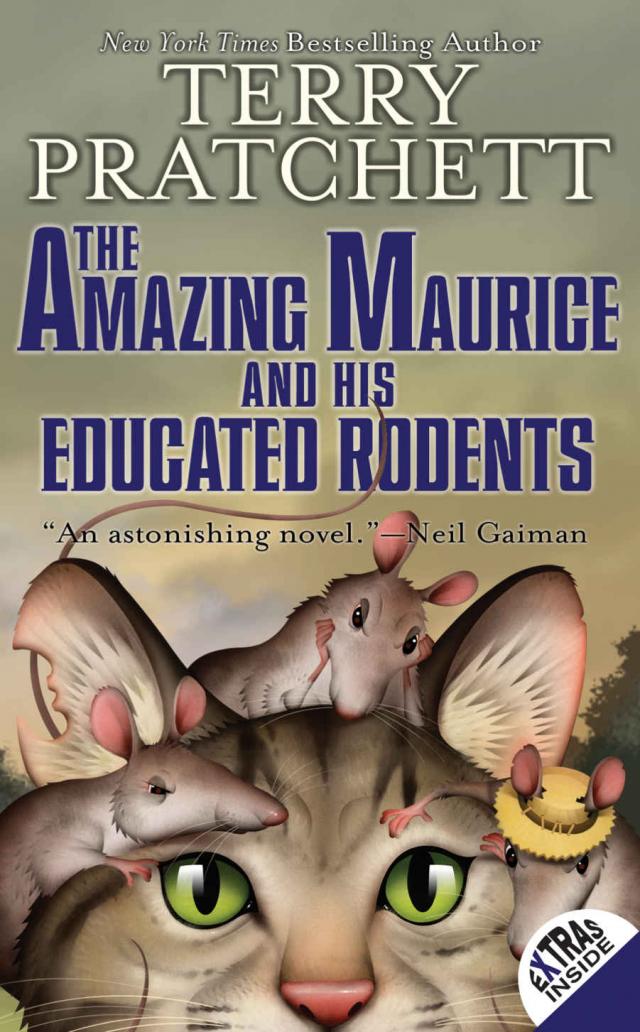


In Maurice, the rats have to confront them all: real monsters, some of whom have many legs and some who merely have two. But some, perhaps the worst, are the ones they invent. The rats are intelligent. They’re the first rats in the world to be afraid of the dark, and they people the shadows with imaginary monsters. An act of extreme significance to them is the lighting of a flame.
People have already asked me if I had the current international situation in mind when I wrote the book. The answer is no. I wouldn’t insult even rats by turning them into handy metaphors. It’s just unfortunate that the current international situation is pretty much the same old dull, stupid international situation, in a world obsessed by the monsters it has made up, dragons that are hard to kill. We look around and see foreign policies that are little more than the taking of revenge for the revenge that was taken in revenge for the revenge last time. It’s a path that leads only downward, and still the world flocks along it. It makes you want to spit. The dinosaurs were thick as concrete, but they survived for one hundred and fifty million years and it took a damn great asteroid to knock them out. I find myself wondering now if intelligence comes with its own built-in asteroid.
Of course, as the aforesaid writer of humorous fantasy I’m obsessed by wacky, zany ideas. One is that rats might talk. But sometimes I’m even capable of weirder, more ridiculous ideas, such as the possibility of a happy ending. Sometimes, when I’m really, really wacky and on a fresh dose of zany, I’m just capable of entertaining the fantastic idea that, in certain circumstances, Homo sapiens might actually be capable of thinking. It must be worth a go, since we’ve tried everything else.
Writing for children is harder than writing for adults, if you’re doing it right. What I thought was going to be a funny story about a cat organizing a swindle based on the Pied Piper legend turned out to be a major project, in which I was aided and encouraged and given hope by Philippa Dickinson and Sue Coates at Doubleday or whatever they’re calling themselves this week, and Anne Hoppe of HarperCollins in New York, who waylaid me in an alley in Manhattan and insisted on publishing the book and even promised to protect me from that most feared of creatures, the American copy editor.
And I must thank you, the judges, in the hope that your sanity and critical faculties may speedily be returned to you. And finally, my thanks to the rest of you, the loose agglomeration of editors and teachers and librarians that I usually refer to, mostly with a smile, as the dirndl mafia. You keep the flame alive.
Chatting with Terry Pratchett
What did you read when you were in your teens?
I started out, as so many do, by reading all the science fiction I could get my hands on. And (as also happens a lot, although it’s seldom acknowledged) the interest in reading that SF had awakened led me to read my way through the whole of the local public library. The one thing I didn’t read in my teens was books for teens.
What first put the idea into your head that you would rewrite the story of the Pied Piper?
I came up with the book title a long time ago, and it became just a one-line gag in an adult book. Then one day I sat down and thought hard about it and, being me, got hold of every book about rats I could find. I thought it was going to be a simple little fun story that’d take me a couple of months to write. Boy, was I wrong . . .
Your plots are fast, furious, and knotty! When you begin writing, do you know where you’re going, or do you have to let the story take control and see where it takes you?
I’m not sure about the “furious and knotty”! And the answer deserves either one sentence or an essay. I’ll try to summarize it like this: writing, for me, is a little like wood carving. You find the lump of tree (the big central theme that gets you started) and you start cutting the shape that you think you want it to be. But you find, if you do it right, that the wood has a grain of its own (characters develop and present new insights, concentrated thinking about the story opens new avenues) and if you’re sensible you work with the grain and, if you come across a knothole, you incorporate that into the design. A lot of things in Maurice “weren’t there” when I started; it’d be more true to say, though, that they were there, inherent in the basic story outline, and emerged as I worked through draft Zero, the one I write for myself to tell me how the story goes.
This is not the same as ‘making it up as you go along’; it’s a very careful process of control.
“There’s no subtext, no social commentary,” complains Malicia about Mr. Bunnsy. Fantasy is often thought of as escapism, but is it escapism with a firm root in reality?
Well, Malicia is a very knowing girl. She reads a lot. She’s aware of the things we try to foist on kids via their reading. Fantasy IS escapism, but wait . . . why is this wrong? What are you escaping from, and where are you escaping to? Is the story opening windows or slamming doors? The British author G. K. Chesterton summarized the role of fantasy very well. He said its purpose was to take the everyday, commonplace world and lift it up and turn it around and show it to us from a different perspective, so that once again we see it for the first time and realize how marvelous it is. Sure, there’s a lot of rubbish produced for kids, usually in order to get them to buy the merchandising, but fantasy per se—the ability to envisage this world in many different ways—is one of the skills that makes us human.
The Amazing Maurice is part of your Discworld series, which has already seen more than two dozen adult books, yet this book is aimed at younger readers. Why?
A lot of authors who have created a successful series tend, eventually, to franchise it. I’ve franchised Discworld, but to myself: I’ve decided to try new things with it. Maurice is “canonical” with the adult series—it’s clearly in the same world—but writing it specifically for children offers me new challenges and opportunities. One of them was to work harder on a book than I’ve ever worked before!
Read an Excerpt from the First of the Tiffany Aching Adventures: The Wee Free Men
Tiffany Aching was lying on her stomach by the river, tickling trout. She liked to hear them laugh. It came up in bubbles.
A little way away, where the riverbank became a sort of pebble beach, her brother, Wentworth, was messing around with a stick, and almost certainly making himself sticky.
Anything could make Wentworth sticky. Washed and dried and left in the middle of a clean floor for five minutes, Wentworth would be sticky. It didn’t seem to come from anywhere. He just got sticky. But he was an easy child to mind, provided you stopped him from eating frogs.
There was a small part of Tiffany’s brain that wasn’t too certain about the name Tiffany. She was nine years old and felt that Tiffany was going to be a hard name to live up to. Besides, she’d decided only last week that she wanted to be a witch when she grew up, and she was certain Tiffany just wouldn’t work. People would laugh.
Another and larger part of Tiffany’s brain was thinking of the word susurrus. It was a word that not many people have thought about, ever. As her fingers rubbed the trout under its chin, she rolled the word round and round in her head.
Susurrus . . . according to her grandmother’s dictionary, it meant “a low soft sound, as of whispering or muttering.” Tiffany liked the taste of the word. It made her think of mysterious people in long cloaks whispering important secrets behind a door: susurrusssusurrusss . . .
She’d read the dictionary all the way through. No one told her you weren’t supposed to.
As she thought this, she realized that the happy trout had swum away. But something else was in the water, only a few inches from her face.
It was a round basket, no bigger than half a coconut shell, coated with something to block up the holes and make it float. A little man, only six inches high, was standing up in it. He had a mass of untidy red hair into which a few feathers, beads, and bits of cloth had been woven. He had a red beard, which was pretty much as bad as the hair. The rest of him that wasn’t covered with blue tattoos was covered with a tiny kilt. And he was waving a fist at her and shouting:
“Crivens! Gang awa’ oot o’ here, ye daft wee hinny! ’Ware the green heid!”
With that he pulled at a piece of string that was hanging over the side of his boat, and a second red-headed man surfaced, gulping air.
“Nae time for fishin’!” said the first man, hauling him aboard. “The green heid’s coming!”
“Crivens!” said the swimmer, water pouring off him. “Let’s offski!”
And with that he grabbed one very small oar and, with rapid back and forth movements, made the basket speed away.
“Excuse me!” Tiffany shouted. “Are you fairies?”
But there was no answer. The little round boat had disappeared in the reeds.
Probably not, Tiffany decided.
Then, to her dark delight, there was a susurrus. There was no wind, but the leaves on the alder bushes by the riverbank began to shake and rustle. So did the reeds. They didn’t bend, they just blurred. Everything blurred, as if something had picked up the world and was shaking it. The air fizzed. People whispered behind closed doors. . . .
The water began to bubble, just under the bank. It wasn’t very deep here—it would only have reached Tiffany’s knees if she’d waded—but it was suddenly darker and greener and, somehow, much deeper. . . .
She stood and took a couple of steps backward just before long skinny arms fountained out of the water and clawed madly at the bank where she had been. For a moment she saw a thin face with long sharp teeth, huge round eyes, and dripping green hair like waterweed, and then the thing plunged back into the depths.
By the time the water closed over it, Tiffany was already running along the bank to the little beach where Wentworth was making frog pies. She snatched up the child just as a stream of bubbles came around the curve in the bank. Once again the water boiled, the green-haired creature shot up, and the long arms clawed at the mud. Then it screamed and dropped back into the water.
“I wanna go-a toy-lut!” screamed Wentworth.
Tiffany ignored him. She was watching the river with a thoughtful expression.
I’m not scared at all, she thought. How strange. I ought to be scared, but I’m just angry. I mean, I can feel the scared, like a red-hot ball, but the angry isn’t letting it out. . . .
“Wenny wanna wanna wanna go-a toy-lut!” Wentworth shrieked.
“Go on, then,” said Tiffany absentmindedly. The ripples were still sloshing against the bank.
There was no point in telling anyone about this. Everyone would just say, “What an imagination the child has,” if they were feeling in a good mood, or, “Don’t tell stories!” if they weren’t.
She was still very angry. How dare a monster turn up in the river? Especially one so . . . so . . . ridiculous! Who did it think she was?
This is Tiffany, walking back home. Start with the boots. They are big and heavy boots, much repaired by her father, and they belonged to various sisters before her; she wears several pairs of socks to keep them on. They are big. Tiffany sometimes feels she is nothing more than a way of moving boots around.
Then there is the dress. It has been owned by many sisters as well and has been taken up, taken out, taken down, and taken in by her mother so many times that it really ought to have been taken away. But Tiffany rather likes it. It comes down to her ankles and, whatever color it had been to start with, is now a milky blue that is, incidentally, exactly the same color as the butterflies skittering beside the path.
Then there is Tiffany’s face. Light pink, with brown eyes, and brown hair. Nothing special. Her head might strike anyone watching—in a saucer of black water, for example—as being just slightly too big for the rest of her, but perhaps she’ll grow into it.
And then go farther up, and farther, until the track becomes a ribbon and Tiffany and her brother two little dots, and there is her country.
They call it the Chalk. Green downlands roll under the hot midsummer sun. From up here the flocks of sheep, moving slowly, drift over the short turf like clouds on a green sky. Here and there sheepdogs speed over the grass like shooting stars.
And then, as the eyes pull back, it is a long green mound, lying like a great whale on the world . . .
. . . surrounded by the inky rainwater in the saucer.
BACK ADS
DISCOVER
your next favorite read
MEET
new authors to love
WIN
free books
WATCH
the latest videos
SHARE
infographics, lists, quizzes
SIGN UP
for bookish fun & news
* * *
epicreads.com
ABOUT THE AUTHOR
Sir TERRY PRATCHETT, OBE, was the author of more than 70 books, including the internationally bestselling Discworld series of novels. His books have been adapted for stage and screen, and he was the winner of multiple prizes, including the Carnegie Medal. In January 2009, Pratchett was knighted by Queen Elizabeth II in recognition of his services to literature. Sir Terry, who lived in England, died in March 2015 at the age of 66.
Discover great authors, exclusive offers, and more at hc.com.
BOOKS BY TERRY PRATCHETT
The Carpet People
The Dark Side of the Sun
Strata
THE BROMELIAD TRILOGY:
Truckers
Diggers
Wings
THE JOHNNY MAXWELL TRILOGY:
Only You Can Save Mankind
Johnny and the Dead
Johnny and the Bomb
The Unadulterated Cat (illustrated by Gray Jolliffe)
Good Omens (with Neil Gaiman)
Nation
THE DISCWORLD SERIES
The Color of Magic
The Light Fantastic
Equal Rites
Mort
Sourcery
Wyrd Sisters
Pyramids
Guards! Guards!
Eric
Moving Pictures
Reaper Man
Witches Abroad
Small Gods
Lords and Ladies
Men at Arms
Soul Music
Feet of Clay
Interesting Times
Maskerade
Hogfather
Jingo
The Last Continent
Carpe Jugulum
The Fifth Elephant
The Truth
Thief of Time
The Amazing Maurice and His Educated Rodents
Night Watch
The Wee Free Men
Monstrous Regiment
A Hat Full of Sky
Going Postal
Thud!
Wintersmith
Making Money
Unseen Academicals
Where’s My Cow?
(illustrated by Melvyn Grant)
The Last Hero: A Discworld Fable
(illustrated by Paul Kidby)
The Art of Discworld
(illustrated by Paul Kidby)
The Illustrated Wee Free Men
(illustrated by Stephen Player)
CREDITS
Cover art © 2008 by Bill Mayer
Cover design by Joel Tippie
COPYRIGHT
THE AMAZING MAURICE AND HIS EDUCATED RODENTS. Text copyright © 2001 by Terry and Lyn Pratchett. Illustrations copyright © 2001 by David Wyatt. All rights reserved under International and Pan-American Copyright Conventions. By payment of the required fees, you have been granted the nonexclusive, nontransferable right to access and read the text of this e-book on-screen. No part of this text may be reproduced, transmitted, downloaded, decompiled, reverse-engineered, or stored in or introduced into any information storage and retrieval system, in any form or by any means, whether electronic or mechanical, now known or hereafter invented, without the express written permission of HarperCollins e-books.
www.harperteen.com
* * *
Library of Congress Cataloging-in-Publication Data
Pratchett, Terry.
The amazing Maurice and his educated rodents / Terry Pratchett.
p. cm.
Summary: A talking cat, intelligent rats, and a strange boy cooperate in a Pied Piper scam until they try to con the wrong town and are confronted by a deadly evil rat king.
ISBN 978-0-06-001235-9 (pbk.)
EPub Edition © May 2015 ISBN 9780061975158
[1. Rats—Fiction. 2. Cats—Fiction. 3. Musicians—Fiction. 4. Swindlers and swindling—Fiction. 5. Human-animal relationships—Fiction. 6. Humorous stories.] I. Title.
PZ7.P8865 Am 2002 2001042411
[Fic]—dc21 CIP
AC
* * *
Revised paperback edition, 2008
ABOUT THE PUBLISHER
Australia
HarperCollins Publishers Australia Pty. Ltd.
Level 13, 201 Elizabeth Street
Sydney, NSW 2000, Australia
www.harpercollins.com.au
Canada
HarperCollins Canada
2 Bloor Street East - 20th Floor
Toronto, ON M4W 1A8, Canada
www.harpercollins.ca
New Zealand
HarperCollins Publishers New Zealand
Unit D1 63 Apollo Drive
Rosedale 0632
Auckland, New Zealand
www.harpercollins.co.nz
United Kingdom
HarperCollins Publishers Ltd.


