

A dutiful daughter, p.15
A Dutiful Daughter,
p.15
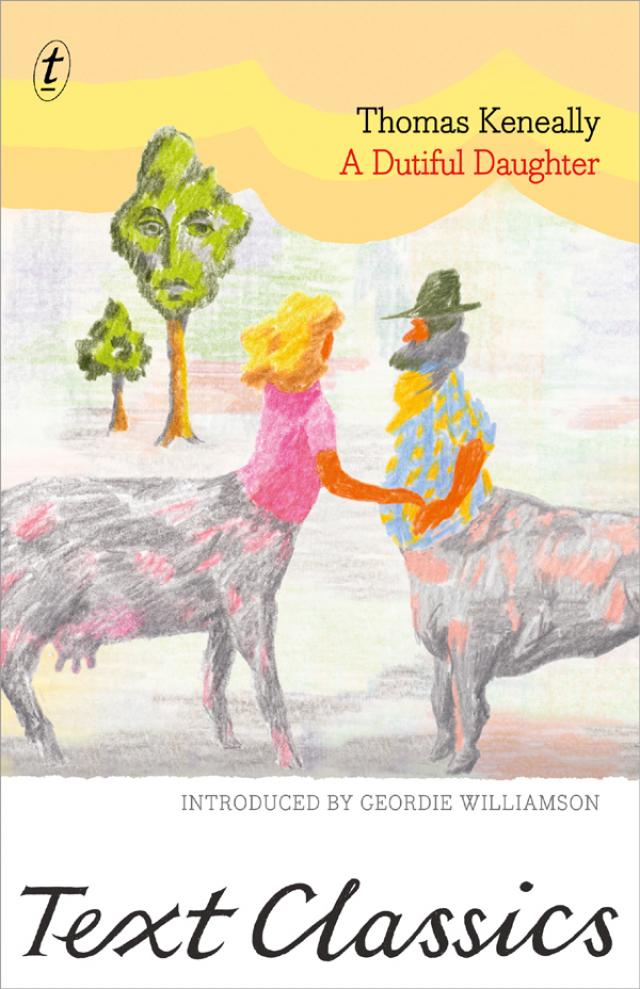


‘Yes,’ said the father as a token, staring all the time at a soundless feral contest on the screen, wild boars contesting to the death. ‘Yes, We’ll have to start taking this condition more seriously.’
Within Barbara there first rose her accustomed grey inability to speak. Numberless clichés of ripe anger, of thoroughgoing sense of misuse, were suppressed by some painful ambition that her throat would one day mould and emit an incomparable formula of revulsion.
‘I’m not going on,’ she told them softly.
‘Not any use of sulking,’ muttered the father, still enchanted by the boars scoring bright damage on each other with every flourish of tusks.
She said, numb at his ingenuousness, ‘No, I’m not going on.’ She referred to their suspicions that she had somehow brought on the accident. That afternoon, she said, she had experienced something that convinced her she had, even if in ignorance. And if that was so, there were surely all sorts of dangers for Damian.
‘Damian!’ the mother gargled, accustomed to the accident, unaccustomed to having a promiscuous son. ‘Damian doesn’t rate with me as highly as he did.’
‘Because of the girl?’
‘It wasn’t what he was brought up for.’
‘You’ve already said that,’ the father murmured over his shoulder, still possessed by the screen.
‘You’d better start listening,’ Barbara told him. ‘And stop deceiving her.’ She was pleased to get that out. ‘She thinks it’s evil for Damian to take a girl. I think it’s evil for you to let her concentrate on these side issues by pretending there’s…you know…somewhere in the world, someone who can help her.’
The mother winced between phrases as Barbara tenderly drew the foul thick milk of her disease from her udders. Wincing in this way, ‘Barbara,’ she said, ‘I think you must be demented if you talk like that. Or jealous.’
‘Jealous. Jealous?’
‘That I’ve been chosen to bear these things.’ The mother gestured with a cupped hand towards her lower parts.
Barbara inhaled, not without a type of ultimate joy: suddenly, for the first time, and at last, she felt too tired for indirectness. In this important way, her combat with Frederic, which had not been lacking in the unambiguous animality that had interested Mr Glover on the flickering screen for the past five minutes, had liberated her.
‘There’s no way to get help for you. He…’ she pointed to the father, ‘encourages you in the belief that there is, because he feels he has something to make up to you— excursions among other animals…’
The father tore his eyes from the wild boars. ‘Barbara,’ he shouted, ‘for God’s sake, that’ll do. No lies.’ Though his pitiable urgency means No truth, please no truth!
Barbara went on in sunny, clinical ruthlessness. ‘But you mustn’t think you weren’t driven to go looking for… other comfort.’
The father was bellowing denials.
‘As for me, I’ve done things…acts…with a man and I’m bound to him, though I don’t want to be.’
‘You don’t mean?’ the father asked. He saw grand-parenthood as a further comical exploitation.
‘No. Nothing as obvious as a child. But we don’t deserve each other, this man and me. We both deserve better and worse, in different ways.’
‘Thank God,’ the father intoned, ‘you’re not educated.’ He meant she was devious enough, without being burdened with a knowledge of semantics.
‘But the point is that you have nothing to be ashamed of. There must be millions…you know…absolute millions of people who are so full of family pride and such, so full of it all, that the only way for them to get humility is through learning they’re…you know…beasts. I’ve learnt it. About myself. And you have.’
‘It was bloody easier than discovering penicillin,’ the father admitted.
‘You make me sick,’ the mother called out. ‘I am like I am because I’ve been chosen out. To be this.’
‘Chosen?’ Barbara frankly doubted.
‘Barbara, you talk as if there was no God.’
‘No, that’s not the truth. Only a God is worthy to look at us and…and…’ she sought for an unpretty word, one that would jolt her mother, ‘…pity us,’ she concluded, giving in. She was reminded of a phrase she had heard somewhere. ‘Only a God is worthy to pity such great wounds.’ Or was it ‘tears’?
‘You want to kill yourself,’ the father stated, with a penetration he could have shown all his life, except that blunt and patent means had always been easier to him: to dismember a calf, for instance.
‘No,’ said the mother. ‘No, there’s no forgiveness for suicides. Unless they’re mad. And it’d be criminal in your case—with your whole life ahead of you. Besides, you can’t leave us.’
‘I think you should come with me.’
‘They also serve,’ the mother said, ‘who only stand and wait.’
The husband looked at his wife with a naked hatred, while between him and Barbara a palpable bond seemed to have grown, a positive discipleship. What a triumph, to lead them to freely selected deaths!
She took time to draw distinctions between the suicide which is a straight denial of life and that which was merely an escape from what was, by human standards, insufferable. The memory rose in her of Jehanne’s leap from the top of the Beaurevoir tower, where she was exercising alone while John of Luxembourg’s prisoner. Three kind ladies had been looking after her, Luxembourg’s wife and aunt and step-daughter: who had even offered to run up a dress for her, or show her a number of lengths of material that she would be sure to find something to her taste among. But she knew what the realities were: the bidding was running high a little to the south of Beaurevoir, where the Bastard of Wandomme, whose archer first pulled Jehanne from her horse, had been paid off by Jean de Luxembourg, who had himself been paid off by the Duke of Burgundy, who was about to be paid off by the English. Only Charles, Jehanne’s weak brother of a king, was failing to put in a tender—he didn’t want her back; he wanted the freedom of being dominated by people of his own choosing. She knew where she would end, and disliked the prospect that there was no means to prepare yourself against the obscenity of flame. So she jumped. That was a sort of suicide, looked at objectively. Morally, it was escape. That was necessary to Barbara now, moral escape. She must not end with mere concussion and a sprained ankle, though, like Jehanne.
She said to the parents—she was swabbing her mother’s tender udders now, ‘I want you to forgive me and die with me. I think my father’s willing. I think he’s tired of the joke.’
‘Yeah! Yes!’ said her father, catching the pitch of her gesture. ‘Yeah!’
‘Your condition will not be cured,’ she stated to the mother. ‘Nor will mine.’
‘I won’t take you seriously,’ the mother muttered. She could gauge their sudden fire and was afraid of it.
‘Yes,’ the father went on saying. ‘Yeah.’
Barbara coughed and gave them the perorational sentence. ‘I want you both to forgive me and die with me.’
She had three bottles of sleeping-tablets, nearly full, the result of the three inconclusive visits to general practitioners made since she was twenty. They should all go away down the beach. It would be wet in the open, but as you took the tablets, a wonderful warmth would suffuse you.
She asked them to promise to wait for her.
When she came inside, there was Helen seated silently at the table, while you defended the stove corner in a permanent posture of stealth. She waited for you to take up some stance indicating greater balance: it was hard to leave you hugging the walls to yourself, like a mental patient. But it was no worse, she supposed, than the demeanours and embittered minds that some other explosive necessity—bomb or earthquake or defective electric water heater—found members of families in every day of the sad week. In her room, on last Christmas’s garlanded stationery, she remembered to compose a note for the police and any others who might tend to endow her death with an importance her life never had. She explained that her parents were ill and she didn’t trust doctors, that the government wanted to convert her to bulk and she didn’t want to be. It would not be such an unlikely letter—except in literacy—to get from a Campbell’s Reach suicide.
Then she wrote to you, in a rush.
Beloved Damian,
If you think I have gone off because of Helen, let me assure you that I suspect Helen means little enough to you and that it was terror of me and them that forced you to attempt loving her.
I am going because of Frederic, because your mother’s case is terminal, because your father wants to go. We have talked about the accident for so long. Well, I have further accidents in me. In the third drawer of my wardrobe you’ll find a document in a plastic sleeve under my slips. It may have value. I think you should find out whether it has. If so, don’t donate it. I know you; you’d be likely to. I think you should sell it. It would be false pride for someone as poor as you to give it away. Besides, I’ve been used to looking on it as a gift from one orphan to another—a peculiar kind of orphan, that is, the kind who don’t lose their parents but the childhood they should have had. Anyhow, please don’t just give the document away.
You have your freedom and I suppose it scares you. You’ll grieve for the three of us, I know, which will interfere with your chances of being sensible even more. But let me tell you this: don’t give up your freedom easily, just for the sake of a bit of animal warmth. I’m not trying to insult you, or Helen. But Helen’s like me, too strong for you. Now you have the freedom to be stronger than that. You are used to being committed—pardon me, forced into peoples’ orbit. Now it’s all yours, to work out. No more being forced.
I love you, Damian, with every part of my body and mind. I’m surprised it doesn’t show up in the surroundings and the climate, and shock my mother.
You’ll always wonder—you know how you talked yesterday—how many centres all my interlocking circles of motives have. I’m sure they have many. For one thing, I hate the idea of that thin little girl sleeping with you. Never mind. It seems all the bigger circles and all the bigger centres are what they ought to be.
Don’t let the police read this. Nor, if possible, the little cash book full of jottings about Jehanne.
I’d like to promise to love you past the grave—as people promise in old books. I don’t know if love is recognized currency over there. So, all I can say is, to the last second of consciousness,
Barbara.
Since the cash-book called Reflections on the Life was her only outlet for melodramatic statement, she wrote in it:
I have been burned alive. Jhesus.
Her three bottles of sleeping-pills occupied a shelf in the laundry, among caulking compound and stove-cleaners. Both you and Helen had begun to speak at the table in an introspective way, eyes cast down. Once or twice Barbara and you had done that: you fictionalized yourself as you went and finished about midnight with a hollow elation and some painful hope in the future. She had been so active, arranging her departure, that she was at the door before the urge to take you against her belly by the ears and absolve you from mourning held her in the room.
‘I’ll be half an hour, Damian,’ she said. ‘Just cleaning up the barn a little. Then I’ll make Helen and you a decent meal.’
‘Yes, yes,’ you both said, your eyes frosted with your egocentric rhetorics. ‘But there’s no bother.’
The veranda’s vacancy hit her with a physical force. It seemed to have been contrived so that the way articles were disposed implied that no one had lived here for years. The television’s eye was perniciously blank; Dairy Farming in Australia lay under doilies in the open cupboard, the pipe lay cleaned on its side—all like exhibits in a folk museum. She was astounded by the cruelty involved in arranging objects with such swift skill and then fleeing.
Running out into the rain, she circled the house calling softly for them, and then back to the veranda, to sniff up the positive smell of their recent presence through her rain-clogged nose.
‘Where are you?’ she whispered. She believed that they could be heard laughing, off in the dark, like children. She ran after them. The three small phials jostled in her pocket.
‘I can’t make any choice,’ you were explaining to Helen, ‘while ever I’m in their shadow. How could it be a balanced choice? It just couldn’t be.’
The clock and your stomach both told you at once that two hours had passed. Helen was wrapped in a blanket, looking very like the flood victims in newsreels. You still wore the clothes in which Frederic had saved you.
You excused yourself and went with a storm-light to the veranda, still overcrowded with furniture and keepsakes but with the appearance of a quickly abandoned camp, and a wasteful electric light shining on it all. The barn was empty and smelt heavily of damp and an even more final desertion.
The Glover herd, you saw, shambled around the cowshed, as if the pastures were all flooded now. Going in to excuse yourself from Helen, you took ten seconds to visit Barbara’s room and found, side-on in her marbled notebook the letter for you.
You left Helen in the house and went searching. Uneasy, still she kept the fire stoked. At eleven the power went, and she and the fire were the only two poles of light in a roaring darkness, a basic darkness, the type that breeds ghosts and visions, rituals for luck or salvation, religion itself. Within half an hour, she glimpsed through a cleft in the dark, a time-embrasure whose edges glinted from firelight like quartz, a boy of perhaps ten, naked, of creamy skin, dark-haired, a little oriental. He smiled very directly and pleasantly at her, and she saw that over his left shoulder was a white towel sodden in the centre with blood. The towel fell and the shoulder was seen to be clean of any wound. A smile of keenest gaiety came to his face.
She ran out, calling for you.
Above, the sky thundered down nasty promises against individuals and species and phenomena, and she found the huddled, frightened cattle in the yard. Catchments spewed and floodgates burst, all levees were devoured. Small’s best bull was washed away and Mrs Glover screamed to find herself hock-deep and tripping in hard and spinning water not a quarter-mile from home. ‘Dad,’ she screamed, ‘Dad.’ Geographies were altered, the town cut through the middle, the soil of profitable farms bundled uselessly into the bottom of Campbell’s Reach or swept north on warm summer tides. Similarly bundled or swept, eons or fathoms deep, were the Glovers and their passive daughter. What futurist ploughshare would crack their bones, what sea-bottom dweller find diversion or intellectual torment in their curious remains?
In the awful tower of his freedom, Damian called out repeatedly for his remarkable sister.
Dancing on Coral
Glenda Adams
Introduced by Susan Wyndham
The True Story of Spit MacPhee
James Aldridge
Introduced by Phillip Gwynne
The Commandant
Jessica Anderson
Introduced by Carmen Callil
A Kindness Cup
Thea Astley
Introduced by Kate Grenville
Reaching Tin River
Thea Astley
Introduced by Jennifer Down
The Multiple Effects of Rainshadow
Thea Astley
Introduced by Chloe Hooper
Drylands
Thea Astley
Introduced by Emily Maguire
Homesickness
Murray Bail
Introduced by Peter Conrad
Sydney Bridge Upside Down
David Ballantyne
Introduced by Kate De Goldi
Bush Studies
Barbara Baynton
Introduced by Helen Garner
Between Sky & Sea
Herz Bergner
Introduced by Arnold Zable
The Cardboard Crown
Martin Boyd
Introduced by Brenda Niall
A Difficult Young Man
Martin Boyd
Introduced by Sonya Hartnett
Outbreak of Love
Martin Boyd
Introduced by Chris Womersley
When Blackbirds Sing
Martin Boyd
Introduced by Chris Wallace-Crabbe
The Australian Ugliness
Robin Boyd
Introduced by Christos Tsiolkas
The Life and Adventures of
William Buckley
Introduced by Tim Flannery
The Dyehouse
Mena Calthorpe
Introduced by Fiona McFarlane
All the Green Year
Don Charlwood
Introduced by Michael McGirr
They Found a Cave
Nan Chauncy
Introduced by John Marsden
The Even More Complete
Book of Australian Verse
John Clarke
The Tournament
John Clarke
Introduced by Michael Heyward
For the Term of His Natural Life
Marcus Clarke
Introduced by Rohan Wilson
Dancing with Strangers
Inga Clendinnen
Introduced by James Boyce
Diary of a Bad Year
J. M. Coetzee
Introduced by Peter Goldsworthy
Wake in Fright
Kenneth Cook
Introduced by Peter Temple
The Dying Trade
Peter Corris
Introduced by Charles Waterstreet
They’re a Weird Mob
Nino Culotta
Introduced by Jacinta Tynan
Aunts Up the Cross
Robin Dalton
Introduced by Clive James
The Songs of a Sentimental Bloke
C. J. Dennis
Introduced by Jack Thompson
Careful, He Might Hear You
Sumner Locke Elliott
Introduced by Robyn Nevin
Fairyland
Sumner Locke Elliott
Introduced by Dennis Altman
The Explorers
Edited and introduced by
Tim Flannery
Terra Australis
Matthew Flinders
Introduced by Tim Flannery
Take Me to Paris, Johnny
John Foster


