

A dutiful daughter, p.5
A Dutiful Daughter,
p.5
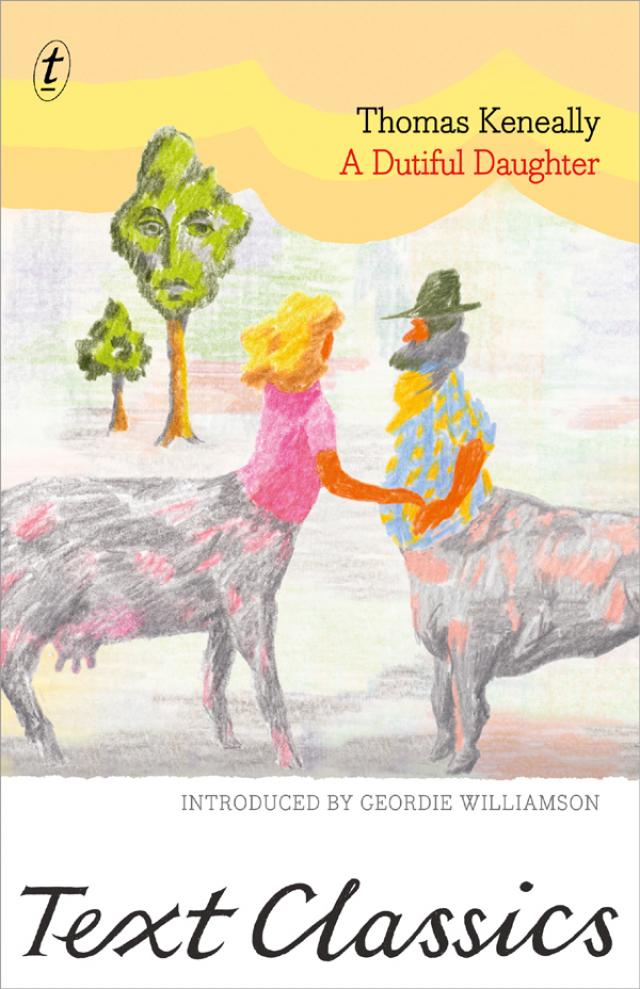


If there was ever a man ripe for having an onus taken from him, it was the Mr Glover of that long postwar hiatus. The mid-fifties found him still bemused, as if his country had, meanly and behind his back, lost its virgin status; and every time he looked, it proved to him more and more thoroughly its loss of innocence. It was his fixed idea that, as an old soldier, he had the right to find a sun-drugged world curled in his palm, fit for pocketing. Yet each migrant ship brought in Europe’s sharp practitioners; there were too many quick brown foxes in this new era of peace: and in the year of Damian’s birth the cities, all rendered primitive by striking unionists, stood convicted of their old-world ugliness.
So, home from the electric trains at dusk, from the thick breaths of Czechs and Croats, Poles and Greeks and wheeler-dealing Magyars, Mr Glover spoke of a return to nature in far from Thoreauvian terms.
‘Back to the land,’ he muttered over his steak charred swiftly by your mother between gasworks’ strikes. ‘Back to nature.’ It was a paranoid ultimatum to God and God’s own country: he seemed bent on proving that they would both let him fail. Failure was, by the night Barbara bled, his mother-fluid, his poor man’s emollient. What was worst was that you knew he had a certain black wit and was capable of a white one. He could not become the oaf he wanted to be. You heard him mutter things you knew by a child’s instinct to be clever; but he would never sparkle at the top of his voice. He knew that society considered subtlety unpatriotic; that Mrs Glover thought it blasphemous; and he suspected that the children might take it as a sign that they could soon expect certain family trophies—a sedan, a holiday cottage. To you, the children, he let himself become totally unreal, inspiredly ugly, a prodigy of madness. You respected him as you respected the thunderstorm, and far more than your concrete, harried mother praying the crisis away in some netherland of loyalties between God, her husband, and you.
That morning, Barbara was about to save his sanity, though there was as yet no indication. Last month his appeal against being refused membership of the Dairy Farmers Cooperative had been denied. His cows were inferior, deficient in butter-fat, subject to brucellosis, ticks, and bloat. The refusal infallibly handed you Glovers information about your status: you were considered one with the inbred families found entrenched all over Camp-bell’s Reach; casual farmers, casual fishermen, mothers of their own granddaughters, fathers of their own nephews, frequenters of black-gins.
So, the scraping protest of your father’s boots in the kitchen. What wouldn’t he do if he knew of this ultimate touch: that his daughter had bled from her private place?
Barbara said, ‘Wait till she goes out for wood and then burn it.’
She gave you the bundled, bloodied nightdress.
The burning of clothing? ‘He’ll give me curry.’
She said no, if it came to his knowing she would stand up against him.
‘Where’s that bloody girl?’ you could hear him saying, and were excited by the special dawn resonance of his voice and the chance of deepening his ignorance of the misfortune he had suffered in his daughter.
You took the nightdress with both hands. After she had gone you remained sitting and tensed, and your right thumb could feel the especial harshness of the cloth where blood had dried. Beginning in your shoulders, spasms of terror ran down your arms to the mere climatic coldness of your hands. How evil was it to bleed from a private place? Was it a sin or a disease? Would it happen often? Would it happen to you?
An especial love, shivery as your mother’s methylated cure for sunburn, vaporized from the pores of your skin. You said her name as a pledge, and pressed the blood patch, its heavy but natural smell, to your lips.
Your mother clopped into boots and took her blockbuster, prized enough to have been given house-room, from its corner. She would split a half dozen sections of red box-tree: her hands, when she gave them to you, were grained with thick, short splinters, which made you blush.
To save kerosene, the lamp had been turned out in the vacated kitchen. There was no room in the grate for the dress until you had worried and broken the blazing wood. Then you put it in, folded. But it burned badly, though the blood took brisk fire independently of the cloth.
You had not expected the pungency of the fabric. Your eyes watered, your hands swatted at the thick fumes. It occurred to you that there was a special bounty in the way wood burned so sweetly even when it came from roots deep in the foul stew of Campbell’s Reach.
When your mother came in, the cloth was two-thirds consumed, its obvious odour hung over the kitchen. She rushed to drop her armfuls of wood.
‘What is it?’ She squinted quickly into your face, into the grate. ‘What is it?’
What could be said? ‘Barbara’s nightie,’ you managed.
‘What? What’s the matter with you? Burning good clothes.’
If it had been a routine evil you were doing, you would have quickly blamed Barbara. Now you could say nothing.
‘It’s your father and me who have to find the money…’
He hated that ‘your father and me’ as a statement of foetid intimacy, just as you hated them to share the one set of spectacles or slippers. Worse still, her exaltation was obvious, she could best identify herself with your father by isolating incidents that increased his acrid money worries. Like a nun she could stand, her chin tucked girlishly against her chest, while your father officiated at the heady sacraments of interrogation and strapping. Seven years old, you could pity her. These were the moments when she knew she had a husband; her marriage was verified for her, her work achieved a marital meaning.
It seemed, when Barbara and her father came in from the cowshed at seven, that the silent ministering to the cows, the daily sorcery that never forgot to swell even those poor udders with milk, had given Barbara some sense of her own innocence. Your mother had retrieved a singed remnant of the gown, a catalyst for the father, a grandiose stage-prop by Glover standards.
‘Because I told him to,’ Barbara called from the edge of the solemnities.
The parents grew instantly wary, sensing sexual inferences, and wondered now how questions could best be asked. Barbara forestalled them.
‘Because I bled all over it, half the night. I felt the blood on my legs. It was like a bubble bursting when it started.’
‘All right, all right,’ the mother shouted. ‘Don’t talk filthy.’
A gentle and unappalled Christ, you noticed, seemed to befriend Barbara from his fixed place above the hearth. You felt inclined to tell your mother of the fact, but were distracted by your father’s stunning bonhomie and by his hand on your shoulder.
‘Listen, cobber,’ he said, ‘what if you run outside. This is woman’s business.’
‘He knows all about it.’ She was terribly strong to their faces, your astounding sister. ‘I didn’t want to bleed all night and think I was dying.’
‘All right, all right, all right,’ shrieked the mother. ‘You’ve said it!’
The father was gentler, as if his child had become a young woman, a person, your aunt—not your sister. But Barbara tossed her head she didn’t give a damn for status, but wanted to live without terror of her body.
‘It’s quite natural,’ said the mother with a tenuous gentleness. ‘And Damian, since you know, you’d better listen too. It’s part of God’s plan to make your sister a… It’s part of growing up. Nothing for alarm. You shouldn’t have been alarmed. Our blessed Mother will take care…’
Your sister’s jaws shuddered. She knew God’s plan was large enough to mind itself. In the meantime she had spent the night dying. Was that just, when they could have told her, even the night before?
You could sense in your parents their caution yet their complacency, for the cycles of nature had been affirmed in your sister’s body; and a further series of physical ironies would assimilate her to them. So their gladness was obscene and you felt intoxicated with the pure justice of Barbara’s anger.
‘It’s still happening,’ Barbara said.
‘That’s right,’ the mother told them. ‘Every month a woman’s system has this bleeding. You see, you’ll be a mother one day, Barbara. And you know…your body has to be prepared and strengthened. So it has to get rid of bad material that’s not any longer useful to that…purpose. You see?’
Instantly you made a formal peace with your mother’s God whom your father suspected of favouring Slavs; and instantly you felt sick. Bad material? you wondered. Am I poisoned? How cruel that you had always thought of blood as the mere juice of heroism, a bright accessory seeping not so torrentially from your flesh wounds as you Roy-Rogered your way around the cowshed.
Then Barbara brought it home to the three of you that she had become immune from punishment. As she began to rip her clothing, none of the pennywise slogans of the house came to your parents’ lips. This was no mere waste Barbara was committing; how do you think we’ll find the money to…? had no validity as Barbara tore her dress, beginning at the neck, and the cardigan, beginning at the hole on the shoulder. You saw too that she was weeping, and that the mother’s eyes were turned aside. A phenomenon, a mighty shift in power and authority, had occurred before your eyes.
Having expressed herself in great farting rips that showed the yellowing rayon of her slip, she turned and ran out of doors. Your parents followed her as if they were servants and bound to attend. So you all stood on the back veranda and saw Barbara loping directly west. The mother’s face, turned to you, was aghast. ‘Now you stay here,’ she said. The father had no words, was chafing to start running.
The sun had just come up and the hill smoked softly, a blue-white clean smoke. Downhill, beyond a wire fence that had slackened and now lay looped and rusted in tussocks of unsound grass, the forest shone. The bog to the southwest glittered like a mineral spring. All of it came close to looking like a place people come to for their health.
Meanwhile, Barbara was through the fence and at the edge of the forest. Even though distance and new light had made them sparkle like a stage set, you knew about those tea-trees, their shafts in the black-water hollows. And the leeches. Any running away of yours, you admitted, would end well this side of the leeches.
Your parents had now come to the grassy mire at the forest edge, and bent to spot Barbara under the branches, and called her name. When they vanished into the trees, straight in though unwillingly, you were startled by the rancid immensity of their love.
The morning grew to be one of those magic periods of abeyance, very still, abstracted from the diverse workloads and orders of events that made a Monday what it was, or gave a Wednesday its special flavour. Yet you kept the fire going, expecting rewards for being dutiful, whatever the new order proved to be. For it would not always be cosmic holiday. Your parents would return to their accustomed forms of authority; or so you supposed.
In the meantime, it was permitted you to toast large slices of tank loaf and eat them sodden with golden syrup. No one stirred the dust of the vacant road, no wind snapped the mesh of last night’s dewed spider-webs spun like a radio system between banksia-tree and cowshed. The sky stood empty; the sea could be heard. Sudden teams of cormorants crackled by, and a crane, its spiny wings almost a nightmare, and the one pelican, white as a cloud, who went over each morning.
What you took as certain was that your amazing breakfast (how many slices? Six? Seven?) consecrated the day to a new course. On days like this, wars began, kings were beheaded, the writing went up on the walls.
At noon you saw movement on the margin of the scrub—your sister stepping out into sunlight. The parents followed, and appeared to have found two cows in the swamp and be leading them home. Barbara kept ahead of them, as if she were sulking, or had even kept her unlikely authority. Wise enough to know you would be, in any case, subject, you ran to put wood on the fire.
After that, you ran out again to check developments, and saw your parents and the animals, and heard a rising cluck of tears which you presumed were Barbara’s.
The group had come to within a furlong of the back steps when you changed all your opinions of it. Barbara was not weeping or being herded. She led. It was the mother’s howling. Nor had your parents found cattle in the swamp. They had found their bovine selves, and now loped on four hoofs and had angular quarters like all the poor Glover cattle.
Your brain jangled, you felt it go cold within your skull. If you were caught seeing things like that…! You simply had to get over the vision, that was all. Back at the fire, you took a faggot, burnt black but very hot, and laid it in the palm of your left hand. Yelping, you felt the flesh melt and nudged the sliver back into the grate. So it was certain that your body still responded to the real.
You went and took, in fear, another look at your parents. Both were tired, as Barbara was, both dearly drained by earlier hysteria. The father still wore his grey drill shirt and old-style vest with its torn satin back. His slack arms hung either side of his bull’s quarters. The mother swayed, trying to evade the issue of home-coming. Whose witchery had given her her dreadful udders?
‘Go inside!’ your father yelled to you.
Out of shame you did, happy if he never asked another thing of you. You plunged your burnt hand into a pot of cold water and waited. What a thing to do to a child—to let their bodily grossness, their shrouded and just-tolerable physicality fall away into the blatant limbs of cattle!
Their strange feet could be heard clopping about in the solid mud by the stairs.
‘Well,’ you heard the father say, as if this were one of the concluding sentences in a long debate, ‘you’ll get me the cartridges from the bedroom lowboy.’
‘Ridiculous,’ said Barbara.
Your mother was asking for her missal. But both of them sounded beyond desperation, into moroseness.
‘Go over to the barn,’ said Barbara with a hint of tenderness. ‘You’ll have nothing to worry about any more.’
The father asked again for the cartridges. ‘They’d shoot a bloody man, anyhow, in this condition,’ he said. He seemed to have accepted half an hour or longer ago that he was in fact what he was apparently.
There was a long silence and then a shuffling, and when you looked from the window, you saw your parents trailing towards the barn in a lope of embittered obedience, their flanks such an accusation of Barbara that she was bound to snatch up a switch of pepper-tree and beat them on their way.
You listened as she came up the stairs and into the kitchen; grey slime to her knees, her boots criminally sodden. But with no tribunal to answer, she took them off and put them by the stove.
‘You kept the fire going,’ she noticed. ‘That’s very good.’
That was the finest moment. You were dizzy with gaiety.
You learned to milk. Even if you did fall asleep at mid-morning, the teacher was used to it: all his school could milk, and rose early for that purpose.
It took time for your parents to assimilate the practical reality of their new state, while all the time they wondered if the accident was something in their woof or a satire their minds or Barbara’s had worked on them. When it had been so assimilated, and when Barbara’s authority had been tested and found reliable, then they tended to become almost garishly human, friends who spoke too nakedly of their vulnerability. Your mind laboured to fit this new scheme of kinship. A tacit suspicion remained: that Barbara had brought on the accident out of some inspired contempt, but your parents divulged it only in moments of depression and paranoia. It had the power, always, to strike Barbara dumb.
There were questions you dreaded to have answered—your mother’s lactation, your father’s bovine lusts. Your chariness of answers augmented Barbara’s dominance.
Barbara, you knew, kept memoirs of the new era, but the only words you wrote rose out of your wry assent to her power. Once, during your last year at high school, you were sent to supervise a junior class whose teacher was sick. An uninspired colleague of the stricken had chalked up an essay subject for the class: ‘My Parents—What I Owe Them, What They Owe Me.’
You yourself opened a notebook and began to write compulsively.
Our parents (you wrote) brought us into the world. We owe them everything. If you asked me what we should do in return, I could best answer by telling a little story. One day my sister, suffering from a sulkiness that has to do with growing up, ran away into the swamp at Campbell’s Reach. My parents followed her. It was very dim in there, and my sister hid in a place where the ground was above water, but very soggy. Still, it seemed a good place to hide. In fact, it was appalling. There were no leeches, but when you stood still, a solid skin of little sandflies would come down on your arms and legs. These little creatures are drinkers of blood. It is awesome to think that that un-visited thicket had probably been their home for centuries, that stinging blood from my sister was probably the apex of all their eons of history. They were so bad that my sister had to give her hiding place away to my parents, who were also plagued by the flies.
Well, they put her ahead of themselves and started to make their way home, away from those tiny vampires. At a certain moment, my sister turned around to them and was staggered by what she saw. Both my parents had turned into half-cow creatures. Wait there, if we’re friends you won’t laugh! They were like centaurs, except that the horse half was a cow half. The amazing thing was that they hadn’t even noticed. They were intent on walking and the flies. To use a favoured word by writers, they were abstracted, and it had been apparently so natural for them to turn into cows, or semi-cows, or rather a semi-bull and a semi-heifer, that they hadn’t suffered a second’s dizziness or nausea.
The point is that my sister immediately let them know. She held no grudge, even though they had intended to punish her, for her own good. Without a second’s selfish thought, she told them.
You raised your head to tell the thirteen-year-olds to keep at it.
That’s the point, you then wrote. It is the duty of a good child to let his parents know the second they turn into animals.


