The victorian internet, p.16
The Victorian Internet,
p.16
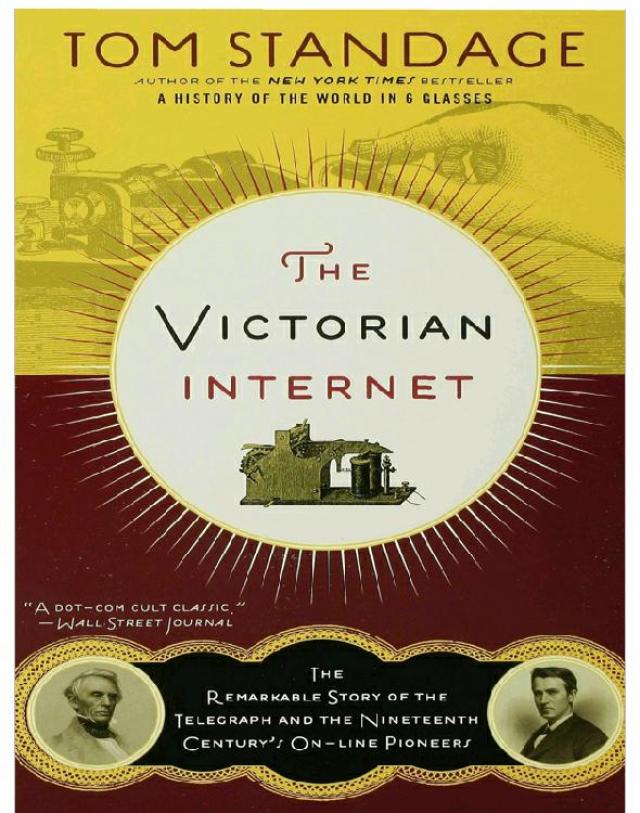


More striking still are the parallels between the social impact of the telegraph and that of the Internet. Public reaction to the new technologies was, in both cases, a confused mixture of hype and skepticism. Just as many Victorians believed the telegraph would eliminate misunderstanding between nations and usher in a new era of world peace, an avalanche of media coverage has lauded the Internet as a powerful new medium that will transform and improve our lives.
Some of these claims sound oddly familiar. In his 1997 book What Will Be: How the New World of Information Will Change Our Lives, Michael Dertouzos of the Laboratory for Computer Science at the Massachusetts Institute of Technology wrote of the prospect of "computer-aided peace" made possible by digital networks like the Internet. "A common bond reached through electronic proximity may help stave off future flareups of ethnic hatred and national breakups," he suggested. In a conference speech in November 1997, Nicholas Negroponte, head of the MIT Media Laboratory, explicitly declared that the Internet would break down national borders and lead to world peace. In the future, he claimed, children "are not going to know what nationalism is."
The similarities do not end there. Scam artists found crooked ways to make money by manipulating the transmission of stock prices and the results of horse races using the telegraph; their twentieth-century counterparts have used the Internet to set up fake "shop fronts" purporting to be legitimate providers of financial services, before disappearing with the money handed over by would-be investors; hackers have broken into improperly secured computers and made off with lists of credit card numbers.
People who were worried about inadequate security on the telegraph network, and now on the Internet, turned to the same solution: secret codes. Today software to compress foles and encrypt messages before sending them across the Internet is as widely used as the commercial codes that flourished on the telegraph network. And just as the ITU placed restrictions on the use of telegraphic ciphers, many governments today are trying to do the same with computer cryptography, by imposing limits on the complexity of the encryption available to Internet users. (The ITU, it should be noted, proved unable to enforce its rules restricting the types of code words that could be used in telegrams, and eventually abandoned them.)
On a simpler level, both the telegraph and the Internet have given rise to their own jargon and abbreviations. Rather than plugs, boomers, or bonus men, Internet users are variously known as surfers, netheads, or net izens. Personal signatures, used by both telegraphers and Internet users, are known in both cases as sigs.
Another parallel is the eternal enmity between new, inexperienced users and experienced old hands. Highly skilled telegraphers in city offices would lose their temper when forced to deal with hopelessly inept operators in remote villages; the same phenomenon was widespread on the Internet when the masses hrst surged on-line in the early 1990s, unaware of customs and traditions that had held sway on the Internet for years and capable of what, to experienced users, seemed unbelievable stupidity, gullibility, and impoliteness.
But while conflict and rivalry both seem to come with the on-line territory, so does romance. A general fascination with the romantic possibilities of the new technology has been a feature of both the nineteenth and twentieth centuries: On-line weddings have taken place over both the telegraph and the Internet. In 1996, Sue Helle and Lynn Bottoms were married on-line by a minister 10 miles away in Seattle, echoing the story of Philip Reade and Clara Choate, who were married by telegraph 120 years earlier by a minister 650 miles away. Both technologies have also been directly blamed for causing romantic problems. In 1996, a New Jersey man filed for divorce when he discovered that his wife had been exchanging explicit e-mail with another man, a case that was widely reported as the first example of "Internet divorce."
After a period of initial skepticism, businesses became the most enthusiastic adopters of the telegraph in the nineteenth century and the Internet in the twentieth. Businesses have always been prepared to pay for premium services like private leased lines and value-added information—provided those services can provide a competitive advantage in the marketplace. Internet sites routinely offer stock prices and news headlines, both of which were available over a hundred years ago via stock tickers and news wires. And just as the telegraph led to a direct increase in the pace and stress of business life, today the complaint of information overload, blamed on the Internet, is commonplace.
The telegraph also made possible new business practices, facilitating the rise of large companies centrally controlled from a head office. Today, the Internet once again promises to redefine the way people work, through emerging trends like teleworking (working from a distant location, with a network connection to one's office) and virtual corporations (where there is no central office, just a distributed group of employees who communicate over a network).
The similarities between the telegraph and the Internet—both in their technical underpinnings and their social impact—are striking. But the story of the telegraph contains a deeper lesson. Because of its ability to link distant peoples, the telegraph was the first technology to be seized upon as a panacea. Given its potential to change the world, the telegraph was soon being hailed as a means of solving the world's problems. It failed to do so, of course-but we have been pinning the same hope on other new technologies ever since.
In the 1890s, advocates of electricity claimed it would eliminate the drudgery of manual work and create a world of abundance and peace. In the first decade of the twentieth century, aircraft inspired similar flights of fancy: Rapid intercontinental travel would, it was claimed, eliminate international differences and misunderstandings. (One commentator suggested that the age of aviation would be an "age of peace" because aircraft would make armies obsolete, since they would be vulnerable to attack from the air.) Similarly, television was expected to improve education, reduce social isolation, and enhance democracy. Nuclear power was supposed to usher in an age of plenty where electricity would be "too cheap to meter." The optimistic claims now being made about the Internet are merely the most recent examples in a tradition of technological utopianism that goes back to the first transatlantic telegraph cables, 150 years ago.
That the telegraph was so widely seen as a panacea is perhaps understandable. The fact that we are still making the same mistake today is less so. The irony is that even though it failed to live up to the Utopian claims made about it, the telegraph really did transform the world. It also redefined forever our attitudes toward new technologies. In both respects, we are still living in the new world it inaugurated.
EPILOGUE
THE HYPC SKEPTICISM, and bewilderment associated with the Internet—concerns about new forms of crime, adjustments in social mores, and redefinition of business practices—mirror the hopes, fears, and misunderstandings inspired by the telegraph. Indeed, they are only to be expected. They are the direct consequences of human nature, rather than technology.
Given a new invention, there will always be some people who see only its potential to do good, while others see new opportunities to commit crime or make money. We can expect exactly the same reactions to whatever new inventions appear in the twenty-first century.
Such reactions are amplified by what might be termed chronocentricity—the egotism that one's own generation is poised on the very cusp of history. Today, we are repeatedly told that we are in the midst of a communications revolution. But the electric telegraph was, in many ways, far more disconcerting for the inhabitants of the time than today's advances are for us. If any generation has the right to claim that it bore the full bewildering, world-shrinking brunt of such a revolution, it is not us—it is our nineteenth-century forebears.
Time-traveling Victorians arriving in the late twentieth century would, no doubt, be unimpressed by the Internet. They would surely find space flight and routine intercontinental air travel far more impressive technological achievements than our much-trumpeted global communications network. Heavier-than-air flying machines were, after all, thought by the Victorians to be totally impossible. But as for the Internet—well, they had one of their own.
AFTERWORD
One OF THE AOVANRAGES of writing an Internet book in which everything is already 150 years out of date is that the story is in less danger of being overtaken, or rendered irrelevant, by subsequent developments. The Victorian Internet was mostly written in 1997, and is published here in its original form. Much has changed on the Internet since then, of course; the utopianism of the late 1990s evaporated in the dotcom crash of 2000, though the spread of broadband connections and the growth of new Internet business models built around online commerce and advertising have since helped many firms to bounce back. And despite everything that has happened in the past ten years, the analogy between the Internet and the telegraph still holds.
That the Internet has continued to evolve is not surprising. But oddly enough the telegraph has been in the news, too. Having been inaugurated with Samuel Morse's first official telegram, "What hath God wrought!" in 1844, telegraph service in the United States was discontinued in 2006 with a rather more prosaic message: "Effective January 27, 2006, Western Union will discontinue all Telegram and Commercial Messaging services. We regret any inconvenience this may cause you, and we thank you for your loyal patronage." Like many people I was saddened to hear of its demise—yet I was also surprised to learn that the telegram had survived as long as it had, given the availability of so many faster, cheaper, and more convenient forms of electronic messaging.
Ten years ago electronic messaging would have meant e-mail in particular, but another striking development of the past decade has been the curious rebirth of the telegram in the form of text messages sent between mobile phones. Initially adopted by European teenagers as a cheap alternative to expensive mobile-phone calls, text messages have become a new communications medium in their own right, all over the world. Around i.3 trillion text messages were sent during 2006; Americans, who were relatively late adopters of the technology, sent 158 billion text messages that year. (The volume of e-mails is still higher, however; around 9 trillion non-"spam" e-mails were sent in 2006.)
Like telegrams before them, text messages force people to be brief and to the point, and they have spawned their own vocabulary of space-saving abbreviations, such as "c u 18r." This is not the only echo from the age of the telegram. A Nokia handset can be programmed to announce incoming text messages with three short beeps, two long ones, and three short ones—Morse code for "SMS" or "short message service," the technical term for text messaging. Samuel Morse would be proud. A defunct nineteenth-century technology has, in effect, been reincarnated in the twenty-first century. The telegram is dead; long live the telegram.
Yet the mobile phone is not just the heir to the telegraph's tradition. It could also prove to be the most important heir to the personal computer, as Internet-enabled mobile devices proliferate. Indeed, mobile phones could do for the Internet what the telephone did for the telegraph: make it easier to use and far more widely available.
It was the telegraph's fate to be overshadowed by several of its offspring, by the telephone in particular, which was first regarded as a minor variation of the technology (a "speaking telegraph") but ended up being far more popular. The telegraph also spawned the stock ticker, teletype machines, and early forms of a fax machine capable of sending pictures by telegraph. All of these dedicated devices used variations of the original telegraph technology for particular purposes. The same thing is now happening to the Internet, as it becomes embedded into other devices, rather than being something accessed only through a personal computer. Task-specific devices such as Internet-capable music players, games consoles, television set-top boxes, and hi-fis are now available.
But access to the Internet through mobile devices, such as phones and BlackBerry handhelds, is the biggest growth area. In rich countries, personal computers were widespread before mobile phones. In poor countries mobile phones are widespread than personal computers. As C. K. Prahalad, an Indian management guru, puts it: "Emerging markets will be wireless-centric, not PC-centric." The number of mobile phones in use is over 2-5 billion and growing fast, even in the poorest parts of the world. Mobile phones will complete the democratization of telecommunications started by the telegraph.
Tom Standage
April 2007
SOURCES
In addition to the specific books and journals listed below, I found information on the subject in the following publications: Electrical World (New York), Journal of Commerce (New York), Journal of the Telegraph (New York), Scientific American (New York), and The Times (London).
Anecdotes of the Telegraph. London: David Bogue, 1849.
Babbage, Charles. Passages from the Life of a Philosopher. London: Longman & Co., 1864.
Blondheim, Menahem. News over the Wires: The Telegraph and The Flow of Public Information in America, 1844—1897. Cambridge, Mass, and London: Harvard University Press, 1994.
Bowers, Brian. Sir Charles Wheatstone. London: HMSO, *975
Briggs, Charles, and Augustus Maverick. The Story of the Telegraph. New York, 1858.
Clarke, Arthur C. How the World Was One. London: Victor Gollancz, 1992
Clow, D. G. "Pneumatic Tube Communication Systems in London," Newcomen Transactions, pp. 97—115, 1994-95.
Coe, Lewis. The Telegraph, a History of Morse's Invention and Its Predecessors in the United States. London: McFar-land, 1993.
Congdon, Charles. Reminiscences of a Journalist. Boston: James R. Osgood & Co., 1880.
Cooke, Sir William Fothergill. The Electric Telegraph: Was It Invented by Professor Wheatstone? (Mr. Cooke's First Pamphlet; Mr. Wheatstone's Answer; Mr. Cooke's Reply; Arbitration Papers and Drawings.) London: W. H. Smith & Son, 1857.
Corn, Joseph J., ed. Imagining Tomorrow: History, Technology, and the American Future. Cambridge, Mass.: MIT Press, 1986.
Dertouzos, Michael. What Will Be. How the New World of Information Will Change Our Lives. London: Piatkus, 1997.
Du Boff, Richard R. "Rusiness Demand and the Development of the Telegraph in the United States, 1844—i860," Business History Review vol. 54, pp. 459—79, 1980.
Dyer, Frank Lewis, and Thomas Commerford Martin. Edison: His Life and Inventions. New York: Harper and Rrothers, 1910.
Gabler, Edwin. The American Telegrapher—A Social History. New Brunswick: Rutgers University Press, 1988.
Headrick, Daniel R. The Invisible Weapon. London: Oxford University Press, 1991.
Holzmann, Gerard, and Rjorn Pehrson. Early History of Data Networks. Los Alamitos, Calif.: IEEE Computer Society Press, 1995.
Hubbard, G. Cooke and Wheatstone and the Invention of the Electric Telegraph. London: Routledge and Kegan Paul, 1965.
Kahn, David. The Codebreakers. New York: Macmillan, 1967.
Kieve, Jeffrey. The Electric Telegraph: A Social and Economic History. Newton Abbot: David and Charles, 1973.
Lebow, Irwin. Information Highways and Byways: From the Telegraph to the vst Century. New York: IEEE Computer Society Press, 1995.
Marland, Edward Allen. Early Electrical Communication. London: Abelard-Schumann, 1964.
Marvin, Carolyn. When Old Technologies Were New-. Thinking About Electric Communication in the Late Nineteenth Century. New York and Oxford: Oxford University Press, 1988.
Morse, Samuel F. B., and Edward Lind Morse. Samuel F. B. Morse: His Letters and Journals, Edited and Supplemented by His Son Edward Lind Morse. Boston: Houghton Mifflin, 1914.
Prescott, George B. Electricity and the Electric Telegraph. London: Spon,1878.
Prescott, George B. History, Theory, and Practice of the Electric Telegraph. Boston, i860.
Prime, Samuel Irenaeus. The Life of Samuel F. B. Morse. New York: Appleton, 1875.
Reid, James D. The Telegraph in America and Morse Memorial. New York: Derby Rrothers, 1879.
Shaffner, Tal. The Telegraph Manual. New York: Pudney and Russell, 1859.
Shiers, George, ed. The Electric Telegraph—An Historical Anthology. New York: Arno Press, 1977
Spufford, Francis, and Jenny Uglow, eds. Cultural Babbage. London: Faber and Faber, 1996.
Thompson, Robert L. Wiring a Continent. The History of the Telegraph Industry in the United States, 183?—1866. Princeton: Princeton University Press, 1947.
Turnbull, Laurence. The Electro-Magnetic Telegraph. Philadelphia: A. Hart, 1852.
F. H. Webb, ed. Cooke, Sir William Fothergill: Extracts from the Private Letters of the Late Sir William Fothergill Cooke, i836-3g, Relating to the Invention and Development of the Electric Telegraph. London: E. & F. N. Spon, 1895.
Wilson, Geoffrey. The Old Telegraphs. London: Chichester Phillimore, 1976.
ACKNOWLEDGMENTS