Gods of opar v1 0, p.71
Gods of Opar (v1.0),
p.71


Restrained by the chains that bound him, Kwasin shuffled angrily down the steps to the hold. When they reached the bottom, Ruseth ordered his men to remove Kwasin’s shackles, including those that had been put on him prior to the tower ceremony.
“Explain!” Kwasin boomed, turning on the young admiral. Ruseth’s soldiers jumped into action, crossing their spears protectively in front of their superior.
“Keep your voice down!” Ruseth whispered. “If you draw the attention of the queen’s guards, I won’t be able to get you off the ship and take you to the oracle.”
Kwasin knocked the soldiers’ spears out of his way and throttled Ruseth in his powerful grip.
“Tell me what’s going on,” Kwasin said forcefully, though he lowered his voice. “If you don’t, you’ll never again utter another prayer to Piqabes!”
Ruseth waved off his men, who were on the verge of running Kwasin through with their swords and spears. “We don’t have time,” Ruseth replied with some difficulty because of Kwasin’s unyielding grip, “but if you insist.”
Kwasin released his hold.
Rubbing his neck, Ruseth said, “A madness has seized the queen. The priestesses tell me her mind went when her baby died of plague, only shortly after she—” Ruseth stopped, his wincing face showing that he only now realized Kwasin knew nothing of the death of his and Awineth’s child. “Forgive me, O King!”
Kwasin felt as if a leopard’s claws had raked out his bowels, but he told Ruseth to go on.
“Because all sense has left the queen’s mind, the oracular priestess has secretly taken charge of the army my ships have carried from Siwudawa. But the oracle knows you have become quite a folk hero among those in the resistance. She wants you by her side, O King, when she announces to the people that Queen Awineth has been deposed.”
Kwasin shook his head, not comprehending. “You say Awineth is mad, and truly she must be, for I have seen it with my own eyes. But the oracle must have lost her own mind to think the queen can be dethroned. Kho’s followers won’t stand for it! After enduring the hell Minruth has caused them, they would rather see the land torn asunder!”
“You wouldn’t be wrong, O King,” Ruseth replied, “except that Awineth has gone too far. She is not content with the priestesses’ contention that Resu must be restored to his rightful position on an equal footing with Kho. No, she has actually declared Resu to be a false god and thrown him completely from the pantheon! And that is not all—she has called for an end to the priesthood and death to its entire clergy. The oracle—the holy voice of the Voice of Kho—was outraged when she learned of this. She says the queen’s position is as unhinged as Minruth’s scorning of Kho. Both positions, the oracle says, create an imbalance among the deities that threatens to give rise to a terrible calamity, one from which the land will never be able to recover.”
“Will the empire never be at peace?” Kwasin cried.
“No, O King,” Ruseth replied. “The priestesses tell us that war has existed since the time Kho’s mortal offspring first fell from Her divine branches. I expect it always will. But then, your question is rhetorical, isn’t it?”
“What is the oracle’s plan?” Kwasin asked before his patience exploded.
“I am under orders to take you across the gulf to the Terisiwuketh Peninsula, where the oracular priestess awaits with her army. A brief ceremony will be held there in which Awineth’s bond to the throne will be officially annulled. Thereafter, you will be wed to Awineth’s young cousin, the priestess Awamethna, who is next in line to the queenship. Subsequently you will be named king of kings and lead the oracle’s army to victory against the last remnants of Minruth’s forces.”
Kwasin’s head reeled, overwhelmed by both the rapidity and the staggering gravity of the new developments.
“But what of Awineth?” he asked suddenly. Though sanity had fled the woman, he still could not shake his feelings of concern for her. He had spent too much time while imprisoned worrying about her fate. Now not only to discover that she hated him, but also that the priestesses and their followers conspired against her—it was too much.
“Leave that to me,” Ruseth replied ominously. At Kwasin’s threatening look he added, “She won’t be harmed, O King.”
Kwasin sighed heavily. “Take me to the oracle then.”
“Aye, sir!” Ruseth said. "I mean, follow me, O King.”
They crossed to the back of the hold and passed up another set of wooden steps to the ship’s stern. Here Ruseth already had a boat manned and ready, waiting to be lowered into the waters. As Kwasin boarded the boat, Ruseth frequently looked over his shoulder. The young sailor must be keeping an eye out for any members of Awineth’s guard who might come to investigate the unauthorized activity. Fortunately, no one came. They were probably all too busy coordinating the campaign to retake the capital.
“Goodbye, O King, and may Piqabes watch over you,” Ruseth said. A few moments later Kwasin was watching the still, blue waters of the channel peel back before the bow as the oarsmen propelled the boat forward.
It should have been a short trip to the peninsula, but because of the battle on the waters, the officer in charge of the boat insisted on taking the long way around, passing south of Mohasi island and up and around the coast. Even so, traffic on the gulf was high, and when one of Minruth’s uniremes spotted them, the officer ordered his men to row as quickly as possible for shore. Seeing that Kwasin’s boat would make it to land before it could be intercepted, the unireme turned about, heading deeper into the gulf for easier game. Still, the officer directed the seaman manning the rudder to make for shore. He told Kwasin they would have to wait until the way north had cleared, or until after the battle had been pitched in favor of the priestesses’ fleet, before again setting out on the waters. Kwasin steamed but he could do nothing.
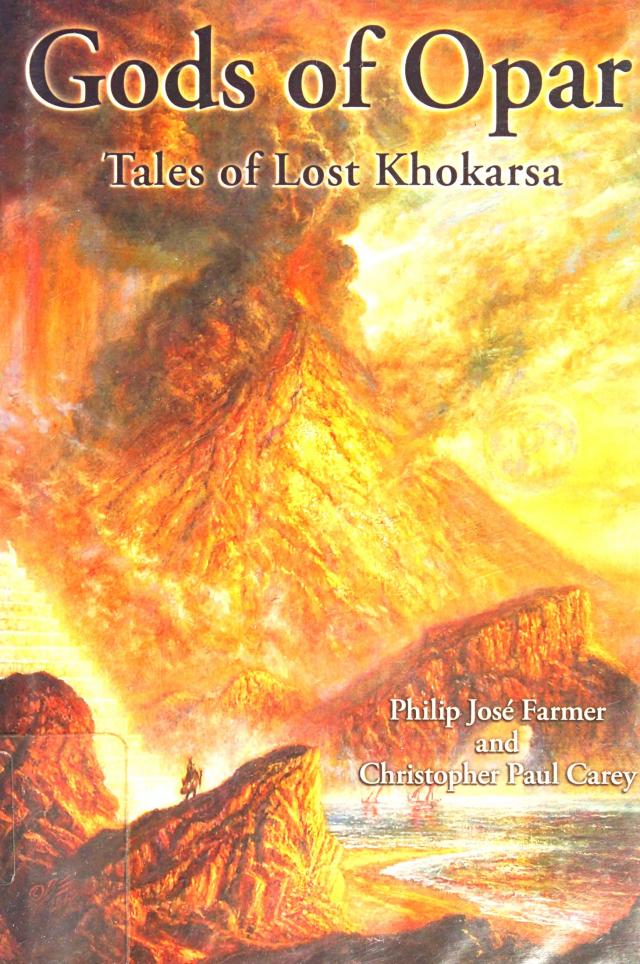
As they neared shore, the high walls of the coliseum of the Great Games, silhouetted against Khowot’s smoking cone, rose upon the horizon. Kwasin wondered how things might have been different if he, and not his cousin Hadon, had been able to compete in the Lesser and Great Games. He liked to think that after winning the bloody contests, as he unquestionably would have, he would have been man enough to stand up to Minruth when he refused to step down from the imperial throne. If he had, then the years of misery and suffering that followed might have been avoided. And perhaps Awineth would still love him. If she ever had.
He growled and shook off the hopeless dream. Even had he won the Great Games, the oracle would have sent him on the same quest as she had Hadon. And during his absence, Minruth still would have seized the reins of the empire.
They pulled up on shore, hid the boat and themselves in a thick copse of trees near the beach, and waited. An hour later Kwasin was about to set out north on foot when a scout returned to announce that the priestesses’ navy had drawn the enemy to the eastern channel. The way was again clear. Kwasin jumped up and, single-handedly, began dragging the boat back to the beach. A short time later they were again rowing northward.
At last they rounded the southern jaw of the two-pronged Terisiwuketh Peninsula, whose name aptly meant the Python’s Head. Kwasin shuddered, remembering old Wasemquth’s prophecy about his fate being tied to that of a serpent and the ax. Did the oracle of Khokarsa send Kwasin a subtle message by summoning him here? He hoped not. He tired of prophecies and the vague, often manipulative meanings of the priestesses and priests.
When the boat rounded the southern tip of the peninsula, Kwasin saw the oracle, surrounded by her priestesses and soldiers, standing high upon a hill above the shoreline. The woman made an impressive sight, the white shrouds of her robes fluttering in the intense winds and both hands clutched around a tall golden spear. Indeed, she looked as grim and terrible as the statues Kwasin had seen of the priestess-heroine Lupoeth.
After they had landed and climbed the hill, Kwasin prostrated himself before the oracle, making his supplications to the Goddess.
“Rise, O King,” the oracle cried, “and meet your wife-to-be! Behold, high priestess of Kho and of her daughter, Lahla the moon—behold, Awamethna, future Queen of Khokarsa!”
Kwasin rose. Beside the Voice of Kho—who, being in her early fifties, was nowhere near as ancient as he had imagined—stood a young priestess whose face seemed as familiar to Kwasin as her name. Then he remembered. The girl, Awamethna, had been one of the initiates who had attended him in the old temple of Kho in the marshlands outside of Dythbeth.
Truly was Awamethna a radiant thing, every bit as stunning as her cousin, though her features ran softer than Awineth’s more cutting beauty. But right now, on the heels of his stinging fallout with Awineth, Kwasin was in no mood for thoughts of women or marriage.
“Tell me, O Priestess,” Kwasin said, addressing the oracle, “what do you see in the future? Will the actions we take today finally bring peace to the land?”
The oracle leaned into her golden spear and fixed Kwasin with the dark pools of her inscrutable eyes. “Your frustration, O Long-Suffering King, is not without warrant. But even though the forces of Kho have today struck a terrific blow against Her enemies, word has come that Minruth—that greatest of blasphemers—has been driven out of the city and now flies with his decrepit followers toward Khowot. He clearly hopes to escape into the wilds beyond the volcano, where he can seek to foster a resistance of his own. Great forces whirl all about us, O King, pulling us within their furious current. There is nothing we mortals may do but remain steadfast to the Goddess and follow the flow.”
“There is one thing I may do, O Holy Oracle,” Kwasin said. “And that is to bring you Minruth’s head!”
“Kho will bring you great blessings if you do so,” the oracle replied. “But first we have other matters to attend.”
“Respectfully, O Priestess,” Kwasin said, “you will have to wait to wed this child to me. Perform what ceremonies you must to annul Awineth’s power, but do not try to stop me from going after Minruth. If I wait around for the ceremony, he’ll be sure to escape. And that I can’t allow.”
The Voice of Kho looked grave, but she said, “Do what you will, O Impatient One, for even I would not think to stop a spirit as mighty as your own. But be warned, what you find on Khowot’s fiery slopes may not be all that you have longed for.”
And with those final enigmatic words, the oracle turned her back on Kwasin, departing with the soon-to-be high priestess of Kho to begin their rituals. Meanwhile, Kwasin assembled a light team consisting of fifteen men and set out to pursue Minruth and his followers.
By the time they had marched south along the peninsula, and crossed the canal and river that stood between them and the volcano, morning had worn into afternoon. As they drew nearer to their destination, the great billows of smoke rising from Khowot’s cone grew darker and thicker, all but blotting out the sun. Bolts of lightning streaked the backdrop of the swelling black clouds, and the edges of the volcano’s lofty crater glowed bright orange as lava threatened to spill down the mountain’s cracked and angry face.
The soldiers accompanying Kwasin paled at the terrifying sight, but he urged them on, telling them that Kho Herself had belched forth the great clouds of smoke. She did this, he said, in order to hide them from Resu’s arrogant gaze and thereby allowing them to sneak up on the enemy. The frightened faces of the soldiers, however, indicated they doubted his words.
As they skirted the northwestern base of the mountain, one of the soldiers cried out. “There!” Kwasin followed the direction of the man’s pointing finger. To the south he saw a number of pale dots moving across a field of hardened lava, the same area where once had stood the Temple of Kho and the sacred oak grove. The tiny figures were ascending the face of the volcano, clearly intent on circling around its southern side. From what he could tell, the party consisted of only seven or eight members.
Again, Kwasin urged his team on. Now, as they climbed upward, the terrain became rougher and more dangerous. The deep furrows of the increasingly steep cone, and the ridges arching across its surface from previous lava flows, made for slow going.
They had made painfully little progress when Kwasin spied a second group ascending the volcano. He counted only five figures among the new party, which followed only a short distance to the south of the first group. At first he thought the newcomers might be more of Minruth’s supporters, but eventually, as his own group drew nearer, he was not so sure. One member of the new group was clearly a woman. Further, the first group seemed to have put on speed, as if desperate to escape the followers. Surely Minruth led the first group, but who led the second?
Kwasin got his answer a short time later when a runner approached from the southeast. Kwasin recognized the puffing and perspiring man as a member of Ruseth’s crew.
“Admiral Ruseth sends word that he has failed in his mission, O King!” the man exclaimed when he arrived. “The queen, aided by those most loyal to her, has escaped!”
Kwasin cursed. The second group, then, must be led by Awineth. After her own priestesses turned against her, she must have fled the city and spotted Minruth also trying to escape. Awineth was making one last attempt to wreak vengeance upon the father who had taken everything from her.
“Why hasn’t your superior sent his men after her?” Kwasin growled.
“He presently has his hands tied, O King,” the runner replied. “Queen Awineth’s men have managed to sink Admiral Ruseth’s flagship, and though it is certain the queen’s loyalists will be subdued, they’re still putting up a hell of a fight. The admiral received word from the oracle and knows of your plans to go after the king. He wanted to warn you to keep an eye out for the queen.” The man looked to the south. “But it looks like you’ve already found her.”
Kwasin charged up the slope, his great strides leaving the soldiers under his command far behind. The group led by Awineth was rapidly closing on Minruth and his men. Within ten minutes, the two groups clashed.
Only two hundred yards now separated Kwasin from the skirmishing factions. Awineth’s soldiers, though fewer in number, seemed to have gained the upper hand. He could see the bodies of three of Minruth’s men strewn across the craggy incline, dead or severely wounded. Minruth, seeing the tide of battle turning against him, now fled the melee, heading farther up the slope. Awineth broke away from the fight and began following her father, dragging something behind her which seemed to be slowing her progress. When Kwasin got close enough to see what burdened her, his heart blackened. Awineth was towing the Ax of Victory behind her up the steep side of the volcano.
Kwasin altered his course, veering toward Awineth.
Suddenly, the ground beneath Kwasin’s feet trembled, and the thick stench of ash wafted over him. He looked up to see a river of red-hot lava searing down the mountainside, following a jagged channel in the volcano’s deeply rutted shell. Now the smoldering current hit a gouge in the slanting terrain, forming a tributary that snaked down and cut off Minruth’s path. The Emperor of Khokarsa, his hawkish face carven in a look of desperation, looked down to see both Awineth and Kwasin running toward him. But Minruth could go no farther up the mountain. Already he winced with pain at the severe heat emanating from the lava flow. Blood streamed down from his left eye socket and the wound caused that morning by the handle of Kwasin’s ax.
Awineth reached her father before Kwasin. She dropped the ax and, drawing a long, slim dagger from the jeweled sheath at her waist, attacked the man who had ruined her world.
The struggle did not last long. Minruth, though unarmed and out of shape, still remembered how to fight from his old days as a champion of the Great Games and a hero of the empire. He grabbed his daughter’s wrist and twisted her arm and the dagger behind her back. Awineth, shrieking with pain and anger, fell to her knees. Minruth plucked the dagger from his daughter’s grip and shoved her forward on her face. Sobbing with rage, Awineth whirled about to look up at her father, who grinned down devilishly at her. In his hands, he held Kwasin’s ax. He looked as if he meant to swing it down and crush his daughter’s skull.
Kwasin cried out, and now both Minruth and Awineth turned to face him.
“Come no closer or I’ll kill her!” Minruth cried, brandishing the great ax over Awineth’s head.
“Why should I care if you do!” Kwasin roared. “The woman has betrayed me!” But despite his words, he stopped his ascent. He stood not half a dozen yards from the two. All about them, heat waves from the surrounding lava flows wavered through the air, lending an eerie, nightmarish quality to the scene. Surely some mysterious force beyond the understanding of mere mortals had led the three to this hellish showdown.
Then Awineth began to laugh, her look of amusement only adding to the uneasy feeling in Kwasin’s stomach.
“Kill me, father,” she said, her piercing gaze still locked on Kwasin. “Or try. The Goddess will not permit it. She will smite you both down for your offenses against Her.”
Minruth shook his head sadly, but his eyes were smiling. “My daughter’s wits have cracked like the golden eggs of Korudeth out of the old legends. But I know that you love her, Kwasin—I can see the passion burning in your "blackeyes!”
“And your own eye,” Kwasin said, “the only one left to you, burns with madness!”
Minruth only smiled and fondled the knob on the ax’s handle. “For the wound you have given me,” he replied, “I express my gratitude, as your vicious attack this morning has not in fact blinded me but rather allowed me to see! For when the haft of your mighty weapon smote out my eye, I was blessed with a vision from Great Resu! You will remember, the ax was brought back from the Wild Lands by the explicit order of the oracle...a fact which I find of extreme interest. But be that as it may, in that moment, half-blinded by your blow and toppling head over heels down the stairs of the Great Tower, I saw the future! And what do you think I saw in my vision? I saw you, Kwasin! You, the mad giant who has been the bane of my elder days, and the man who, according to the secret records I uncovered from the Temple of Khukhaken in shattered Dythbeth, was fathered by none other than Sahhindar himself! Do not look so sickly, my great opponent—or should I say ally, since everyone knows Sahhindar is the loving son of Resu.” Minruth’s wide grin cracked his bloated, heat-reddened face. “Have you not long wondered why your wild temperament burns hotter than any other in the land? It burns so fiercely because the blood of the Flaming God sears your veins!”