A samurai comes of age d.., p.1
A Samurai Comes of Age (Death Among Brothers, Book One),
p.1
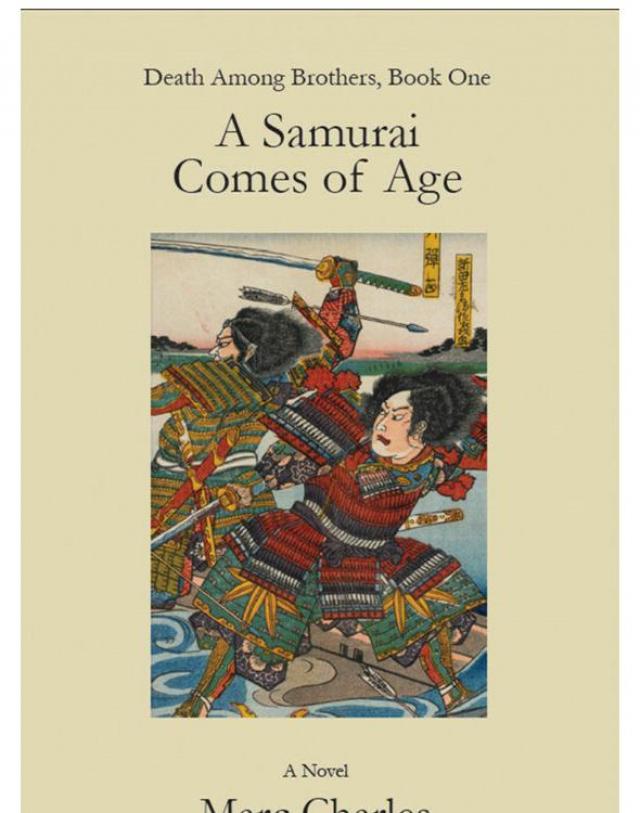


Death Among Brothers
Book One
~
A Samurai Comes of Age
a novel
Marc Charles
Copyright © 2018 by William Marcus Charles II
All rights reserved under International and Pan-American Copyright Conventions.
Published in the United States by The Ross House Press, an imprint of Canopic Publishing, Woodstock, Illinois.
Original book and cover design by Phil Rice
Canopic Publishing
389 Lincoln Ave
Woodstock, IL
www.canopicpublishing.com
For Sako, who makes it all worthwhile
Table of Contents
Preface
Chapter 1: The Lesson
Chapter 2: People of the Grass
Chapter 3: The Fox
Chapter 4: The Classroom
Chapter 5: The Call
Chapter 6: Succession
Chapter 7: Ichijoji Temple
Chapter 8: The Visitors
Chapter 9: The Tokaido
Chapter 10: The Noodle Shop
Chapter 11: Jail
Chapter 12: Jail Break
Chapter 13: New Beginnings
Chapter 14: The Castle
Chapter 15: Inspection
Chapter 16: Saving the Five Families
Chapter 17: The Bird Woman
Chapter 18: Goro’s Knot
Chapter 19: The Trial
Chapter 20: Assassins
Chapter 21: The Review
Chapter 22: New Police
Chapter 23: Payback
Chapter 24: Romancing the Nin
Chapter 25: Capture
Chapter 26: Decisions
Chapter 27: End Game
Chapter 28: Retribution
Preface
In early 1969, I stepped off an airplane at Kadena Air Base in Okinawa, a twenty-year old Marine second lieutenant with gold bars on my collar replacing the stripes on my sleeve. With the exception of Canada across the Ambassador Bridge in Detroit, I had never been outside the United States. The first thing to hit me was the smell. It was a combination of hot soy in a skillet, open binjo sewers, and the acrid bite of burning automobile tires as Okinawan protesters snake-danced around torched cars chanting “go home” in pigeon. Everything was different. I felt I’d fallen through a looking glass.
The world was much larger then. Heartland Americans seldom saw Asians. When we did, Hondas and Toyotas did not come to mind. That would follow. In those days, the derogatory characterizations from WWII and Korea were our references.
U.S. Armed Forces bases in Asia were bastions of home town America, designed to give the soldier, sailor, airman, and Marine everything he could find in any-town USA—well, almost everything. What many young men wanted they found outside the compound gates in the “vill,” short for village. Cheap beer and female companionship topped a lot of lists. Beyond these baser drives, very few were interested in the history or culture of the country in which they now resided.
But a very small group were curious about the marked differences beyond their own culture and the one that existed just beyond the gate. My discovery of the martial arts changed my world forever. Through books, constant questions to sensei’s, and searching the island on an old Honda motorcycle, I learned that the Okinawans had kingdoms and diplomats at the ancient Chinese court in Peking when the Japanese had no cities or cohesive culture and were busy foraging for food on rocky beaches. The Japanese who came to Okinawa much later did so as vanquished people from wars in Japan and commenced to trample the island culture. The islands had been known by their Chinese name of Lieu Chu for centuries, but the new conquerors from the north had trouble with the “L” sound. In the Japanese language the “L” is sounded as an “R,” so Lieu Chu became Ryuku, the name the island chain was known by until the late 20th century. At the time, very few knew this. Most didn’t care to know.
In 1969 the Okinawan people wanted to be Japanese, not the servants of the American military. They were not the less-human species our culture assumed. If you took the time, they were warm, they were forgiving of our oddities, and they demonstrated martial arts that seem almost magical—vanquishing larger foes by controlling their force. Such was not common knowledge in 1969 outside of Asia. For the next two decades I would spend a lot of time in the orient trying to learn from all.
I have walked the Shwedagon in Rangoon and climbed the Badaling Great Wall in China, breathed the soot-filled air of Shenyang and coughed the red dust of New Delhi. I have been amazed and humbled by Mother Teresa and her oasis of calm among the slums of Calcutta and dodged unmentionable waste on city sidewalks in the metropolis now known as Mubai, then called Bombay. I have watched around the clock cremations at Pashupatinath Temple in Kathmandu, dined with the Gurkha and wandered the streets of Nepal during a beggar’s moon. I’ve watched the beaches of Sri Lanka at their most peaceful and seen the aftermath of civil war in the north. I’ve dodged lightning strikes in Kuala Lumpur, wandered the back alleyways of Singapore, and bartered for a kris in Jakarta. I have taught self-defense in Dhaka, Bangladesh, and gotten lost in the tenements of Hong Kong and the maze that is Kowloon. I’ve done time on Yankee and Dixie station in Viet Nam and explored off the beaten path in Kaohsiung, Taichung, and Taipei, Taiwan. I have trained in the jungles of the Philippines and learned to eat bat, owl, and other delicacies from Negritos. I have also ridden Jeepneys, studied Escrima and given karate and kobudo martial demonstrations to Manila police. I have wandered Thailand from Phuket to Bangkok to the Golden Triangle. I have traveled Asia as a Marine on official assignment, sometimes as a traveler, infrequently as a tourist, and often as a student of martial arts trying to accumulate more skill. But Okinawa was the first stop on my Asian odyssey, and Japan captured my heart.
Eventually I would become a Roku-dan (sixth degree black belt) in Okinawan Kenpo Karate and a Roku-dan in Kobudo (the weapons of Okinawa). I would also obtain a Sho-dan (first degree black belt) standing in Shorinryu Karate, and I studied under some brilliant instructors in Aikido, Aikijujitsu, American Kenpo, and other art forms. I have founded Okinawan Kenpo and Kobudo schools in Virginia and Hawaii, and taught hundreds of Marines on aircraft carrier hanger decks, amphibious well decks, and embassy Marine houses in every clime and place.
I trained in backyards, garages, alleyways, and in some very small dojos as well as some of the grandest. Whether searching for a kris in Jakarta or katana in Kamakura, I tried to cobble out a sense of history in each one of the countries visited while adding to my arsenal as a professional Marine. I have spent much of my adult life studying, working, and living in Asia. For thirty-four years I have been blest to be married to a remarkable university educated Japanese lady who claims I know more about Japanese history than she. She is wrong; I don’t. But I have made it a point to learn about the unique warriors of ancient Japan.
Japan’s history has been one of strife. Remains found in burial tombs ranging from the fourth century AD are ringed with swords, spears, helmets, shields, bows, arrows, and all manner of martial gear, attesting to the military sophistication and mindset of the people. The culmination of this warrior ethos led to the establishment of a military government in 1185. Yoritomo Minamoto seized control of Japan when his unsophisticated bushi warriors easily defeated the more civilized noble army of the emperor in engagements known as the Genpei Wars.
Yoritomo did not want his tough country warriors to fall victim to the bureaucratic malaise of other conquering armies as they adjusted from conquerors to rulers. He also was a little paranoid—looking over his shoulder and listening for footsteps of the next ambitious warlord from the provinces wielding a sword and a bow in search of glory. Yoritomo moved his army and his paranoia eastward to Kamakura and established the bakufu (government). It was the first centralized government run by a military junta in Japan’s history. Some form of this junta, with samurai at the helm, would rule Japan for the next 683 years. In 1868, the last Tokugawa shogun would resign and power shift back to the emperor (Meiji Restoration), ending the rule of the samurai.
The word “samurai” derives from the verb saburau, “to serve.” The samurai and their earlier cousins, the more proficient bushi warriors, were unique in the annals of history. Their allegiance to their overlord was fanatical. Their willingness to die and the ritual suicide of seppuku (more commonly termed hara kiri—belly cutting) set them apart. A samurai’s life was to be “light as a feather,” and he had to be ready to lay it down at a moment’s notice.
Another tenant of the samurai that set him apart from other ruling classes of the world was the code of the warrior—Bushido. In the 19th century Nitobe Inazo would write a bestseller called Bushido, the Soul of Japan. (President Teddy Roosevelt bought five dozen copies for family and friends.) Bushido teaches that men should behave according to an absolute moral standard, one that transcends logic. What’s right is right, and what’s wrong is wrong. The difference between good and bad and between right and wrong are givens, not arguments subject to discussion or justification—and a man should know the difference. The Eight Virtues of Bushido were: 1) Rectitude or Justice; 2) Courage; 3) Benevolence or Mercy; 4) Politeness; 5) Honesty and Sincerity; 6) Honor; 7) Loyalty; and 8) Character and Self Control. Upon these pillars rode the chivalry of the samurai.
The death knell of the samurai was sounded with the
ascension to power of Ieyasu Tokugawa and the 265 years of peace he and his progeny presented the country. In 1600 he was victorious at the battle of Sekigahara. Three years later he became the founder of a shogunate in a dynasty that would last 265 years—until 1868. These 265 years of virtual peace reshaped the country.
Once control was established, people could move about. Intra-country trade flourished. Harvests were stabilized, subject only to natural disasters, not the ravages of war. Hunger was still an issue, but not on the grand scale of the preceding 200 years of the Warring States Period.
Ieyasu was a visionary and an intricate planner. But like the law of unintended consequences, many of his edicts eventually proved counterproductive to the government that wrought them. His burdensome taxation of large landowners brought many of them down, releasing a flood of master-less samurai onto the economy. These ronin (wave-men who floated from place to place without allegiance to a master) were warriors in a land of peace. They had no jobs and no way to get them. Many put up their swords and became laborers or artisans. Others became bodyguards for gangsters or outright brigands themselves, abandoning all the precepts of Bushido.
Another unintended consequence was kyodai goroshi, or "relative killing." Ieyasu had been specific in dictating the manner in which his successors would be chosen. They had to come from his line. Whether legitimate or not, any male progeny was to be considered by the chamberlain (the departing shogun’s chief of staff), the Tairo (greater counselors) and the Roju (lesser counselors)—a total of about eight men.
Unfortunately, Ieyasu left many progeny. Because many owed their livelihood and power to continued favor of the shogun, they had a vested interest in who might ascend to the shogun position. Some attempted to influence the outcome. Many of the progeny would not live to make the trek to Edo for an audience and evaluation. They would die of mysterious causes, suddenly and without warning, or they would fall victim to “bandits.” Of course, none in the government wanted a scandal tied to their actions, so third party assassins were used. Who better to employ for such a task than shonobi no mono ("children of the grass"—ninja)?
The Tokugawa’s gift of peace to the land meant the samurai had no wars to fight. The constant honing of martial skills was not required. Bushido gave way to getting ahead in a country where merchants controlled trade and money. The country’s hierarchical symmetry was turned on its head. samurai had few skills with which to make money. They did have power, still being at the apex of government. Needless to say, corruption was rampant at every level. As always, the commoner paid the price. Young samurai were either schooled in the art of corruption and influence peddling or they were taught the old ways of Bushido with few means to get ahead or to test their ability. This led many of the dedicated to test their martial skills via musha shugyo (warrior’s pilgrimage).
The acolyte would travel the country stopping in dojos (martial schools) trying to perfect his skill with the sword. If he lived, he might become famous. If he died, then he had been true to Bushido. But whether he became famous of not, if he lived and adhered to Bushido he was relegated to the life of a pauper, living off the largess of others. The era of Tokugawa peace had simply made the samurai obsolete.
In the following novel, Hideki, the protagonist, is one of the young descendants from the line of Tokugawa Ieyasu. He and his older brother Naga are summoned to Edo at the announcement that the current shogun is retiring. Hideki is a likeable seventeen year old and a little of a rapscallion prone to ducking his samurai responsibilities for more time in the dojo. The sword is his life and Bushido is his mantra. He dreams of being a great swordsman but has trouble even beating his older brother—until he sees a real master swordsman on his own musha shugyo challenge and defeat the head of Hideki's dojo.
On their trek to Edo for an audience and evaluation, Hideki grows from a daydreaming teenager to a responsible adult, dealing with his first crush on a female, assassins out to extinguish his life, and deceptive and corrupt police and government officials. He is aided in his journey by a deadly master duelist, a young ninja steeped in the old ways of the shinobi, and a princess of a large ninja clan who unknowingly falls in love with her target.
Hideki attracts a loyal following because of his childlike belief in Bushido as cure-all for everything, but he becomes internally conflicted when he learns his code may not provide all the answers. And if his brother does become shogun, Hideki will never be allowed the opportunity to become the swordsman he wants to be.
Writing a novel is the easy part. It is generally a solitary endeavor. Getting the book ready and into publication is not. This is where the real work starts. Superstar authors have a team of high speed, low drag, Teflon coated wordsmiths ready and willing to slice and dice each sentence. I have had to rely on a team of well-educated, well-read and well-meaning people to give me a hand. They all have my heartfelt thanks. Sako Charles for her expertise on all things Japanese and discovering my monotone delivery of each chapter is an instant cure for insomnia. Mary A. Charles had to suffer through a chapter at a time when direction was an elusive goal. Her insights proved most helpful. Michelle Charles read the entire first manuscript and gave invaluable suggestions from a voracious reader’s perspective. Ashleigh Charles Palmer gets my thanks for telling me definitions in sentences slow down the action.
Pamela Charles gets many, many thanks for too many things to mention here, not the least of which is putting up with my musings during writer’s block and reminding me that readers do not need three paragraphs to describe socks. Who knew? James L. Charles, J.D. gets my thanks for his time and for pointing out minor characters were often more interesting, thereby planting a seed for a sequel. I am thankful to Dr. Raleigh Charles for suggesting I take advantage of Tom Tyner’s expertise and good-naturedness. I am deeply indebted to Tom Tyner of Middle Tennessee State University’s English Department for his detailed work in turning my scribbling into English and for introducing me to Phil Rice of Canopic Publishing. Phil Rice, my publisher and partner, turned the English into prose and put up with sophomoric questions.
There are many others that I ought to thank but they are in other countries in obscure dojos teaching the next generation martial arts.
William Marcus Charles II, MBA
Lieutenant Colonel, USMC (Ret.)
Chapter 1: The Lesson
Five men on their knees, foreheads wedged into the hot dirt, paid tribute before him. This part never felt comfortable. It did not seem proper for five village headmen, most twice his age, to prostrate themselves to him. Bowing to grandfather Jii was proper. He was the senior Yoshinobu. He had fought beside Ieyasu at Sekigahara. Everyone bowed to Jii. Bowing to his older brother Naga was also proper. Naga acted old, although only three years separated them.
Hideki had never felt comfortable with older people bowing to him. It was not that he lacked self-esteem or confidence. He was samurai. Self-esteem, confidence, and superiority were his birthright. Bowing just did not seem important to Hideki. Balancing the census rolls would be a better use of the five men’s time. Then he could get to the afternoon dojo practice without worrying whether Jii would scold him for another job half completed.
The dojo was important. Honing his skills with a katana was important. Becoming the best swordsman in the land was important. Bowing and apologizing for problems was a waste of time. It accomplished nothing. However, he would have to let the drama play out for a few moments. He was committed now, but he tuned out the denials and moanings coming from the bowed men. He instead focused on the noon sun penetrating his brown summer kimono. The rays felt like a shower of fine hot needles from which the thin cotton fabric across his shoulders afforded scant protection.
He was glad he was not required to keep his head shaved like most young samurai men. Leaving the sides long, pulled back into a heavily waxed chonmage and folded forward on the shaved pate was ridiculous in Hideki’s mind. Naga did not agree. His older brother wore his hair in the latest Edo style. Hideki thought many things that Naga did were strange. Naga had always been everyone’s favorite. He was destined for great things, they would say. Maybe he was, but the great things he was destined for held little interest for Hideki. He lived for Bushido.