A samurai comes of age d.., p.8
A Samurai Comes of Age (Death Among Brothers, Book One),
p.8
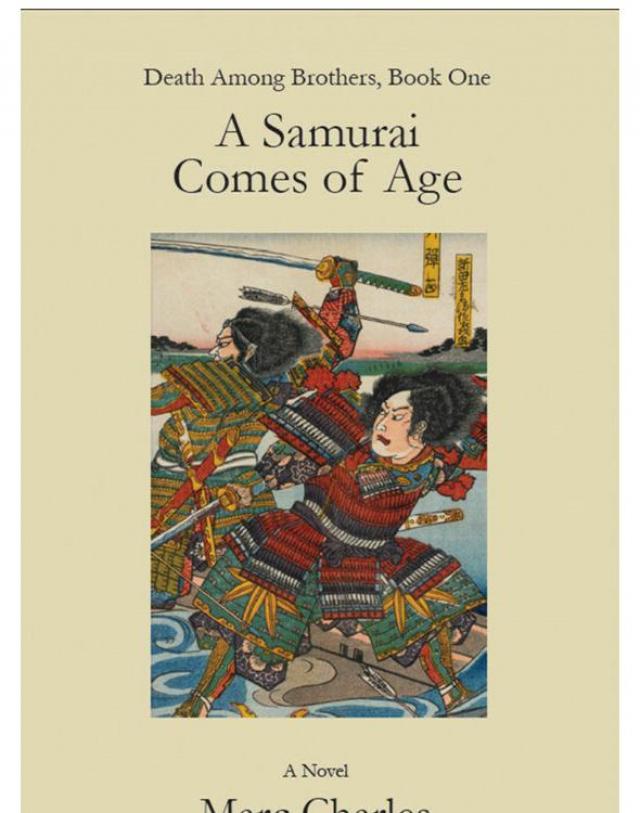


Hideki took the ladle, dipped it into the pool, brought it toward his lips, and paused. “I did it for two reasons. One, you do look like you have traveled far and therefore needed it more than I did. Secondly, I was honoring your bravery.”
“My bravery … I am not the one who kicked a doshin and threatened to kill a police officer.”
Hideki smiled. “No, but you opened your mouth in defense of the girl when I would not. Your actions made me ashamed for not following Bushido.”
The sitting samurai smiled. “Amoshiroi. I witness a courier protect a complete stranger and a sharp-eyed youngster speak of Bushido. How interesting.”
Hideki bowed to the older samurai. “Simasen, you probably don’t remember me as we were not properly introduced.”
“I remember you. You were the only one in the dojo in Kii a couple of weeks ago with sense enough to watch me instead of that idiot instructor I knocked unconscious. That is why I made the comment about you having sharp eyes.”
Hideki bowed deeply this time. “Hai, Yoshinobu Hideki desu. Dozo uroshuku onagai shimasu,” he announced by way of introduction.
The samurai stood up and returned the bow just as deeply. “Myamoto Musashi, ona gaishimasu,” he stated. Then he sat back down. Hideki’s mouth must have been open again. “You have heard of me?”
“Yes sensei, who has not? You are famous even in Kii for your many duels. They say you have never been beaten,” Hideki managed. “Some say you are Tsukahara Bokuden reincarnated. Some say you are Osensei.”
“Osensei?” Musashi snorted. “I am neither Tsukahara sensei nor a sword saint, Yoshinobu-san. I am a traveling ronin on a musha shugyo. I travel the country on my warrior’s pilgrimage, trying to perfect myself. And I, like you, try to live by Bushido.”
“Musashi-dono. You are living my dream,” Hideki proclaimed.
“Call me Takezo, Yoshinobu-san,” Musashi said. “Although a samurai, I had humble beginnings and find among friends I prefer my original name.”
“Hai,” Hideki said. “Please call me Hideki.”
“Hideki it is,” Musashi said. Then, turning to the courier, he asked, “And what is your name, my courageous courier?”
The courier looked embarrassed. Then he bowed deeply. “I am honored that you speak to me at all. I am just a commoner. I am Yoshi of the Abe Courier Service in Edo. I was delivering a package to the abbot of this temple.”
Musashi bowed in return. “A courier perhaps, but I believe you to be more.”
Yoshi bowed deeper. “No samurai-san. I am only a courier,” he insisted.
Musashi nodded. “As you wish Yoshi, but your skills betray you.”
Yoshi raised his eyes to meet Musashi’s. “Not many would have noticed,” Yoshi complimented.
Musashi brushed off the praise. “To tell the truth, I pay a great deal of attention to men who fight with a jo ever since one defeated me.”
Hideki’s face showed his surprise. “Takezo, I heard you were undefeated. Is the rumor not so?”
“It is not so, Hideki,” Musashi said. “Nor are most of the rumors about me. Twice a young priest and his mother defeated me. The mother was unarmed, but the priest was armed with a jo.”
“But how could a short wooden staff defeat a great swordsman like you?” Hideki asked.
Musashi smiled. “How long is your katana, Hideki?”
Hideki responded immediately. “It is two and one half shaku.”
Then Musashi turned to the courier. “How long is your jo, Yoshi?”
“Four shaku, samurai-san.”
“There is your answer,” Musashi said.
“Wait! That doesn’t make sense, Takezo,” Hideki protested. “If reach were the only answer, then peasants armed with six-foot staffs should defeat a sword every time.”
Musashi turned to the courier. “Do you want to tell him?”
Yoshi looked to both men, and then settled his gaze on Hideki. “The rokushaku bo staff is too long. It is six shaku long. It is a good standoff weapon but once a swordsman gets inside it is over for the bo-man. However, the jo’s length advantage over a katana does not nullify its advantages. It is short enough to allow reversal of strikes. All the strikes you make with the sword can be duplicated with the jo. In addition, I have the length advantage.”
“Well said, master,” Musashi praised.
Yoshi looked uncomfortable.
“Domo Yoshi-san,” Hideki said. “I think I begin to understand. So I didn’t save your life just now and probably landed in hot water with the law for nothing?”
“I wouldn’t say for nothing, Hideki-sama. This is the first time in my life a samurai has cared enough to defend me or ask for my advice on anything,” Yoshi said.
“You have never talked with a samurai?” Hideki asked.
“Only to be told to get out of the way.”
“Well, I don’t believe we are that much different, Yoshi,” Hideki said.
Yoshi swallowed hard and then continued. “Musashi-sama I understand. He is beyond class distinctions. He lives for his sword. You Hideki-san are obviously high born and privileged. Your speech proves such. Nevertheless, you interfered on behalf of a commoner for justice’s sake. Those are not actions expected from samurai. I am intrigued.”
“You make too much of it, Yoshi-san. It was you who spoke up first in defense of the girl,” Hideki said.
“True, but it was you who shouldered the burden and acted when you thought that I was helpless,” countered Yoshi.
“I just cannot believe you have never had a discussion with a samurai,” Hideki said.
Musashi intervened. “To address a samurai can end in death for a peasant. Most avoid contact with us. That keeps the peasants alive but ensures the ruling class is seldom in touch with the real world.”
“But if you don’t talk to samurai, how did you become master of the jo?” Hideki asked.
“You pry too much, Hideki-san,” Musashi chided. “Each man has his own secrets. The abbot of this temple is a master of the jo and he was never a samurai nor taught by one. In fact, he was taught by his mother.”
“Mother?” Hideki questioned. “I don’t believe it. He cannot be much good if taught by a woman.”
“Would you rate me as good with this sword?” Musashi asked.
“Of course,” Hideki said.
“Then it was the same not so very good jo-man of this temple who defeated me twice,” Musashi said.
Hideki looked down at Yoshi, who, smiling, said, “I had not heard that story, but it doesn’t surprise me. The abbot is known to be very strong.”
“Hideki, your provincial education is showing. That is why you need to take up a musha shugyo of your own. It is how you learn,” Musashi said. “There are martial arts all over this country that have no official status or schools. To ensure they live to the next generation they are taught between father and son, mother and daughter, and sometimes mother to son. This knowledge is the priceless heirloom of that family. How do you think the ninja families pass on their skills?”
Hideki nodded. “You are right, Takezo. I misspoke. Jii had just such little known masters come to Kii to teach my brother and myself everything from Naha te to aikijujitsu throwing arts. But none were women!”
“Well, maybe some of them should have been,” Musashi said as he slapped his right thigh with his free right hand and laughed.
A young merchant and his wife, bowing to them as they moved to the shrine behind the well, interrupted the three.
“What a night,” Hideki said. “I have learned much.”
“Yoshinobu is a famous and well-respected name,” Musashi said. “On a rainy day many years ago, there was a Yoshinobu who fought with the Tokugawa on the left flank at Sekigahara.”
“My grandfather,” Hideki said. “He is a wise and good man. He raised my older brother and myself.”
“You are lucky, Yoshinobu-san,” Musashi said.
“Yes, I know. He brought us up after my parents died. He raised us well,” Hideki said with conviction.
Musashi tilted his head slightly. “I was a very young man at Sekigahara and witnessed his bravery from the other side.”
The merchant couple’s loud clapping interrupted the three again.
“They must be raising the kami asking for a child. This temple has developed a reputation for making a barren wife fertile—if the gods answer when you awaken them with clapping hands,” Yoshi said. When the clapping stopped, he continued. “What of you young master, what are your plans?”
“What do you mean?” asked Hideki.
“You are about my age, you are educated, you seem to have a refreshing outlook on protecting the defenseless, and you are headed to Edo. As I have said, I have never talked with a samurai before. What are your hopes and plans for your life, if I may ask?”
“Oh, I see,” Hideki said. “I guess my future is being planned for me by others.” Then, with an excited tone, he added, “but if it was left up to me, I’d be doing what both of you are doing—traveling the country to make it a better place for everyone.”
“Now you sound like that bozu Takuan,” Musashi said, remembering the rascal priest with fondness.
Yoshi interrupted Musashi. “Wait Musashi-dono—do all Yoshinobu think this way?”
“Oh yes,” Hideki answered. “It is what Jii taught us. Why do samurai have power if not to better society? Being a samurai means serving others. The heart of Bushido is the protection of the weak and defenseless. That goes for war, taxes, or anything else,” Hideki said. Then adopting the deep guttural rasp of Jii, Hideki quoted, “There is no wrong too small to right and no right too small to defend.”
“Wow,” Yoshi said. “They are going to love you and your brother in Edo.”
“Why?” Hideki asked.
“Because that way of thinking is counter to what the Tokugawa have been doing in the land for the last ten years,” Yoshi explained. “What do you think happens every time the government confiscates a diamyo’s lands and dissolves a clan? Even the beggars don’t outnumber the ronin in Edo.”
The couple clapping again interrupted the three.
“The fertility rumor must have something to do with the poetry,” Musashi mused.
“Takezo, do you know this temple?” Hideki asked.
“Yes, the head priest lets me stay when I am in the area, if there are any rooms. We are great friends now,” Musashi replied. “A musha shugyo doesn’t allow for much high living. I must trust in my wits and the benevolence of others.”
“I’ve heard some ronin take jobs as yojimbo to earn their way,” Hideki offered.
“That is true, but then I’d be using my sword for someone’s profit. I would not stain my soul by being a rich merchant’s bodyguard.”
Hideki looked at Musashi. “You are not joking, are you?”
“No, Hideki, I am not.”
“I thought, besides Jii, all the real bushi were dead,” Hideki said. “In our time of peace I never suspected that I would meet a man who lives by his sword.”
“Yoshi is right. There are too many ronin in the land,” Musashi said. “Not having a master provides us with a freedom such as most samurai will never know. But freedom comes with a price, and the main price is hunger. We must live by our wits and the largesse of others. Speaking of hunger,” Musashi switched, “have you eaten, Hideki?”
“No, Takezo, I have not eaten.”
“Excellent,” Musashi said as he stood up and placed his katana in his obi. “You can treat me and Yoshi to noodles at a stand just around the corner.”
“Gladly,” Hideki laughed.
Yoshi rose and placed his jo and bundle over his shoulder. Musashi straightened up as Hideki turned toward the main gate. Then he froze. Coming through the gate were many armed men. Hideki counted seven. All carried the two swords of the samurai.
“It looks like the doshin had friends,” Hideki observed.
“I don’t think so,” Musashi said. “I believe they are here for me.”
“Is this a vendetta?” Hideki asked.
“Not an official one,” Musashi answered. “But I knew people were after me.”
“They are dressed like scarecrows, not samurai,” Hideki said.
“The swords look real enough,” Musashi said.
“Yes,” Hideki had to admit. “The swords do look real.”
“Yoshi, you and Hideki stay out of this; it is my fight,” Musashi said. “Try to protect the couple at the shrine. If this is like the last time there will be no safe ground.”
“Hai,” Yoshi answered.
“I will not, Takezo. There are rules and procedures to follow in Bushido,” Hideki stated assertively.
Musashi started to drift off to the right and away from his new friends. “Only in the history books Hideki,” he said.
“Who are you?” Hideki demanded of the scarecrows. “State your names and your purpose.”
They just kept coming toward the temple. At about three paces distance they pulled their swords as if on command.
“But there are rules and protocols to follow. This isn’t vendetta. This is murder,” Hideki protested.
“Hideki, either stay out of this or get your sword out,” Musashi commanded as he drew both swords.
Then they all charged Hideki. “Amida Buddha,” Hideki screamed as he drew his katana using the fast-draw iai style to deflect two incoming blades and step back a pace. He could not believe this was happening—he had gone from a spectator to fighting for his life in the blink of an eye. On reflex he had drawn and on reflex he was now parrying, striking, deflecting, slashing, pivoting, and chopping at any target that presented itself. He cut ankles, he cut elbows, he cut ears, he cut anything and everything he could get close enough to slice, fighting with all his strength and slipping into that zone he had experienced earlier with the police officer. His initial panic turned to pure focus. All of his training made him move. He did not think; he cut.
The initial onslaught lasted for just a few seconds as Musashi and Yoshi both recovered and came to Hideki’s side. With three of them fighting, they faced only four remaining scarecrows as three of their original number lay at Hideki’s feet. Then things got worse. Springing up from the hip-high wall surrounding the temple, tan-clad men with fox masks poured into the lot. There were many of them. The four remaining scarecrows saw their reinforcements and were motivated to attack anew. They moved forward with the first wave of the foxes.
Musashi had both swords out. Hideki did not want to waste the time to retrieve his short sword. He was too busy blocking, slashing, parrying, thrusting, and trying to stay away from the foxes’ shorter and straighter swords. They had very little wasted motion and fought better than the scarecrows.
Hideki became his sword. He reacted to everything around him. He started to feel more pressure on his left as he realized Yoshi was no longer there. Using peripheral vision, he saw Yoshi pinned to the ground by a long sword from one of the scarecrows. Hideki did not have time to see if the sword penetrated flesh or cloth. He did see that one of the foxes was standing over his new friend with a raised sword aiming for a final blow.
Hideki shifted his katana to his left hand. He drew his wakazashi short sword with his right and spun and threw it with all his might at the back of the fox standing over Yoshi. He did not have time to see it he hit his mark because two foxes were trying to disembowel him. He barely got his katana sword back into both hands and parried when Musashi’s katana sliced off the arm of one attacker and Hideki charged headlong into the second fox to negate his distance. He could feel the fox’s breath but could not see his face, only the lacquered fox face inches from his own. Hideki held the fox’s blade down with his right arm and pulled his scabbard from his obi with his left hand, raised it up and smashed it into the fox mask. Both the scabbard and the mask splintered and broke. As the fox stepped back, Hideki executed a high sweeping horizontal strike and sliced his neck with the tip of this katana. The fox dropped to the ground, twitching and gurgling.
Hideki stole a quick glance toward Yoshi. There was no fox at Yoshi’s feet with Hideki’s short sword sticking out of this back, but Yoshi was busy pulling a short sword out of a scarecrow’s stomach as he relieved him of his long sword. Then Yoshi was moving back to Hideki’s side armed with two swords. One more wave came and the three stood their ground, killing those in their immediate front and helping to kill those in front of their neighbor. Yoshi handled the swords with an unusual style. Hideki noticed he trapped the opponent’s blade with the two swords and then counterattacked to the body all in one motion.
The momentum of the attack eased. Musashi jumped in front of Hideki and slashed into the darkness. Two arrows dropped at Yoshi’s feet. “Move behind the well!” Musashi yelled.
They all retreated to the stone well and ducked down. Hideki looked behind them and saw the young couple cowering by the shrine, vulnerable to the arrows. He bent low and ran to them, motioning to cover behind the well, but they did not move. He physically grabbed the woman by the kimono lapel and dragged her behind him to the well. Her husband followed.
Hideki turned to Yoshi. “Yoshi-san, when we go back up, you stay here and ensure these two are protected,” he commanded.
“Hai,” Yoshi answered.
The arrows were a mixed blessing. As long as they flew in their direction, the foxes could not mount another attack. Therefore, the arrows stopped. Hideki stuck his head above the well and saw another attack was about to be launched.
“Amida Buddha,” Hideki muttered. “These people must really hate you, Takezo.”
Musashi looked at Hideki and smiled. “It is amazing who you count as friend and foe in this life.” Hideki did not have time to think about that remark as the foxes were coming.
Hideki and Musashi assumed their positions in front of the well and met the onslaught head on. The fighting was fierce. Hideki was aware of Musashi hitting the enemy with shoulder blows, head butts, knees—striking them in the face, stabbing them in the mask, hitting them in the throat with the butt of this sword. Both men used everything in their arsenal.
Hideki had never felt like this before. The blood lust was upon him. He was cutting legs, ankles, arms, throats, and ears—anything he could reach. He was a mad man and felt neither fatigue nor fear. He did feel the burn of two cuts on his left forearm, but they were not bleeding much.