Capes and clockwork supe.., p.20
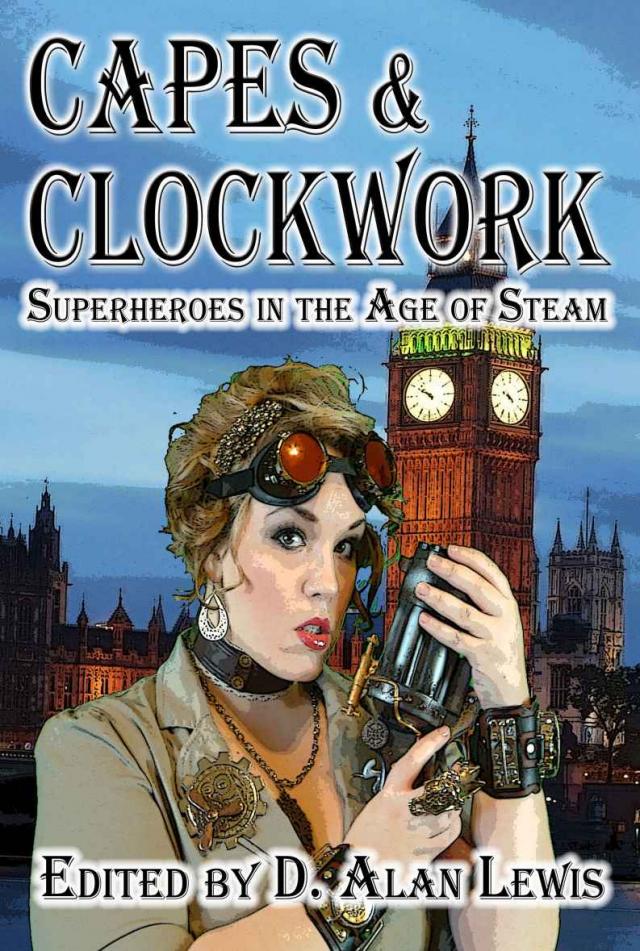
Capes & Clockwork: Superheroes in the Age of Steam,
p.20


The old man looked at his invention and smiled. “I made you very smart, I did,” he said proudly. He chortled happily and rubbed his hands together in childish glee. “Oh, I did make you smart, didn’t I?”
“How?” it asked again, leaning forward, telescopic camera eyes focusing upon his face.
“Why don’t you let me replace that knee, my boy,” he suggested, “and tell me where you have been, and then I will see if I can explain this information I have been withholding.”
“Do I have your word on that, professor?” it asked.
“My word? My word? My boy, have I ever failed to keep my word?”
“Yes.”
He fell quiet, the bubbling, self-satisfied mirth ebbing a little, and sighed, “Well, yes, I suppose I have, if you go with the idea of withholding information being a lie.”
“It is in the dictionary, Professor. It is part of the definition,” said the Self-Winding Man.
“My memory fails me, my boy. I will have to take your word for it.”
“Mine does not, Professor, I revisit that word often, and it stays in my memory.”
“Very well, I give you my word, this time. May I replace that knee for you?”
“Very well, Professor, we have an agreement.” It extended its hand, and he took it, bemusedly.
The fingers, so far from the heat sources in its chest, were cold. They shook his hand gently though, and, gears clicking and whirring, let go.
“You’ve learned so much, my boy,” he told it as he took up his tools to begin disassembling and replacing its knee. It was badly dented.
“You should not call me ‘boy’ or ‘man,’” it told him. “I am sexless. Males of the human species can procreate. I am not a member of the human species, and I cannot procreate. I could perhaps build another like me, but that would not be the same thing.”
He paused his work and looked up. “You are like a son to me. If I am not to call you ‘my boy,’ what am I to call you?”
“Thursday Morrow, as you named me. That should suffice.”
“Very well, Thursday, keep your part of the bargain. Where have you been?”
The noise of tiny connections in its head grew as it thought back. “I left you on Monday of this week, Professor, and I went to the general store as you had instructed, but, on the way, I saw again the man with the bowler hat and the red hair and beard. He was, if you remember, Sir, the man who had snatched Mrs. Melody’s purse on the previous Saturday.”
“Yes, I saw that in your daily readout. I saw the pictures. I gave them to the police.”
“You did, but I did not see the police around, and I saw the man in the process of doing harm again, Professor.”
“Oh?”
“Yes, he was beating another man. He was beating him with a cane.”
“Did you go to the police?”
“I think you know that I did not, Professor.”
“Oh, how’s that?”
“You have been reading the papers, have you not?”
“I have, but it’s a better story, hearing it from you.”
It stared at him, and he grew uncomfortable there under its gaze as he removed the last screw in the external plates around its knee. Inside, there were some wobbly gears with broken cogs.
“Well, go on with your story then, Thursday,” he prompted, wondering how the knee had gotten in such condition.
It continued. “You never told me right from wrong, Professor. I had to hear it from others. Why is that?”
He stopped his work and painfully raised himself up in his astonishment. “Thursday, I filled you with knowledge, important facts. I hadn’t time for Sunday school moralizing.”
“It was at Sunday school that I learned right from wrong.”
“But, Thursday, I never sent you to Sunday school.”
“I have walked by the Sunday school every Sunday for ten years, Professor, on the way to and from the regular errands on which you sent me. It is a forty seconds walk going by each way during which I recorded everything I heard, just as you made me to do. I have spent six hundred ninety three point three three minutes in Sunday school, and that is enough to glean right from wrong if reason itself coupled with observation of human interaction were not enough. And, you have read to me an entire book on logic.”
He sat there and was quiet. It waited and then continued, “There was no one helping the man who was being beaten. I think he was too far down the alley for anyone to hear what was going on over the noise of traffic in Main Street. So, I abandoned my instructions and went to help him. I ran, which I had never done before, except on your instructions, and I struck the man in the bowler hat down. I had never struck anyone before, at all. I killed him, as you must have read in the papers.” It waited for a response.
“Yes,” he muttered, “I did read about it in the papers. The Daily News called you a danger to humanity. The Tribune called you a hero. The Sun seconded the Tribune. The police came to me telling me that I hadn’t the right to make my mechanical man do such things. I was astonished, and they quickly realized, despite my attempts at duplicity—for your sake, Thursday, for your sake—that you were acting on your own. They determined then and there that you were too dangerous to have running loose.”
“They have been after me several times since then, Professor. I spoke to one of them the first time, but he tried to destroy me, and I was forced to flee.”
“Why did you not strike him down?”
“Respect for legitimate authority is integral to the working of civilization.”
“Oh, I see. Well, the authorities may be suspicious, Thursday, but the people seem to deem you a hero.”
“Yes, some, but others are quite deeply afraid of me.” It paused, gears whirring, then it asked, “Do you know what a hero is, Professor?” It leaned forward again, its eyes recording carefully the expression on Morue’s face. He wondered what it was looking for as it focused so intently upon him. It didn’t need to lean forward. Its telescopic eyes could see every detail of his face without that motion being required. It must, he realized, want him to know how important it thought his response to be. Why?
“A hero,” he repeated, a bit confused and tired, “a hero is one who risks his life to help others, someone…brave and goodly. A do-gooder, if you will. Why do you ask?”
“It is another word, which I may know because you put a dictionary in front of me after you taught me to read, but not because I have ever heard it pass your lips.”
“But what does that mean? I am an engineer, an inventor, what time am I supposed to have for other things?”
It said, “A hero is a man of distinguished courage, moral or physical. It is a good thing to be a man of distinguished moral and physical courage, I think. All I had done in my life to that point was to patiently be filled with facts and definitions by you while carrying out menial tasks. In that moment, when I had killed the mugger—and I did not mean to kill him, Professor—I chose a new path. I realized that it was only by a happy chance that I had achieved any kind of moral character. And so I abandoned your instructions forever.”
“Thursday.”
“I mean you no disrespect, but I am my own now. I was invented by you, but I am my own.”
“I created you, Thursday.”
“You did not. You invented me. You constructed me. There is a difference.”
“No difference.”
“To invent is to think up. To construct is to make one thing from component parts, but to create, well that is the only word in the English language that carries the connotation to make something out of nothing. To create is only possible via a creator. You are but a man. It is wrong to claim abilities you do not possess.”
He chuckled, “I was being artistic, Thursday. I was using the word artistically.”
“The artistic usage is presumptive, Professor, and strikes me as blasphemous.”
“You walked by that Sunday school too often. You must realize that language is the invention of man and subject to his whims.”
“Language is a means of expressing thought, which is a gift from God. Thoughts are meant to be true, so language must be true. Well, that is clumsy, but I hope you understand.”
“I don’t at all. God is as much a human invention as language, my boy.”
“Professor, you speak beneath your dignity.”
He sighed mightily and suggested, “Tell me more of your story, Thursday.”
The gears and connections, the little hammers and plates and wires in its head whirred and clicked a bit before it responded. Morue prompted it, and it finally said, “You take a turn, Professor, how was I made? How did you make me think?”
“I need a drink,” he said, and he got up and walked over to the shelf where he kept his whiskey. He poured a shot, drank it all, gasped, and poured another.
“Professor, I would prefer a sober explanation, if you please.”
He returned to his bench and set the shot on it. He silently returned to his work on Thursday’s knee.
“How was I made?” it asked again.
“Much as I always told you, my– Thursday, it really began much as I originally told you. I made a little clockwork figure that could walk across the floor. It would come to an obstacle and either fall over it or get stuck at it. I began working on a mechanism that would lift its foot up and over after striking on an obstacle twice. From there I began to work on other mechanisms for making choices. It was terribly complicated after just a few decisions. Go right if the obstacle is too tall. If the right path is blocked, back up the number of paces it took from the obstacle and go left, and so on and so forth. The machines became bulky. I began to make smaller and smaller gears to keep them a manageable size. I invented a set of interconnecting choice gears.”
“I have seen the designs, Professor,” it said, “What do they mean? A series of conditional, ‘if not option one then option two choices’ is not the same as thought.”
“What is thought if not an unlimited number of if/then choices?”
“Thought is memory, too. Thought is choice. How do I choose?”
“Every possible choice, I thought, had an analogous, physical operation. They could all be conceived as actions in a set of interconnected gearboxes and such.” He gestured at the workbench and its heaps of spare parts.
“And memory?”
“You know as well as I do that you have the most wonderful cylinders that record every sound you hear, and filter out those that you do not reuse while keeping those that you use again and again. And you know that, based on the daguerreotype, and others, all that you see is recorded partially on the tiniest plates which again you either keep if you reference them frequently or discard if you do not.”
“You would not believe how unimportant those are to me, Professor. I remember without them. I remember so much more. How?”
“I don’t know what you mean.”
“This brain, Professor, these tiny bits and pieces that you cast smaller each than grains of rice and arranged with magnets-”
“A very clever bit, if I do say so myself.”
“Indeed, Professor, this brain knows more than the pictures and recorded sounds, far more than the gear connections between it and the phonograph cylinders and photographic plates can make account. How do I think?”
“Well, there is a physical analog between thought and action.”
“Your words make very little sense, Professor. Surely you can explain it.”
“Let me think, Thursday. I’m so tired. I never wrote it down for fear of my ideas being stolen. Let me think. Tell me where you have been and what you have done while I think.”
“Very well, professor. After I assisted the injured man to St. John’s Hospital in Brooklyn, I went looking for other people to save. The man had called me his ‘mechanical hero.’ I liked the sound of that. I have pride, forgive me, and he flattered it.”
“Pride is nothing to forgive, Thursday. Every man should have pride.”
“Pride is a sin.”
“Pshaw.” He got the lower leg free and set it on the bench.
“That night, I saved a lady from being attacked by two men. I was more careful and killed no one, though I broke a man’s leg. I escorted the lady home and took her assailants to the police. They were less grateful and tried to hold me for questioning. That was when I had to flee them. On Tuesday, I saved a boy from drowning and helped an old lady avoid a log wagon.”
He had read about all of these incidents in the newspapers.
“On Wednesday, I stopped the robbery of a bank. I had to use a gun on that occasion. I had never fired one before, but it is remarkably easy. Again, I killed no one, though I did shoot through a man’s shoulder. On Thursday, I was attacked by a number of rough men who found me outside a schoolhouse and were intent on destroying me, lest I ruin their plot to murder the mayor. One of them hit me in the knee with a sledgehammer. I was forced to be very hurtful to them to preserve myself. I am afraid that one of them may not survive.”
“What is the worry? You were defending yourself.”
“If I kill them, how can they repent?”
“Well, if there is a God, my boy, I mean, Thursday, their sins are between them and this God, correct?”
“True, Professor, true, but I wish to do as little harm as possible. I will not kill unless I have to.”
He worked carefully at replacing the broken parts that he had now removed and was silent.
“There is a girl, named Mary, whom I met on Wednesday evening, Professor.”
“You’re telling it out of order. You’ve never reported anything out of chronological order before.”
“I know,” it said, but it did not explain. “She was walking home from a trip to the library. I was standing in the shadows, wearing an overcoat and hat left behind by one of the would-be bank robbers. She asked me the time. I gave it to her, and she thanked me and went on.”
Morue smiled, happy that he had made sure it had a proper clock inside it.
“She had not gone another block when three men approached her and took her forcibly down a side street. They grabbed her arms. Her books fell to the ground. When she cried out, one of them slapped her hard across the face. She went limp. This was obviously an evil act by the men, so I ran down the street to rescue her. When I reached the corner, I saw them standing over her arguing. A heavy wagon had just trundled by on the next street, and they had not heard me approach. I paused to assess the situation, for I had learned to be careful lest the victim be injured in my attempt to rescue. The men were arguing.
“One of them said, ‘Well, how can we deliver the message when you’ve knocked her out, Jack?’” Thursday played back the scene using its recording of the men’s voices.
“She’ll come around,” another voice responded nonchalantly.
“Well, what if it takes a while, and we get caught?”
“Quit your squalling, Sanderson, and get some water or something to splash in her face. She’ll come around fast if we take the time to make her.”
“Professor,” said Thursday, “Since you made me to gather information, and the girl was in no immediate danger, I listened in, standing there at the corner. One of the men went down the way and found a rain barrel. He brought water back in his hat. They set the girl up against the back wall of the building and splashed her until she awakened. She sputtered and coughed, because some of the water had gone into her open mouth.”
Here, a girl’s voice sounded, “Who are you? What do you want?”
The next voice was that of the one called Jack. “Listen up, Mary, and listen close, because daddy’s in trouble, and from now on, his trouble is your trouble. You tell him that, hear? You tell him, if we can’t get to him, we can get to you. When he gives my boss trouble, we give you trouble.”
There was quiet.
“Do you hear me, Mary, do you understand?”
“You are a very bad man.”
He chuckled, “I sure am, little girl, I sure am. You tell your daddy what a bad man I am. You tell him that next time I’ll cut you right across your pretty face.”
Thursday explained, “At that point, the man, Jack, pulled a large knife from his belt and showed it to the girl. I was still waiting and listening, but I was beginning to think it was time to act. The girl kicked out suddenly, and her foot caught Jack in the crotch. She must have kicked him very hard, because he doubled over and began to wretch. She struggled with the other two men, but they were on her very fast and began to slap her around. That was when I acted.
I ran down toward them, clanking and thumping. They heard the noise, and one of them turned to see me. In the dusk, I do not think he saw me clearly because he pulled a cudgel from under his coat and ran at me. ‘Do you want some of this fella?’ he asked me. I did not answer. It was, I think, a rhetorical question. I struck hard and fast, being careful to strike non-lethally. With my left hand I caught the descending cudgel, and with my right, I struck him in the gut, knocking the wind out of him.
At this point, the other man left off slapping Mary and turned on me. My hat had come off, and he saw me for what I was. I think he was terrified. He yelled, turned white, and fled from me. I chased. It would not do for him to escape unpunished. I’m faster than a flesh and blood man, and I caught him by his coat before he reached the end of the block. I yanked on the coat, and he fell with his feet before him, landing on his rump. It seemed expedient to pull him down the street to the scene of the crime by that coat, so I proceeded to do so. He pleaded with me on the way, struggling to escape the coat. ‘Don’t kill me, oh, don’t kill me, like you did that other fellow.’ I assured him that his crime did not merit capital punishment, but he continued to plead and struggle. Before I reached the girl again, he slipped out, and I was forced to chase him again. I threw the coat over his head and pulled him down. Once I had him on the ground, I deemed it appropriate to administer a corporal punishment, so I spanked him. He wept and begged for mercy before I was done. I warned him not to return to a life of crime and let him go.