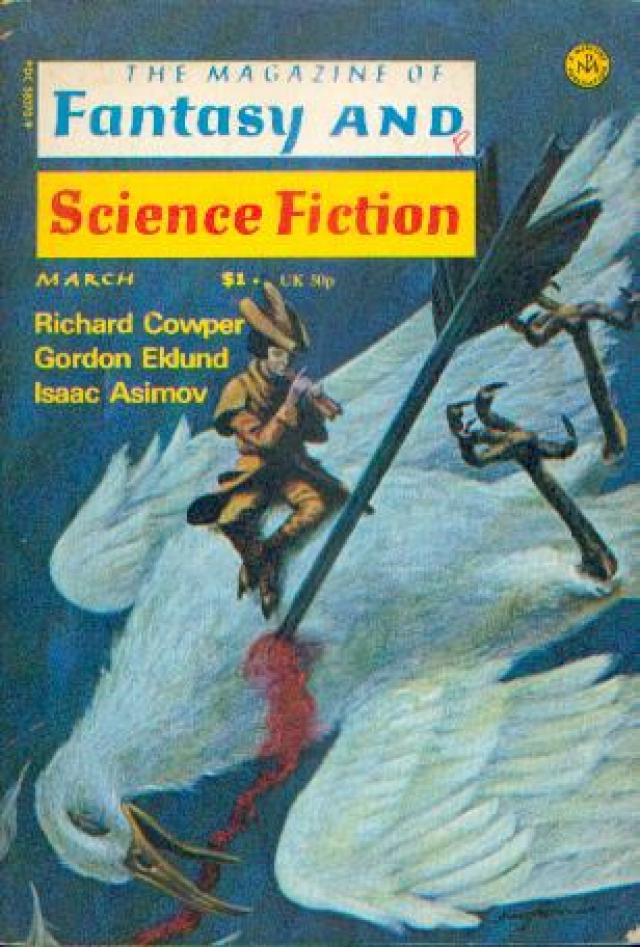
Richard cowper, p.3
Richard Cowper,
p.3


They stopped to eat shortly before noon, choosing the shelter of an outcrop of rock close to where a spring bubbled. The sun struck warm on to their backs even though, but a few paces from where they sat, the wind still hissed drearily through the dry bracken bones. Old Peter broke in two the flat scone which Katie’s mother had given them and then divided one of the halves into quarters. He sliced off two substantial lumps of the smoked salmon and handed bread and meat to the boy.
For a few minutes they both chewed away in silence then Peter said: “I’d been thinking of trying our luck at Sedbergh Manor, but maybe we’d do better at the inn. There’s a chance we’ll strike up acquaintance with a carrier and get ourselves a lift to Aysgarth. Better ride than leg, eh?”
“Whatever you say,” agreed Tom.
The old man nodded sagely. “If luck’s with us there’s no reason we shouldn’t pick up a royal or two into the bargain. Between the two of us, I mean. Reckon we could milk it out of them, eh?”
Tom glanced across at him but said nothing.
“You’ve never thought of roading for a living then, lad?”
“No.”
“Ah, it’s the only life if you’ve got the talent for it. Blast, but we two’d make a splendid team! Think of legging the high road through the Seven Kingdoms! York, Derby, Norwich, London. New towns, new faces! Why, we could even duck it across the French seas an’ we’d a mind to! Taste the salt spray on our lips and see the silver sails swell like a sweetheart’s bosom! How’s that strike you as fare for a spring morning, lad?”
Tom smiled. “But I thought you said you weren’t going to go to sea again.”
“Ah, well, that was just a façon de parler as they say across the water. But with you along it would be different. We could work up a proper act, see? You’d feel your way into the mood of each tale and then, with that pipe of yours, you’d come drifting in along o’ the words like a feather on the tide. Between the two of us we’d reach right down through their ears and tickle their pockets. Blast it, Tom lad, I tell you you’ve got a touch of magic in those finger-ends of yours-a gift like nobody’s business! You don’t want to chuck all that away while you choke yourself to death on Minster dust! A dower like yours cries out to be shared! You owe it to the Giver of Gifts! Out there on the wide high road you’ll be as free as the wind and the birds of the air! Up and off! Over the hills and far away!”
Tom laughed. “But I am free. Morfedd taught me that. He unlocked something inside me and let it fly out. Besides, I want to learn how to read and write.”
“Pooh, there’s nothing to letters, Tom. I’ll teach you myself. And more besides! There’s only one school for the likes of us, lad. The great high road. Once you’ve begun to turn the pages of that book you’ll never want another.”
“And Mum? What would she think? After she’s taken all that trouble to bespeak Cousin Seymour for me?”
“Ah, your heart does you credit, lad. Real credit. But I know my Mistress Margot. Been dreaming up plans for you, hasn’t she? How maybe you’ll catch the Bishop’s eye and gain a preference and so on and so forth? Isn’t that it? Ah, that’s just a mother’s daydreams, Tom. Believe you me, lad, the only way to preference in York Chapter for a boy like you is up the back stairs and on to the choirmaster’s pallet. Faith, I tried to tell her so, but she wouldn’t listen. Said your Cousin Seymour would shield you from anything of that sort. But I know the ways of the world and-”
“People become what you think them, Peter.”
“Eh? How’s that?”
“Morfedd said so. He said our thoughts are unseen hands shaping the people we meet. Whatever we truly think them to be, that’s what they’ll become for us.”
The old man stared at him, wondering if the Kendal gossips had spoken true and the boy really was touched. “Oh, he did, did he?” he said at last. “And what else did he say?”
“Morfedd? Oh, lots of things.”
“Well, go on, lad. Let’s hear one.”
Tom rubbed his nose with the back of his hand and stared out across the hillside. “He used to say that seeing things as they really are is the most difficult seeing of all. He said people only see what they want to see. And then they believe the truth is what they think they see, not what really is.”
“Aye, well, I’m not saying he doesn’t have a point here. But I’ll warrant he didn’t think to tell you how to recognize this truth when you do see it.”
“You don’t see it exactly. You feel it.”
“And just how’s that supposed to help someone like me who lives by his lying? Didn’t you know they call me ‘Prince of Liars’?”
Tom grinned. “Oh, that’s different,” he said. “Your stories are like my music. They tell a different kind of truth. People hear it in their hearts.”
“Blast it, boy, you have an answer pat for everything! Look here, I’ll tell you what. From now till Christmastide we’ll work the road ‘twixt here and York-Leyburn, Masham, Ripon and Boroughbridge -finishing up at ‘The Duke’s Arms’ in Selby Street. That way you’ll get a fair taste of the life I’m offering. Then if you’re still set on the Chapter School, why that’s all there is to it. Till then you’ll have a third-part share in all we take. That strike you as fair?”
“All right,” said Tom. “But you must tell me what you want me to do.”
“Done!” cried Peter. “We’ll set it up while we’re legging down to Sedbergh. Have you done with eating? Right then, partner, let’s be on our way.”
It soon emerged that the book of the open road which Peter had recommended to Tom with such enthusiasm contained at least one chapter which he himself had never read. By the third week of December when they reached Boroughbridge the old man found that rumor, racing ahead like a fell fire, had brought scores of curious people riding into town from as far afield as Harrogate and Easingwold. And the rumors were extraordinary. Even Peter, whose life’s philosophy was based on seizing fortune by the forelock and never looking a gift horse in the mouth, was genuinely bewildered by them. They seemed to bear no relation whatsoever to the facts which were, as he saw them, that a pair of troupers were working the road down to York for the Christmastide fair. What in the name of the Giver of Gifts could that have to do with any White Bird of Kinship? Yet there was no escaping the fact that it was this which was bringing these credulous country folk flocking in.
Nor was that all. Getting a quarter out of a fell farmer was usually about as easy as pulling his teeth with your bare hands, yet here they were showering their silver into his hat as though it was chaff, and none of them thinking to dip a hand in after it either. Over a hundred royal they’d taken in three weeks, not to mention the new suit apiece that dimwitted tailor in Leyburn had insisted on making for them, refusing even a penny piece for his labor. Why, at this rate, in six months he’d have enough put by for that little pub in Kendal he’d always hankered after. Six months? A bare three at the pace things were going! Sure Tom couldn’t grudge him that. Meanwhile here was the landlord of “The Bull” fingering his greasy cow-lick and trusting they would favor him with their esteemed custom. No question of paying! It would be his privilege. And the inn yard with its gallery would surely be ideal for their performance. It could accommodate three hundred with ease-three fifty at a pinch. The venerable Tale-Spinner had only to give word and the news would be all round the town before the church clock had struck the hour.
“All right, landlord,” said Peter magnanimously. “But it’ll cost you two royal.”
The landlord blenched, made a rapid mental calculation, and agreed.
“Two a night,” said Peter imperturbably. “For the two nights.”
A slightly longer pause followed by a nod of grudging acquiescence.
“And I’ll have half in advance.”
“There’s my hand on it,” said the landlord, and suited the action to the word.
A wall-eyed serving wench showed them up to their room which overlooked the inn yard. “There’s a spread of clean linen,” she informed them shyly, “and coals to the fire. Would you like that I fetch you a bite to eat?”
“Aye, lass. A meat pasty. And a jug of hot punch to help it down.”
She bobbed a half-curtsey and ducked out. Tom, who had wandered over to the window, observed that it looked as if it was going to snow.
“More than like,” said Old Peter, rubbing his hands briskly and stretching them out to the flames. “Aren’t we due a few feathers from the White Bird?” He snorted tolerantly. “Can you make head or tail of it?”
Tom breathed on to the glass before him and drew a “3” on its side. “I think it’s like you said to Norris. People want to believe it. They’re tired of feeling afraid.”
“But what’s that got to do with us, lad?”
“I don’t know.”
“Oh, I’ll not deny you play a very pretty pipe and I tell a stirring enough tale, but what kind of sparks are they to set this sort of kindling ablaze? I tell you true, Tom, if it wasn’t that we’re coining money hand over fist I’d be sorely tempted to turn around and head right back to Kendal. I don’t like the smell of it one bit.”
Tom moved away from the window and wandered back to the. fire. “There’s nothing to be afraid of,” he said. “I think we should go along with it.”
“Go along with what?”
“Well, tell them the story of the White Bird. You could, couldn’t you?”
“And have the crows about my neck? You must be out of your mind.”
“But Morfedd said-”
” ‘Morfedd said!’ That joker said a deal too much for your good, if you ask me! The sooner you start putting him behind you, the better for both of us. Oh, I don’t mean to belittle him, lad, but we aren’t in the back of beyond now, you know. Down here they’re a sight more touchy about such things than they are along the Borders. And as for York…”
Tom regarded the old man pensively. “I’ve been making up a tune to go with the White Bird,” he said. “It’s not finished yet. Would you like to hear it?”
“I suppose there’s no harm. So long as it’s without words. But what put that idea into your head?”
“I’m not really sure. The first bit came to me just after we left Katie. When I looked back and saw her standing there on top of the hill. Since then I’ve been joining things on to it. I’ve been using some of them for Amulet. That scene where the Prince meets his father’s ghost is one. And there’s another bit later on when he believes Princess Lorelia has been drowned. The last bit I made up at Ripon when you were telling The Three Brothers. Don’t you remember?”
“To be honest, lad, I can’t say as I do. The fact is, when I’m stuck into a tale I don’t hear much above the sound of my own words. I’m hearing it and telling it at the same time. Seeing it too. In a bit of a dream I suppose you might say. Maybe that’s why my tellings never come out word for word the same. Not even Amulet. And, blast me, if I had a silver quarter for every time I’ve spun that yarn there wouldn’t be a richer man in Boroughbridge!”
Tom laughed. “And has it always had a happy ending?”
“Amulet? Aye. The way I tell it. My old Dad would have the Prince dying at the end. But that cuts too close to life for my taste.”
“The White Bird dies too, doesn’t it?”
“Look, do me a favor, will you, lad? Just forget about that Holy Chicken. Leastways till we’re shot of York. Down south in Norwich we’ll like enough get away with it, tho’ even there it could still be a bit risky.”
Tom who had taken up his pipe now lowered it to his lap. “But we’re not going to Norwich,” he said. “Just to York. That’s what we agreed, wasn’t it?”
“Aye, so it was,” said Peter easily. “The fact is, Tom, I’ve grown so used to having you along I can’t think of it being any other way. Tell me straight now, hasn’t this past month been a fair old frolic? Remember that flame-headed wench at Masham, eh? Blast me but she was properly taken with you! And yon whistle wasn’t the only pipe she was pining for neither! I tell you that between us we’ve got it made, lad! Stick with me and I swear that six months from now you’ll be taking such a bag of royals home to your mam as’ll topple her on the floor in a fit! You can’t just let it drop now!”
Tom raised his pipe and slowly lowered his head above it as Peter had seen him do once before in the farmhouse kitchen. For a full minute he said nothing at all, then: “I must go to York, Peter. I must.”
“Well, and so you shall. Show me him as says otherwise. We struck hands on it, remember? ‘Sides I had word only this morning from Jack Rayner at The Duke’s Arms’ that he’s looking to us for Friday. The way I’ve planned it we’ll just work out the Christmas fair and then you’ll trot round and pay your respects to your Cousin Seymour at the Chapter House. You can’t say fairer than that, can you?”
Tom nodded. “I’m sorry,” he said. “I really am, Peter. I think you’re the finest storyteller that ever was. Listening to you is like sharing in a golden dream. But you see I promised Morfedd I’d go to York, and I can’t break my promise.”
“Morfedd? What’s he got to do with it? I thought this was all Mistress Margot’s idea.”
“She thinks so,” said Tom. “But really it was .Morfedd. He planned it years ago. Long before he chose me. Before I was even born. It was a secret between us.”
“I’m not with you, lad. Planned what? That you should get yourself schooled in York Chapter? Is that supposed to make sense?”
“Oh, that’s nothing to do with it. I just have to be in York at Christmas. For the forthcoming.”
“Blast it, boy, why must you speak in riddles? What ‘forthcoming’?”
Tom lifted his head and gazed into the flickering coals. Then in a gentle sing-song he recited: ” ‘The first coming was the man; the second was fire to burn him; the third was water to drown the fire, and the fourth is the Bird of Dawning.’” So saying he took up his pipe and began to play very softly.
It seemed to the old man that the tune came drifting to him from somewhere far away like the voice of a young girl he had once heard singing on the far side of a twilit lake high up in the Appenines, strange and sweetly clear and so magical that he had scarcely dared to breathe lest he should miss a note of it. He closed his eyes, surrendering himself wholly to the enchantment.
At once there began to drift across his inward eye a series of glittering pictures that were not quite real and yet were more than mere daydreams, memories almost, of not quite forgotten moments woven into the long tapestry of years that had gone to make up his life; instants when, wholly in spite of himself, he had seemed about to reach out towards something that was at once so simple and yet so profound that he just could not bring himself to accept it. And yet it could be grasped because it was not outside him but within him; a vision of what might be, as when he, and he alone, by stretching out an arm in thought could wrest the deadly weapon from the Uncle’s hand and grant Prince Amulet life. The power was his-was anyone’s -was …
The thread of the melody snapped. Peter’s eyes blinked open and the room seemed to rock into stillness around him. He felt his cloudy identity distill itself like mist on a windowpane and trickle downwards in slow, sad drops. There was a tap-tap at the door and, to Tom’s summons, in came the serving girl bearing a tray on which was a jug and two earthenware cups and the steaming pasty which Peter had ordered. She set it down on a stool before the fire, then turned to where the boy was sitting on the edge of the bed. “It’s true what they’re saying,” she whispered. “I stood outside the door and listened. I was feared to come in while you was a-playin’.”
Tom grinned at her. “What are they saying?” he asked.
“That the White Bird’s acoming. It is, isn’t it?”
“Do you think so?”
“Aye, young master,” she said. “I do now.”
The night before they were due to leave for York there was a heavy frost. The landlord of “The Bull” lit some charcoal braziers in the yard and Peter and Tom gave their final performance at Boroughbridge under a sky in which the stars seemed to quiver like dewdrops in an April cobweb. Peter was perched up on a rough dais made of planks and barrels and Tom sat cross-legged at his feet. As the recital was drawing to its close the old man caught, sight of a figure slipping away from the outer fringe of the crowd. Lamplight gleamed briefly on polished metal and, a minute later, Peter’s alerted ears caught the brisk and receding clatter of iron-shod hooves on cobblestones.
Later, while settling accounts with the landlord, he inquired casually whether any “crows” had been pecking around.
The landlord glanced quickly about him, saw that they were unobserved and murmured: “Aye, there was one.”
“Happen you know what he was seeking?”
“Not I,” said the landlord. “He asked nowt of me.”
Peter took a bright gold half-royal out of his purse and laid it on the table between them. With his extended fingertip he nudged it delicately an inch or two toward his host. “Flown in from York, I daresay?”
The man’s eyes swivelled away from the coin and then back to it again as though tethered by an invisible thread. “Aye, most like,” he said.
“And home to roost by starlight,” mused Peter, coaxing the coin back toward himself again. “I wonder what sort of song he’ll be croaking in the Minster?”
The landlord leant across the table and beckoned Peter closer by a tiny jerk of the head. “Know you aught of the White Bird of Kinship, old Tale-Spinner?” he whispered.
Peter clucked his tongue, chiding ironically. “Did you think to speak heresy with me, landlord?”
” ‘Twas you that asked, and that’s the carrion the crows are pecking for. They’ve smelt it blowing down strong from the hills these twelve months past. Don’t tell me you’ve not heard the talk.”
“Aye, some to be sure. Along the Borders.”
The landlord shook his head. “No longer. It’s in the open now. Seems even the field mice have got bold all of a sudden. Me I keep my thoughts to. myself.”