Richard cowper, p.6
Richard Cowper,
p.6


He was kept waiting for a cold half hour at the Chapter House before Clerk Seymour could receive him and by the time all the details of the transaction had been settled, the cash handed over and a pledge drunk in wine, the last half-hour chime before midnight was sounding from the Minster. Peter stepped back out into the night to find that the air had become alive with snowflakes, large and soft as swansdown.
There was no wind at all, and where the two wall torches flamed beside the entrance to The Falconry the currents of rising air were setting the drifting flakes into a swirling dance like twin clouds of golden moths.
As the old man hefted up the hood of his cloak and re-tied the leather laces at his chin a solitary horseman came spurring into the Close. He reined up outside The Falconry, flung himself from the saddle and, without even bothering to tether his mount, raced up the steps and into the building. Reflecting that no news travels faster than bad news, Peter made haste to quit the scene. He was hurrying toward the southern gate when a troop of five Falcons, helmeted and with their bows at their backs, galloped past him down the main street, the steel-shod hooves of their horses striking showers of sparks from the snow-slippery cobblestones. So uncannily silent was the town that Peter could hear their clattering racket long after they had passed out of his sight.
The last quarter-chime had just died on the air as he set foot on one of the ancient stairways that led up to the top of the city wall. Pausing to gather breath for the climb, the old man suddenly remembered Tom. The thought came to him in the form of a brilliantly clear mental image of the boy’s face as he had once seen it lit up by the flamelight from Norris’ hearth. As if a hand had been thrust violently into his back, the old man began scrambling up the stairs two at a tune. Heart pounding, lungs wheezing like a blacksmith’s bellows, he staggered up on to the battlements and peered dizzily over. The sight that met his eyes all but brought his heart to a full stop. By the light of a dozen bonfires an enormous crowd was assembled, a silent sea of blank white faces gazing upwards toward the city wall. The only sound to be heard was the crackle of flames as a log broke in two and a fountain of sparks swept up to meet the ceaseless downward sift of the snowflakes. The only sound? “Dear God,” groaned the old man in what was part prayer, part incantation, “Dear God, no.”
He set off in a shambling, broken-winded run along the battlements, pausing every now and again to peer downwards. He came upon other silent watchers, first in ones and twos, then clustered ever more closely together, leaning over the parapet, rapt and still. He elbowed his way between two of them and saw that a little way below and some thirty paces to his right, a rough wooden scaffold had been erected by masons working to repair an inward-curving section of the wall. A ladder led down from the parapet to a boarded platform, and there, seated so casually that one leg hung dangling over the airy gulf below, was Tom. His back resting against a rough pine joist, the snow already beginning to settle unheeded upon his bent head, he was playing his lament for The White Bird of Kinship; playing it really for nobody but himself, unless perhaps it was for the spirit of a man he had once loved who had dreamed an impossible dream of human kinship long ago among the hills and valleys of Bowness.
As Peter stared downwards it seemed to him that the whole scene was becoming oddly insubstantial: the pale upturned faces of the silent crowd beginning to swirl and mingle with the drift and swirl of the pale flakes; the stones along the parapet touched with the rosy firelight until they appeared to glow with the warm inward glow of molten glass. All about him he seemed to sense a world becoming subtly transformed into something wholly new and strange, yet a part of him still realized that this transformation must lie within his own perception, within himself.
-I believe there’s a master-key, Peter. One to unlock the whole world. I call that key The White Bird.
As the boy’s words came whispering back into his memory an extraordinary excitement gripped the old man. Fear slipped from him like a dusty cloak. He began to hear each separate note of the pipe as clearly as if Tom were sitting playing at his side and he knew that every listener in that vast concourse was hearing the same. So it was that, despite himself, no longer caring, Peter found his head had tilted backwards until the feathery snowflakes came drifting down upon his own upturned face. And gradually, as he surrendered himself to the song, he too began to hear what Gyre had once heard-the great surging downrush of huge wings whose enormous beat was the very pulse of his own heart, the pulse of life itself. He felt himself being lifted up to meet them as if he were being rushed onwards faster and faster along some immense and airy avenue of cool white light. Of their own accord his arms rose, reached out in supplication, pleading silently-Take me with you … take me … take me … But, ah, how faint they were becoming, how faint and far away. Ghostly wingbeats sighing fainter and ever fainter, washed backwards by an ebbing sky-tide, drifting beyond his reach far out over the distant southern sea. Away. Gone away. Gone.
The old tale-spinner opened his eyes without realizing that he had ever closed them. What had happened? There was a mysterious sighing in the air, an exhalation, as if the held breath of the whole world had been released. Gone away. Gone. Our bird. Our own White Bird. Why hast thou forsaken us? He shook his head like a wet dog and blinked round at the vacant, dream-drugged faces beside him. And it was then that he realized the music had stopped. A sound most like an animal’s inarticulate bewildered growl broke from his throat. He lunged forward, thrust himself half over the parapet and squinted down through the lazily drifting petals of the indifferent snow.
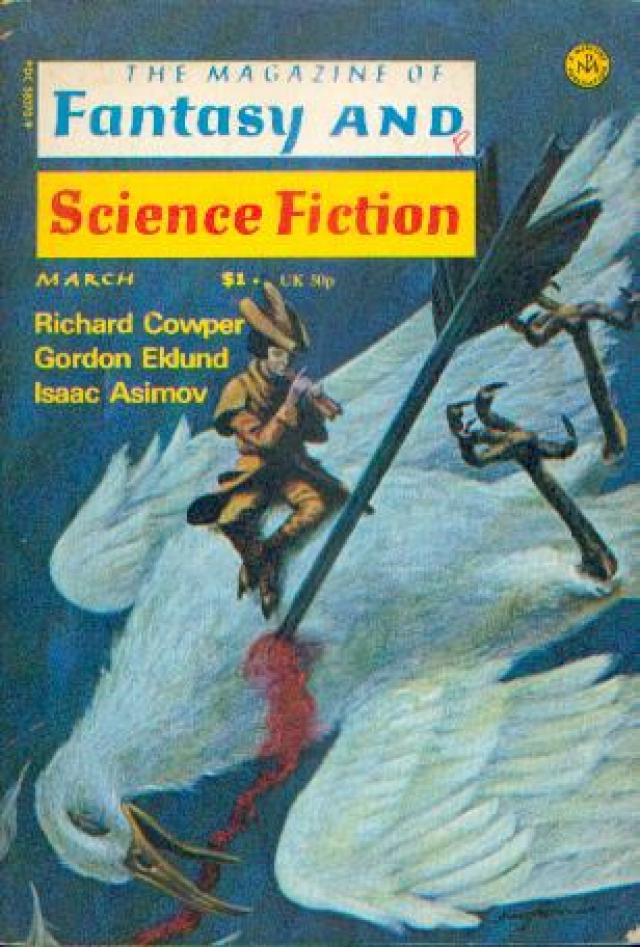
The boy was lying, head slumped, limbs twisted askew on the wooden platform. Through the left side of his chest a single crossbow bolt fledged with ravens’ feathers was skewering him to the pine joist behind him. One hand was still clutched around the projecting shaft of the bolt as if to pull it free. On the snowy boards blood was already spreading outwards in a slow, dim puddle.
Forcing his way through the press of stunned spectators the old man gained the ladder by which Tom must have descended and, heedless of his own safety, clambered down to the platform. As he set foot on it the Minster bells suddenly unleashed their first great clamorous peal, flighting out the Old Year and welcoming in the New.
Accompanied by Marshal Barran the Chief Falconer strode furiously along the top of the city wall. In the distance he could make out a little huddled knot of on-lookers, lit by flickering torch light, gathered around the top of the scaffolding. Down in the meadows below, the mounted troopers were already dispersing the crowd. For the third time he asked the same question: “And you are absolutely certain this was the same boy?”
“There could not be two such, my Lord. He fits the Boroughbridge report perfectly.”
“Insane,” muttered the Bishop. “Absolutely insane. Whose troop is the madman in?”
“Dalkeith’s, my Lord.”
“And why that way when he could have slit the pup’s throat in a back alley and no one a wit the wiser? Now we’ve got ourselves five thousand eyewitnesses to a needless martyrdom. And on this one night of all nights!”
“Aye, my Lord. They’re already murmuring about Black Bird.”
“And for how long do you suppose it will stay a murmur? In a month they’ll be shouting it from the rooftops. What they’ll be saying by this time next year is anybody’s guess.”
Already the snow was falling more heavily and a breeze had sprung up, blowing in from the sea, bringing the smoke from the dying bonfires billowing up along the battlements. Two members of the Civil Watch had found a plank, had laid the boy’s body upon it. Having covered it with a piece of sacking, they were now arguing about how best to get it down the narrow steps. The Chief Falconer strode into the center of the group. “Back!” he commanded.
As they shuffled to obey he stooped over the makeshift bier, twitched aside the sacking and stared down at the pale calm face of the dead boy. He caught sight of a leather lace about the throat and, thinking it might be a crucifix, jerked it clear. All he found was a bloody fragment of a shattered green pebble. “The bolt,” he said. “Where is the bolt?”
“I have it safe,” said a voice from the shadows.
The Bishop raised his cowled head and peered into the shadows. “Who are you?”
“Peter of Hereford. Tale-Spinner. He was my lad.”
Marshal Barran leant across and whispered something into the Bishop’s ear. The Chief Falconer frowned. “What know you of this sad accident, Peter?”
The old man stepped forward into the pool of quivering torchlight. From beneath his cloak he produced the black-fledged bolt, its crumpled feathers already stiff with congealed blood. “This was an accident, sire?” he said. “Your birds flew here this night to shed innocent blood.”
“Have a care for your tongue, old man.”
“Fear you the truth, my Lord Bishop? Know then there should by rights have been two of us down there. I to tell the tale and he to breathe the breath of life into it. Ask any man or woman who heard Tom play whether or not the White Bird of Kinship hovered here tonight.”
The Bishop glanced swiftly round at the circle of impassive faces and felt suddenly as if the sea wind was blowing right through his bones. Why was this old scoundrel not afraid to speak these heresies to his face? Men had been racked to death for less. Something was stirring here that even he might well be powerless to quell. There was a rank smell of false faith in the air. Well at least there would be no more public martyrdoms this night. He touched the bier with his foot. “Get this down to the gatehouse. As for you, Tale-Spinner, present yourself at the Falconry by the tenth hour of forenoon. Meanwhile you would be well advised to place a closer guard over that precious tongue of yours.”
The snow stopped shortly after dawn. When Peter made his way to The Falconry next morning it was through streets muffled as if on purpose to honor the dead. Everywhere along his route people, recognizing him, came up and touched hands and went away. Few said more than: “I was there,” but their eyes were eloquent.
The ghost of an old fear brushed against him as he mounted the snowy steps to The Falconry but it no longer had the same power to freeze him from the inside out. He strode into the building, stamped the ice from his boots and told the doorkeeper who he was. The man directed him down an echoing passage into a room where a log fire was burning. Crouched on a stool beside the fire was Falcon Gyre.
Peter gazed at the bowman in surprise then walked across and placed a hand on his shoulder. “Well met, friend,” he murmured. “Would that we had heeded those dreams of yours.”
Gyre looked up but there was no hint of recognition in his eyes. They seemed to look right through the old man to something far beyond that only he could see. Peter remembered how he had stared back along the sunlit road across the moors to Hammerton and wondered what thoughts were going through his mind. “You did your best, friend,” he said. “No one could have done more.”
As though by a superhuman effort Gyre brought his eyes to focus on the face above him. His lips trembled loosely and, suddenly, with a shock of real pity, Peter saw the man was weeping silently, the tears runneling down his unshaven cheeks and dripping unheeded from his chin. At that moment the door opened and the Chief Falconer walked in. He stood for a moment gazing with obvious distaste at the blubbering Gyre, then he turned to Peter and said: “What do you wish done with him?”
Peter glanced round, half convinced that the Bishop was addressing someone else in the room whom he had not yet seen. “I?” he protested. “Why should I … ?”
“He has not told you?”
“He has not spoken a word. I thought perhaps he was …”
“He is in a state of profound shock,” said the Bishop. “He remembers nothing. Nevertheless he was responsible for the accidental death of the boy.”
“Gyre! Never!”
“So you know his name?”
“Aye. We rode into York together. My Lord, I assure you there has been some mistake. This cannot be the man.”
“There has been no mistake,” said the Bishop testily. “Gyre loosed the bolt by accident. Think you we would have ordered him to do it? Surely even you must have the wit to realize that it was the last thing on earth we could have wished.”
Peter stared down at the silently weeping man and then back to the Bishop. “No man could have fired that shot by accident,” he said slowly. “It would have been difficult even for a skilled marksman. Upwards-against the falling snow-with only the firelight to aim by? That was no accident. But whoever did it it was not Gyre.”
The Bishop drew his lips back against his teeth with a faint sucking sound. “And just what makes you so certain?” he asked curiously.
Peter shrugged. What had either of them to lose by it now? “Because Gyre tried to warn us to leave the city three days ago.”
“Warn you? How?”
“He told us to quit York. He said he had had a dream.”
The Bishop gazed at the old man, seeing the ripples of superstition multiplying, crowding thick upon each other, ringing outwards wider and wider with every minute that passed. “A dream,” he said flatly. “What dream?”
“He would not tell us. But he said he had the same dream three nights running. He just warned us to leave. Would to God we’d listened to him. But I had arrangements still to make with the Chapter Clerk for the lad’s schooling.”
“Schooling?” echoed the Bishop. “Are you telling me the boy was to enter the Chapter School?”
“Aye, my Lord. That’s why I brought him here to York.”
“But in that case he was certainly destined for the Ministry.”
“I know naught of that, my Lord.”
The Bishop punched one hand into the other. “Oh, he was, he was,” he said. “There can be no question of it. Besides, the Clerk will certainly confirm it. You must realize that this puts a very different complexion on the matter.”
“How so, my Lord?”
“Why naturally he must be interred in the Minster crypt with all due honor as befits a true son of the Church. How like you that, old man? Better than a public grave in the wall ditch, wouldn’t you say?”
Peter looked hard at him. “I daresay Tom will not be minding much either way,” he said. “But make it a grave in the open Close if you must. Those Minster stones would lie too heavy on his heart.”
“So be it,” said the Bishop. “Leave it to us, old man. I promise you he shall lack for nothing.”
“Except a little breath, my Lord.”
Frost laid an icy finger on the Bishop’s smile. “Have a care,” he murmured, “or that golden tongue of yours may buy you a grave of your own.”
And so it came to pass that on the third of the New Year the Minster bells rang out once more. The pine coffin, decked with blood-berried holly, was borne from the gatehouse through the twisting streets to the doors of the Minster and vanished inside. By the time it re-emerged the crowd of mourners in the Close had swollen beyond computation, lapping out even to engulf the steps of the Falconry itself.
Gazing down somberly from his fifth floor eyrie the Chief Falconer was moved to question his own wisdom in acceeding to the old man’s wish that the body be buried outside the Minster. Where had they all appeared from, these massed ranks of silent watchers? What marvelous sign were the fools hoping for? He watched with growing impatience as the bearers made their slow way through the crowd toward the heap of upturned earth beside the newly dug grave. As they laid the coffin across the leather straps, the first feathery flake of new snowfall came drifting downwards outside the window. Another followed and another, and then the Bishop saw faces here and there in the throng lift and gaze upwards. In less than a minute only the officiating clergy appeared concerned in the burial, the rest were reaching upwards, hands outstretched in supplication toward this miraculous manna softly falling feathers of the immortal White Bird of Kinship whose song once heard would never be forgotten.
The Bishop turned to Marshal Barran with a mirthless smile. “I suppose you realize that it is more than likely we are witnessing a future miracle.”
Barran nodded. “You did well, my Lord, to claim him for the Church. Think what this might have become had it taken place below the city walls.”
“I hope you’re right,” said the Chief Falconer. “Myself I’m not so sure. What if this fledgling we’ve taken into our nest should prove to be a cuckoo?”
Barran returned his attention to the scene below just in time to see the coffin disappear jerkily out of sight. The priest scattered a handful of soil into the grave and stepped back. As he did so those nearest to the graveside shuffled forward and each appeared to drop something white on to the lid of the hidden coffin. Soon a long procession had formed. As it wound slowly past the heap of raw earth each man, woman and child stretched out an arm and dropped a single white feather into the open grave.
Barran debated whether to draw the Bishop’s attention to this new development and decided against it. Instead, he remarked: “Do you recall, my Lord, how the fable ends?”
“With the death of the bird, of course.”
“Oh, no, my Lord. They would have it that when the blood of the dying white bird splashes the breast of the black, then the black bird becomes white itself and the cycle is repeated.”
The Bishop swung round on his Marshal, his eyes seeming to smolder like dark red coals. “In God’s name, Barran, don’t you see what you’re saying? Why didn’t you tell me this before?”
“My Lord,” stammered the Marshal, “indeed I would have done so, but you assured me you were familiar with the legend. As I recall it you-”