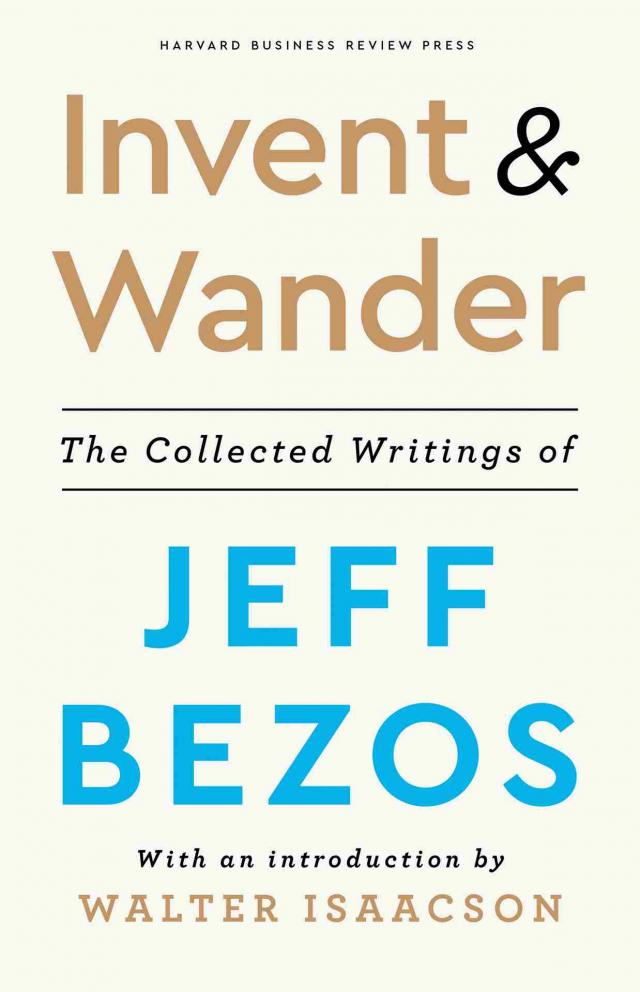
Invent and wander, p.3
Invent and Wander,
p.3


Eventually Bezos hopes to integrate the Amazon online store, Amazon Prime, Echo, and Amazon’s customer data analytics with the Whole Foods Market grocery chain, which Amazon bought in 2017. Bezos says that his purchase of the company was partly due to his admiration for the outlook of its founder, John Mackey. When he meets with the founder or chief executive of a company that Amazon is thinking of buying, Bezos tries to assess whether he or she is in it merely to make money or because of a true passion for serving customers. “I’m always trying to figure out one thing first and foremost: Is that person a missionary or a mercenary?” Bezos says. “The mercenaries are trying to flip their stock. The missionaries love their product or their service and love their customers and are trying to build a great service. By the way, the great paradox here is that it’s usually the missionaries who make more money.” Mackey struck him as a missionary, and his passion infused the Whole Foods ethos. “It’s a missionary company, and he’s a missionary guy.”
Outside Amazon, Bezos’s greatest enthusiasm, one nurtured since childhood, is space travel. In 2000 he set up a company, very secretively, near Seattle called Blue Origin, naming it after the pale blue planet where humans originated. He called upon one of his favorite science fiction writers, Neal Stephenson, to be an advisor. They kicked around wildly novel ideas, such as using a bullwhip-like device to propel objects into space. Eventually Bezos focused on reusable rockets. “How is the situation in the year 2000 different from 1960?” he asked. “The engines can be somewhat better, but they’re still chemical rocket engines. What’s different is computer sensors, cameras, software. Being able to land vertically is the kind of problem that can be addressed by those technologies that existed in 2000 that didn’t exist in 1960.”
In March 2003 Bezos began putting together a huge tract of ranchland in Texas where he could build his reusable rockets in secret. One of the great scenes in Christian Davenport’s The Space Barons is the description of the helicopter trip Bezos took to find the land, which ended with a terrifying crash.
When reporter and Bezos biographer Brad Stone discovered the existence of Blue Origin, he emailed Bezos, asking for comment. Bezos wasn’t ready to talk about it, but he did go on the record to push back against Stone’s notion that he had founded the company because he thought that the government-run NASA program had become too risk averse and sluggish. “NASA is a national treasure, and it’s total bull that anyone should be frustrated by NASA,” Bezos wrote Stone. “The only reason I’m interested in space is because [NASA] inspired me when I was five years old. How many government agencies can you think of that inspire five-year-olds? The work NASA does is technically super-demanding and inherently risky, and they continue to do an outstanding job. The ONLY reason any of these small space companies have a chance of doing ANYTHING is because they get to stand on the shoulders of NASA’s accomplishments and ingenuity.”
Bezos approaches his space endeavors as a missionary rather than a mercenary. “This is the most important work I’m doing, and I have great conviction about that,” he says. Earth is finite, and energy usage has grown so much that it will soon, he thinks, strain the resources of our small planet. That will leave us with a choice: accept static growth for humanity or explore and expand to places beyond Earth. “I want my grandchildren’s grandchildren to be using way more energy per capita than I am,” he says. “And I would like to see us not have a population cap. I wish there were a trillion humans in the solar system; then there would be a thousand Einsteins and a thousand Mozarts.” But within a century, he fears, the Earth will not be able to sustain this growth of population and energy use. “So, what will that lead to? It will lead to stasis. I don’t even think stasis is compatible with liberty.” That prompted him to believe we should now begin thinking about new frontiers. “We can fix that problem,” he says, by lowering the cost of access to space and using in-space resources.
Blue Origin is focused on lowering the cost of accessing space through its reusable launch vehicles and engines. New Shepard, named after the first American in space, Alan Shepard, was the first rocket to take off vertically, go to space, then land vertically back on Earth—and then it was the first to be reused again. Launching out of West Texas, New Shepard was designed from the beginning for human spaceflight and the rocket is getting ready to fly paying customers to space and back and has been launching research experiments on board for universities, research labs, and NASA. Blue Origin’s larger orbital rocket, New Glenn, named after John Glenn, the first person to orbit the Earth, is poised to take commercial, NASA, and national security customers to space. In 2019 Bezos also announced the Blue Moon lunar lander, which was awarded a nearly $500 million contract from NASA to develop a system to take humans back to the moon. Blue Origin has partnered with Lockheed Martin, Northrop Grumman, and Draper on the project. Separately, Bezos funded an expedition that recovered several of the F-1 engines that powered the Saturn V rocket to the moon during the Apollo program.
Another personal passion is the Washington Post, which Bezos bought in 2013. In an era when newspapers were declining, he infused the Post with cash, energy, technological skills, and new reporters while allowing its great editor, Martin Baron, unfettered editorial control. “I was not looking for a newspaper,” Bezos says. “It had never occurred to me. It wasn’t like a childhood dream.” But then the paper’s owner, Donald Graham, approached him and, over a series of conversations, convinced him that the mission was important. So Bezos did some soul searching and, as always, relied on intuition as well as analysis. “This is an important institution,” he says he concluded. “This is the newspaper in the capital city of the most important country in the world. The Washington Post has an incredibly important role to play in this democracy.” So he told Graham he would buy it, and he didn’t haggle over the price. “I didn’t negotiate with him and I did no due diligence,” he says. “I wouldn’t need to with Don. He told me every wart and pimple and he told me all the things that were great. And every single thing he told me on both sides of that ledger turned out to be true.”
Although Bezos has made the paper better and more financially viable, the purchase has been very costly. Donald Trump neither understood nor cared that Bezos exercised no editorial control and that the paper was completely separate from Amazon. So the president, in ways that seem to me to be corrupt, has abused the power of the federal government to try to punish Amazon and deny contracts to Amazon Web Services that were merited.
Bezos’s own politics and philosophy, which he does not impose on the Post, comprise a mix of social liberalism—he donated to the campaign to legalize gay marriage—and economic views that stress individual liberty. It is an attitude he shares with his father, who fled Castro’s Cuba. “A free market economy, which by necessity involves a lot of liberty, just happens to work well in terms of allocating resources,” he says. But the merit of the free market arises not merely from its efficiency but also from the moral value it accords to individuals, he believes.
Imagine a world where some incredibly artificially intelligent computer could actually do a better job than the invisible hand of allocating resources, and were to say, “There shouldn’t be this many chickens, there should be this many chickens,” just a few more or a few less. Well, that might even lead to more aggregate wealth. So, it might be a society that if you give up liberty, everybody could be a little wealthier. Now, the question that I would pose is, if that turned out to be the world, “Is that a good trade?” Personally, I don’t think so. Personally I think it would be a terrible trade. I think the American Dream is about liberty.
THROUGH THIS BOOK you can learn many of the lessons and secrets revealed in Bezos’s interviews, writings, and the annual shareholder letters he has personally composed since 1997. Here are the five that I think are most important:
1. Focus on the long term. “It’s All About the Long Term,” he said in the italicized initial headline in his first shareholder letter in 1997. “We will continue to make investment decisions in light of long-term market leadership considerations rather than short-term profitability considerations or short-term Wall Street reactions.” Focusing on the long term allows the interests of your customers, who want better and faster services cheaper, and the interests of your shareholders, who want a return on investment, to come into alignment. That’s not always true in the short term.
In addition, long-term thinking permits innovation. “We like to invent and do new things,” he says, “and I know for sure that long-term orientation is essential for invention because you’re going to have a lot of failures along the way.”
Bezos’s interest in space travel, he says, helps remind him to keep his focus on the distant horizon. Among his many strengths is his ability to keep his eye on that distant horizon, as he has done at Amazon. In the mission statement for his space company, he wrote, “Blue Origin will pursue this long-term objective patiently, step by step.” As Elon Musk pushed his own competing space program forward with very public fits and starts, Bezos advised his team, “Be the tortoise and not the hare.” Blue Origin’s company shield has a Latin motto, Gradatim Ferociter: “Step by Step, Ferociously.”
Among Bezos’s many strengths is his ability to follow this motto by being exuberantly patient and patiently exuberant. At his Texas ranch Bezos has begun construction of a ten-thousand-year “clock of the long now,” designed by the futurist Danny Hillis, which has a century hand that advances every hundred years and a cuckoo that comes out every millennium. “It’s a special clock, designed to be a symbol, an icon for long-term thinking,” he says.
2. Focus relentlessly and passionately on the customer. As he put it in his 1997 letter, “Obsess over Customers.” Each annual letter reinforces that mantra. “We intend to build the world’s most customer-centric company,” he wrote the following year. “We hold as axiomatic that customers are perceptive and smart.… But there is no rest for the weary. I constantly remind our employees to be afraid, to wake up every morning terrified. Not of our competition, but of our customers.”
In an interview with me at a conference sponsored by the Aspen Institute and Vanity Fair, Bezos elaborated. “The core of the company is customer obsession as opposed to competitor obsession,” he said. “The advantage of being customer focused is that customers are always dissatisfied. They always want more, and so they pull you along. Whereas if you’re competitor obsessed, if you’re a leader, you can look around and you see everybody running behind you, maybe you slow down a little.”
An example of keeping the focus on customers was his policy of allowing negative reviews of products to appear on Amazon. An investor complained that Bezos was forgetting that Amazon only makes money when it sells things, so negative reviews hurt the business. “When I read that letter, I thought, we don’t make money when we sell things,” Bezos says. “We make money when we help customers make purchase decisions.”
Amazon gets criticized—as does Walmart—for squeezing suppliers and forcing them to cut costs. But Bezos sees “relentlessly lowering prices” for consumers as core to Amazon’s mission. For most recent years Amazon has come in first in major surveys of customer satisfaction.
3. Avoid PowerPoint and slide presentations. This is a maxim that Steve Jobs also followed. Bezos’s belief in the power of storytelling means that he thinks that his colleagues should be able to create a readable narrative when they pitch an idea. “We don’t do PowerPoint (or any other slide-oriented) presentations at Amazon,” he wrote in a recent shareholder letter. “Instead, we write narratively structured six-page memos. We silently read one at the beginning of each meeting in a kind of study hall.”
The memos, which are limited to six pages, are supposed to be written with clarity, which Bezos believes (correctly) forces a clarity of thinking. They are often collaborative efforts, but they can have a personal style. Sometimes they incorporate proposed press releases. “Even in the example of writing a six-page memo, that’s teamwork,” he says. “Someone on the team needs to have the skill.”
4. Focus on the big decisions. “As a senior executive, what do you really get paid to do?” he asks. “You get paid to make a small number of high-quality decisions. Your job is not to make thousands of decisions every day.”
He divides the decisions that have to be made into those that can be walked back and those that are irrevocable. The latter require a lot more caution. In the case of the former, he tries to decentralize the process. At Amazon he created what he calls “multiple paths to yes.” In other organizations, he points out, a proposal can be killed by supervisors at many levels, and it needs to pass through all those gates in order to be approved. At Amazon, employees can shop their ideas around to any of the hundreds of executives who are empowered to get to yes.
5. Hire the right people. “We will continue to focus on hiring and retaining versatile and talented employees,” he wrote in an early shareholder letter. Compensation, especially early on, was heavily weighted to stock options rather than cash. “We know our success will be largely affected by our ability to attract and retain a motivated employee base, each of whom must think like, and therefore must actually be, an owner.”
There are three criteria he instructs managers to consider when they are hiring: Will you admire this person? Will this person raise the average level of effectiveness of the group he or she is entering? Along what dimension might this person be a superstar?
It’s never been easy to work at Amazon. When Bezos interviews people, he warns them, “You can work long, hard, or smart, but at Amazon.com you can’t choose two out of three.” Bezos makes no apologies. “We are working to build something important, something that matters to our customers, something that we can all tell our grandchildren about,” he says. “Such things aren’t meant to be easy. We are incredibly fortunate to have this group of dedicated employees whose sacrifices and passion build Amazon.com.”
These lessons remind me of the way Steve Jobs operated. Sometimes such a style can be crushing, and to some people it may feel tough or even cruel. But it also can lead to the creation of grand, new innovations and companies that change the way we live.
Bezos has done all of this. But he still has many chapters to write in his story. He has always been public spirited, but I suspect in the coming years he will do more with philanthropy. Just as Bill Gates’s parents led him into such endeavors, Jackie and Mike Bezos have been models for Bezos as he focuses on missions such as providing great early-childhood education to all kids.
I am also confident that he has at least one more major leap to make. I suspect that he will be—and is, indeed, eager to be—one of the first private citizens to blast himself into space. As he told his high school graduating class back in 1982, “Space, the final frontier, meet me there!”
FOR ALL THE YEARS of building Amazon to its formidable global role, Bezos could not have anticipated the cascade of crises in 2020. The COVID-19 pandemic created an immediate spike in demand for e-commerce deliveries as people were encouraged to stay home, and Amazon faced the daunting challenge of keeping its hundreds of thousands of warehouse workers safe. Bezos said his time and thinking were “wholly focused on COVID-19 and on how Amazon can best play its role.” The New York Times reported that he was holding daily calls to help make decisions about issues such as inventory and virus testing, a marked change from recent years when Bezos had shifted day-to-day responsibilities to senior executives as he focused on long-term projects. And then there was the congressional pressure on the tech industry. On July 29, Bezos testified to a House hearing along with the CEOs of Facebook, Google, and Apple. In his testimony, Bezos framed the challenges the nation faced: “We’re in the middle of a much-needed race reckoning. We also face the challenges of climate change and income inequality, and we’re stumbling through the crisis of a global pandemic.” And then he shifted his tone to the positivity of an entrepreneur. “Still, with all of our faults and problems, the rest of the world would love even the tiniest sip of the elixir we have here in the US … It’s still Day One for this country.”
A Note on Sourcing
All content in Part 1 and Part 2 of this book is drawn from the words and ideas of Jeff Bezos.
Part 1, “The Shareholder Letters,” is composed of the letter sent by Jeff Bezos in April of each year to Amazon.com shareholders.
Part 2, “Life and Work,” has been drawn from the following transcripts of interviews and speeches by Jeff Bezos:
Economic Club of Washington on September 13, 2018 (David Rubenstein interviewer)
The Climate Pledge Launch press conference on September 19, 2019
Washington Post Transformers conference on May 18, 2016
Jeff Bezos address to the Princeton graduating class of 2010
2019 Reagan National Defense Initiative (RNDF) conference, Ronald Reagan Institute (Fred Ryan presiding, Roger Zakheim interviewer) on December 7, 2019
Washington, DC, event on May 9, 2019, to unveil Blue Origin’s lunar lander, Blue Moon.
Jeff Bezos’s conversation with his brother, Mark Bezos, at Summit LA17 on November 4, 2017.
The sections of Part 2 are drawn from these sources as indicated:
My Gift in Life (Economic Club interview)