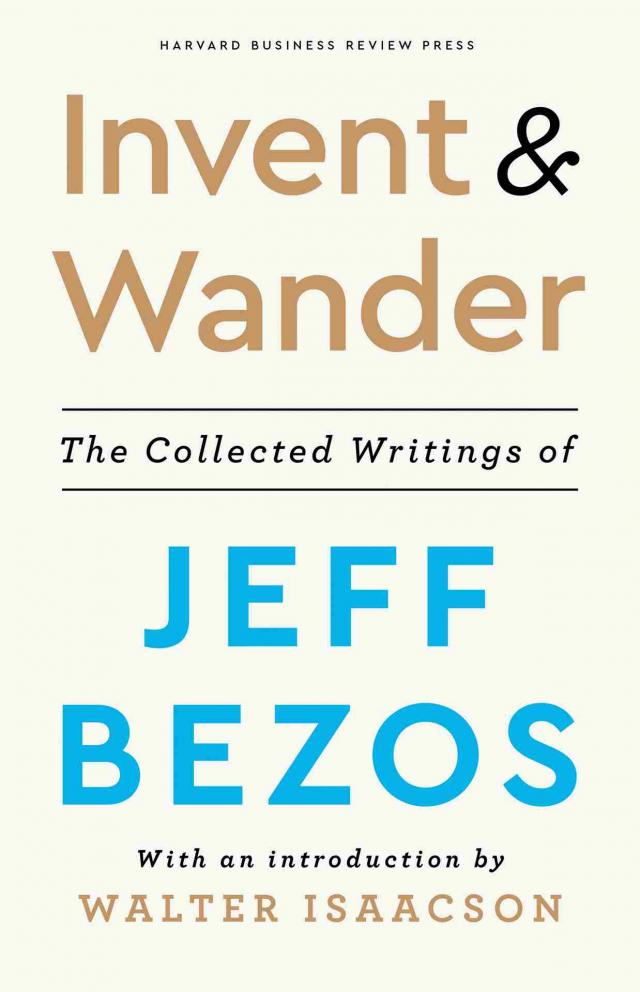
Invent and wander, p.4
Invent and Wander,
p.4


A Crucial Moment at Princeton (Economic Club interview)
“We Are What We Choose”: Address to the Princeton Graduating Class of 2010 (Jeff Bezos speech to the graduating class)
Resourcefulness (Transcript of conversation between Jeff Bezos and Mark Bezos)
Why I Went from a Hedge Fund to Selling Books (Economic Club interview)
Finding the Root Cause (Economic Club interview)
Creating Wealth (Economic Club interview)
The Idea for Prime (Economic Club interview)
Thinking Three Years Out (Economic Club interview)
Where the Idea of Amazon Web Services Came From (Economic Club interview)
Alexa, AI, and Machine Learning (Washington Post conference)
Physical Stores and Whole Foods (Economic Club interview)
Buying the Washington Post (Economic Club interview)
Trust (RNDF interview)
Work-Life Harmony (Transcript of conversation between Jeff Bezos and Mark Bezos)
Recruiting Talent: Do You Want Mercenaries or Missionaries? (RNDF interview)
Decisions (RNDF interview)
Competition (RNDF interview)
Government Scrutiny and Big Companies (Economic Club interview)
The Climate Pledge (Climate Pledge press conference)
The Bezos Day One Fund (Economic Club interview)
The Purpose of Going into Space (Washington, DC, Blue Origin event)
It’s Still Day One for America (Remarks submitted by Jeff Bezos prior to his testimony before the US House of Representatives Committee on the Judiciary Subcommittee on Antitrust, Commercial, and Administrative Law on July 29, 2020)
Part 1
THE SHAREHOLDER LETTERS
It’s All About the Long Term
1997
AMAZON.COM PASSED MANY milestones in 1997: by year-end, we had served more than 1.5 million customers, yielding 838 percent revenue growth to $147.8 million, and extended our market leadership despite aggressive competitive entry.
But this is Day 1 for the Internet and, if we execute well, for Amazon.com. Today, online commerce saves customers money and precious time. Tomorrow, through personalization, online commerce will accelerate the very process of discovery. Amazon.com uses the Internet to create real value for its customers and, by doing so, hopes to create an enduring franchise, even in established and large markets.
We have a window of opportunity as larger players marshal the resources to pursue the online opportunity and as customers, new to purchasing online, are receptive to forming new relationships. The competitive landscape has continued to evolve at a fast pace. Many large players have moved online with credible offerings and have devoted substantial energy and resources to building awareness, traffic, and sales. Our goal is to move quickly to solidify and extend our current position while we begin to pursue the online commerce opportunities in other areas. We see substantial opportunity in the large markets we are targeting. This strategy is not without risk: it requires serious investment and crisp execution against established franchise leaders.
It’s All About the Long Term
We believe that a fundamental measure of our success will be the shareholder value we create over the long term. This value will be a direct result of our ability to extend and solidify our current market leadership position. The stronger our market leadership, the more powerful our economic model. Market leadership can translate directly to higher revenue, higher profitability, greater capital velocity, and correspondingly stronger returns on invested capital.
Our decisions have consistently reflected this focus. We first measure ourselves in terms of the metrics most indicative of our market leadership: customer and revenue growth, the degree to which our customers continue to purchase from us on a repeat basis, and the strength of our brand. We have invested and will continue to invest aggressively to expand and leverage our customer base, brand, and infrastructure as we move to establish an enduring franchise.
Because of our emphasis on the long term, we may make decisions and weigh trade-offs differently than some companies. Accordingly, we want to share with you our fundamental management and decision-making approach so that you, our shareholders, may confirm that it is consistent with your investment philosophy:
We will continue to focus relentlessly on our customers.
We will continue to make investment decisions in light of long-term market leadership considerations rather than short-term profitability considerations or short-term Wall Street reactions.
We will continue to measure our programs and the effectiveness of our investments analytically, to jettison those that do not provide acceptable returns, and to step up our investment in those that work best. We will continue to learn from both our successes and our failures.
We will make bold rather than timid investment decisions where we see a sufficient probability of gaining market leadership advantages. Some of these investments will pay off, others will not, and we will have learned another valuable lesson in either case.
When forced to choose between optimizing the appearance of our GAAP accounting and maximizing the present value of future cash flows, we’ll take the cash flows.
We will share our strategic thought processes with you when we make bold choices (to the extent competitive pressures allow), so that you may evaluate for yourselves whether we are making rational long-term leadership investments.
We will work hard to spend wisely and maintain our lean culture. We understand the importance of continually reinforcing a cost-conscious culture, particularly in a business incurring net losses.
We will balance our focus on growth with emphasis on long-term profitability and capital management. At this stage, we choose to prioritize growth because we believe that scale is central to achieving the potential of our business model.
We will continue to focus on hiring and retaining versatile and talented employees and continue to weight their compensation to stock options rather than cash. We know our success will be largely affected by our ability to attract and retain a motivated employee base, each of whom must think like, and therefore must actually be, an owner.
We aren’t so bold as to claim that the above is the “right” investment philosophy, but it’s ours, and we would be remiss if we weren’t clear in the approach we have taken and will continue to take.
With this foundation, we would like to turn to a review of our business focus, our progress in 1997, and our outlook for the future.
Obsess over Customers
From the beginning, our focus has been on offering our customers compelling value. We realized that the web was, and still is, the World Wide Wait. Therefore, we set out to offer customers something they simply could not get any other way and began serving them with books. We brought them much more selection than was possible in a physical store (our store would now occupy six football fields), and presented it in a useful, easy-to-search, and easy-to-browse format in a store open 365 days a year, twenty-four hours a day. We maintained a dogged focus on improving the shopping experience, and in 1997 substantially enhanced our store. We now offer customers gift certificates, 1-ClickSM shopping, and vastly more reviews, content, browsing options, and recommendation features. We dramatically lowered prices, further increasing customer value. Word of mouth remains the most powerful customer acquisition tool we have, and we are grateful for the trust our customers have placed in us. Repeat purchases and word of mouth have combined to make Amazon.com the market leader in online bookselling.
By many measures, Amazon.com came a long way in 1997:
Sales grew from $15.7 million in 1996 to $147.8 million—an 838 percent increase.
Cumulative customer accounts grew from 180,000 to 1,510,000—a 738 percent increase.
The percentage of orders from repeat customers grew from over 46 percent in the fourth quarter of 1996 to over 58 percent in the same period in 1997.
In terms of audience reach, per Media Metrix, our website went from a rank of ninetieth to within the top twenty.
We established long-term relationships with many important strategic partners, including America Online, Yahoo!, Excite, Netscape, GeoCities, AltaVista, @Home, and Prodigy.
Infrastructure
During 1997, we worked hard to expand our business infrastructure to support these greatly increased traffic, sales, and service levels:
Amazon.com’s employee base grew from 158 to 614, and we significantly strengthened our management team.
Distribution center capacity grew from 50,000 to 285,000 square feet, including a 70 percent expansion of our Seattle facilities and the launch of our second distribution center in Delaware in November.
Inventories rose to over two hundred thousand titles at year-end, enabling us to improve availability for our customers.
Our cash and investment balances at year-end were $125 million, thanks to our initial public offering in May 1997 and our $75 million loan, affording us substantial strategic flexibility.
Our Employees
The past year’s success is the product of a talented, smart, hard- working group, and I take great pride in being a part of this team. Setting the bar high in our approach to hiring has been, and will continue to be, the single most important element of Amazon.com’s success.
It’s not easy to work here (when I interview people I tell them, “You can work long, hard, or smart, but at Amazon.com you can’t choose two out of three”), but we are working to build something important, something that matters to our customers, something that we can all tell our grandchildren about. Such things aren’t meant to be easy. We are incredibly fortunate to have this group of dedicated employees whose sacrifices and passion build Amazon.com.
Goals for 1998
We are still in the early stages of learning how to bring new value to our customers through Internet commerce and merchandising. Our goal remains to continue to solidify and extend our brand and customer base. This requires sustained investment in systems and infrastructure to support outstanding customer convenience, selection, and service while we grow. We are planning to add music to our product offering, and over time we believe that other products may be prudent investments. We also believe there are significant opportunities to better serve our customers overseas, such as reducing delivery times and better tailoring the customer experience. To be certain, a big part of the challenge for us will lie not in finding new ways to expand our business, but in prioritizing our investments.
We now know vastly more about online commerce than when Amazon.com was founded, but we still have so much to learn. Though we are optimistic, we must remain vigilant and maintain a sense of urgency. The challenges and hurdles we will face to make our long-term vision for Amazon.com a reality are several: aggressive, capable, well-funded competition; considerable growth challenges and execution risk; the risks of product and geographic expansion; and the need for large continuing investments to meet an expanding market opportunity. However, as we’ve long said, online bookselling, and online commerce in general, should prove to be a very large market, and it’s likely that a number of companies will see significant benefit. We feel good about what we’ve done, and even more excited about what we want to do.
1997 was indeed an incredible year. We at Amazon.com are grateful to our customers for their business and trust, to each other for our hard work, and to our shareholders for their support and encouragement.
Obsessions
1998
THE LAST THREE and a half years have been exciting. We’ve served a cumulative 6.2 million customers, exited 1998 with a $1 billion revenue run rate, launched music, video, and gift stores in the United States, opened shop in the United Kingdom and Germany, and, just recently, launched Amazon.com Auctions.
We predict the next three and a half years will be even more exciting. We are working to build a place where tens of millions of customers can come to find and discover anything they might want to buy online. It is truly Day 1 for the Internet and, if we execute our business plan well, it remains Day 1 for Amazon.com. Given what’s happened, it may be difficult to conceive, but we think the opportunities and risks ahead of us are even greater than those behind us. We will have to make many conscious and deliberate choices, some of which will be bold and unconventional. Hopefully, some will turn out to be winners. Certainly, some will turn out to be mistakes.
A Recap of 1998
Heads-down focus on customers helped us make substantial progress in 1998:
Sales grew from $148 million in 1997 to $610 million—a 313 percent increase.
Cumulative customer accounts grew from 1.5 million at the end of 1997 to 6.2 million at the end of 1998—an increase of over 300 percent.
Despite this strong new customer growth, the percentage of orders placed on the Amazon.com website by repeat customers grew from over 58 percent in the fourth quarter of 1997 to over 64 percent in the same period in 1998.
Our first major product expansion, the Amazon.com music store, became the leading online music retailer in its first full quarter.
Following their October launch under the Amazon brand and with Amazon.com technology, the combined fourth-quarter sales in the UK and German stores nearly quadrupled over the third quarter, establishing Amazon.co.uk and Amazon.de as the leading online booksellers in their markets.
The addition of music was followed by the addition of video and gifts in November, and we became the leading online video retailer in only six weeks.
Twenty-five percent of our fourth-quarter 1998 sales was derived from Amazon.co.uk, Amazon.de, and music, video, and gift sales on Amazon.com, all very new businesses.
We significantly improved the customer experience, with innovations like 1-ClickSM shopping, Gift Click, storewide sales rank, and instant recommendations.
1998’s revenue and customer growth and achievement of continued growth in 1999 were and are dependent on expansion of our infrastructure. Some highlights:
In 1998 our employee base grew from approximately six hundred to over twenty-one hundred, and we significantly strengthened our management team.
We opened distribution and customer service centers in the United Kingdom and Germany and in, early 1999, announced the lease of a highly mechanized distribution center of approximately 323,000 square feet in Fernley, Nevada. This latest addition will more than double our total distribution capacity and allows us to even further improve time-to-mailbox for customers.
Inventories rose from $9 million at the beginning of the year to $30 million by year end, enabling us to improve product availability for our customers and improve product costs through direct purchasing from manufacturers.
Our cash and investment balances, following our May 1998 high yield debt offering and early 1999 convertible debt offering, now stand at well over $1.5 billion (on a pro forma basis), affording us substantial financial strength and strategic flexibility.
We’re fortunate to benefit from a business model that is cash-favored and capital efficient. As we do not need to build physical stores or stock those stores with inventory, our centralized distribution model has allowed us to build our business to a billion-dollar sales rate with just $30 million in inventory and $30 million in net plant and equipment. In 1998, we generated $31 million in operating cash flow which more than offset net fixed asset additions of $28 million.
Our Customers
We intend to build the world’s most customer-centric company. We hold as axiomatic that customers are perceptive and smart, and that brand image follows reality and not the other way around. Our customers tell us that they choose Amazon.com and tell their friends about us because of the selection, ease-of-use, low prices, and service that we deliver.
But there is no rest for the weary. I constantly remind our employees to be afraid, to wake up every morning terrified. Not of our competition, but of our customers. Our customers have made our business what it is, they are the ones with whom we have a relationship, and they are the ones to whom we owe a great obligation. And we consider them to be loyal to us—right up until the second that someone else offers them a better service.
We must be committed to constant improvement, experimentation, and innovation in every initiative. We love to be pioneers, it’s in the DNA of the company, and it’s a good thing, too, because we’ll need that pioneering spirit to succeed. We’re proud of the differentiation we’ve built through constant innovation and relentless focus on customer experience, and we believe our initiatives in 1998 reflect it: our music, video, UK and German stores, like our US bookstore, are best of breed.
Work Hard, Have Fun, Make History
It would be impossible to produce results in an environment as dynamic as the Internet without extraordinary people. Working to create a little bit of history isn’t supposed to be easy, and, well, we’re finding that things are as they’re supposed to be! We now have a team of twenty-one hundred smart, hard-working, passionate folks who put customers first. Setting the bar high in our approach to hiring has been, and will continue to be, the single most important element of Amazon.com’s success.
During our hiring meetings, we ask people to consider three questions before making a decision:
Will you admire this person? If you think about the people you’ve admired in your life, they are probably people you’ve been able to learn from or take an example from. For myself, I’ve always tried hard to work only with people I admire, and I encourage folks here to be just as demanding. Life is definitely too short to do otherwise.
Will this person raise the average level of effectiveness of the group they’re entering? We want to fight entropy. The bar has to continuously go up. I ask people to visualize the company five years from now. At that point, each of us should look around and say, “The standards are so high now—boy, I’m glad I got in when I did!”