Gravity wars nova strike, p.24
Gravity Wars: Nova Strike,
p.24


“Still…” Baal said. “You can’t be one hundred percent certain that isn’t the case.”
“Yes, sir,” Naram Sin said, deciding there was no use talking about this anymore. “You have made your decision, and I respect it.”
“It is the right decision,” Baal said, trying to sound confident.
“You are most likely correct, sir.”
Baal gave him a squinting stare, then heaved himself to his feet. “Now, we will go back and you will say no more about this. We will be ready for any devious moves the Earthers may unleash. Otherwise, we shall follow our plan to our victory.”
“May it be so,” Naram Sin said, rising to his feet and following Baal for the hatch.
-7-
The three Enforcers made their final braking insertion on the dark side of the Moon. Sensors scoured the lunar surface, searching for any surprises. At the same time, from farther back, the seven auxiliary vessels began their final braking maneuvers.
Probes launched from the Lagash on one edge of the Moon and from the Nabu on the other edge, headed for the horizon. In moments, the probes shot around in a curving orbital trajectory. As soon as they scanned, they sent data back to following probes, which beamed the information to the Enforcers.
These probes were different from the earlier ones. The Earthers would have seen those probes coming for a time, knowing exactly when they would appear over the horizon and higher up. There were Earther Watchdog satellites in the far distance constantly keeping the invasion fleet under observation. These new probes launched directly from the Enforcers. It meant they acted by surprise. This allowed the initial probes to map out the enemy’s defensive systems closer to the horizon between the near and dark sides of the Moon. However, the Earthers’ near side Moon defenses then targeted and eliminated the probes.
More probes flew from different directions, zipping over the horizons, scanning and exploding far too soon due to enemy fire.
Naram Sin stood in the command center on the Enkidu, behind Baal. Soon, a map of the Earther Moon’s missile sites, sensor stations, bunkers—all the information they could sort out—gave them a good idea about half of the near side of the Moon. That area was along all the edges of the horizon. The central areas of the Moon contained vast blank spots.
Advanced AIs took the known data and extrapolated, creating a simulation probability map of what likely existed in the blank regions.
Baal and the other high commanders on the Enkidu soon had an idea of where the various enemy forces and defenses on the near side were situated. They did not find any hidden spaceships. The nearest space vessels were the Orion ships one-third the distance from Earth to the Moon. That meant the enemy fleet was approximately 256,000 kilometers from the Moon.
“They’re hanging back,” Baal said to the others.” He turned. “Why do you think that is so, Naram Sin?”
Naram Sin stepped up with his brow furrowed. “Given what we see, I suggest we use the Enforcers, build up velocity and make one orbital pass around the near side, destroying what we can.”
Baal glowered at him. “If that were the decision, we would have already done it. Now, it is out of the question.”
“Earlier,” Naram Sin said, “we did not know what the Earthers had or where to fire. It was a risk earlier. Now, it is a safer and wise maneuver.”
“I will tell you what it is not,” Baal said angrily. “It is not the maneuver Chief Marshal Assur designed for the invasion fleet. Do you wish to flaunt the prime authority of the colony?”
“I do not,” Naram Sin said. “Please forgive my foolish talk, Marshal.”
Baal made a swift, flickering gesture. “We will forget it. But remember, we follow the prime authority here. We follow the outlined steps and stick to the plan,” Baal said in a stentorian voice.
Naram Sin understood. Baal loved to hear himself talk. That was his true métier. But making hard decisions…
Naram Sin turned away and closed his eyes for a moment. He felt heat on his brow. He knew what they should do.
As the chess master of the colony, Naram Sin knew how to win and do it quickly. They could still use the Enforcers to circle the Moon, destroying enemy Moon emplacements. Given the probes and the AI projections, they could smash everything, including enemy space marine barracks. There would be a few hidden locations they would miss. But they could take out eighty to ninety percent of the Moon defenses now, instead of making their space marines fight for every inch of it. The Earthers were out of position. This was a rare opportunity.
Naram Sin opened his eyes and wiped the sweat from his brow. He was not the invasion leader. He performed an auxiliary function. He needed to remember that.
So… if Baal wanted to make the decisions, let the Marshal do so.
Abruptly, Naram Sin realized he was in another chess match—a chess match for his life and maybe to bring peace between Earthers and Valiants. What a marvelous concept, one he had not anticipated before.
Meanwhile, Baal and the space marine commanders sat together, outlining the projected surface campaign that would give them victory.
“My recommendation, Marshal, is that we move swiftly and violently,” one of the space marine leaders said. “The Earthers are out of position. It will take their Orion ships time to move forward. We should hit the enemy hard while we can and take out as much as possible before the main fleet maneuvers to a more reasonable range.”
Baal grunted, eyeing the two. Then he began to instruct him. In a sense, it was no instruction at all, for he followed Assur’s original plan almost to the letter. “Are there any objections?” he asked the commanders.
Both space marine commanders shook their heads, their faces stiff.
“Then off to your duties,” Baal said. “We will begin the planned assault without alterations. Is that understood?”
The space marines gave a snappy salute and left.
Naram Sin had drifted to the background, watching on a screen as the auxiliary vessels came down. Three were combat transporters and held the bulk of the space marines.
The rest of the space marines were aboard the three Enforcers.
The other auxiliary vessels carried disassembled military equipment, missiles, and masses of spare parts. The last transport held all the unassembled, one-kilometer-long mass drivers and their generators. Those were critical to the campaign’s utility and the greater war effort.
Naram Sin wished Baal had followed his advice. The odds were still on their side, but the Earthers had a chance because Baal hadn’t taken the initiative and used the Earthers’ hesitation against them. Instead, Baal had matched it with his own hesitation.
Thus, two cautious forces, neither willing to expose their most precious assets: the Enforcers and Orion ships faced each other.
The Valiants needed to unload and erect the mass drivers as fast as possible in order to provide firepower against the Earthers and damage the orbital stations and then the industries of Earth. This was the riskiest part of the invasion—conquering the entire Moon—and already they had missed a critical opportunity toward that.
Naram Sin shrugged and figured this was how it was going to be. He would give good advice again when Baal was ready to listen. Unfortunately, who knew when that would be?
-8-
It took twelve days of around-the-clock preparation to unload and assemble the military vehicles, check all space marine battle suits and weapons, and shake out the marines themselves.
Three of the cargo vessels—the combat transporters—each at 10,000 tons, had been dedicated to carrying marines and their 1.8-ton battle suits and personal weapons. Given the length of the journey and the need to keep the marines fit, it had allowed for 110 space marines per combat transporter. That meant 330 space marines in the three CTs, combined with the 160 in the three Enforcers. That gave Marshal Baal 490 surface combatants, a large number given the number of Earthlings on the Moon.
The probes and recon drones had shown fourteen Moon bases on the near side. The largest establishments were in the center area. Those three bases were Central Command and Luna Hub, the two spaceports, and Crater Alpha.
Central Command and Luna Hub were the primary command and logistics points for the humans on the Moon. The two bases had optimal communications with the Orion ships and orbital stations and in-depth defenses along with a small complement of space marines each. Naram Sin had estimated each of those bases to hold 70-100 personnel, which included the space marines.
There were five missile bases on this side of the Moon, similar to those they had faced on the dark side. These held big offensive missiles and silos, together with launch control centers, storage and maintenance areas, and point-defense turrets. The missile bases likely had 10-20 personnel, mostly maintenance.
Then there were multi-purpose bases with modular habitats, labs, resource extraction equipment and minor defense systems. They seemed to hold 5-10 people each.
Overall, there appeared to be 215-370 Earthlings on the Moon. This was pitiful compared to the number of Valiants who had just arrived.
The big question was this: Why hadn’t the humans put more people on the Moon? Another important question was: why wasn’t there more defensive equipment? In all this time, the Earthlings had hardly done anything to help defend their planet by fortifying the Moon.
Well, that wasn’t exactly accurate. The Earthers had built many sensor stations, along with a few missile bases. Most of those systems had surely been installed to help against the projectiles from the Iapetus railgun of several years ago.
Perhaps the Earthers were simply not much for space exploration, and obviously, they hadn’t expected a direct assault until only a few months ago. That was contrary to Valiants, who had lived aboard ship or on a moon their entire lives, making it a natural habitat for them.
Two of the combat transporters had carried the vehicles for the lunar surface assault. When Assur first envisioned the plan, he expected a greater Earther presence on the Moon. He had been counting on superior Valiant fighting prowess to carry the day.
Each of the two 10,000-ton vessels held one assault lander weighing 500 tons. Its purpose was for the rapid deployment of troops and heavy weapons. An assault lander resembled a flattened armored wedge with retractable landing gear and wide pads for lunar stability.
A combat transporter also carried four 50-ton combat moon rovers. They were for ground mobility and engaging enemy forces, with a turret on top and big balloon tires.
A CT also carried three recon flyers of 30 tons each. As the name said, they were used for recon and quick responses. They were delta wing shaped with two pilots, and hardy in a short engagement.
Each CT also carried one heavy cargo lander of 1,000 tons. The heavy lander transported large military equipment and supplies.
Finally, each CT carried four defensive turret vehicles. Each vehicle weighed 50 tons and was used to rapidly set up automated defensive systems, mostly turrets as the name implied.
That came to thirteen vehicles per CT, or twenty-six in all.
The mix favored slugfests more than rapid, all-Moon assaults. The combat rovers would be nearly useless in the coming missions, the turret vehicles not quite so much.
“I wonder, sir,” Naram Sin said in the Enkidu’s ready room. “Perhaps we could transfer the moon rovers to the mass driver construction crews. They could use more heavy vehicles to move large sections of the magnetic rails.”
Baal eyed him from the desk where he wrote mission statements.
“The mass drivers are the key to this,” Naram Sin said. “The sooner we construct one, the sooner we can press our primary advantage.”
Baal raised an eyebrow.
Did the Marshal want him to reiterate it? It seemed so. “We convert their Moon into a fortified super-gun, forcing them to attack us. The mass drivers are the goads and later the weapons we use to de-industrialize Earth. Once all six drivers are laid and operative, the battle and then the war is essentially won.”
Baal nodded as if he’d already known that, which he should have.
“I suggest we start the near side assault with a mass attack,” Naram Sin said.
“Trying to capture all fourteen bases at once?” asked Baal.
“That would be too aggressive. Perhaps if we captured four bases at once: that would speed up the schedule sufficiently, giving the Earthers less time to reinforce the Moon.”
“Are you forgetting already?” admonished Baal. “Stick to the plan, remember?”
“I understand that’s your mantra, sir. It’s a good one, too,” Naram Sin hastily added. “But if you make faster advances when the opportunity presents itself, the expeditionary force will see you can make your own command decisions when it counts.”
Baal eyed him and then scratched his chin. Finally, he nodded. “See to it.”
Naram Sin rose. “Then, by your leave, sir, I’ll begin to make the arrangements.”
Baal nodded.
Naram Sin left the ready room and bridge. He had proposed the idea based on the recommendation of his friend, Group Leader Tiglath. Tiglath had suggested a mass assault would be safer for the space marines, giving the Earthlings less chance to call for reinforcements or to use any mobile force they might possess. If they had such a force, they couldn’t shuffle it from one fire to another, but be forced to use it once to defend one base.
However, given what Naram Sin had seen so far, the Earthers would remain timid and tepid, giving the invasion fleet too many chances to excel and win the larger war faster.
-9-
Three days later, the first ground attack was ready to be launched.
Each of the Enforcers maneuvered near the horizon between the dark side and the Earther-held near side.
Both sides had been using probes and drones to study each other. The Earthers had the advantage with their Watchdog satellites scanning from afar and sending the information back to the Orion ships. Nothing could be done for now about the Watchdogs.
These probes and drones were launched from the Enforcers before they zipped over the horizon near Earther Moon defenses, where lasers and missiles took them out.
Despite that, the Valiants had learned enough to plan their first multi-base assault.
***
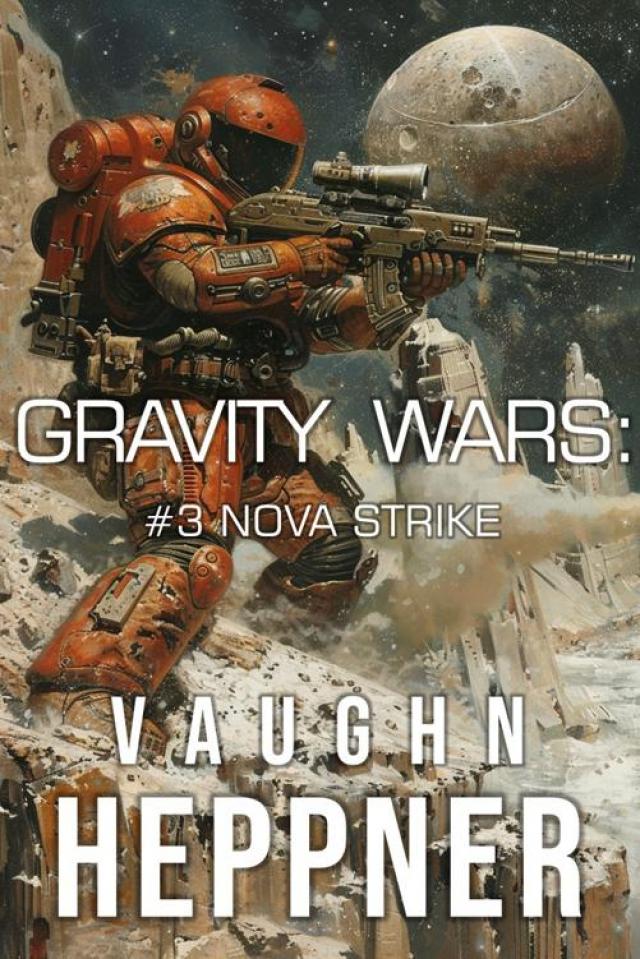
In his 1.8-ton battle suit, which also acted as a spacesuit, stocky Group Leader Tiglath stood at the edge of the loading zone. His armored boots sank into the fine lunar regolith or dust.
Some of the technicians were worried about the regolith because the particles were incredibly sharp, like glass. Because of the vacuum, there had never been any weather to dull those sharp edges. Even worse, the fine dust stuck to everything.
The techs gave a techy reason why this was so: lunar dust stuck to everything because the particles were electrostatically charged by the sun’s ultraviolet radiation. It was like a person rubbing a balloon against their hair, causing the balloon to stick. The vacuum prevented anyone easily removing such dust. Additionally, the iron content in some particles gave them magnetic properties, and frictional contact could cause additional electrostatic attraction. These factors combined to make lunar dust a pain for everyone on the Moon.
Could that be one of the reasons why there were so few Earthlings on the Moon?
Tiglath turned to his marines, one hundred strong, each clad in an armored battle suit. Many of the helmet visors reflected the distant starlight.
“It’s time to board. Squad A, you will begin.”
The first space marines moved up as the lander’s ramp lowered. It revealed the dimly lit interior.
After that last squad boarded, Tiglath took his place in the command seat at the front, securing his harness. Through a front window, he could see the cockpit. Four operators sat amidst an array of controls, screens, and instruments.
The pilot clicked a toggle switch, initiating the pre-flight sequence. The lander’s engines hummed with power.
Tiglath could feel the vibration through his seat and then battle suit.
“All systems go,” the pilot said, the sound coming through the helmet speakers.
The assault lander lifted, the surface of the Moon falling away. Two recon flyers flanked them.
As the assault lander ascended, Tiglath peered through a port at the moonscape. The barren, cratered terrain stretched in all directions, illuminated by the faint light of distant stars.
Soon, the lander crossed the horizon onto the near side. Jagged mountains rose in the distance. Tiglath and others grunted as they viewed the blue object hanging in the darkness. Earth looked so enticingly alive. That was the ultimate goal: to conquer Earth and make it the new home of the Valiants. It was such a captivating sight. Tiglath had grown up on the Voyager and later in the Titan colony. Earth was worth battling for. The Valiants would take it from the weak Earthlings and make it their homeworld. The Valiants would never let anyone take it away from them.
The lander sank so it flew lower, skimming just above the rocky terrain. The flyers had sped ahead and no longer flanked them.
Even though the name ‘dark side’ was a misnomer, as the sun shone on it as much as on the near side, the sun hadn’t been shining on their side. Now, the moonscape began to change. The sun blazed its light, casting long shadows and highlighting the rugged features. In other places, a harsh glare reflected off the rocky terrain, forcing the visor’s polarizers to work.
Later, in the distance, the structures of Equinox Base came into view.
Tiglath’s heart rate quickened. This wasn’t the only assault. Others would be taking place. The plan was to capture four Moon bases in one fell swoop.
Now, Tiglath’s HUD highlighted Equinox Base, marking tactical information. The base was a cluster of domes and cylindrical modules, connected by narrow walkways. It sat in a relatively flat area, surrounded by smaller craters and rocky outcrops.
The assault lander maintained course, the base growing larger in the viewport. Tiglath’s grip tightened on his gyroc rifle. This was for real, a direct fight against Earthers.