Gravity wars nova strike, p.26
Gravity Wars: Nova Strike,
p.26
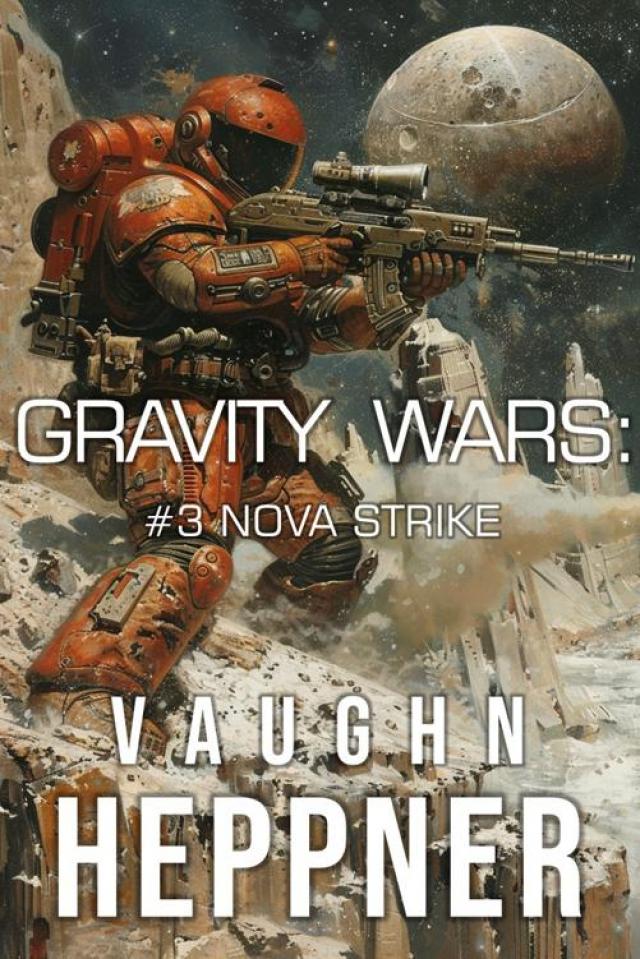


Turrets switched to ground fire. Marines hunkered behind Moon boulders. Others fired rocket-propelled shells, while a few launched EW grenades that emitted fierce jamming patterns.
A squad of marines surged ahead, their battle suits glinting under the harsh sunlight. For weeks, the relentless lunar dust had been a persistent adversary as they practiced. The dust clung to every surface and infiltrated every crevice. Despite the advanced sealing and filtration suit systems, the abrasive, electrostatically charged particles found their way into the smallest gaps.
Squad Leader Kael’s battle suit had been operating at its limits, with micro-abrasions forming around the seals of its joints and helmet. Over time, the tiny breaches allowed more and more dust to penetrate the suit. The fine particles had worked their way into the life support system, clogging air filters and contaminating the internal circuitry.
As the squad neared Central Command, Kael’s suit began to falter. Warning indicators inside his helmet blinked erratically as the life support system struggled to maintain a breathable suit atmosphere. The filters, choked with fine lunar dust, could no longer purify the air. The cooling system, designed to regulate temperature, began to overheat as dust particles gummed up its delicate mechanisms.
With a sputtering whine, the life support system failed. The oxygen supply, already thin, was cut off.
Kael’s breaths grew shallow and rapid, his vision dimming as hypoxia set in. He stumbled, disoriented, but his suit, now a death trap, offered no relief. The internal temperature soared, and the once-advanced technology became a prison of heat and suffocation.
With a final, desperate gasp, Kael collapsed, the suit’s rigid frame locking him in place. His squad, too focused on the mission, pressed on, unaware of his plight.
The assault on Central Command continued, but for Squad Leader Kael, the battle was over, claimed not by enemy fire but by the lunar dust that had infiltrated and ultimately destroyed his life support system.
Despite that and other changes, in many ways, this was a repeat of the first base assault. This base was bigger. There were more humans present. But the Valiants had done this before, getting practice and coming up with better countermeasures.
“Practice makes perfect,” Tiglath told himself. He wished that was true in chess.
His HUD display showed more losses than last time, 28 and climbing. This was a bigger base, and enemy space marines fought back. Despite that, superior training and tactics told against the Earthlings.
Had the other targeted Moon bases fallen today? If so, soon, there would be no humans on the Moon except for the prisoners in the Enforcers.
That was good, because Tiglath’s battle suit had started to give him problems, and that was no doubt because of the crazy moon dust.
Tiglath did not yet know about Squad Leader Kael.
If Tiglath had to keep using his battle suit, it would soon need to go back for a thorough refit, or it would shut down at the worst possible moment just as it had for poor Kael.
-12-
LUNA
OCTOBER 2074
The lunar surface lay still under the black expanse. In one area, an alien structure stretched across the regolith, a one-kilometer mass driver, the first of six brought from Titan. Built in a feverish two and a half months, the weapon was finally ready to unleash its first payload.
Naram Sin had arrived to watch, coming down from the Enkidu, working under the direct authority of Marshal Baal.
Senior Technician Eridu stood at the control center, a reinforced dome nestled at the base of the mass driver. The chamber vibrated with the low thrum of machinery. Before him and Naram Sin, a display projected the trajectory and specifications of the upcoming launch: a pumpkin-sized projectile destined to smash one of the enemy’s missiles.
“All systems nominal,” reported Mechanic Tran from lower down.
“Is that good?” asked Naram Sin.
Eridu nodded, his gaze shifting to a window that offered a panoramic view of the mass driver.
Naram Sin looked out as well. The one-kilometer weapon was composed of superconducting coils and electromagnetic rails, a silver line against the gray dust of the Moon.
The projectile, nestled at the start of the track, looked almost innocuous—a pumpkin-sized metal sphere, its surface dark to make it harder to see. It was designed and would be propelled to strike with the kinetic force of a small meteor.
Eridu looked up for permission to begin.
Naram Sin nodded, knowing that much of the invasion depended on this. Baal would want to know everything concerning this moment.
“Initiate final countdown,” Eridu said hoarsely.
The smaller and lower-ranked Tran raised his shaking hands, engaging the final sequence. “Countdown has started,” he said in a whisper. “We are at T-minus thirty seconds.”
Outside, energy surged through the superconducting coils, creating a magnetic field that would accelerate the projectile. The rails began to vibrate with power.
Naram Sin felt it. Two and a half months of feverish work was being completed this moment. The Earthers had become too complacent. They would find out that having a plan was essential. Time had to be utilized effectively. The Earthers had squandered their opportunities.
“T-minus twenty seconds,” Tran said, his voice firming.
Naram Sin felt a bead of sweat trickle down his temple, a rare sign of anxiety. Would the mass driver live up to their hopes?
“T-minus ten seconds,” Tran said.
The display showed the projectile’s predicted path, an arc from the lunar surface to a targeted Guardian III missile 128,000 kilometers away.
“Launch has initiated,” Tran whispered.
A blinding flash of light erupted along the length of the mass driver as the electromagnetic forces engaged. The projectile shot forward, accelerating to 44.7 kilometers per second (approximately 160,920 kilometers per hour). The dark blur vanished into the blackness, its velocity carrying it toward its distant target.
Naram Sin watched its trajectory on the display, the arc aligning with the target’s coordinates.
“Projectile is away,” Tran said needlessly.
Eridu grinned at Naram Sin.
“Excellent,” Naram Sin said. This was like capturing an opponent’s queen. This was critical. This was marvelous… if the projectile hit.
Eridu clicked several switches before he said, “Initiate cooldown.”
High-capacity radiators had been installed along the length of the mass driver. They helped dissipate the heat from the coils. Advanced cryogenic systems kicked in, accelerating the cooling process. Meanwhile, automated loaders positioned the next projectile at the beginning of the track.
Lower down, Tran monitored the capacitor banks, watching as they recharged from the facility’s nuclear reactor and solar arrays. The display showed the charge levels climbing slowly but steadily.
“Capacitors at eighteen percent and rising,” Tran said.
Twenty-three minutes later, the radiators retracted, and the loading mechanism completed its cycle. The next projectile, a black iron sphere, was locked in place.
“Cooling complete,” Tran said. “The next projectile is loaded.”
Eridu glanced at the watching Naram Sin.
“That’s impressive,” Naram Sin said. “I had no idea it could fire that rapidly.”
“This is the first shot,” Eridu said. “It might not cooldown as fast later. It’s likely the moon dust will also retard the line, as we’ll have to clean it from time to time.”
“But the driver can launch again now?” Naram Sin asked.
Eridu nodded.
“Then please do so,” Naram Sin said.
“Prepare for the next launch,” Eridu said.
Another ten minutes passed, with the final checks confirming all systems were nominal.
“Capacitors are at full charge,” Tran said.
Eridu glanced at the countdown timer. “That took thirty-three minutes,” he said.
Naram Sin felt victorious, which surprised him. He hadn’t expected to feel this way.
Naram Sin said, “Let’s hammer the Earthers into submission.”
Soon, the second projectile shot down the length of the mass driver, on its way to the mass of Guardian III missiles out there.
-13-
The pumpkin-sized iron ore projectile from the first shot was hurtling through space, straining to reach its target.
Embedded within its core were an AI, a camera, and a miniature ion thruster. As it exited the mass driver, the AI activated, orienting itself. Eleven minutes and thirteen seconds later, it ignited the ion thruster. Pale blue ionized particles streamed from the rear of the projectile, providing slight thrust corrections to keep it on its calculated path.
The AI processed the data in real time. It also communicated with the mass driver base, confirming trajectory adjustments and monitoring its position. The thruster pulsed rhythmically, corrections ensuring the projectile stayed on course for a Guardian III missile, currently 127,861 kilometers away from the mass driver.
The Guardian III was a huge missile, nearly the size of the old Saturn V rocket that once took humanity to the Moon.
As the projectile sped through space, its velocity remained blisteringly fast, covering the distance in under an hour.
The AI continuously refined its trajectory, accounting for gravitational influences and minor variations in its course. The ion thruster fired in precise bursts, each correction bringing it closer to target.
As the projectile closed the final kilometers, the AI made its last adjustments.
The projectile, traveling at 44.7 kilometers per second, collided with the targeted Guardian III missile. It struck with a kinetic energy equivalent to 2.3 terajoules, a force comparable to over half a kiloton of TNT. The collision generated an intense flash of light as the kinetic energy was instantaneously converted into heat and shock waves.
The front section of the Guardian III disintegrated, vaporizing into a cloud of superheated plasma. The energy shattered the missile’s structure, sending shards spiraling outward in a violent explosion.
The shockwave rippled through the surrounding space, creating a burst of electromagnetic radiation detectable even from the lunar surface. Within milliseconds, what had been a big-bad missile was reduced to a rapidly expanding sphere of debris.
As the debris spread out, high-velocity fragments collided with another Guardian III. Shards of metal tore through fuel tanks, igniting a massive secondary explosion. The resulting blast sent more debris flying outward, creating an even wider field of destruction.
One fragment, a jagged piece of the original missile’s engine casing, slammed into a third missile. This missile was shredded along its length, its guidance systems and payload ripped apart in an instant. The wreckage spiraled out of control, adding to the chaos.
Several other Guardian IIIs sustained minor damage. Smaller fragments peppered their hulls, denting armor plates and compromising external sensors. One missile’s communication array was sheared off, leaving it unable to receive further commands. Another had its stabilization thrusters punctured, causing it to drift off course.
Inside the Daniel Boone Orion ship, alarms blared as the crew witnessed the chain reaction.
Officers assessed the situation. The debris field expanded rapidly, each piece of shrapnel a potential threat to other missiles.
Soon, Admiral Wilson understood. The enemy’s mass driver had launched its first shot, and it proved devastating. The Valiants might have just made the fleet’s location here untenable.
“Patch me through to O.S. Aphrodite,” Wilson told a comm officer. “I need to talk to CEO Petty. This is an emergency.”
-14-
“Guard the missiles,” Petty shouted over the communications screen. “Do you hear me? We need time to make a decision. Don’t lose the Guardian IIIs before we can use them. Think of your ship as a guard dog.”
“Yes, sir,” Admiral Wilson said. “We are already redeploying the missiles. However, the mass driver can fire faster than we anticipated. We’ll take temporary measures.”
The Daniel Boone Orion ship had used two nuclear propulsion bombs to push it ahead of the mass of Guardian III missiles. It had rotated and used two more nukes to brake and remain in this new location.
This close to the Moon, their margin for error had shrunk compared to when they had been twice as far away.
The Daniel Boone had become a guard dog ready to protect the Guardian IIIs from the damned mass driver.
Admiral Wilson had given terse orders. Every sensor and instrument was trained on the lunar surface, focused on the mass driver.
Lieutenant Dan Martinez, the ship’s lead sensor officer, was glued to his console as he studied the various screens displaying real-time data from the Moon.
“Keep a close eye on that mass driver,” Wilson said. “At any sign of activity, I want to know immediately.”
The lieutenant and others responded with a chorus of acknowledgments. Losing too many Guardian IIIs would be a severe blow.
“Energy spike detected,” Ensign Patel said. “It looks like the mass driver is powering up again.”
Martinez’s fingers flew over his board, bringing up enhanced visuals and sensor readings. The mass driver glowed faintly as power surged through its superconducting coils, preparing for another launch.
“Sir,” Martinez said.
Admiral Wilson had taken over from the Orion ship’s captain. Wilson hadn’t done anything like that in the past few months. Petty’s instructions a short time ago had rattled him.
“Prepare for interception,” Wilson said. “Bring the railguns online and get me a targeting solution as soon as possible.”
The bridge buzzed with activity. Officers worked frantically to bring the Orion ship’s railgun systems to readiness, while the tactical officers calculated the probable trajectory of the projectile.
“Launch confirmed,” Patel said. “The object is away. Size and speed match the previous launch. It will be here in less than an hour.”
Wilson stared at a screen, his heart pounding. The pumpkin-sized projectile was a tiny target and it was moving at an incredible speed. They had all seen what the first one had done. His eyes locked onto the display, tracking the object as it hurtled through space.
Still, despite the urgency, it took time for the object to travel 128,000 kilometers at 44.7 kilometers per second.
“Look at that,” Patel said thirty minutes later. “The object is on a direct course for that Guardian III. Time to impact: fourteen minutes.”
“Engage the railguns,” Wilson said. “We have to take it out before it reaches the missile and starts another chain reaction.”
The railguns, designed to hurl projectiles at incredible speeds, powered up with a low hum that resonated throughout the Orion ship. The targeting system locked onto the tiny incoming object, calculating the precise lead necessary to intercept it.
“Firing solution ready,” Tactical Officer Harris announced. “Railguns locked on target.”
“Fire,” Wilson said. “I have to know we can do this.”
The railguns roared to life, sending a stream of high-velocity projectiles into the void. The first shots missed, narrowly passing by the hurtling chunk of iron. Adjustments were made, the targeting system refining its calculations with each shot.
“Adjusting aim,” Harris said. “Firing again.”
Another salvo erupted from the railguns, the projectiles streaking toward their target. This time, the calculations were right. The first of the projectiles struck the iron dead on, shattering it into a cloud of smaller fragments.
“Direct hit,” Patel said. “The object is neutralized; all the fragments are off target.”
Wilson exhaled a breath he hadn’t realized he was holding. All around him, the bridge erupted in cheers.
“This is far from over yet,” Admiral Wilson said. “Captain, I’ll leave you to it then.”
As the captain took the admiral’s place, Wilson hurried to the ready room, no doubt to report to CEO Petty about their victorious engagement.
-15-
In O.S. Aphrodite, Petty paced in Command Central. His gut had been seething ever since the first mass driver projectile had taken out far too many Guardian III missiles. No one had expected the projectile to travel so fast. According to the readings, it ejected at 44.7 kilometers per second. That wasn’t anything like the railgun on Iapetus, but that had been across the Solar System. This was in their backyard. They were going to have to move the missiles or watch them all be shredded into debris. He knew they never should have moved up to just one-third of the way to the Moon.
“A mistake,” Petty told Huber.
The others in Command Central sat at their stations, alert.
“Sir?” asked Huber.
“It was a mistake to move the missiles and Orion ships so close to the Moon,” Petty said. “It hasn’t stopped anything, and it has made our missiles vulnerable to the mass driver.”
Huber nodded absently as he stared at a display.
Petty didn’t care for it. The anxiety of always being the man to make the final decisions had begun to eat him alive. He needed a drink. He badly needed several drinks. “What’s wrong with you?” he shouted at Huber.
Several personnel turned and glanced at him.
Petty hated that.
He must have scowled, as the personnel jerked the other way, concentrating on anything but him.
Huber turned from the display and regarded him. “Did you say something?”
“We never should have moved everything to within 128,000 kilometers of the Moon,” Petty said. “It was a mistake. We’re paying for it now.”
Huber shook his head.
“You don’t agree?” Petty snapped.
“I don’t.”
“Did you see the missiles blow up?”
“Of course,” Huber said.
“Well?”
“We must react to it or lose too many missiles,” Huber said.
“Yes! That’s what I’ve been saying.”