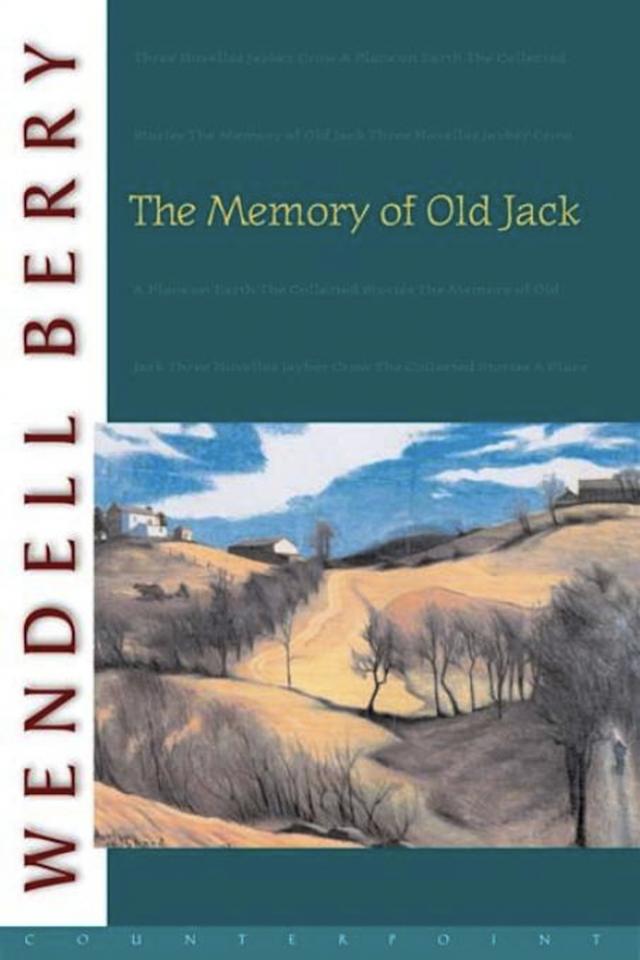
The memory of old jack, p.11
The Memory of Old Jack,
p.11


He returns to himself as he was when he was a breaker of horses. For that was one of his economies and one of his earnings after the disaster of the barn. The fire had cleaned him of work stock except for one gray mare mule, an excellent plow mule by the name of Queen that he had lent the summer before to Ben Feltner. Needing then to save every possible penny, he agreed to take a pair of young mules from Ben and break them in return for the use of them through the crop year. And he did. He had always broken his own work and saddle stock, and so the art of it was known to him. Working the young mules at first separately, hitched with Queen, and then together, he made a team of them, and carried on his work in the process.
Soon the word got around, and he was given other stock to break-horses and mules of all kinds, occasionally a saddle horse, but he had little time to spare for that, and mostly he stuck to work stock. It was tricky, dangerous work for a man to do alone. But he was good at it. He was skillful. He knew what was possible. He knew, in any circumstance, what was apt to happen.
He liked it. The danger of it was giving him back the feel of his life—as Ruth and his work, blighted by debt, no longer could. Working the young teams, always on the lookout against tooth and hoof, alert for the blowing leaf or flying bird that would start them running, using by turns skill and main strength, he lived on the narrow line between life and death, in deeper touch than he had been in ten years with the intricacy of power and skill that made his manhood.
There was something fine about it. Something rare. To take a pair of young horses, after he had worked them sufficiently with the gray mule, and hitch them together for the first time as a team: harness them, stand them side by side along the wagon tongue to snap the check lines to their bits, talking to them to keep them settled and quiet (it is all up in the air now, like a young bird learning to fly, moving tensely from one point of assurance to another), then fasten the breast chains (talk easy, be quiet and quick), then the traces (here’s where you watch their feet; “Whoa, boy”), and take the reins in one hand and ease up into the wagon. He is standing in the wagon now, with the reins in his hands. He speaks to them—“Come up”—bringing it all together. Ah!
Dessert is finished. They have smoked. There comes a long moment of suspension between the conclusion of the meal and the return to work. An ancient anguish builds among them now, especially among the older ones, who know best that it is inescapable. Old Jack can feel it. Here they are, out of the sun, at rest, drinking for the pleasure of it the trickles of water melted from the ice in their glasses. And outside the sun is blazing, not a breath of wind stirs, the loads wait. They are again at the gate of Eden, looking out. Again they must resume their journey, the long return of dust to dust.
And then Mat pushes his chair back. “Boys,” he says quietly, “let’s go, let’s hit it. Andy, you fill the water jugs.” And he gets up.
It was Mat’s place to say those words, and Old Jack has heard them with relief and joy. Mat is sixty-eight years old, past the workdays of a lot of men in these times, his hair white. And yet there he stands, sore and tired, able and ready, telling them, “We ain’t getting it done setting here, boys.” Old Jack looks up at Mat, his sister’s son. The window flares in his gaze, a wall of light.
The others pick up their hats and caps from the floor and scrape their chairs back and get up, Burley and Jarrat, like Mat, standing bent at the hips; every time they stop and start again, there is the stiffness to be worked out. They put on their hats, joking at each other—“Going to be just a leetle warm up under that barn roof, Andy boy”—and follow Mat out the door. In no time the sound of their footsteps has died away and the silence is large in the room. The women clear the table of bowls and spoons and glasses, set places for themselves, and sit down to eat. It is a quietness and a leisure that they have coveted while they prepared the meal and served it and they take their time with it. Margaret is speaking of Andy’s impending departure with a simplicity that is characteristic of her.
“I don’t want him to go,” she says, “but I know it’s right. The Lord gave him a good mind. That’s what I think about.”
Mary Penn laughs. “Well, maybe he’ll learn to use it for something. Lord, he’s a dreamy one, that kid. Elton says he’d be a fine hand if he could just keep his mind on what he’s doing.”
“He’s a good old boy, though,” Hannah says. Andy confides in her. She knows something of where his mind goes when it leaves his work.
“He is a good boy,” Margaret says. “He’s never worn out a hat in his life for forgetting where he leaves them, but he’s a good boy. Of course, as his grandaddy says, there’s a lot he’ll have to get past. He’ll have to try out some things.”
“Wouldn’t you like to have a glimpse of him trying out that city life,” Mary Penn says, “and him not know you were looking?”
“No,” Margaret says. “I don’t think I would.”
Old Jack seems to doze, and they go on as if he is not there. But he is not asleep. He is deeply and quietly awake in the climate of women, the talk and the domestic warmth of women at ease among themselves, and he is basking in it. He has been a long time coming to it, this temperate zone, but here he is at last. It is a goodness not of his making, he knows. What he feels here, this ease of women, has been made by them and their men in darknesses strange to him. Though he has come close enough to it in his time to recognize it, he has made no such thing. But he is an old man, and he has not come here by contrivance or deceit; say rather that this warm surrounding has come to him unasked, a blessing, and he will stay in it as long as he can. He stays until their meal is finished, until the drawers are shut and the cabinets closed, until Mary Penn goes to join the men at work, until Mattie wakes from his nap and Hannah prepares to start home.
He gets up then and thanks Margaret and Hannah, patting their shoulders so as to touch them with the direct gravity of his praise, and goes out. He starts back down into town, taking his time. The passivity of his old age is beginning to afflict him now, the sense of having nothing to do, no intention; his afternoon will fill itself with what he will let happen, not what he will make happen.
The town is filled with light. The shadows of the trees along the street have begun to stretch eastward, but not much. Every surface glints with a hard, piercing brightness. The steeple of the church thrusts its point into a sky that swells and aches with light. His eyes seek the shadows to rest in. An old black-and-tan coonhound is asleep on the maple-shaded sidewalk in front of Jasper Lathrop’s house. No other man or beast is in sight. A gust of sparrows rounds the weeping willow in Mamie Spanker’s yard and flies over the roof of the hotel.
He goes by the church and its crony, the bank. Just below the bank he stops, for he has heard from far back the sound of an empty wagon drawn swiftly over a rough road. And now he feels shuddering in his body the jolt and chatter of the ironshod wheels over the rocks. He is angry at Ruth and he has wasted half the day. He is headed home as fast as the wagon will travel over that road and hold together.
The cause of his anger is trivial enough perhaps. Or the immediate cause is. When he came in to dinner Ruth said, “Jack, I have baking to do, and I’m nearly out of flour.”
It was a dangerous admission and she knew it. Here it was only Wednesday and he had been to the store at the landing on Saturday. He was hurrying to get his crops plowed before laying them by.
“I’m sorry,” she said, bridling at the exasperation in his eyes. “I didn’t realize the barrel was getting so low.”
“By God, I’m sorry too,” he said. “That’s a long drive down there and back for nothing.”
“For nothing! I assume you want to eat.”
“And I assume, damn it to hell, that you want a living made for you. If I farmed the way you run this kitchen we’d be short more than a barrel of flour.”
“That is not true.”
He knew the truth. She was right, and it made him madder than ever.
“And don’t you speak to me in that language.”
“I’ll speak as I God damn please.”
They fought it out among those trivial issues that later, as always, would shame them both. And yet the quarrel had the same real subject as all their quarrels: the failure of each of them to be what the other desired. The subject was loneliness and sorrow. Between them now no grievance was too trivial to reach directly into that anguish that was costing them their hopes.
He ended it by leaving the house without eating. He hitched a team to the wagon and set out for the landing. Except for what she most desired, he could deny her nothing. Both of them knew that. But it was also his way of punishing himself for his failure to win her. In the desperate symmetry of their tragedy, what was true of him was true of her: she could deny him nothing, except what he most desired.
He drove the four miles in to Port William and then the mile down from Port William to the landing only to find that they were out of flour; they were expecting a boat but it had not come. The trip was for nothing, as he had said. His anger assumed the dark gladness of vindication. By then it was starting to rain, and he had to tie the team and take shelter in the store. There was an hour’s hard downpour. That put an end to plowing for a while. Unless the worst of the storm had somehow missed his place, he knew that his crops and his fields too had been damaged. He dreaded what he would see when he got home.
The necessity of conversation while he waited in the store made an abeyance of his mood. But once he was by himself again on the road home, his anger, now compounded by the uselessness of the trip and anxiety about the damages of the storm, returned to him. Now on the levels and the downgrades he touched the horses with his whip, urging them into a trot. The road ditches were flowing full of muddy water. The foliage along the embankments bent low with the weight of the beaded rain. Several times he had to get down and drag a fallen branch out of the road.
The day had turned altogether wrong. It had opened that cleft, that desert place in his life, between him and Ruth, field and house, desire and realization. As always when new failure opened it to him, that vacancy was filling with the aimless demon of his fury.
He passed back through the town and turned onto the Birds Branch Road. The road followed the ridges for a mile or so and then reached the lip of the creek valley. From there he could see the muddy currents of the creek risen over the ford. He could not yet tell how high the water was, but if he could not cross he knew he would have a long wait. He would have to sit and wait while gravity at its leisure drew the runoff down from the ridges. While he looked he allowed the team to stop. Again he touched them with his whip, sending them into the descent.
Now he stands with his knees flexed against the jolt of the wagon, enclosed and suspended in the pounding and clattering of the wheels. He is halfway across the bottom and he can see the creek again. It is higher than it looked from above. Over the shoal of the ford the standing waves look at first like a flock of brown hens feeding, and then he sees a tree trunk tossed down among them. But he does not slow the team. As though watching himself from far off, with a strange, calm judgment of foreknowledge, he knows what he is going to do. He plunges, rattling, into the no man’s land of his despair. In opposition to darkness he has shut his eyes and called up a darkness of his own. He is standing in the attitude of a man ready to leap. In his throat there is a swelling as of laughter.
For an instant, where the road makes its final brief downturn above the water, the horses’ hind hooves brake and skid over the rocks. But he shouts and lays on the whip, and they yield to him and go on. He takes them tightly in hand now as they throw their heads up and go into the water, the current sucking and pouring loudly around them. They are a young team of sorrels—another that he has taken to break—big and strong, work hardened, thoroughly responsive to him, and for a time as he stands leaning there above them it seems to him that they will make it. But the water is already over his shoes in the wagon bed. The brown current piles and beats against the sideboard on the upstream side, beginning to slosh in. Beneath him now he can feel the wheels edging downstream as they turn. And then, with a motion that is serene, almost stately, in the midst of the turbulence and striving, the wagon floats free.
He calls on the horses, his voice calm and quieting, as if he had foreseen it all and is not surprised, as if he has been through this before and knows what to do. He has moved instinctively to the upstream side of the wagon to hold it down and keep it from rolling in the current. But now the wagon is swinging downstream, turning the horses and dragging them backwards. They are losing their purchase on the ground. He sees it all come loose and turn in the water. It is like falling.
Again he knows what to do. He is working now as if the job is familiar to him and he follows a plan. He springs from the headboard of the wagon onto the back of his lead horse. He gets out his knife and cuts reins and checkreins. And now—he does not know what happened; maybe something snagged the wagon and held it momentarily—he and horses and all are under water. He clings to the horse’s back and to the knife. They come up choking in the pool below the ford. Though the current remains strong there is no turbulence here, and he finishes his work, cutting the top hame strings and backbands to free the horses of the harness and wagon. As the horses struggle loose and begin to swim, he leans out and catches the rein of the off horse’s bridle.
They go into the next rapid, Jack having time only to slip his arm through the collar of the horse he is riding and turn the off horse’s rein once around his hand. This time he loses his seat on the horse’s back, but he holds to collar and rein and is dragged through, all three of them going under again in the suck at the foot of the plunge. In the next stretch of quiet water he gets astride the lead horse again. They reach the edge of the stream, climb the bank, and stop at last in a little grove of sycamores. He slides to the ground. And now the energy of his fury goes. His knees will scarcely support him. He grasps the collars of the two horses and holds on. He hangs between them, dripping and trembling. It will be some time before he can stand alone.
Six : Rose
Present vision returns to him, re-enters his head and looks out like a woodpecker in an old tree. Maple foliage rears above him like a breaking wave. Beyond its shade the light beats and glances upon the town as it floats, slowly rising and sinking, in the light. For a moment desire and grief, the old famine of his loins, live in his flesh again. And then he feels the coolness of the shade. Though the beginning seems to him strangely disturbing, a derangement of permanent order, as though a tree should walk, he moves.
In front of Burgess’s store there is a bench that he knows he can have to himself, for at this time of day it is in the sun. He goes there. He needs the sun. Though his plunge into the flooded stream, his dark and airless struggle in the waves, is behind him once again, this time he has kept the chill of it. He is a man wrapped in shade.
He reaches the bench and sits down. He becomes deeply still again under the pouring light. The warmth of it touches his skin and reaches into his flesh. Eyes shut, head tilted back, hands at rest upon his cane’s crook, he sinks immeasurably down and down into a well of light as warm and red as blood. He has met the sun at its entrance to the earth, where it is blooded and then darkened. It burns away the shadow and ash of the flesh of his old age, and he lives again, light and strong, in his mind. And now, as if out of an old history living in his hands, returns to him the presence and the touch of her who loved him as he was.
Rose McInnis. Rose. She had become, soon after her twentieth birthday, the wife of an old doctor of the community, Clay McInnis. Why she should have consented to such a marriage Jack never heard, and she never said. The town, as usual, was willing to supply any motive that was not announced. She had married him, had seduced him into marriage, the town declared, in order to inherit his farm and other worldly goods, for which it was thought that he would soon have no further use. He lived thirteen more years—to Rose’s deep consternation, the town supposed, though it did not know, for Rose and her old doctor passed those years quietly, mainly within the bounds of the tiny farm, with its brick cottage and log barn, on the town’s edge. The doctor’s practice had been largely taken up by a younger man, and only a few of the old patients remained faithful and came to the cottage to be cured, or if not cured then at least soundly lectured, by old McInnis whose indignation against the weaknesses of the flesh became stronger as his own flesh weakened. Rose surrounded the little house with flowers and kept a garden, a flock of hens, and a cow. She knew the town’s judgment of her, but though the decent, comfortable life she made for her old husband deserved a better one, she signified no wish to have it changed. She kept to herself, asked for nothing, and on her infrequent trips to the store to make purchases or to market eggs and cream, there would be a tightness in the corners of her mouth, a certain tilt to her head, suggesting that she had made a judgment of her own.
The death of the old doctor did not change her life—a fact that the town found more enduringly worthy of notice and comment than any change it might have made. If she had quickly remarried, or sold everything and moved away, the town would have noted with pleasure the fulfillment of its expectations and turned to other matters. But the old doctor made his silent trip to the graveyard and things went on as before. The farmer who had grown the crops on the little place went on growing them. When her cow was fresh and her hens were laying, Rose appeared at regular intervals, walking through town with a basket of eggs and a bucket of cream. The little house looked the same as ever: in winter lonely and small beneath the halted black fountain of its old elm; in summer half buried in flowers, veiled in bee hum and bird song. Port William knew no other place like it.