The memory of old jack, p.9
The Memory of Old Jack,
p.9
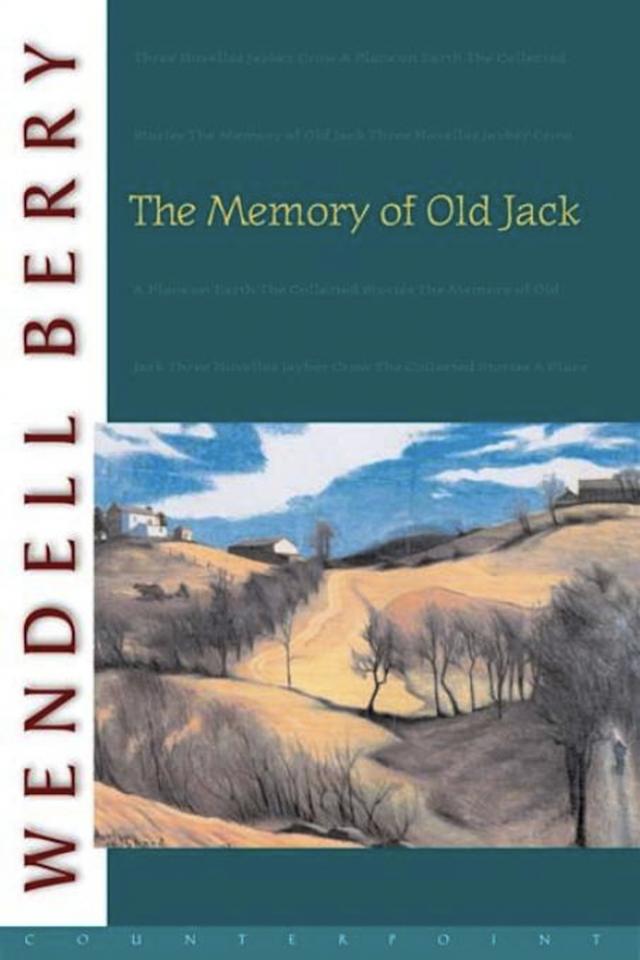


And that is all. There is no going in again. The driveway of the barn is suddenly bright with fire. Three brood mares, a team of mules, and two milk cows are still in there and they will burn. For what seems a long time their cries fill the air around him.
Finally they are silent, and the sound of the fire seems to return. He looks around. Three of his neighbors have come now. Together they fill what buckets and barrels they can find and bring out a ladder so as to be ready to protect the other buildings if need be. But there is no need. The wind is out of the east, and the sparks are carried harmlessly away over the fields. The four of them stand in a sort of formal row, facing the fire, feeling the heat of it, saying little. So intent are they upon the fire that they are surprised after a while to see that the gray of dawn is already well into the sky, having slipped up behind them. The three neighbors leave to do their morning chores.
And now Jack stands there alone. He is nearly thoughtless, as if whatever there may be to think is still disassembled in the air around his head. The fire has nearly burned out. The barn is now only a heap of glowing ash that dulls to gray as the sky brightens. Ruth comes out, carrying the baby. Since she woke to hear Jack running out of the house she has watched from the kitchen window, weeping with horror and, yes, with pity for her husband. She has allowed herself to think that he may need her. And so she steps across the frozen grass in the dawn.
He stands there in front of her, his back to her, facing the ruin of the barn, whose little smokes drift up into the slowly brightening air. She sees how he stands there. Even now he keeps the easy straightness of a horseman that she has never seen bend in any weariness, that even in his old age will not bend. His hat tilted backward off his forehead, his coat unbuttoned, he stands with his feet a little apart, his hands hanging at his sides. He seems to her to stand as completely and finally where he is as a tree. His attitude reveals no surprise or shock or misery, and no pity for himself. It is the posture of a man who has already endured worse than he expected, and who knows that he can endure still worse. Seeing in that, perhaps, his mastery of a lesson that she has taught him, she slows her steps and then stops. She cannot go to him, nor for a while will she be able to return to the house.
A quietness has come over Jack. He knows that he is damaged. He knows that he is looking at what may be his ruin. He also knows that in a little while he will catch his horse and with a makeshift bridle ride bare-back to town to see if he can borrow the money he will need to go ahead—to rebuild his barn, to buy new work stock and harness and all else that he will need to replace what has been destroyed. He already owes the bank, and so he will have to go to Ben—something he hoped never to do. But he is caught now. The boundaries of the old farm, which he so confidently thought to surpass, now contain him like walls. He who so short a time ago saw his work leading him to new land will now have to struggle for years to keep from losing the land he has. But he has come to the depths of a strange quietness in himself as he stands on the verge of his ruin, breathing the air.
He has heard Ruth come up behind him, but he cannot turn toward her. It will be some time yet before he will be able to bring himself to move at all. While the dawn comes, the two of them stand and do not move.
One of the posts of the barn is still standing, charred and smoking, the building burnt and fallen clean away from it, leaving it upright by itself, as plumb as the builders stood it. And now as Jack and Ruth stand there in one of the great turnings of their life, and as the sun rises and stains the white frost with its rosy light, a woodpecker comes up from the woods, its flight curving and dipping in the air, and clips itself to that blackened post. For an instant, just an instant, it is still and they see the vivid white and black of its wings, its head glowing red in the new light. And then it feels the heat. It cries once, casts off, and drops away down the slope of the ridge.
Five: Hunger
She is big. She feels big to herself, her breasts and belly swollen with life that is hers, yet greater than hers. Quick in her now is the life that has come like a pilgrim across the forgotten reaches of time, and is going on. She feels it, the weight of it bearing insistently into her mind, thrusting away from her. Though she is hurrying, she moves with a sort of delicacy and deliberation such as one might use in maneuvering a heavily loaded boat. Nearly eight months gone, she has felt the problem of balance slowly rising up into her consciousness until she has grown as attentive to it as a dancer who lifts his partner. Leaning back a little against the weight of the child in her womb, she steps rapidly back and forth at her work. The linoleum is smooth and cool under her bare feet. She remains always a little conscious of her footing, of her body pivoting about its shifted center.
She takes from the stove a pot of green beans, another of cabbage, a dish of baked pears, a blackberry cobbler, and wraps each in newspaper and sets it carefully into a cardboard box on the table. As she works her face is preoccupied, deliberative, lighted as if from beneath the skin by a serenity that lives upon her sense of being equal not just to what she is doing but to whatever she has imagined she may have to do. It is a beautiful face, wreathed by dark, heavy hair, radiant from the touch of the sun and her strong blood, the features clear. She is some years past the simple prettiness of her girlhood. Her beauty no longer has its source merely in her physical presence, though that is pleasing enough; it comes, rather, from some deep equanimity with which it has accepted the marks of an extraordinary knowledge of herself, her powers as a person and as a woman, her mortality. That understanding of mortality has been Hannah Coulter’s great suffering, as now it is her peculiar gift; she has known and borne and accepted it upon the terms of her womanhood and her flesh. Before she became the wife of Nathan Coulter she had been for three and a half years the widow of Virgil Feltner, Mat’s son, who, like Nathan’s brother Tom, was killed in the second of the World Wars. And so she has learned by loss what it is she has. Her beauty now is the grace of her knowledge, a moving, level candor in her eyes. She has accepted the gift of mortality, loving a man’s mortal love and her own given in return, her womb filled with a life that the earth will inherit.
She can hear Mattie squalling in the living room, but she is paying him no mind. She places the last of the dishes of food in the box and spreads a newspaper over them all and tucks it in around them. She straightens up, letting the trouble in the living room have her attention now, though she does not yet start out of the kitchen. On the wall over the sink is a shelf with Nathan’s shaving things on it, and above the shelf a small mirror. Standing before the mirror, she hastily combs her hair, holding its silver clasp in her teeth, and then replaces the clasp and washes her hands at the sink. She goes to the back door where she left her shoes and puts them on. She looks around the kitchen again—everything that she is not to take with her is put away—and then she hastens into the living room to see what is the matter.
Mattie is sitting by himself in the middle of the floor, wailing in desolation, and his sister is on the couch, prim disgust on her face, pretending to read a book. Little Margaret is seven years old, blond, with something of the delicate prettiness of the girlhood pictures of her grandmother and namesake. She is pleased to be trusted to take care of Mattie, but because she is now fairly often capable of reasonable behavior she finds the unreasonableness of the little boy hard to put up with. At present he is offended because she made him be still while she put his shoes on him, and she is offended because he will not accept her efforts to comfort him.
Hannah bends down and swings the sad little boy up into her arms. “Well, goodness.”
Mattie howls even louder to show the depth of his outrage.
“Mathew Burley Coulter, you stop that!”
He hushes, and sticks out his lower lip.
Hannah laughs. “Look at that face. Bring the washrag, hon,” she says to the girl.
She carries Mattie over to the couch and sits down, holding him on her lap. It is getting on into the morning. The sunlight from the east window now makes only a narrow bar on the floor, drawn back nearly to the wall. Outside it will be hot. The men will be loading the wagons. “Margaret,” she says.
Margaret comes with the washrag, and Hannah washes Mattie’s face.
“You want to go to Granny’s?”
The boy nods. His face changes. He is excited now. “I want to see Granddaddy.”
“You can see him at dinner. And Papaw Coulter too.”
“I want to see Papaw Coulter, and Uncle Burley.”
“If Granny and Granddaddy are my daddy’s parents,” Margaret says, “then how can they be Mattie’s grandparents?”
It is a question that she has been asking lately, in jealousy partly, but also in a sort of reaching toward the reality of her father’s death. Earlier she used to ask directly to have his death explained to her; now she has grown sensitive to the pain in that and no longer mentions it. She asks instead about Mattie’s relation to her grandparents, to symbolize by that the other question and to keep in touch with it. Hannah weaves again her life’s complex bonds of love and kinship.
“For a long time once, when we needed them, Granny and Granddaddy took care of us, because we all loved each other. So I’m their daughter now because of that.”
Margaret knows the story and likes it. Though she is little aware of the pain that was the making and the seal of that love, she feels its strength.
“And now Mattie and Granny and Granddaddy love each other too.”
“That’s right.”
“And Daddy belongs to us all because he married you.”
“Yep. And we all belong to him for the same reason. There!” Hannah puts Mattie down. “Now you’re ready. You hold Margaret’s hand.”
She gets up, hurrying again, and goes back to the kitchen. The two children come along after her. Mattie is holding his sister’s hand, minding. Things are going to suit him now.
“Go on out to the truck,” Hannah tells them.
They go out across the back yard. She can hear them talking busily to each other. Though she cannot hear what they are saying, she pauses to listen. It is one of the good moments when both children are satisfied, and in their satisfaction she feels her own. She feels her house around her, quiet now, and around the house the quiet buildings and fields of the farm where today no one is at work. Now the children are out of earshot and there is no sound anywhere. She feels the silence reaching out like a live strand, binding her to her place. As always, when in such a silence she is most aware of herself, she is also most aware, even in his absence, of Nathan, and of what the two of them have dared to begin and to make out of war and death and loss, and what they hold together and continue now in the time of yet another war. She has not forgotten the prophecy she heard when she was a child, and which she has read many times since with recognition and without much doubt: “And ye shall hear of wars and rumors of wars.... For nation shall rise against nation, and kingdom against kingdom: and there shall be famines, and pestilences ... woe unto them that are with child, and to them that give suck in those days!” She understands that woe. She knows that she does not know what will have to be suffered by the child drowsing in her womb. She mourns for the future, as the past has taught her. And yet there is a rejoicing in her, persistent and unbidden as the beating of her heart. There is a deep imperative in her flesh, not her mind’s work but its strongest argument nevertheless, that tells her to step cheerful and quick. It alerts her to the welcoming hunger of the men who will soon be coming hot and weary from the field.
As she steps out into the day, the heat fits closely around her. She enters the brilliant ocean of it. It lies over the dry pastures with the yellow flowers of autumn blooming in them, and over the woods on the bluffs, and over the newly painted tin roofs that flash with aching brightness in it. After the cool night the air is without haze, the horizons deep and clear.
The kitchen that she has just stepped out of has a finished, composed look about it, suggesting that by the slow creation of use everything in it has found its place and become familiar. But out here, though the marks of use are everywhere, there is still the disorder of change. Nathan bought the place a little more than four years ago, shortly before he and Hannah married. At that time it was badly run down. Since then, while they have been living in it, they have labored at its renewal. The pastures have been cleaned up, the fences have been mended to forestall for a few years the expense of building them all again, four of the six rooms of the old house have been made livable, a water line has been laid from the well to the kitchen, and just before the tobacco cutting started Nathan and Burley painted the roof. But a lot either remains to be done or is in the process of being done. The newly painted roof makes it more noticeable than ever that the outside walls have not yet been painted. The back porch has been torn away from the house and not yet rebuilt; the old lumber, cleaned of nails, is piled nearby, waiting to be used again in the new porch. The bare ground where the porch stood is crossed by a makeshift walkway of old boards warping in the sun.
There are still plenty of eyesores; there is still plenty of work to be done, plenty to be desired. But the disorder is only in appearance—visible perhaps to a stranger’s eye, but not to Hannah’s, who knows the deeper order of intention and labor. As long as she and Nathan are here and able to work there will be order, if not in sight, then within reach. How long and carefully have they planned it, thought it out, talked it over? How many winter nights have they sat at the table, supper dishes put away, drawing out their plans on paper? So much, at least, of what lies ahead of them they have desired, foreseen, planned, pictured in their minds. Against all that they cannot foresee, against all dread, this is what excites her and hurries her on.
As soon as the present rush of work is over—when the tobacco is all in, here, at Mat’s, at Burley’s and Jarrat’s, at Elton’s, and the ground is sowed in grain to keep it over the winter—then they will build the new porch. It will be an enclosed porch, with lots of light for flowers, and space to wash and iron. She looks forward to the prettiness and the comfort of it. And she looks forward to its building. All the men will be here then, full of enthusiasm for the work. There will be a lot of talk and joking, much of it for her benefit. She will be called upon to consider and consult. The children will be full of the happiness of it. The work will have the pleasure and leisure that only fall work has, when the growing time is over and the crops are safe.
The milk cows are resting in the shade of the old white oak out by the feed barn. Two barred rock hens look irritably up at her from their dust holes under the snowball bush. She goes by with her load, looking around. No other breathing thing is in sight. The hot light weighs upon the earth, a sky-high hush. In the field, she knows, the men will be aware of that quiet, of the midday deep rest of things, of the shade-enclosed drowsing of beasts and, within that, of their own effort and weariness going on. They have been into it more than a week now, working long days, a lot ahead of them to do, and the tiredness and strain of it have begun to build up. She can tell it by the way Nathan turns and stirs at night, too wound up and anxious to lie still, even asleep.
Much of the night now she does not sleep, but she is not restless. She lies still, in a patience that makes her body one with the world, time passing, her time coming. It is as though she holds in herself, against darkness and even weariness, a bright cell of summer light. She grows full with the season, heavy with yield. It is a light that she recognizes as her own, though she is only its bearer. Now that she has come to know it, she knows she has never been without it. She has borne it to the men who have loved her; they have touched it in her, brought it to life. But only Nathan made her know it as her own.
When she looks back now, her time with Virgil seems remarkable for its innocence. They seem to her to have been almost children. Their love did not know what it risked. It did not know what it was going to cost. And now this second love has come, that does know, that has stood up in the world—as one who has been sick nearly to death and grown well again rises, wondering, in the mortal light, and stands and moves. A wondrous thing: she is a mortal woman, and she is not afraid.
Nathan rises and stands in her mind. She has always remembered Virgil, even while he lived, as turning toward her, seeking her, waiting for her to meet the asking of his gaze. In Nathan’s absence she remembers him turning away, trusting her, depending on her, sure, not of her faith, but of herself, as she is sure. He will grin at her and turn away, going to the barn, going to work, leaving her to be what he knows she is. He makes no conditions. She is what she is. The day will be what it will, according to his intention and his strength, according to its weather and its chances. He grins—yes; all right—and leaves. This morning he had on an old shirt with the sleeves ripped off at the elbows. She thinks of his bare forearms, their smoothness, their piling and cording of muscle, their standing veins. The cell of light in her dilates and shines, crowding her heart.
She knees her load up against the side of the old truck to open the door, and then slides it in on the seat, not rattling a dish. The children are standing in the back.
“Here,” she says. “Get up here next to the cab and sit down. Mattie, you hold Margaret’s hand.”
She goes around, yanks open the door on the driver’s side, and gets in. She slams the door three times before it catches, jerks the choke out, stomps the starter. The truck is indomitably Nathan’s, is apparently in some dumb fashion loyal to him; he drives it effortlessly. She can get nothing out of it without violence. She goes at it with a sort of utilitarian rage, shoves the choke halfway in, gives another punitive stomp to the starter. The engine catches, she guns it, backs through a cloud of blue smoke into the front yard, snatches the gearshift down into first. The old truck tumbles over the ledges of their lane to the road that follows the little stream known as Sand Ripple down to the river. She turns right, and they go up through the woods in the Sand Ripple hollow and out again into the open light of the upland. She comes to the blacktop at the schoolhouse hill beyond the edge of town and turns right again. She gets the old truck into high gear now and pours the juice to her.