Warrior king, p.17
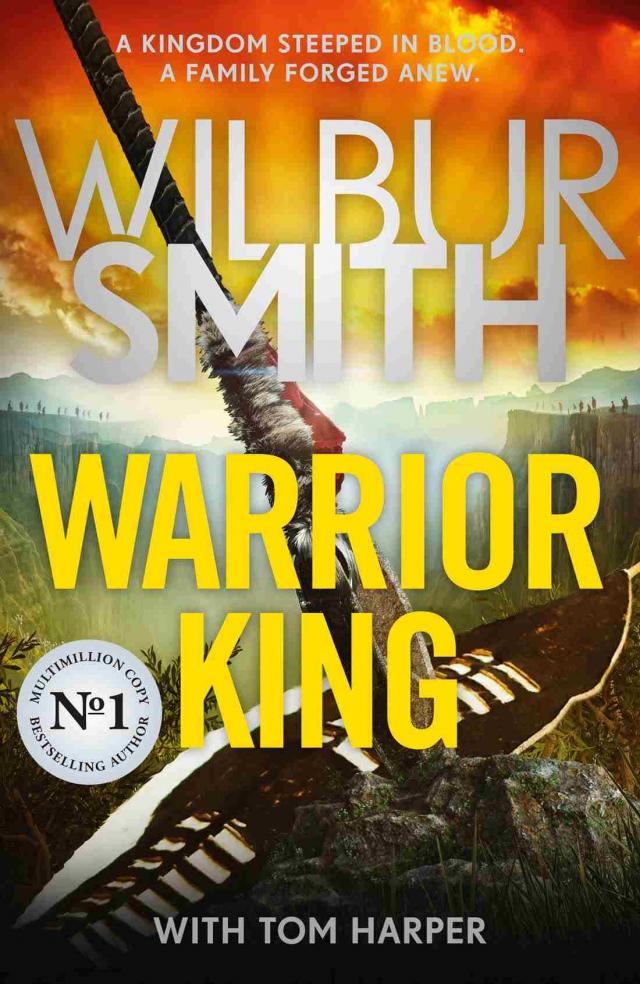
Warrior King,
p.17


Then Dingane disappeared in a puff of smoke as an explosion burst from behind Ralph. To a man, the Zulus flung themselves to the ground with cries of fear. Turning, Ralph saw Marius with the rifle raised. While Ralph was fighting, he had managed to reload the gun.
If he had shot Dingane, that would be the final nail in their coffin. The Zulus were already rising to their feet, ready to avenge their leader.
But Dingane was still standing, unhurt. Fifty yards away, the herdboy was lying on the ground, clutching his chest. Blood oozed from between his hands.
The bullet must have gone straight through his heart. The child’s eyes went wide, frozen in shock. They seemed to hold on Ralph for a moment, indicting him. Then the boy slumped backwards and fell in the dust.
‘What have you done?’ Ralph screamed at Marius, though he could hardly hear the words for the ringing in his ears.
‘What you should have done the first time, hey? I saved our bloody lives!’
‘He was a child.’
Ralph had his own rifle in his hands. For a moment, anger burned so hot in his heart he wanted to smash it into Marius’s fat, complacent face.
Again, he felt Dingane’s eyes on him. The prince had not moved. Even his face had maintained the same expression.
He wants Marius and me to fight, Ralph realised. He feeds on division and conflict.
Ralph lowered the gun, forcing himself to control his breathing. ‘You see,’ he said to Dingane, spitting out the words through gritted teeth. ‘A man will die as easily as a dog.’
The Zulus drew back. Dingane tipped his head and stared at him through narrowed eyes. Ralph had the feeling that they had passed a test, though the thought sickened him.
‘Better him than us,’ said Marius.
Having witnessed the power of Marius’s rifle, Dingane returned to the city. The Zulu guards still ringed the compound, but they did not make the visitors go back into the hut. Perhaps they feared what Marius and Ralph would do to each other if they were forced inside that little space together. Instead, the men paced around the cattle enclosure like a pair of angry bulls.
‘How could you do that?’ Ralph raged. ‘You shot a defenceless child.’
‘I saved our lives, because you didn’t have the balls,’ said Marius. ‘Shooting the bloody dog? Did you think that would satisfy that bloodthirsty Kaffir?’
Ralph turned to Jobe. ‘What would you have done?’
Jobe’s face gave nothing away. ‘If the king’s brother says so, it must happen.’
Marius nodded. ‘You think you are better than me?’ he said to Ralph. ‘That you have scruples, morals, that bullshit? The only reason you are alive right now is because that boy is dead.’
Is that true? Ralph remembered the look in the boy’s eyes, helpless and uncomprehending. I have been a man without a conscience, a man who will hurt anyone to get what he wants. I will not be that man again, he told himself.
‘It would be better if we had not made Dingane our enemy,’ said Jobe.
‘He does not have to be our enemy,’ said Marius.
‘Did you see how he looked at us?’
‘Did you see how he looked at the king?’ Marius lowered his voice. ‘There is no love lost between those two. The brother understands the power of our guns. Maybe we could do him a good turn, earn his gratitude.’
‘No!’ Ralph shouted. He glanced at the watching guards. He did not think they could understand what was being said, but if they guessed . . . ‘Are you mad? Whatever bad blood there is between the brothers, we cannot take sides.’
Marius did not react. He seemed to take pleasure in having provoked Ralph again. A sly smile spread across his face.
‘Where there’s two men wanting the same thing, you always end up taking a side.’
‘We will not discuss this,’ Ralph insisted, longing to be out of the cattle pen and away from Marius.
You came here to make your fortune, he reminded himself. You cannot cut and run, just because it does not fall in your lap like an apple at the first time of asking.
He saw the bloodstain the boy had left in the dust. Was that an acceptable price?
Marius had crossed to the far side of the kraal and was leaning on the fence, looking down into KwaBulawayo. A vast crowd was streaming into the city. Many were warriors, with their matched cowhide shields and stabbing spears. They marched into the great enclosure, lining up in ranks facing towards the palace, the ostrich feathers in their hair waving like a field of wheat.
‘There are thousands of them,’ marvelled Marius.
‘Tens of thousands,’ Ralph corrected him.
When they had first met Hamu, Ralph had been amazed that the Zulus could put a regiment of men in the field. Now he saw that Hamu’s men were just a fraction of Shaka’s immense power.
A shiver of fear went through Ralph. ‘Why would they gather so many men together?’
‘It is Umkhosi,’ said Jobe. ‘A ceremony. The first crop. To celebrate the harvest.’
‘How do you know that?’ Marius demanded.
‘I heard the guards speaking.’
‘So it is just bad luck that we arrived when the king has gathered his entire army together?’
Ralph could see the suspicion written on Marius’s face, fear that this was some plot against them. But that was arrogance. The king did not need to muster his full power because three shoeless explorers had stumbled into the kingdom.
Another delegation of Zulus was approaching their kraal from the city. This time, Ralph saw Hamu leading them.
‘Whatever it is,’ he said, ‘we are about to find out.’
Hamu brought Ralph and the others down the hill to a side gate, along a narrow passage and into the inner courtyard. Shaka sat on a wooden chair in front of the great domed house, surrounded by the usual crowd of indunas and retainers. He had his head tipped back. Two attendants flanked him, one holding a small hollowed-out gourd, the other a tiny spoon. The spoon was dipped into the gourd, then held to Shaka’s nostril. The king inhaled deeply.
‘He is taking snuff,’ said Jobe.
Ralph had been prepared for the Zulus to have many different rituals and habits, things that were outside of his understanding, but this he had not expected. The snuff seemed to agree with Shaka, though. He gave a prodigious sneeze. The crowd nodded approvingly. The servant with the spoon pushed it up Shaka’s nostril, scooping out a great quantity of mucus.
Without looking around, Shaka began to speak. It was only when Jobe started translating that Ralph realised the words were for him.
‘King Shaka had a good sleep last night. The pain inside him is gone.’
Ralph tried not to let the relief show on his face. ‘I am glad to hear it. I was certain that umGeorge’s medicine would work.’
Shaka did not acknowledge the point. He seemed reluctant to admit in front of his men that Ralph’s pills might have had any benefit.
There was a silence. For the Zulus, this was normal. In their society, it was the height of bad manners to speak without time for reflection first. For a white man, it was difficult not to be disconcerted by it.
And Marius was not known for keeping his mouth shut.
‘Tell him what we did with the rifle, hey?’ he said. ‘Tell him we are powerful wizards.’
Ralph tasted bile. He saw the dead herdboy bleeding into the dust.
‘We will not speak of that.’
It seemed Shaka did not wish to speak of anything. The audience was already over. Shaka rose from his throne and advanced into the great cattle enclosure. While they had been talking, the warriors Ralph had seen from the hill had continued to flood in. Now, the whole space was filled with men and women. The men were warriors, fully armed and wearing the Zulu equivalent of parade dress uniform. The women were bare-breasted, with only thin strips of hide tied around their hips, and brightly coloured strands of beads worn like crossbelts across their chests.
‘They love those beads,’ Ralph observed, noting the size and colours they favoured, calculating how many beads it took to make each piece. Many of the necklaces were fashioned from carved wood or dried berries, though some of the most beautiful girls wore glass.
Shaka took up a position at the top of the kraal, facing his people. The indunas spread out around him. Hamu gestured to Ralph and his friends to stand by him, only a few yards from Shaka. Ralph did not miss the symbolism.
‘It seems we are in Shaka’s good favour,’ he said to Marius, with a flush of satisfaction. The medicine had done the trick.
‘Or maybe he wants us where he can keep an eye on us,’ the Dutchman retorted. Being here in the great enclosure, with so many Zulus, put him in a bad humour. He kept touching his hand to his shoulder, feeling for the rifle that wasn’t there.
The soldiers drew back to the perimeter, making a vast circle. Young girls brought cattle in to the centre, parading them around the ring like prize racehorses. Ralph noticed that the herds had been separated by the colour of their skins, matching the shields of the soldiers around them. Caramel brown, white, black and spotted: each seemed to belong to a particular regiment.
After the herds had been presented, there was dancing. Young women came out, formed in companies like the men. Instead of spears, they carried thin staffs, which they waved in perfect rhythm to the beat of the song. They advanced towards the men, retreated, and advanced again, like waves on a seashore. Many were strikingly handsome.
‘Look at that poesje,’ Marius exulted. ‘I’d take some of that, hey?’
Jobe glared at him.
‘You know how long it’s been since I had a woman? First prison, then the ship, and only that frigid little English bitch to look at.’ He did not notice the way Ralph stiffened at the mention of Ann. ‘Now I have ten thousand black girls shaking themselves at me. How is a man to resist?’
The Zulus danced and sang in the great kraal until sunset; then they lit bundles of rushes and held them aloft so that the whole ring was lit by fire. The dancers lifted their legs high, bent their backs and stomped forward with outsized, exaggerated motions. They raised their spears and stabbed them down, singing all the while. Shaka came down from his throne and danced with them, stabbing at the ground as if he was finishing off a defeated warrior.
‘Your people have grown strong,’ Ralph said to Jobe.
He meant it as a compliment. He had not expected the reaction he got from Jobe: a clench of his jaw, and a flash of anger in his eyes.
‘They are not my people,’ said Jobe. ‘Do you not see how they look at me?’
‘No.’
Ralph had grown up in India, where white faces were always a minority. But there it was a privilege, casually assumed and easily forgotten. Here, in front of many thousands of black men and women, a prisoner in all but name, he had felt the whiteness of his skin in a new way – these people looked at him like he had a disease. He had assumed Jobe would blend in; had envied him for it.
‘They are as different from me as a Dutchman from an Englishman,’ said Jobe. ‘To them, I am amaLala.’
‘What is that?’
‘A cross between an Irishman and a Kaffir.’ Marius chuckled at his own wit. In his sly way, he had understood faster than Ralph. To a proud nation like the Zulus, the less powerful peoples next door would be the butt of jokes and scorn, maybe even contempt. That human habit was ingrained deeper than the colour of a man’s skin.
‘But you can speak their language,’ Ralph pointed out.
‘When I speak, they laugh.’
Despite the energy of the dance, a tense atmosphere hung over the kraal. Ralph had the feeling that he was being watched, but at the same time no one would meet his eye. Except one person: a young woman, standing back from the indunas among the attendants and serving girls. She was probably in her mid-twenties, wearing nothing but a thin hide girdle. She had high cheekbones, smoky eyes and hair twisted into short, spiky braids held up by a beaded headband. A small leather bag hung on a string around her neck. When she caught Ralph’s gaze, she held it.
Ralph narrowed his eyes, as if to say: What are you looking at? But her face remained expressionless. Then Ralph noticed the slightest upturn at the corner of her full lips.
What is she thinking, behind those smoky eyes? Ralph was intrigued. The tens of thousands of Zulus around him seemed to recede and the torchlight spiralled in and wrapped her in its light.
Then suddenly she vanished. Without any warning, the top of the kraal had been plunged into darkness.
‘What the hell is this?’ said Marius.
All the torches had been extinguished at once, as if a blast of wind had blown them out. But the night was still.
In an instant, Ralph forgot about the woman. Around him he heard murmurs of alarm sweeping through the crowd.
‘Stay close to me,’ he hissed to Marius and Jobe. His senses were on high alert. He was acutely conscious he was unarmed, surrounded by thousands of men with spears.
Did Dingane plan this? Was this deliberate? Did he have men poised to strike Ralph down for his disobedience in the kraal? He began pushing through the darkness towards the place where he imagined the throne would be, hoping that no one would dare to attack him in front of the king.
Unless Shaka himself had engineered this moment.
Light flared on the edge of his vision. Someone had managed to rekindle a torch, and as the dry grasses flamed, Ralph saw Shaka. He had collapsed to his knees, while another man who Ralph did not recognise stood over him, holding a short stabbing spear.
The shock of the moment paralysed everyone. Ralph was first to move. He lunged forward, hurling himself at the assassin. Long shadows flickered over the ground; the few yards between them stretched like miles.
The assassin saw the movement. He turned, caught for a second between finishing the man at his feet and pivoting to defend himself.
His mission was paramount. He tensed his arm and brought the spear down.
Ralph was still a yard short of him. The king threw up his arm to defend himself, but flesh was no match against steel. The blade sank deep into his side, passing between his ribs below his armpit.
The assassin’s shriek of triumph was choked off as Ralph cannoned into him.
The force of his charge knocked the man to the ground. The spear, still in his grip, was jerked out of the wound. Before the assassin could turn it against Ralph, Ralph grabbed it with both hands. For a moment, the two men wrestled it between them.
Something flew over Ralph’s head, ruffling his hair. An object smashed into the assassin’s head, the impact so violent that his temple was inverted. The man went limp.
Hamu stood over them, holding one of the knob-ended fighting sticks.
‘Thank you,’ said Ralph. But Hamu didn’t hear him. The murmurs in the crowd had risen to mournful shrieks as those nearest saw what had happened. Men and women hollered and wailed, one word cutting through the chaos: Shaka. They surged forward towards the fallen king, a shadow army in the flickering torchlight. If they came any closer, they would crush Shaka underfoot in their grief.
Ralph and Hamu ran to the king and lifted him between them. Ralph had to fend off the crowd with his arm, or he also would have been trampled, while Hamu swung his stick to clear the way.
‘Where are you going?’ Above the din, Ralph heard a voice shouting in English. Marius pushed through the crowd, his bulk acting as a shield against the wave of humanity pressing in.
‘Shaka is wounded.’ Or is it worse? The king hung limply; Ralph could not tell if he was alive. ‘We must get him to safety.’
‘Are you crazy? They will say we did this.’
‘I tried to save him.’ Ralph was yelling at the top of his voice, but even so he could not tell if Marius understood him. ‘They saw that.’
‘They saw you standing over the king with a spear in your hand. What do you think they will say? A dead king, and a white man’s hand on the weapon?’
Ralph could not think with all the noise. Hamu’s guards had managed to fight their way through and had pushed back the crowd, making a corridor to the royal quarters. Hamu had already begun to drag Shaka away. Ralph had to follow or let go of the king.
He took two steps. Instantly, human bodies filled the space he left, marooning Marius in their midst.
‘Get Jobe and find me in the palace!’ Ralph called, though he doubted Marius heard him. Then the crowd and the darkness swallowed them both.
They left the great enclosure and entered the palace area. Guards barred the entrance behind them, but to no avail. Hundreds of women lived in the royal quarters, and they crowded the narrow passageways between the huts, emitting a cacophony of despair as if they could not bear to be alive.
Hamu shouted something in Ralph’s ear. Ralph looked at him blankly. He could see the impatience on the Zulu’s face; he was desperate to make himself understood, but without Jobe, there was no way they could speak to each other.
Hamu brought two of his men over. One shouldered Ralph aside and took up Shaka’s weight. The other tugged Ralph away. Ralph looked uncertainly at Hamu, but an impatient flick of the general’s eyes told him what was expected of him: Go.
Ralph obeyed. The escort led him through the back gate, up the hill to the kraal where they had stayed, and gestured that he was to go in.
Now I wait, Ralph thought. Hamu had seen him attack the assassin, but to the rest of the watching Zulus it would have appeared as Marius said: They saw you standing over the king with a spear in your hand. First, they would see if Shaka lived or died. Then they would decide what to do with Ralph.
The wicker gate that covered the door rustled. Ralph looked up, expecting that the guards had found Jobe and Marius, too. But it was not his companions. It was the guard who had brought him.
He pointed to Ralph’s bag, hanging from a peg on the wall.
Ralph squinted. ‘What do you want with that?’
The two men stared at each other in mutual incomprehension. The guard pointed to the bag again, then through the door towards KwaBulawayo. He said a short word that sounded urgent. When that made no impression, he repeated it three times more.