Storm tide, p.31
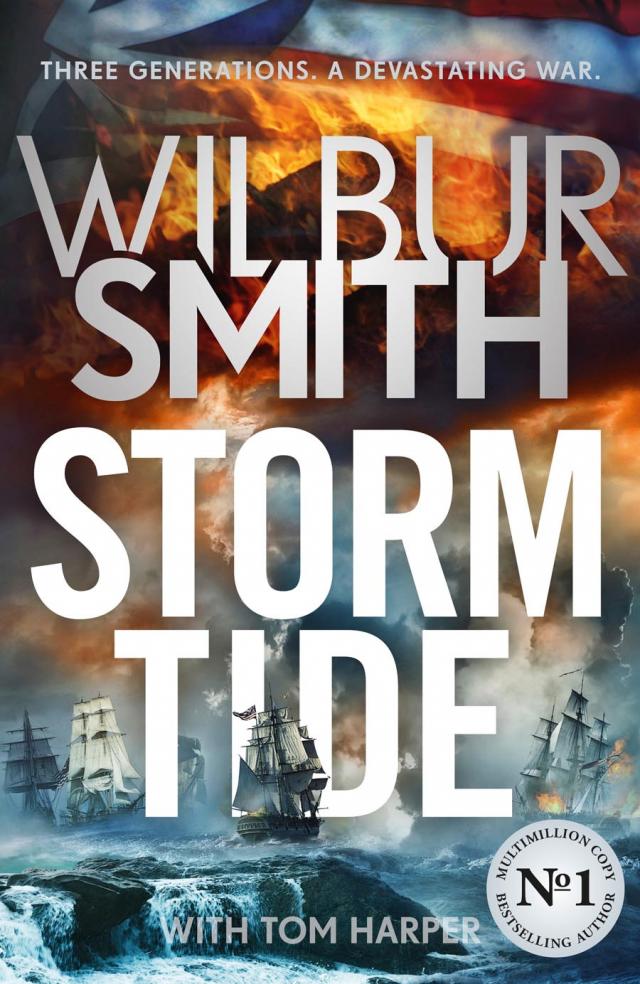
Storm Tide,
p.31


Rob felt no jealousy. If anything, he was stirred to shame to think that he’d once thought he loved this woman. But it was not the time to dwell on his own feelings.
Rob pulled the gag off.
‘We’ve sighted a sail,’ he said, before Coyningham could speak. ‘She may be hostile. Shall I order the men to clear for action?’
Coyningham nodded.
‘I will leave you to get dressed.’
O
n deck, the guns had already been loaded. The other ship was closing fast. She had seen the Perseus clearing for action. Hastily, she ran up her own flag. The white ensign of a British merchantman.
‘It could be a feint,’ said Rob. ‘We’ve seen privateers hoist false colours before.’
But watching her approach, he did not feel the tremor of danger he had felt when he saw the Rapace. A thin cloud had veiled the moon, making it hard to see clearly, but there was none of the activity on her deck that would tell of a ship getting ready to fight. And although he had only seen the Rapace in the heat of battle, there were aspects that did not seem right. There were too few men on her deck. Too few guns. None of the splashes of fresh paintwork that told of recent repairs that the Rapace would have to have made.
She shortened sail as she came alongside the Perseus, a musket shot away. The moon came out and her bow moved around and Rob could see the figurehead plainly at last.
It was not a screaming, rapacious hawk. It was a placid brown bird, like the quails that Rob had often seen running about his feet at Fort Auspice.
He should have felt relieved. Instead, he tasted bitter bile in his throat. He had had the chance to save Phoebe, free Scipio and avenge Angus, and he had missed it.
‘What ship?’ he called across the narrow gap of water.
‘The Corncrake,’ came the reply. ‘Out of Bristol, bound for Port Royal. We have orders for you.’
She was nothing more than a merchantman.
R
ob told himself the mutiny had been doomed the moment the sail appeared. They could never have seized the Perseus with another vessel bearing down on them. In his heart, he knew it wasn’t true. The plot had been well planned. They could have taken the ship, and if the Corncrake had tried to intervene a shot across her bows would have sent her away.
Rob had made the wrong decision. He replayed the events of the night before in his head a thousand times. What was the real reason for his decision? Why had he not taken his chance? Was there an ugly flaw in his mettle, his ability to face up to the ultimate test? Lurking in the back of his mind was the cruellest question of all.
Was he a coward?
Angus had not spoken to him since. The other men who had been in on the plot refused to meet his eye. They were tardy and disobedient, slow to follow his orders. Those who hadn’t known about the plot could tell something was up. They watched him suspiciously, as if they could smell the failure on him.
At least Coyningham stayed in his cabin. He assumed that by now every man in the ship must know what Rob had seen him doing with Sophie. He could not step on deck without drawing a hundred furtive glances and sniggering whispers. He could not flog every man aboard, so he stayed below, nursing his battered dignity.
The only time Rob saw him was when he summoned the officers to the great cabin to relay the orders the Corncrake had brought. Coyningham looked awkward when Rob walked in, poring over the chart table so that he would not have to meet Rob’s eye.
The other officers crowded around. Bracewell was present, having graciously allowed them to use the great cabin. Sophie was absent.
‘This is our position,’ said Coyningham, pointing to the channel between Cuba and Saint-Domingue. ‘From here, we have a clear run south to Jamaica.’
Jamaica stretched across the map like an extended thumb. Bracewell planted a finger on the north-west corner of the island, far from any of the towns and ports that were marked.
‘Thebes Plantation, my estate, is here.’
‘The Corncrake has brought further orders,’ said Coyningham. ‘A supply convoy from England is approaching Jamaica. It is bringing powder and ammunition for the Caribbean garrisons, a year’s supply.’ He looked around gravely. ‘There is enough powder and shot aboard that convoy to start a war.’
The officers nodded.
‘Then we had best make sure it reaches its destination,’ said Fawcett, the first lieutenant.
‘Precisely,’ said Coyningham. ‘A squadron of warships has escorted her this far, but they will now sail to join the war in America. As soon as we have delivered Mr Bracewell and his niece to their home, we will rendezvous with the convoy and escort it to Port Royal, which is here –’ he pointed on the map – ‘at the mouth of the Kingston Harbour in south-eastern Jamaica.’
The officers’ faces fell. For a ship like the Perseus, convoy duty was like yoking a racehorse to a hay wagon. Slow sailing, endless chivvying of the cumbersome merchantmen, and no prospect of battle or prizes.
‘Are there no other ships that could do this?’ asked Fawcett, speaking for all of them.
Coyningham shook his head. ‘We will be the only escort.’
‘If the convoy’s as valuable as you say,’ Rob said, ‘surely it needs more protection.’
‘As ever, Lieutenant Courtney blanches at the first sign of danger,’ said Coyningham.
Several of the midshipman laughed sycophantically.
‘The seas around Jamaica are safe,’ Bracewell assured them. ‘Once the convoy is in sight of land, there is no danger of attack.’ He pointed to the far western end of the island. ‘The only danger is here. There is a shoal where many ships have grounded, and a strong current runs around the cape. You must keep close to the shore here.’
‘We will do as you say,’ said Coyningham.
‘It would be safer to keep away from land,’ argued Rob. ‘If the convoy is close to a lee shore, an attack even by a single privateer could wreak carnage.’
‘You heard Mr Bracewell’s advice. We will set our course close to shore.’
‘Mr Bracewell knows nothing of navigation,’ Rob persisted.
Coyningham coloured. ‘Do you presume to question my orders?’ A dangerous edge came into his voice. ‘That would be insubordination.’
Rob held his tongue. There was no point giving Coyningham another pretext to discipline him.
Coyningham turned away. ‘If that is all, you may return to your duties. With a fair wind, we should raise Jamaica tomorrow.’
There was nothing more to be said. But as Rob filed out with the other officers, he noticed Bracewell examining the map, a smile spreading across his face.
T
hey saw Jamaica from afar: hazy blue mountain peaks rising towards the clouds, higher than anything Rob had seen since he left Africa. Their steep slopes were thickly wooded, laced with strands of white cloud. Below, everything was lush and green.
‘Looks like Eden,’ said one of the men.
‘Aye,’ said Angus. ‘And full of serpents, too, I’ll wager.’
He shot a look at Bracewell and Sophie, who had come on deck as soon as they heard the lookout announce the sighting of Jamaica. With her raven hair bound neatly under her bonnet, a long green dress and a pair of white gloves, Sophie looked a picture of modesty. Phoebe stood behind her, holding a parasol over her mistress’s head.
From the charts, Rob knew that most of the settlements in Jamaica were in the south-east of the island, around Kingston and Port Royal. The Perseus sailed clear of those harbours, making instead for the north-west coast. A spyglass confirmed what the maps had indicated: it was a wild, remote country. Villages were few and distant; the mountains came down close to the shore, leaving a narrow strip along the coast which was thick with mangrove swamps.
‘There,’ said Bracewell, steadying himself on the rail as he peered through a telescope. ‘Thebes Plantation.’
The estate stood on an eminence above a sandy bay. A vast white house towered bright on a promontory against the green cane fields. Beyond it clustered groups of small cottages, storehouses and tall stone windmills, their red sails turning in the breeze. Further away the forest rose quickly to the mountains.
‘It must be lonely, living here,’ said Coyningham, who had emerged from his cabin.
‘Indeed.’ Sophie spoke politely, as if she were at a tea party in a Hampshire drawing room – as if the events in Coyningham’s cabin had never happened. ‘We are quite cut off from society at the Thebes Plantation. But my uncle prefers his solitude.’
Rob imagined Bracewell on his estate, a virtual monarch. He shuddered to think what a man like Bracewell would do with unchecked power like that.
‘I hope you do not feel removed from agreeable company,’ Coyningham persisted.
Sophie smiled at him. ‘Never when you are present, Captain. You are always most stimulating.’
Coyningham glanced at Bracewell to see if he had noticed the saucy tone in her voice. But Bracewell’s attention was on his estate.
‘She is worth fifty thousand a year,’ he announced. ‘One thousand hogsheads of sugar, and rum besides.’
‘And how many slaves?’ Rob asked.
‘Near four hundred.’ Bracewell put down the telescope. He had not forgotten their confrontation at Seabrook Bay. ‘There will be a few more, of course, with the people you brought from South Carolina.’
Rob did not dare look at Phoebe. The guilt was intolerable.
Before they dropped anchor in the bay, boats had set out from the wooden jetty that served the estate. Rows of bare-chested slaves manned the oars, lashed by the overseers who stood in the stern. As they came alongside, Rob saw that every man was chained to his oar. If the boat flipped in the surf, they would all drown.
Coyningham summoned the marines on deck, fully armed, making a phalanx around the hatchways. Then he opened the hold. The stench was almost unbreathable. The slaves were brought up one by one and forced into the boats. Rob could see from the disgust on some of the marines’ faces that they did not like this duty, but Coyningham gave them no choice. He was desperate to curry favour with the Bracewells.
‘You must dine with us tonight, Captain,’ said Bracewell. His luggage had been loaded into the last of the boats, and he was ready to disembark. ‘And your officers, too. We owe you a debt of thanks for bringing us safely home.’
‘I would be honoured,’ said Coyningham.
‘Lieutenant Courtney must come, too,’ added Sophie.
Rob and Coyningham both started in surprise, though a second later Rob realised he should have expected it. Sophie was like a cat, licking her claws as she toyed with the mice she had trapped. She didn’t want Rob’s company, except perhaps to flaunt herself. She wanted him there to prick Coyningham’s lust, to put them in competition like two cocks in a ring. She didn’t care who won. The sport was what she lived for.
Coyningham looked so downcast Rob almost felt sorry for him, until he glanced out to the water, and saw the boats taking Scipio and the other slaves ashore. Lust was no excuse for what Coyningham had done.
‘Alas, Miss Bracewell,’ Coyningham said, ‘Mr Courtney must stay aboard ship to keep watch.’
‘Quite right,’ said Bracewell, who had no desire to bring Rob to his plantation. Behind him, Crow looked appalled. But Sophie was undeterred.
‘Have you forgotten, Uncle, how Lieutenant Courtney rescued us from Newport? And saved our property in South Carolina. He must join us. I insist on it.’
‘Very well,’ said Bracewell. ‘If Captain Coyningham agrees.’
Coyningham bowed stiffly. ‘You know I can deny you nothing.’
Sophie lowered her voice. ‘I do hope not, Captain.’
R
ob and Coyningham went ashore in the middle of the afternoon. Fawcett and three of the midshipmen accompanied them, buoyant with excitement and high spirits. Rob and Coyningham sat awkwardly in the stern of the boat, saying nothing to each other.
From the jetty, stone steps led up the hill through terraced gardens. Vivid colours exploded all around them – pinks and oranges and blues and yellows of flowers Rob had never seen before. Marble statues watched from among the plants, bare-breasted goddesses and priapic gods. The scent of the flowers was lush and thick around them. Everything was rich and sensual.
Yet Rob could not forget what underpinned it all. Through the trees at the top of the slope, he could see the ugly silhouette of a gibbet. A mournful chant sounded from beyond, a low wail like a funeral song.
A man was waiting for them at the top of the steps, silhouetted against the sky like a bird on a tree. Crow. He bared his blackened teeth as he saw them approach.
‘Welcome to Thebes Plantation,’ he drawled.
Bracewell’s mansion loomed on the clifftop away to their right. But Crow led them inland towards the cluster of buildings beyond the palm trees.
‘Mr Bracewell said to give you a tour of the estate before dinner,’ Crow explained as they arrived at the stables.
Half a dozen horses were saddled and waiting for them. Crow’s grin broadened as he watched the naval officers’ ungainly attempts to mount, assisted by the black grooms and stable boys.
‘Is the estate so large that we cannot walk?’ asked Coyningham, clinging to the unfamiliar saddle.
‘Even on horseback we’d need a full day to cover the whole plantation,’ Crow answered. ‘This is but a taste.’
He led them on horseback to a cluster of buildings about half a mile away. They stood downwind from the big house, and as Rob approached he understood why. The smell of rum hung over everything. Even in the Perseus’s hold, where the packed rum casks sometimes split open, Rob had never smelled anything like it. Just breathing in the saturated air made him feel tipsy.
They dismounted in front of a complex of buildings. At its heart was a tall octagonal windmill, built of stone and tapering to a high point. The red sails turned briskly in the breeze. A large, barn-like shed stood next door, and a succession of other outbuildings. The air was hot with an alcoholic steam that made Rob’s eyes weep rum-flavoured tears.
‘Sugar works,’ said Crow.
As he spoke, a gang of slaves appeared, pulling a cart stacked high with cane stalks. They unloaded them and carried the stems in great armfuls into the mill. Crow and the officers followed.
Inside, the mill was dim, stifling and deafening. Cogs and axles descended from the ceiling, transmitting the sails’ revolutions into a contraption where copper-covered rollers turned in parallel, parted slightly like the lips of a disembodied mouth. The slaves fed the cane into the voracious maw, their hands inches from the spinning cylinders. As each stalk entered, it was crushed as thin as paper and spat out the other side.
‘You would not want to catch your arm in there,’ said Fawcett.
‘Perhaps that is what makes the sugar brown,’ said Coyningham.
The others laughed, though it was no joke. It would be easy for a limb to get stuck in the mechanism, especially for the tired slaves. They looked half dead, their shoulders slumped and their eyes dulled almost past living.
‘Harvest season,’ Crow explained. ‘We work the crop every hour of the day and all the night through.’
The rollers squeezed the brown cane juice from the stalks. The liquid dribbled out and collected into a channel below, which carried it away through an opening in the side of the mill. The party from the Perseus followed it outside and into the next building.
The moment they entered, the heat hit the officers like a body blow. Slaves worked stripped almost naked, ladling the liquid between a series of iron kettles, while children fed the fires burning beneath with the crushed stalks and cane trash.
‘Boiling house,’ said Crow.
As the cane liquid progressed from one kettle to the next, it became thicker and more viscous, until finally it was taken to the next building and decanted into large clay funnels set over jars.
‘In a month, it’ll be ready to put in your tea,’ said Crow.
‘What is the jar underneath for?’ asked one of the midshipmen.
‘Molasses,’ said Crow. ‘It runs out down the funnel. We turns that into rum in the still house.’
They went back outside and remounted their horses. There was another building, a squat shed set apart from the others, but Crow did not take them there. A chill went through Rob’s heart as they passed it. It was the twin of the punishment hut he had seen at Bracewell’s plantation in South Carolina. Even the slaves bringing in carts of fresh cane went out of their way to avoid it.
The Perseus’s officers passed the thatched slave cottages, surrounded by vegetable plots, and rode down a narrow track between the cane fields. Slaves ran ahead of them to open the gates that fenced off the different fields, or ‘cane pieces’, as Crow called them. They waited until the party had passed through, closed the gate, then raced ahead again. Crow kept a brisk pace with his horse, so that the slaves had to sprint to reach the next gate in time.
Rob could hardly believe how far the plantation stretched. They rode for almost a quarter of an hour between the rustling cane thickets before they reached a place where a gang of slaves were working. All were dressed in white calico, shirts and trousers for the men, blouses and skirts for the women. They slashed the cane with long, curved knives, topping off the fronds and stripping the leaves before putting them in the carts. They didn’t glance up at the new arrivals. They knew if they slacked their work for a moment, they would feel the lash of the overseer who paced the rows behind them. Four more men armed with rifles and pistols stood guard at the corners of the field.
Rob recognised a couple of the faces working the cane – men who had fought beside him at Seabrook Bay. Bracewell had wasted no time making use of them. Rob felt relief that they did not look at him – he could not have stood the rebuke – then felt ashamed of himself. What was his guilt next to the torments these men would suffer?