Sherlock holmes mystery.., p.1
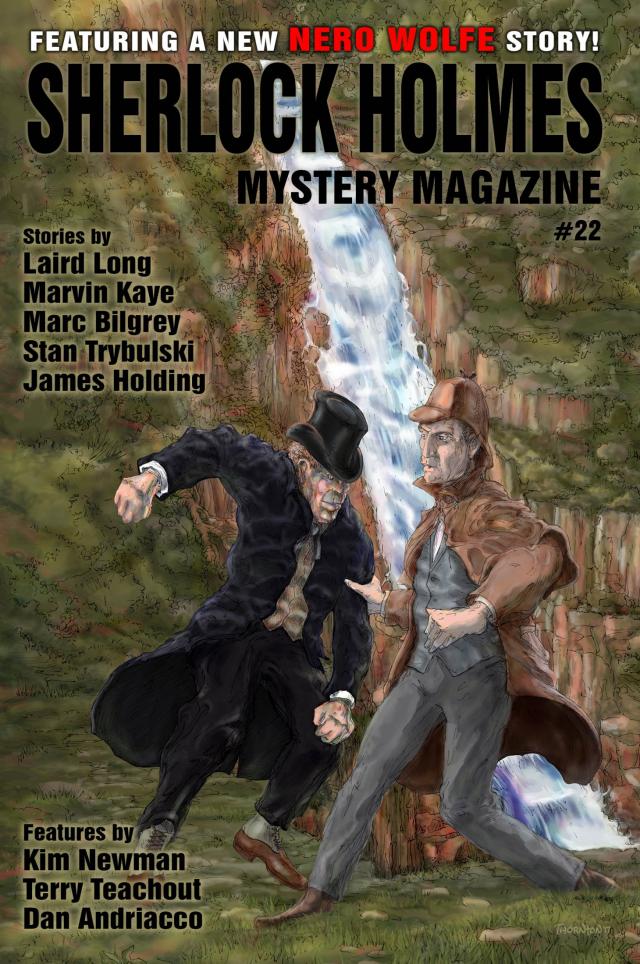
Sherlock Holmes Mystery Magazine, Volume 22,
p.1


COPYRIGHT INFORMATION
Issue #22 (Vol. 7, No. 1)
Copyright © 2017 by Wildside Press LLC.
All rights reserved.
Visit us online at wildsidepress.com.
Sherlock Holmes Mystery Magazine is published by Wildside Press, LLC. Single copies: $10.00 + $3.00 postage. U.S. subscriptions: $59.95 (postage paid) for the next 6 issues in the U.S.A., from: Wildside Press LLC, Subscription Dept. 9710 Traville Gateway Dr., #234; Rockville MD 20850. International subscriptions: see our web site at www.wildsidepress.com. Also available as an ebook through all major ebook etailers, or our web site: wildsidepress.com.
CARTOON
by Marc Bilgrey
STAFF
Publisher: John Betancourt
Editor: Marvin Kaye
Non-fiction Editor: Carla Coupe
Assistant Editor: Steve Coupe
FROM WATSON’S NOTEBOOK
This issue of Sherlock Holmes Mystery Magazine offers a single story that I wrote—the tale of the cardboard box—but several other stories are well worth reading, too. I will let my colleague and coeditor Mr Kaye tell you about them.
—John H Watson, M D
* * * *
Most authors in this issue are what I like to call recidivists since they have appeared here before—Dan Andriacco, Marc Bilgrey. Laird Long and Stan Trybulski. A new story by Eugene D. Goodwin introduces us to Lieutenant Warren T. Sutton, head of the Markheim Colorado police force. In the story of the thief Roebius he is thoroughly baffled by a strange series of bank robberies. Sutton will return with other cases in later issues. We also introduce a “Classic Reprint” department, to showcase rare but exceptional tales by modern writers, kicking off with “The Tahitian Powder Box Mystery,” by James Holding.
Finally, thanks to the Rex Stout Estate, the theft of a priceless figurine of a platypus is solved by America’s greatest detective Nero Wolfe.
Our 23rd issue will again offer new stories by Dan Andriacco and Laird Long, as well as returning author Steve Liskow. It will also include two Sherlock Holmes adventures and two new Nero Wolfe tales, one by the late Henry Enberg, who used to be on the steering committee of the Stout aficionados group The Wolfe Pack.
See you soon!
Canonically Yours,
Marvin Kaye
d
ASK MRS HUDSON
by (Mrs) Martha Hudson
Dear Mrs Hudson,
I wonder how you became landlady of 221 Baker Street and whether you were otherwise employed prior to that time?
Curious in Carfax
* * * *
Dear Curious,
The only thing I did before taking over this establishment was to attend school in a London suburb. The Baker Street building was given to my mother to hold for me till I reached maturity. It was a gift from a kindly gentleman named Scrooge. Our coeditor Mr Kaye tells about this in The Last Christmas of Ebenezer Scrooge, which was published by the same company that heads this magazine.
Cordial Regards,
(Mrs) Martha Hudson
* * * *
Dear Mrs Hudson,
As a psychologist I would like to know whether you have ever lost your temper at something Mr Holmes or Dr Watson did?
Henry Vollmer, M D
* * * *
Dear Dr Vollmer,
Dr Watson has never done anything that is not considerate and gentlemanly … I might even say loving. As for Mr Holmes, one must allow for and expect the eccentricities of his genius and in this he never disappoints. I have become mildly distressed on occasion by his behaviour, though he almost always has a cogent reason that he reveals afterward. I was miffed by the noise and damage of his target practice on one of my walls, but he voluntarily added what one may call a remuneration of conscience to the rent for nearly a year.
(Mrs) Martha Hudson
* * * *
Dear Mrs Hudson,
Does Mr Holmes ever go on vacation and if so, where?
Lillian Stackhouse
* * * *
Dear Miss Stackhouse,
The only time Mr Holmes ever leaves the city and his practice is when Dr Watson insists on it to preserve his friend’s health. Unfortunately, no matter where he goes, trouble always seems to catch up with him (them).
Once they did go fishing in Scotland and brought back a few excellent fish from the river Tay.
Sincerely,
(Mrs) Martha Hudson
* * * *
Dear Mrs Hudson,
What literature interests your illustrious tenants?
Gordon Sewald
* * * *
Dear Mr Sewald,
Mr Holmes devotes most of his time to crime reports in the newspapers as well as whatever news there may be in the criminal world, also justice and law enforcement. He does read philosophy from time to time.
(Mrs) Martha Hudson
* * * *
Dear Mrs Hudson,
I have always lived frugally, but recently I won a huge lottery. I did not buy a ticket but found one in the street and picked it up out of the curiosity. To my surprise, it was a winner.
I am both pleased and troubled ethically. I should like to share my windfall with the ticket’s original purchaser, but have no idea how to do so. Have you and advice?
Miss Ilene Duguid
* * * *
Dear Miss (aptly-named) Duguid,
I applaud your generous spirit. I asked Mr Holmes and he says you must insert a notice in the newspapers, but he cautions you that frauds will surely surface in great number. If you provide details as to where you found the ticket and what day it was and what time, Mr Holmes will act as your intermediary and find the correct ticket purchaser. He does not expect remuneration for his services.
Admiringly,
Martha Hudson
* * * *
This issue I have chosen three recipes to share. They are in no way related. I picked them because I’m fond of them all, and so are Mr Holmes and Dr Watson. They are an American dish, broiled turkey; a favourite vegetable, roast fennel, and brandied cherries, of which Dr Watson is fond.
BROILED TURKEY
1 turkey, no more than two months old
5 tablespoons of butter
1 cup of white wine
Salt and fresh-ground pepper
1. Wash, split and dry the turkey.
2. Work in the salt, pepper and two tablespoons of butter.
3. Grease broiler, then put turkey on it and cook till it is brown.
4. Turn over bird and cook till it also browns.
5. Put turkey in a roasting pan and put dabs of 1 tablespoon of butter on it.
6. Boil the wine and pour ¾ cup of it over the bird.
7. Put turkey in oven and bake at 375 degrees till done, occasionally basting it.
8. Pour remaining wine on bird and add rest of the butter, bring to a boil and serve.
* * * *
ROAST FENNEL
2 fennel bulbs without stalks
2 teaspoons of coconut oil
Lemon juice
Salt and pepper
1. Heat oven to 375 degrees.
2. Put foil in a baking dish.
3. Cut fennel into thin strips.
4. Coat fennel with coconut oil and put into the baking dish.
5. Pour lemon juice on the fennel and add salt and pepper.
6. Heat for 30 minutes.
7. After 15 minutes, turn over the fennel.
* * * *
CHERRIES WITH BRANDY
2 pounds of dark sour cherries
2 pounds of sweet bing cherries
3 slices of pineapple
2 cinnamon rods
2 tablespoons of cloves
1 cup of sugar
½ cup of Hennessy cognac
1. Remove cherry stems and wash the fruit.
2. Make chunks of the pineapple and add to the cherries.
3. Fill two 1-quart glass bottles with the fruit, leaving space at the top.
4. In each bottle, place a cinnamon rod, 1 tablespoon of cloves and ½ cup of sugar.
5. Pour half of the cognac in each bottle and tightly seal each.
6. After 1 hour, turn each bottle over. Repeat until the sugar cannot be seen.
7. Place the bottles in a cool spot and serve them 4-5 months later.
d
THE SCREEN OF THE CRIME
by Kim Newman
Sherlok Kholms
In 2013, writer-director Andrey Kavan made a Sherlok Kholms series for Russian television, consisting of six feature-length episodes. It has turned up on youtube with fan-made sub-titles. Its approach to the Conan Doyle source material might once have been considered radical, though now it’s almost a default to throw away the deerstalker and the meticulous unflappability to present a stubbled, slovenly bipolar Holmes and a PST-suffering Watson pitted against a chaotic, corrupt world with much contemporary resonance. If you think the BBC’s current Sherlock is overshadowed by its Watson’s hard times in a more recent Afghan war than the one Doyle wrote about, imagine how Russians feel about that blood-soaked patch o
f the world map. Unlike Sherlock and Elementary, Sherlok Kholms doesn’t relocate the characters to a contemporary setting—but it goes further than Guy Ritchie’s films in finding Victorian parallels for the way things are today.
In 1979, then-Soviet television produced a fond (and fondly-remembered) Adventures of Sherlock Holmes and Doctor Watson with Vasily Livanov and Vitaly Solomin as a genial sleuth and his intrepid sidekick. Sherlok Kholms positions itself as radically different from this show, but is structurally rather close to it—with miniseries-like overall arcs to do with the developing relationship of Holmes and Watson and the shadow of Moriarty, and key stories pulled out of canonical order and slotted in to highlight the lead characters. The older show presented its heroes in a nostalgic light—expressing a peculiarly Russian anglophilia—and stressed comradeship and noble endeavour, but the new take is complicated and sometimes uncomfortable. A sub-plot has Watson (Andrey Panin) struggling to become a writer, debating with a publisher about how to make his accounts of thorny real stories more saleable. This suggests that the versions we’re familiar with are removed from a truth we are only now being let in on. Throughout, characters say or do things this Watson could never put in print—Watson’s marriage proposal to Mrs Hudson (Ingeborna Dapkunaite) is astonishing enough without the throwaway revelation (unthinkable in any British or American Doyle adaptation) that much of the doctor’s struggling practice involves performing ‘underground abortions’. The approach has some textural precedent in that Doyle has Holmes complain about the way Watson dramatises their cases, but this goes further even than The Private Life of Sherlock Holmes or Mr Holmes in making its takes on Doyle’s characters vastly different from the ones found on the page. There’s a sustained riff on the adverse reactions of the people involved when Watson’s stories see print: Mrs Hudson resents being represented as ‘am old granny’ and gives him till the end of the month to get out of 221B ….
The first episode, Beyker Strit, 221B (Baker Street 221B), opens with exactly the quotation about the Afghan War from A Study in Scarlet used in The Abominable Bride (‘the campaign brought honours and promotion to many but for me it had nothing but misfortune and disaster’) as Watson returns to London, ‘health irreparably damaged’, and is drawn into an alliance with Holmes. In an unusual selection, their first case is ‘Black Peter’, with Aleksandr Ilin as a suitably imposing, impaled dastard. In suitably dramatic fashion, Watson meets Holmes (Igor Petrenko) over a corpse lying in the street and wind up in separate quarters at 221B. This Watson is balding, moustached and more affected psychologically than physically by the war—and Panin, who narrates and frames each episode scratching away with his pen, is the lead actor here. Petrenko’s Holmes looks and acts more like a revolutionary poet than a detective: unshaven, fiddling with rimless glasses, getting drunk rather than taking drugs, treated pretty much as a criminal busybody by the police and flattened in his first ‘boxing lesson’ with Watson. A very Russian take on male bonding involves hard liquour, pugilism and tears. There’s a running joke as Watson assumes several fussy little old ladies in and around Baker Street are his new landlady … only for the slim, glamorous Dapkunaite to show up at the end (the biggest star in the show, the Lithuanian actress was in Burnt By the Sun and has English language credits in Mission: Impossible, Shadow of the Vampire, Prime Suspect and Wallander) and strike sparks with the retiring doctor.
Kamen, Nozhnitsy, Bumaga (Rock, Paper, Scissors) is a loose adaptation of The Sign of Four, which quickly manages to introduce Irene Adler (a lively, lissom Lyanka Gryu), Mycroft (whose face isn’t shown—setting up a payoff we have to wait six episodes for) and the malign influence of Moriarty. Here, Watson is involved in the backstory of the Agra treasure as a comrade of the guilty officers—who have returned to London and become a criminal gang, working as cabdrivers to expedite burglaries. Holmes is drawn into the case when Peter Small (Mikhail Evlanov), an old comrade of Watson’s, shows up in Baker St badly wounded, taking advantage of the special rates Watson offers for veterans. In the finale, the detective is shut out of a duel at an officers’ club between a grim Watson and virulent racist Thad Sholto (Igor Skylar). Your assumptions about the politics of Russian popular entertainment might well be challenged by the way the villain of the piece spouts anti-immigrant/refugee sentiments which sound horribly familiar in the 21st century … and is roundly condemned for it. The scene has added bite in that several of the extras are visibly and genuinely scarred—are they real veterans of the USSR’s Afghan campaign? In a later episode, Watson’s publisher tells him to drop the ‘chauvinist officer’ and the politics and invent a romance to dress up the story. Here, Mary (Elizaveta Alekseeva) is Small’s orphan daughter and it’s Holmes who sends her an annual pearl (for her board and education) from the otherwise lost treasure; we’re to infer that Watson spins this into the love story of The Sign of Four, and that the imaginary romance is another thing that irritates Mrs Hudson about Watson’s writing.
Only in Payatsy (Clowns) does the focus start to shift from Watson to Holmes. A key clue in the previous episode is a photograph of the guilty officers taken in Afghanistan, with a shadowy physics professor nearly cropped out. A great deal of time is spent trying to get a full version of the photo as Holmes begins to perceive a single hand behind most of the evil in London. It is personal for the detective in that Irene, who keeps showing up briefly to overturn his composure, is ensnared in the coils of Moriarty. This episode has a magnificently gruesome opening as a wedding photographer is murdered when his flash powder is replaced with TNT, spattering the bride (Natalya Turkina) with gore. The story then revolves around farcical diplomatic business about a fake affair between the American ambassador’s naïve wife and a French diplomat which might foment a war between France and America. In a splendid bit of new Holmesianism, the bride is too shocked to describe Moriarty, whom she has seen, and the detective seizes on her profession (fishmonger) to cajole her to think in piscine terms and liken the villain to a pike (long face), crab (eyestalk-like blue spectacles) and an octopus (tentacular arms). This Holmes is anything but immune to emotion—he slaps Watson for calling Irene a whore, and rolls around on the floor in agony when betrayed yet again.
Lyubovnitsy Lord Maulbreya (The Mistress of Lord Maulbrey), a case made from whole cloth, features an apparent serial murderer who is eliminating the women who might be mentioned in the will of a wealthy, just-dead aristocrat. It offers a solid, formidable villain in Gilbert Roy (Leonid Timtsunik), who is shockingly violent and ingenious (he favours a poison-dart-firing airgun disguised as a rolled newspaper), and an intriguing femme fatale in scheming innocent Ellen (Aleksandra Ursulyak), a gifted artist who presents Holmes with a sketch of the Professor he is looking for. We also learn that Moriarty (Aleksandr Adabashyan), aka Bernard Buckley, smokes distinctive Royal Caribbean cigars. Though Doyle set many stories in London and in rural areas, he oddly neglected to have Holmes work in any of the UK’s other cities … here, the case takes him and Lestrade (Mikhail Boyarskiy) to Bristol, where there’s an impressive shoot-out in a hotel and on the street.
It’s back to Doyle for the bones of a story in Obrad Doma Meysgreyvov (The Musgrave Ritual), a detour into the gothic which offers a snowbound Scots castle, a Baskerville-like naïve American Musgrave heir (Aleksandr Golubev), a dour bastard brother (Sergey Yushkevich) who insists even Holmes and Watson wear kilts in freezing weather, a centuries-old family feud, a black-robed ghostly monk (who might evoke Chekhov or Edgar Wallace), the sword of Charles I, Watson delirious with flu and the arrival of the horseless carriage. The most traditional, standalone episode of the series, it might make a useful sampler for folks who just want to give the show a try—getting away from London for a spell means that Holmes and Watson are also away from their ongoing storylines. Suggesting that the makers have a familiarity with previous film and TV takes on the canon, the heir has the character name Reginald Owen, after one of the few actors to have played both Holmes and Watson.
By the time of Galifaks (Halifax), Watson is a published author—and his work puts him on the outs with an offended Holmes and Mrs Hudson, while the resentful Lestrade is envious of how much the doctor is paid for his stories. With Holmes made famous, Baker Street is thronged with curiosity-seekers and Holmes worries he’ll no longer be able to work anonymously. When a corrupt official is glimpsed in a deerstalker and checked cape, smoking a curved pipe, Holmes asks Watson to describe him as looking like that, to get back his ability to work undercover. This begins with a reasonably straight version of ‘The Red-Headed League’, but the tunnel-to-the-bank business is just Act One of an insanely complex Moriarty plot to heist a printing press from the Royal Mint. The ruthlessness of all parties is stressed—Moriarty poisons the stooges he sends into the bank so they all die during a chase and policemen gun down suspects Wild West fashion. As in Kamen, Nozhnitsy, Bumaga, there’s a theme about the pride of men in uniform. Lestrade (here, fully named as Fitzpatrick Lestrade) is coldly furious at the members of the police fraternity who have let down the side. Knowing that the constables who have muddy trousers have sold out to Moriarty, he lines his whole force up for inspection and walks past, calmly shooting the traitors. The eponymous Halifax (Andrey Merzlikin), a forger forced to work with the Moriarty gang, specialises in trompe l’oeuil tricks—painting a convincing escape tunnel entrance in a cell to alarm a warden—and seems to be making a philosophical point about how trapped and doomed everyone is.