Red company first strike, p.18
Red Company: First Strike!,
p.18
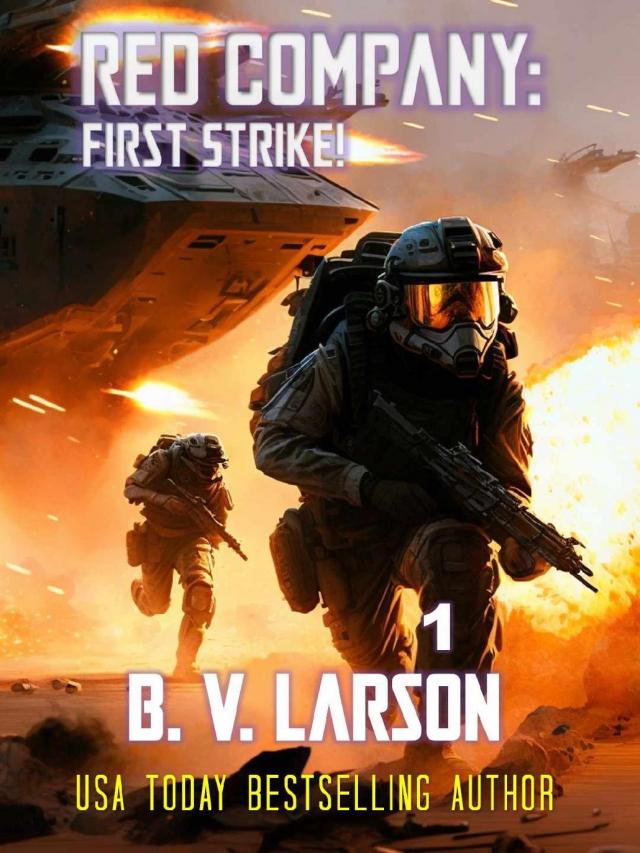


My footprints appeared in the crunchy, frozen methane snows as I walked. They were almost certainly originals.
“Spread out, men,” Quinn ordered. “I don’t think there’s anybody out here to shoot at us, but we might as well make it hard on them if there is.”
Right then, a realization hit me like a bolt of lightning. This was why Captain Hansen had sent Red Company first.
Before we’d taken a hundred steps, we could all see our destination. It was a vast hulk that started off as a shadow but became ever more clear as we approached in the dark. Soon, the outline was unmistakable. It was a ship—a big ship, at least as big as our mining rig. In fact, if I had to guess, I would say it was bigger.
The strangest thing about the ship was how quiet it was. As we got closer, we played lights over it. Swirling flecks of snow-like material, which were really made of frozen methane, frosted up our faceplates and occluded our vision. Every dozen steps or so, I had to reach up with my glove and smear some of it away from my visor so that I could see again.
The ship was big, really big.
“She’s a miner,” Lt. Quinn said. “A miner just like Borag—but see that flag painted on the tail? The one that looks like a computer with eyes? This ship is from Teklutions.”
I glanced over at him in surprise and alarm. Teklutions was a rival conglomerate, a monstrous organization that was as big or possibly even bigger than Interplanetary Excavations.
“What’s a Teklutions vessel doing all the way out here, sir?” Corporal Tench had the balls to ask.
“The same thing we are,” Quinn said, marveling at the ship.
“Then why is she dead and lying on her side?”
Quinn glanced at the corporal. Tench had always been the mouthy kind of enlisted man, but Quinn didn’t shout him down. He just looked at him and looked back at the big hulk that wallowed on its flank before us. “Obviously, she’s in some kind of trouble. We’ll render assistance if there’s anyone left alive to help.”
We broke up into squads and circled around the entire ship. We didn’t find anything obvious. No gaping holes in the hull, nothing like that. There were, in fact, a variety of drill-bots encircling the area, especially up against one large hill that was a few hundred yards from the big ship’s resting spot.
We found a variety of airlocks, but they were all sealed up. No one answered when we tapped the butt of a rifle on each door.
“Looks like there’s nobody home,” Corporal Tench said.
“Looks like it,” Lt. Quinn agreed. “But we’re going to have to go in there and check it out, anyway.”
“Hold on, Lieutenant. Hold on,” Ledbetter said. He’d been sweeping on his own recognizance, walking a path farther out from the perimeter. Instead of looking at the big ship that we’d just circled around, he was looking at the hill. “There’s a lot of equipment over here, sir. A lot of machinery was going in and out of that hill. In fact, it looks like they’ve dug some kind of a mineshaft.”
“A mine?” Immediately, Quinn’s voice rose high. He, like everybody else aboard this miserable expedition, had been hoping against hope that there was some profit to be made out here. Perhaps an abandoned mine was just the thing Borag needed.
“All right,” Quinn said. “I’m going to call this in, and then we’re going to check out that mine before we do anything else.”
He contacted Captain Hansen, telling her about the situation. She agreed to send out a team of scientists and engineers to cut their way into the derelict mining ship if she had to. In the meantime, she ordered Quinn and the rest of us to investigate the hole that Ledbetter had found in the nearby hill. More than one marine cursed Ledbetter’s name during that long trudging walk, let me tell you.
A dozen steps and then a hundred more took us to the opening on the side of the hill. We were already on the darkest side of the darkest planet we any of us could imagine, and now we were going to walk down into a hole drilled into the surface. I could hardly think of anything less appealing.
What if there was a sudden venting, as this planet experienced now and then? Maybe that’s what had knocked out this ship and possibly killed the men who were running the various drill-bots and ore carts that we’d seen strewn over the area.
Lt. Quinn wasn’t thinking like that. He was thinking with greed in the mind. He was thinking about making a big strike, not about what had caused the obvious disaster that was evident all around us.
Without hesitation, he snapped his suit lights to their brightest and then marched into the yawning cavern. We followed him with grunts of disappointment.
As we descended deeper into the rocky shaft, the temperature dropped sharply, and the frozen landscape became more prominent. Rock, metal, and a lot of methane-based frost was everywhere. It was a hazardous environment, and we had to be cautious with every step we took.
Lt. Quinn led the way, his suit lights illuminating the path ahead. We followed him, zigzagging and descending deeper into the unknown terrain. The walls of the rocky descent were covered with melted patches and gouges from laser drills. The risks were evident, but we had to continue. We had to find out what had caused the disaster and whether there were any survivors.
The ice-crusted walls of the cavern were jagged and irregular, with sharp edges and uneven surfaces everywhere. The temperature within the cavern was extremely cold, well below the freezing point of water, and the atmosphere was composed primarily of methane gas.
The weirdest thing was the ice itself. It wasn’t water, but frozen methane, which was used to make propane gas back on Earth. One would think a planet made of such a highly flammable chemical would be dangerous, whether it was frozen or not, but fire takes more than fuel to burn—it takes oxygen as well.
One thing Eris didn’t have was oxygen, which made it virtually impossible to light a fire of any kind. Borag had her own supply, of course, but since the thin atmosphere of Eris had none, at least there should be no chance of an explosion.
Quinn marched deeper into the mineshaft, and we all followed him. I could tell the rest of the men were getting a little nervous. Even Corporal Tench looked unhappy. Our communication systems were no longer able to reach the surface due to too much ice, rock, and debris above us. We were spiraling downward instead of going down in a straight line.
“What in the nine hells were they trying to find down here?” Quinn muttered to himself.
All of us glanced at each other, hoping against hope that the man would call a halt to this insane march straight down to Hell. We all wanted to turn around and head back up to the relative safety of the surface.
But no, Quinn straightened up his shoulders and kept going. We followed in his wake, hoping for the best.
When we were several hundred yards below the surface, the tunnel changed in nature, making one last turn before opening up into a giant cavernous zone.
“This has got to be it,” Quinn announced. “There’s got to be something valuable down here. Get out your sniffers, boys—metal detectors, everything.”
Being crewmen from a mining ship, we actually had sensors built into our spacesuits to detect rich veins of ore. It was, after all, the main business of Borag to find such things.
Immediately, gasps went up from a half-dozen marines around me. I checked my own instruments and stared in disbelief.
“This place is all metal,” I said. Being a miner, I knew the signs. I could read one of these sensors better than any marine.
Quinn whirled around and marched up to me. “You,” he said, pointing a big finger at my chest. “You were a miner once, weren’t you, boy?”
“That’s right, sir.”
“All right, you lead the way. You take us to this big treasure trove I’m seeing on my instruments right now.”
Gritting my teeth, I nodded and followed the path laid out for me.
At first, I was confused. We walked up onto a large humping hill—all of it underground, mind you. The cavern was so large that it actually had room to have a rise in the flooring of the cavern. It was like climbing a hill, crunching on frozen chunks of ice.
When I reached the highest point in the cavern floor, I looked around and shined a beam around me. A huge pile of ice under our feet reflected the beam off of a thousand facets.
The critical moment came when I shone a bright light directly downward into a thin spot in the ice. There was something big down there—something dark that gleamed back at me.
It was metal—it had to be.
That’s when I realized the whole bottom of the cave was metal. I stood straighter and looked around, my mouth gaping. I directed the light up high to see the jagged ceiling of ice above me and then flashed the light down low again, looking at that crusty coating of more ice that was hiding the smooth, rounded hull of a monstrous hunk of metal.
“This is what we’ve been detecting all along. That’s why our sensors were going crazy…”
I knew in my heart that this was why the Teklution ship had come here and landed just outside this cave. They’d bored their way down here all the way to the bottom.
They’d somehow detected what we’d just found—a very large, frozen mass of manufactured metal.
Lt. Quinn had been on a treasure hunt, but he’d gotten more than he’d bargained for. When I carefully explained the situation to him, he stood there in the middle of that vast cavern and looked in every direction, gaping just as I’d done. He finally turned back to face me and asked the question that was burning everyone’s mind as they all gathered around and stared.
“Are you kidding me?” he said. “This thing is huge. If you look at the parabolic curve, it’s got to be way bigger than Borag—even bigger than the Teklution rig.”
I nodded. “I’d have to agree, sir,” I said. “This thing, whatever it is—it’s friggin’ huge.”
Quinn stood quiet for a moment. Everyone else was gaping, gawking and standing around crunching on the ice. We were looking every which way and shining our lights at the ice.
Suddenly, Quinn’s voice changed. Instead of greedy, he sounded somewhat fearful. “It’s got to be dangerous,” he said. “That’s the only thing that makes sense. How did that other ship get to be a derelict? What happened to them? To the first crew who discovered this thing?”
I shrugged, and I decided right then and there to confess a little bit of what I knew from the meetings back on Mars. As far as I knew, no one else in Red Company had been privy to the details of our mission.
“Sir,” I said. “I’ve got to tell you something.”
“What now, Starn? Make it snappy. We’ve got to go back and report this.”
“We will, sir. I’m sure we will. But sir, it’s about the nature of this mission.”
I confessed then to the fact that I’d been in the conference room with the Mars execs for Interplanetary Excavations when Captain Hansen had been given her fateful charge to fly out to Eris. I explained that there had been another ship, one they’d sent out earlier and lost contact with.
Quinn’s jaw sagged lower to an improbable point. I didn’t even think there was room inside of my helmet for my chin to sag so low. “Are you shitting me, Starn? You were there? You knew about this all this time, and you didn’t say a goddamn thing?”
“No, sir. I was under orders not to—orders from the captain. The last time I looked, she’s above your rank—or Commander Kaine’s.”
Quinn nodded at last. “Right… So, you’re telling me now because it doesn’t matter anymore? We might as well know, right?”
“That’s right, sir. If Red Company is in danger, I’m not going to withhold information, even under orders.”
Quinn reached out a hand and slammed it on my shoulder. A little puff of frozen ice and gas flew away as he did this.
“Good man,” he said. “All right. I’ve got to think. I’ve got to think about what the hell are we going to do.”
“I found something over here, sir!” it was Corporal Tench, and he was shouting and waving. “I’ve found something!”
We looked in his direction, and we saw his light flicker toward our eyes. Quinn hesitated for just a moment, and then he marched over there, mumbling curses.
Corporal Tench was standing right at the center of the arcing dome of ice. He’d apparently done a little searching while we were having our private discussions. He’d made it up to the summit, and he’d indeed found something to crow about.
You couldn’t see it from any distance away, but once you got up close, there was a dark patch in the ice. A hole in the frost that revealed the metal below.
We all shined our lights down into that hole. We played lights over the smooth metal surface, the gleaming, twisted ice, and jagged crystalline growths that surrounded it.
“That, gentlemen,” Lt. Quinn said, “is a hatch. Have you tried to open it, Corporal Tench?”
“Hell no,” Tench said.
Quinn stared, and he thought about it. I could tell he was considering opening the hatch or trying to. Finally, he marched down into the hole, which was about three yards across and five long. The hatch—if that’s indeed what it was—wasn’t circular, but rather oblong with rounded edges.
Quinn looked for a wheel or something to spin, but he found nothing obvious. There was no clear way in.
“Whatever this thing is, it seems to be sealed tight,” he said. “I can see the outline of the hatch, but I don’t see any way to get it to open up…”
“They burned their way down here,” Ledbetter was saying. “The guys from Teklution must have melted this open spot in the ice. Hey, Devin, you’re the miner. You see this? See all these scars in the ice? That’s laser drills, right?”
“Sure is,” I told him.
“How the hell could they fire lasers with all this methane around and not blow up?”
I shook my head. “It won’t burn. Not without oxygen. The atmosphere here is way too thin for that. Methane wouldn’t burn on the moon either.”
“I sure as hell hope you’re right.”
“I’d better be,” I said, pointing. “They obviously burned and melted away the ice. They melted away the methane without lighting it”
“Yeah,” Quinn said, “I guess you’re right. You’ve got to be right. We need to get the miners down here. We got to deploy tech teams. They’ll have to find a way in.”
We all looked at Quinn. Our eyes were big and round already. He was talking about getting into this thing.
Did nothing impinge on this crazy officer’s sense of self-preservation? Hadn’t we just found a dead ship up above? Weren’t we following in their footsteps even now?
I didn’t know what to say, so I said nothing. A lot of the marines around me were stepping from foot to foot. They were looking in every direction at once. Everyone was feeling spooked.
“Where are the bodies?” Corporal Tench asked suddenly, asking the question out of nowhere. But when I thought about it, I realized he had a point.
“What bodies?” Quinn asked.
“The crew of the Teklution ship. Shouldn’t we have found them dead somewhere?”
“Well…” Quinn said, “they aren’t necessarily dead, and if they are, they’re probably back on up on top. Inside their ship.”
“But what would have killed them in there?” Tench pressed. “If they came down here and they opened that hatch, and they found their way inside… assuming something killed them, shouldn’t there be some bodies?”
Quinn fell silent. All of us did. He looked down slowly toward the hatch. Finally, I think even he had had enough.
“Marines,” he said, “we’re doing a U-turn. We’re marching back up to the surface. We’re going to talk to Captain Hansen, and we’re going to let her decide what to do next.”
Chapter 25: The Dead Ship
We all breathed a big sigh of relief as we began the trek upward. As we marched up the spiraling rampway that had been cut by a Teklution team, who knew how long ago, we moved markedly faster than we had on the way down. Despite the fact that we were going uphill, it seemed as if our boots wanted hustle us out of there.
By the time we came out of the mineshaft onto the open plains of Eris, we were bounding like giants. Lt. Quinn halted and called the troops to halt as soon as we were out in the open. He immediately reported in privately, and after a moment, he switched back to our channel.
“I’ve just had a talk with Captain Hansen,” he said. “It looks like they’ve managed to break into the Teklutions ship. We’re to report to the breach point—right now.”
He bounded off, and we followed him, double-time. The amount of ground a trained man could cover on a low-gravity airless surface like Eris was shocking. Fortunately, there weren’t too many boulders or other large obstacles on the landscape to trip us while we were bounding along.
Normally, it was difficult to make good time on a very dusty or icy surface. Running over loose dust was kind of like running on a beach, it always slowed you down. But our boots were built for this kind of thing. They automatically released cleats, especially in the toes, to give you a solid grip. And these smart cleats weren’t just rubberized spikes. They were more advanced than that. They would adjust themselves to the ground as you ran, and they deployed just the right length of spike to give you the most grip. That allowed a man’s musculature to be fully used to send him sailing across the landscape.
Quinn and the rest of 1st Squad raced to the aft side of the great Teklutions ship. There, right under one of those big painted emblems, was a blasted-open hatchway.
“Looks like a secondary airlock right next to the main cargo hold,” Quinn said.
Two dockyard types stood there waiting for us. One on either side of the passageway they’d managed to cut open. They just looked at us and showed no inclination to go inside themselves. These men were often called yard-dogs because they typically worked in spaceship yards. Sometimes we shortened that down to just “dogs.” Both of the dogs had naval ranks. One was a boatswain, and the other one was a boatswain’s mate.
“Chief?” Quinn said, turning to the boatswain. “What can you tell us about the interior?”