Red company first strike, p.22
Red Company: First Strike!,
p.22


“That’s chilling,” he said. “So… there’s some kind of computer running this place right now?”
“Yes, definitely. Haven’t you noticed the increasing temperature? You’re no longer blowing steamy breath, are you? Why has the temperature risen so much? We didn’t turn anything on, we didn’t adjust any thermostat—in fact, we haven’t found any controls at all. And yet, the environment here inside this lab is slowly transforming itself to meet our needs.”
We all looked around the ceilings and walls, wondering what else we were going to see next.
“Okay, so there are aliens,” Quinn said. “What’s their nature? You must have found some of them. Have you found any bodies? Have you dug any of them up?”
“No, not me personally,” she said. “I’ve never seen anything that you would call a typical flesh and blood alien.”
“That’s pretty useless. We could have deduced all this from what we’ve seen here today.”
Dr. Sharaf glared at him. “I don’t know everything. I’ve only been involved in a few projects. What I do know is that every undamaged chamber we’ve found is operated robotically. There are… guardians, sometimes. They have advanced physical forms, both electromechanical and biochemical.”
“Okay, okay, so we’re dealing with some kind of alien robots? That’s just wonderful. You think they’re still here? They’re still active? Are they running this place, or is it just some automated computer responding to our presence?”
“I suppose we’ll find out in time.”
Lt. Quinn turned again to examine the strange walls. He ran his gloved hands over the metallic surfaces, but nothing revealed any secrets to us.
“What’s their purpose?” he asked. “These aliens… what are they doing here with these little weird labs buried underneath the ice?”
“We don’t know. Whoever built these installations, whatever the original purpose was, is essentially dead or gone or destroyed. All we are seeing is the remnants. These labs are at least forty thousand years old, Lieutenant.”
“What? How the hell do you know that?”
Dr. Sharaf looked furtive, as if she were about to release a grim secret. “I’ve heard rumors,” she said. “They say we’ve found Neanderthals and Cro-Magnon in these places. The DNA of our distant human ancestors from long ago has been identified and confirmed.”
“So… you’re saying they were visiting Earth? Thousands of years ago?”
“That’s what I’m saying, yes. That’s the best of my knowledge.”
“That is truly unsettling…”
She shrugged. “Perhaps, but at least we know their purpose was to study us, perhaps it was nothing more sinister than that. If they’d wished to destroy humanity, they certainly could have done so long ago when we were a primitive species.”
Quinn squinted at her. “So, there were once some relatively peaceful aliens out here. But somewhere along the line, somebody else came along and wrecked their labs. And it couldn’t have been us, not if we were a bunch of Neanderthals and Cro-Magnon…”
“Yes, the destruction we’ve witnessed in these places certainly wasn’t delivered by anyone from Earth. Whoever destroyed their hidden bases around the Solar System was obviously more powerful and advanced than the people who built the labs in the first place.”
Quinn was nodding and rubbing his chin. He’d opened up his faceplate, breathing in the air deeply, as it was now fresh and almost warm. He rubbed at his chin and his carpet of stubble, and he thought over all this shocking information.
Tench spoke up again. I don’t think he could help it. “I bet I know why they’re buried in remote locations underneath ice like this,” he said.
Dr. Sharaf, for once, did not admonish him, and neither did Quinn. Everybody looked at him, hoping for an answer—hoping against hope, given the source.
“Well… just think about it,” he said. “They built underground in hidden locations because they were under threat. This base is thickly armored with heavy hatchways to prevent intruders. But why?”
He looked around at our blank faces for a moment before continuing. “It’s not like some guy from Earth with a spear was going to come out here and kill them. No, they knew they had an enemy. They knew they had someone to hide from way back when they first built these installations. Back then, we were running around grunting in caves.”
We thought about that. None of us could find a flaw in his logic. There would be no reason to build a highly defensive hidden installation if you were simply examining earthlings. It didn’t even matter what your purpose was.
“I get what you’re saying,” Quinn said. “Way, way back—around the time of the Ice Age—we were no threat to them at all. I think you’re right, Tench.”
Dr. Sharaf grumbled, but she was grudgingly willing to admit Tench was right. The logic was pretty much unassailable. She definitely didn’t like the source, but she accepted the idea.
“But I don’t see how this gets us anywhere,” Quinn said. “We’re still stuck inside this place. We’ve been deserted and marooned. Even if we figure out every secret this lab has in the way of technology, it wouldn’t matter much because we’ll probably all die long before anyone comes out here again from Earth again.”
“That might be true,” Sharaf admitted, “but we might as well do it anyway. For the good of science.”
Quinn snorted. “Maybe we can write it all down, throw it outside the hatch, and leave it there for the next guy that comes along—to give him a little leg up. Huh?”
“That’s very altruistic of you, Lt. Quinn,” Dr. Sharaf said in a sarcastic tone. “Anyway, let’s keep looking around.”
The passages wound deeper into the ground and sometimes split up. But there were no rooms, no chambers—only more passages. It was an irregular labyrinth. We soon found that every passageway we went down ended in a dead end. When we ran out of passages, we stopped searching, dumbfounded.
“There’s got to be more to the place than this,” Quinn said. “Spread out, tap at the walls, the deck—even the ceiling. If anyone detects a hollow sound, report in.”
We did as we were ordered. Pretty quickly, we found what might be a hollow chamber that at the end of every corridor. The wall there seemed to be completely seamless metal, but there was indeed a hollow sound when you tapped the butt of your gun on it.
Quinn allowed Dr. Sharaf to work on these spot looking for possible alien doorways for several minutes. When there were no results of any kind, he unslung his laser carbine, aimed it at a wall, and held the trigger down.
We all snapped our helmets closed, backed away, and watched as the laser bolts flashed and banged, scarring up the metal. He gouged the wall significantly, but he wasn’t breaking through.
“Lieutenant,” Dr. Sharaf said, “stop wasting power. The energy in your weapons can be used to keep us alive.”
Lt. Quinn stopped firing and turned to look at her. “You know as well as I do, someone or something is heating up this place. Energy isn’t going to be our problem. Food and water, that’s our problem. If there is any, it’s on the other side of this door. Have you got any more ideas about opening it?”
She shook her head reluctantly and walked away grumbling. Corporal Tench joined Quinn, and together they fired a very focused set of beams on a single spot. This soon began to make headway. We’d dug in several inches when all of a sudden there was a strange burning sound and a wild screeching hiss of gas.
“We’ve breached it!” Quinn shouted.
It was true. All the air and heat were rapidly depressurizing through the hole they’d punched through that wall. I had to wonder if he’d managed to kill all of us by exposing our pressurized chamber and opening it up to the cruel, unrelenting cold of Eris.
Dr. Sharaf raced forward with a patch in her hands, attempting to get it over the hole, but Quinn pushed her back.
“It’s not hissing anymore. Look!”
It was true. After a brief escape of gas and, I’m sure, a thinning of the atmosphere in the passageway, the pressure seemed to have equalized with whatever was on the far side of that burnt wound in the metal wall.
As we gathered around, peering and shining flashlights into the wounded metal, we were met with a fresh shock. The hole began to move. It began to crawl upward, in fact, without a sound.
It glided up and seemed to merge with the ceiling, as if the metal had turned to liquid and flowed upward, retaining that burnt hole in it the whole while. Soon, a dark passage could be seen beyond.
We’d been keeping our suit lights dim since there was a bit of a glow of light inside the passageway, and we instinctively wanted to preserve our batteries for as long as we could. One never knew, especially when one was on a remote planetoid, just how long you would have to rely on your suit, your batteries, all the very minimal life support systems that we carried with us.
“There’s something moving in there,” Tench said. “Look out!”
We recoiled from the doorway. We’d been edging forward, probing with our lights.
Inside, we saw things moving, things in the darkness. As I got a better look at them, I realized they were artificial, that much was clear. They weren’t flesh and blood.
I’d never seen anything like them. They were insectile, kind of like giant grasshoppers or praying mantises. They had manipulative arms which were covered in spikes and thorns. Their eyes were bulbous and multifaceted. All of them seemed to be made of the same strange metallic surface that the corridors and the passageways, even the hatch of this massive installation, were made from.
They whirred smoothly as they moved—and they moved wickedly fast.
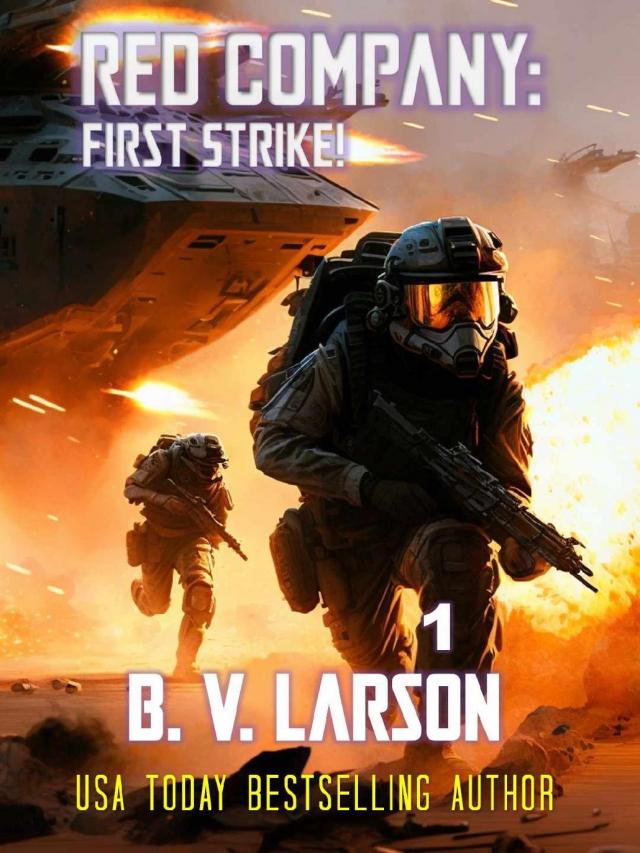
Being Red Company Marines and seeing as we were surprised by an obvious threat that looked quite dangerous, we unlimbered our carbines, formed a line, and fired without even having been ordered to.
Only Dr. Sharaf was yelling “Wait, wait!” she cried—but it was too late. We weren’t listening to her. In fact, I threw an arm out, blocking her from marching in front of our field of fire. Ledbetter, Corporal Tench, Lt. Quinn, and several others, we were all shooting.
Two alien monstrosities made it to us somehow, one of them falling just as it reached out with one of those strange, hooked, metallic claws to gouge at Quinn’s foremost boot. It died there—if you could even use that word. It ceased functioning anyway, rasping, whirring, and churning its strange legs on the deck.
Its strange, multifaceted eyes had been punctured, but they didn’t bleed. Instead, they released strange vapors and smoke, as if a fire had been lit within the machine by our laser bolts.
The second robot performed better. Private Mendoza had stepped aside to get a clear shot, and the second robot managed to reach him before we could bring it down. We had focused so much of our time and fire on the first robot that by the time we turned our attention to the second one, Mendoza was in trouble.
The robot seemed to know how to kill a human, slashing at him with its claws and thrusting deep. One of its claws aimed for Mendoza’s heart, but his body armor protected him. The second thrust, however, came just under his helmet. It found its way into Mendoza’s throat, where hooked spikes ripped his throat out. His esophagus was thrown from his body, and blood was everywhere. Less than a second later, the robot finally succumbed to our shower of bolts and collapsed like the first one.
Dr. Sharaf approached with her hands on her hips and pointed first at Lt. Quinn and then at the dead man. “This is what you get when you proceed without caution,” she said. “You didn’t give me enough time to work on that lock. You didn’t give me enough—”
“Shut up, Doctor,” Quinn said. “I’m in charge, and there’s one thing we don’t have much of here: time. We have a serious enemy aboard this vessel, and we must act decisively.”
“It’s not a vessel, you fool,” Dr. Sharaf corrected. “It’s a base, a laboratory. I already told you that.” She seemed somewhat hysterical.
Lt. Quinn looked worse for the wear, as if he might shake Dr. Sharaf, but he forced himself to calm down and turned away from her, ignoring her hysterics. She’d clearly lost it, probably frightened by the alien machines.
She was obviously a person who would lash out in anger when she was afraid or confronted with something unexpected and unpleasant.
Once we confirmed that Private Mendoza was indeed dead, we quickly divided up his power cells and weapon. We gave the extra weapon to Charlie, who looked at it as if he didn’t know which end had the trigger and which end had the emitter.
“Just carry it,” I told him. “Only try to fire it if you really have to.”
He nodded, his eyes wide. “We’re all going to die here, aren’t we Starn? I mean, that’s what I’m feeling right now.”
I shook my head and smiled, then I began lying. “Nah, Lt. Quinn will figure it out. We’ll get out of here.” I turned away before Charlie could realize I was lying, but he continued to stare at me and fondle the strange laser carbine in his hands.
We got a little bit of water, food, oxygen, and power from Mendoza’s corpse, but we couldn’t use his suit or helmet as they’d been torn up during the attack. Every time one of us died, it meant the others could live for perhaps another hour. It was a ghoulish way to survive, and I tried not to think about it.
“Ah-ha,” Dr. Sharaf said, drawing our attention. “It’s obvious! I’m such a fool.” It was the first time I had ever heard her refer to herself as a fool, and I found the admission refreshing. She was usually our resident expert in detecting fools, but this time she was beating her fists against her own head.
“These doors,” she explained. “We can tell where they are by tapping along the walls and listening for a hollow sound. That’s a doorway. You can’t see it, it’s too perfectly made, almost seamless. If I had a microscope, I might be able to see the fine line where the door meets the wall, but it doesn’t matter.”
She looked around us with an expression of triumph, while we stared back in a bewildered fashion. Her face soured. “Try to turn on your primitive brains,” she said. “Think about it. Would a door built for robots like these respond to the touch of a human hand? Or to warmth or moisture? No, it would respond to things a robot possesses: magnetism, electricity, a tiny static charge, perhaps pressure.”
She was right, of course. We had spent a lot of time pressing, nudging, and feeling every crevice, hoping to find a pressure plate or button that would open the door we had blown our way through, but we’d never found anything like that.
“So, are we going to tear off one of those big claws and tap it against the wall?” Quinn asked.
“That’s actually not a bad idea,” Dr. Sharaf said. “But it may not have to be something like that. Maybe any metal item would work: a knife blade, or perhaps the barrel of one of your guns. Try it.”
Quinn approached the wall where she’d identified another door, but she stopped him.
“Do we have a plan of action for this next room?” she asked.
Quinn looked around the room. His Marines had gathered, and we had our carbines ready. Essentially, our main plan of action as Marines was to shoot down anything that came at us.
“You’re right,” he said. “Let’s set up a charge on the floor—right here. Maybe this time we won’t have to lose a man if we get rushed again.”
Specialist Edgars, who was the closest thing we had to a sapper, stepped forward. He carried a few explosive charges. These were usually meant for blowing holes in doorways or airlocks, but they could also be rigged as a mine.
“You have mines?” Dr. Sharaf complained. “Why didn’t you use them on the first door?”
Lt. Quinn eyed her with displeasure. “Because I’d rather bore one small hole through a door into the unknown than blow a gaping hole in it. If it led to something even more dangerous, we couldn’t have plugged it up if we’d blown a monstrous hole in it.”
Dr. Sharaf thought about that and nodded, finally backing off and stopping her complaints.
Edgars placed a small, flat mine and set it up with a proximity fuse. “Don’t put your foot close to that thing,” he warned us.
Quinn and the rest of us stepped back.
“All right,” Quinn said, “be careful with the mine. Ledbetter, tap around the outer edge of that doorway.”
“Me, sir?” Ledbetter squawked. Quinn gestured furiously, and Ledbetter approached the wall, grumbling. He reached toward the invisible doorway at an oblique angle and began lightly tapping on the metal wall with his knife. As he got closer, you could hear a small difference in tone, indicating he was indeed tapping on a hollow spot.
Suddenly, the door seemed to melt. It shifted form and flashed upward, rolling away into the ceiling just like the previous one.
There was a gush of depressurization, but this time, we were prepared. Our visors were down, and our suits pressurized, so we weren’t frozen or asphyxiated.
The interior of the chamber Ledbetter exposed was pitch-black, but the chamber we were in had adjusted to our presence. It was now filling with breathable air, heat, and a soft, warm glow of light. Whoever had built this place had designed it so that creatures like us could survive.
We raised our carbines and put our fingers on the trigger, tensing up and aiming into the dark hole.
Suddenly, I saw movement out of the corner of my eye. Another door had opened to my left, and as I wheeled to face this new threat, two more doors open as well. Apparently, activating this latest door also opened all the others.
There was no movement coming through the door that Ledbetter had opened. Nothing rushed through and activated the mine on the deck. But from the other two doors, there were sounds and signs of movement.
They were coming at us—from our flanks.
Chapter 29: The Laboratory
I shouted the alarm, but it was utter confusion. This time, the enemy got in the first blow instead of us.
Dr. Sharaf and her two minions had taken refuge at the back of the room. They had placed themselves as far away from the charge on the floor as possible. A moment ago, this had seemed like a good strategy, as they were far from the potential danger of the explosive and the opening doorway that was likely to contain a charging, vicious alien robot.