Red company first strike, p.23
Red Company: First Strike!,
p.23
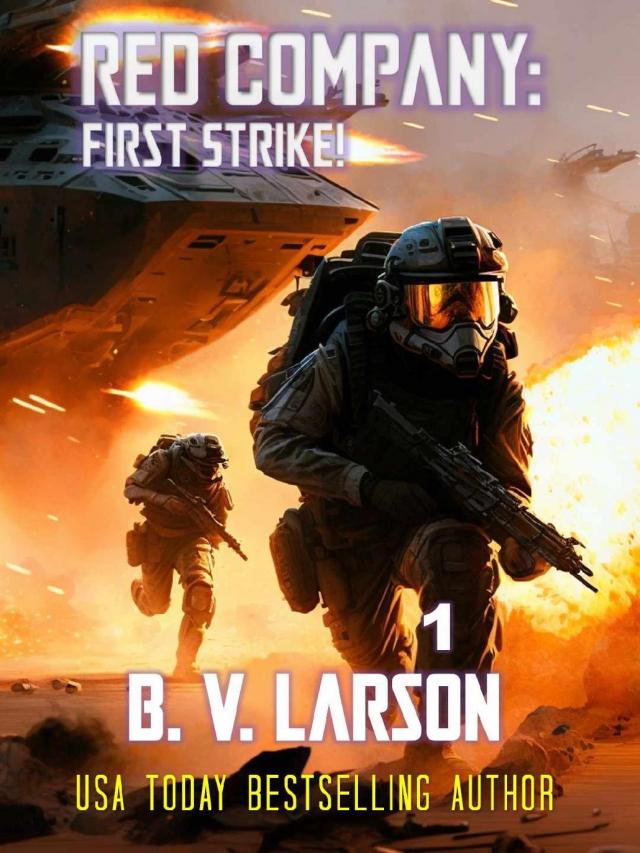


Unfortunately, this also placed them between two opening doors when the alien robots rushed in. Of the noncombatant group, only Charlie was armed. He let out a wild stream of curses and laser bolts. He swung the carbine wildly, sending a spray of bolts across the room, making everyone duck. He managed to hit the nearest robot with many bolts, but it wasn’t enough to kill it.
The robot turned to face Charlie, but before it reached him, it reached one of Dr. Sharaf’s minions. It’s possible that the good doctor had pushed her assistant in front of the robot to save herself, but later I could never be fully sure of this. I couldn’t be certain of what I saw in all the confusion. It did seem to me that her position had shifted, placing her hapless sidekick between her and the charging alien horror.
The enemy robot, being a machine, went for the closest item on its target list—which was Dr. Sharaf’s minion. He was closer to it by perhaps a foot or two than Charlie was.
The robot turned on the unarmed man and tore him to ribbons. The scientist had no body armor, and every thrust of the robot’s spikes and hooks easily punched through the spacesuit. Gouts of blood and organs flew everywhere.
Charlie was making a low wailing sound as he held down the trigger of his laser carbine and fired away. A few of the bolts may have hit the scientist, but it didn’t matter, as the man was already dead. Meanwhile, the robot was busy attacking the man on the deck, allowing Charlie and a few of our Marines to finish it off with short bursts of fire.
Another robot had entered through the door closest to Lt. Quinn and myself. It was quickly defeated, as we were more prepared and faster to react. In the end, we killed both robots, but lost one scientist.
After the battle, we checked the newly exposed chambers but found no more robots. As far as we could tell with our probing lights, there were no more robots to be found. They’d all rushed us and died in the effort to destroy us.
We were licking our wounds and shaking our heads when Quinn looked around sternly. “Where’s Tench?”
We counted heads and came up one short.
“Where’s Tench, dammit?” Quinn demanded. “Did anyone see him leave? Starn, are you running your cameras?”
“I am, sir—but just the one on my helmet,” I replied.
“Back it up, play it, and send it to my helmet,” he instructed.
I did as he asked. I’d been more or less aiming in the direction of Corporal Tench, expecting to see a robot run out and activate the mine on the floor.
Looking at the video retrospectively, both Quinn and I saw the same thing: when the action had begun, Corporal Tench hadn’t participated. He hadn’t fired his weapon, but instead withdrew and went back through the door in the direction we’d originally come—the door that was now wrecked with a hole in it.
“Let’s go find him,” Lt. Quinn said.
Dr. Sharaf approached and put a small hand on his bulky elbow. “Lt. Quinn,” she said, “one might expect a deserter under this kind of pressure.”
“I don’t expect anything of the kind,” he replied. “This is Red Company. If he’s deserted us without good reason, he’ll face the consequences.”
Dr. Sharaf dropped her hand and shrugged, and we all followed Lt. Quinn as he walked through the passageways. The path slanted upward toward the entrance. As we moved forward, searching through the corridors we had searched before, we reached the original hatch and found nothing—no sign of Corporal Tench.
“That is really strange,” Quinn said. “Do you think he went through the hatch and outside? Why the hell would he do that?”
Dr. Sharaf chewed her lip, and her eyes moved around the group, but she made no comment. For once, she held her tongue.
Baffled by the corporal’s disappearance, Quinn had us search every passageway in the complex, mainly by tapping on the walls to see if we discovered any hollow-sounding responses. We found five spots that sounded like doorways rather than solid walls.
He also instructed a small group, including myself, Ledbetter, and another man named Morrison, to go through the airlock and check outside. If Corporal Tench had gone that way, he wanted to know.
We went outside through the airlock, and we looked around out there on the jagged ice in a very paranoid fashion. We resembled gophers poking their noses out of a hole for the first time in a year. It was funny to think that we were more comfortable inside our air and warmth-filled passages now, even with robots lurking, than we were out here on the open, exposed surface of Eris.
We were unable to find any tracks that obviously belonged to Tench. Of course, they could have gotten mixed up with the countless other footprints that we saw etched in the ice. There was no sign of Tench, and transmitting radio calls resulted in nothing. We returned after about ten minutes of searching to report back to the Lieutenant.
“Damned strange,” he said. “He’s got to have gone through one of these five doors.”
Charlie laughed. “Well, sir, if he did, he has bigger balls than I do. I think he’s probably robot food by now.”
That was the general consensus from the group. If Corporal Tench had lost his nerve or gotten a wild hair for whatever reason, he’d most likely met a grim fate. Wandering off in this complex by yourself would almost certainly be fatal.
I could tell that Lt. Quinn was more upset and baffled by this desertion than any of the rest of us were. None of us liked Corporal Tench much, and if he had gotten himself killed, it was going to be hard to cry too much at the funeral. Still, it was unsettling to note we’d lost another man. Red Company seemed to be shrinking by the hour.
While all this searching went on, Dr. Sharaf did many tests on the atmosphere, the decks, and the aliens. She declared these last to be a combination of biotic and artificial creatures. Essentially, they were cyborgs.
“Cyborgs?” Quinn asked her. “Are you sure? That sounds crazy.”
“Yes, I’m sure. They’re outer carapaces are metal, but there is some meat inside them. They have organic muscles and brains. Some of their organs are cellular in nature as well.”
“That’s really disgusting,” Quinn said, twisting up his face. “We should drive them all out of this ship, or burn them, or something.”
Dr. Sharaf made a choking sound and moved as if to protect her fallen robots. “That’s insane,” she said. “First of all, burning them would waste our precious oxygen. Secondly—”
“Never mind, Doctor, never mind,” Quinn said. “I’ve got no intention of lighting a fire in here, don’t worry. But if they are partially organic, they’re going to start to stink after a while, aren’t they? They already do, if you ask me.”
He had his helmet open, as did most of us.
Sharaf eyed us all. “There is another matter…”
“What’s that?” Quinn asked.
“Well, we have been exposed to organics that are most likely alien in nature. That’s pretty much undeniable at this point.”
“Yeah? So what?” Quinn asked.
“So, certain protocols must be observed.”
“Like what?” Quinn asked, squinting at her.
“I have here a set of injections,” Dr. Sharaf explained. “I’ve mixed them up from my medical kits. They should help prevent any kind of infection that these creatures might have already delivered into the air or into our bloodstreams directly. Some of us were injured,” she looked around, eyeing Ledbetter pointedly, “and we’ve already seen what such injuries might cause.”
“What?” Quinn asked. “Are you talking about those psycho half-dead people? The crew of the Teklution ship? You think we might end up like them?”
Dr. Sharaf shrugged. “How else would you explain their state? They obviously came into contact with these creatures. They probably fought a battle with them aboard their own ship. According to my observations, they clearly lost that fight.’
“Yeah…” Quinn admitted. “You’ve got a point there. Somehow the Teklution ship was overcome. It could have been disease, some kind of madness, some kind of parasite—or these weird robot aliens themselves.”
“That’s right, the cyborgs might have been the cause. We really don’t know the truth.”
“All right, all right,” Quinn said. “So, what’s in this compound of yours?”
“It’s a tri-ox compound mixed with several other key ingredients. Antivirals, things like that.”
“Hey,” Ledbetter said. “That’s the same stuff you said you injected into me. When that zombie-dude scratched me on the Teklution ship.”
“Naturally,” Dr. Sharaf said. “It’s the same compound. Experimental Lot Six.”
Quinn frowned at her. “Just how is it that you happen to have a sufficient quantity of such medications to take care of me and all my men?”
Sharaf shrugged again. “Foresight,” she said. “Simple foresight. That, and the ingenuity of a biochemical AI-driven organelle built into my pack. From base materials, it’s essentially able to make quite complex organic chemicals on demand.”
“What’s this compound supposed to do and how will you deliver it?”
“Injections, of course,” she said. “Just a small, thin needle, nothing too frightening for fighting men such as yourselves.”
Quinn snorted. He eyeballed what was left of the squad. “Do I have any volunteers?” he asked.
No one raised a hand. Not even me this time. I had to admit I wasn’t in too trusting a mood when I looked at Dr. Sharaf and her kit full of odd amber fluids.
She began building up her first injection as we watched. Contrary to everything she’d said, the needle looked rather large, and the fluid looked like maple syrup to me. It was sort of thick and orangey-brown.
“I thought not,” Quinn said. He disconnected one of his gauntlets, rolled up a sleeve and presented his arm to the ghoulish scientists. They administered an injection which Quinn did his best to pretend didn’t hurt.
“What the hell?” he complained after ten seconds or so. “Are you drilling for oil there?”
“We’ve got to get into a vein—deep into a vein.”
Quinn frowned and watched them. When they were finally done the syringe was empty. We all watched as she began to prepare the next injection. This time, it was Charlie who objected.
“Hold on a second. Are you using the same needle for all of us?”
Dr. Sharaf shrugged. “I don’t have enough disposable needles for the whole lot of us. We must make do.”
“That’s disgusting,” Quinn said, “and dangerous.”
“That’s true,” I said, speaking up for the first time. “If one of us is infected, you’ll make sure that we all are.”
Dr. Sharaf pouted a bit, but she finally agreed to use one separate needle for Ledbetter, and a second one for the rest of us. She used the tip of a laser rifle to burn off any residue between injecting different people.
When it was my turn, I almost bit my tongue. The process was actually quite painful and extremely lengthy. It felt like a surprising amount of fluid was gushing into my veins.
When it was over, I shrugged down my sleeves, slammed my gauntlets back on, and then picked up my carbine.
“How long does that inoculation last anyway?” I asked her. “For life, I hope.”
She laughed at me. “No,” she said, “not that long, but hopefully it will keep us stable and healthy until we get out of here—or until we all die.”
“An encouraging thought, doctor.”
We munched on rations, sipped water, and tapped on the walls until at last, Lt. Quinn came to a decision. We’d been in here something like five hours, and although we clearly had enough oxygen to last a long time, water and food were not in plentiful supply.
“Corporal Tench hasn’t reappeared,” he said in a glum tone. “I’m marking him down as lost in action. Any objections?”
None of us argued. Maybe he’d freaked out and run off somewhere. Whatever had happened, he’d probably gotten himself killed by now. That didn’t seem like Tench, but you never knew how a person was going to react when they were faced with their first killer alien cyborgs.
Quinn decided to attempt breaching the doorway we’d found that was closest to the airlock next. He reasoned that it was possibly less dangerous than the others.
I didn’t find his logic compelling, but then, I wasn’t in command.
We used the same electrostatic discharge technique to open the door again, and it rolled up with silent, smooth perfection.
Inside was yet another dark, frigid room. We lit up the chamber and aimed a half-dozen laser emitters into it with our fingers caressing the triggers—but we didn’t fire. There wasn’t anything to shoot at.
Stepping inside, we began to search the place. It was quite a bit different from the other chambers we had discovered thus far. The room was large, dark, and extremely cold.
Unlike all other chambers, it didn’t warm up as we spent time inside. It stayed frigid. Lights had come on, and air had begun to fill the space—but there was no heat.
Slowly, very slowly, a bluish light began to filter in from the walls, but the heat never did come on. Soon, we discovered why.
When we reached the back of the chamber, we found nothing but a bank of cylinders. These large, tall containers were made of the same metal as the doors and passages were. Each of the cylinder had an opening that could be triggered exactly as the alien doorways had been.
When we dared to open the first one, again standing in a circular firing squad pattern, the door rose up to reveal no insectile robot or cyborg. Instead, something new and equally terrifying met our eyes.
It was human, we could tell that much—or at least it had been once. A frozen figure was inside the cylinder. His face was twisted up in horror and pain—even agony. The look reminded me of the expression we’d seen back aboard the Teklution ship.
The entire cylinder was filled with a block of ice. Vapor poured off it. I suspected the substance wasn’t frozen water, but rather frozen methane.
The figure inside was still visible, as the ice was only an inch or two deep over the face.
“What a way to go…” Quinn said. He reached out and polished a section over the face. “It’s a woman, I think.”
He was right. We all stared, wondering who she was.
“Probably a crewman from the Teklution ship,” I said.
“Yep, that must be it. Well, that proves it. These aliens obviously attacked the Teklution ship, got aboard, and took a few prisoners.”
“Either that,” Dr. Sharaf said, “or this fool wandered into this complex, just as we’ve done, to explore it. She was captured and frozen.”
“That’s possible.”
“Out of the way,” she said, crowding forward. “I must take a sample.”
We watched, frowning, as she stepped up with a tiny electric drill. She bore deeply into the ice until she finally struck the frozen corpse. After nearly a minute of creating smoke and making whirring sounds, she extracted a sample of flesh. She stowed it in a specimen jar tube and packed it away.
None of us objected to this desecration of the dead. After all, we needed information. Dr. Sharaf, as unpleasant as she might be, was probably the one who was going to give it to us.
Chapter 30: Corporal Tench
We moved from metal tube to metal tube after that, finding each of them to contain a frozen human—or at least a humanoid—figure. Several of them seemed like modern people, just like us. They even wore crewman’s clothes underneath all that ice.
But when we got to the seventh in the line, we all gasped. The figure inside was different. It was unmistakable.
“What is that?” Quinn demanded. “Some kind of a freaking caveman?”
“Look at all that hair…” I said.
“Fantastic…” Dr. Sharaf chimed in. She immediately stepped up with her drill again. Her hands were almost shaking with excitement. “What a find,” she said. “It might be Cro-Magnon—or a Neanderthal. Maybe even Homo erectus? This is the find of the century.”
We watched in disgust as she performed her ghoulish probing of the frozen corpse.
“If that thing really is some kind of primitive human,” Quinn said, “even if it’s just from the Bronze Age or something, then this alien base has been here for a very long time.”
“I told you that already,” Dr. Sharaf said. “We’ve found evidence before—things like this. Yes, these alien cyborgs… beings, robots, whatever the hell they are, they’ve been studying us for a long, long time. If they’ve been visiting Earth to investigate us lately, however… well, we haven’t seen one.”
“What about UFOs?” Ledbetter asked. “I’ve always heard about those.”
Dr. Sharaf scoffed at him. “Fantasies and scare tactics,” she said. “Extraordinary claims require extraordinary proof.”
Ledbetter grunted and pointed a finger at the Cro-Magnon, or whatever it was, frozen in the tube in front of us.
“What do you call that, then?” he demanded. “I’d call that physical evidence. I’m feeling pretty convinced right about now.”
Most of the rest of us were nodding. Even Dr. Sharaf’s one surviving sidekick seemed to be on Ledbetter’s side this time, but Sharaf only scowled and kept working her drill.
In the end, we opened up over thirty tubes. We took a sample of each and stuffed them away in Sharaf’s backpack—or more accurately the backpack of her overburdened minion. He was serving as little more than a pack mule at this point.
Then, she sealed each of the strange frozen tombs by reversing the process of engaging the strange metal sliding hatches.
“Why would they put this room so close to the entrance?” I asked.
Dr. Sharaf shrugged. “Of course, we can’t know their logic, but I would suspect they’re somewhat like ants in their thinking. They all look alike, after all. They’re quite busy creatures, and they’re often ferocious. In fact, calling them something like ants with a metallic exoskeletal structure seems like a pretty apt analogy. I must make a note of that.”