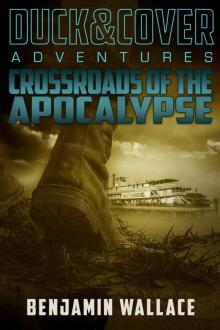
Crossroads of the apocal.., p.15
Crossroads of the Apocalypse,
p.15


Lana was hitting him.
He was going to have to talk to her about that.
He closed his eyes. It was his decision this time. The beagle licked his face and he opened them once more.
Another pirate landed in the boat. But he didn’t even get a chance to storm the cabin. His chest exploded without a sound and he fell back into the water. How did they manage that?
His eyes were closing again.
He didn’t want to miss this. He wished the beagle would lick him again. Not because he liked it, but it kept his head in the game.
The boat banked. They were almost perpendicular to the water. He could feel gravity pulling at him from a new direction. They turned so fast that he didn’t even have time to slide. All of a sudden, he was looking into someone else’s boat. Staring at a boatful of the pirates that had attacked them the day before. The stupid boat captain said they couldn’t get past that town. He wondered what the smart guy had to say now. He couldn’t move, but he felt his eyes roll back and saw the captain. Mike had one hand on the wheel. The other had a gun in it. He didn’t know what kind, but it was silver so it was probably a revolver. Those were louder, too, and this gun was loud and it jumped several times as he fired and the pirates in the boat fell dead.
The Boomer—what a dumb name for a boat—settled back in the water and he felt the wake catch them.
“Is he okay?” Lana asked. She was the best. He was glad he was so nice to her all the time. She deserved it.
Laura was back to assuring him that he was going to make it.
There was still noise. But it was farther away now.
Thomas Caine blacked out.
17
Voices woke him. He didn’t rush to open his eyes; instead, he kept them closed and did his best to take in his surroundings with his remaining senses. Thomas was no longer on the floor of the boat. He knew that much. He was inside somewhere. On a bed. The air felt cramped. Thick. Angry? Definitely wet. He was still on the river.
He wasn’t alone, but he was being ignored. The two women were no longer tending to his wound.
The older woman’s concern was now focused on their belongings. She was pleading with someone. “Please don’t. Those are our things. It’s all we have left.”
Had the pirates won? He could have sworn they had gotten away. Caine kept his eyes shut, feigning sleep in case the other passengers needed him to…needed him to do what? Spring into action? He had been shot once already. The victim of a pirate’s gun. He was useless to anyone. Still, he pretended to be asleep and remained ignored. He felt it best until he knew more about the situation.
There was a crash, followed by a clattering and at least one gasp and a dozen questions from that damned little dog.
“What are those, Eve?” Fidget asked. “They look like sticks.”
“They. Are. Guns!” Mike shouted and grunted. Another crash followed and more weapons fell to the cabin floor. “Cases and cases of guns. They’re also the reason that Marco and his men came all this way looking for us. Which—in case anyone was wondering—is the exact reason I have the ‘no gun running’ rule in the first place!”
Once he realized it was the captain causing the distress on the boat and not the pirates, Caine opened his eyes and sat up to find himself in the captain’s bed. “Wait, what’s going on?”
Eve glanced at him and pointed to the older couple. “It seems Mr. and Mrs. Grandma here haven’t been completely honest with us. They’re running guns.”
“Wait,” Caine said, shaking his head to get everything lined up right. “I nearly died because you were running guns?”
“You didn’t nearly die,” Eve said. “You barely got shot.”
“Barely got shot?” Thomas looked down at his shoulder expecting to see a large wad of gauze taped in place. Instead there was a bandage with a cartoon pony on it. He pulled it back to reveal a small wound that had already scabbed over. “Then why did I pass out?”
“Because you’re a pussy,” Dalton said.
Before Caine could argue, Laura interrupted and resumed pleading with the captain. “Please, Mr. Mike. You have to believe us. We weren’t trying to break your rules. We have a really good reason for taking these guns with us.”
“Money is a good reason for a lot of things,” Dalton muttered.
“No,” Laura snapped. “It’s not money. It’s not...” Her voice trailed off and she turned to Andy.
“We really are going home, Captain,” Andy said. “If it’s still there.”
“What do you mean, ‘if it’s still there?’” Lana had been sitting quietly on the edge of the bed until now. Caine hadn’t even seen her there and he jumped when she spoke.
“About six months ago, we started to experience raider attacks. The Penance, as they appear to be calling themselves now. It didn’t seem all that out of the ordinary at first. I mean, no worse than the raider attacks everyone has to deal with. But they’ve gotten worse.”
“We were lucky for a really long time,” Laura said. “We haven’t really had to fight for much. Our community has been able to take care of itself. And we never raised much attention. All the weapons we have were for hunting. And when they came, it wasn’t enough. So we brought everything we had north and…” She gestured toward the pile of guns on the floor.
Silence followed the confession.
Caine could see conflict on Captain Mike’s face as he decided whether or not he would buy the story.
“Pack them back up,” Mike said. “And when we get to Cairo, you keep this quiet. I don’t run guns. And I don’t want anyone getting the idea that I do.”
“Actually, Mr. Mike,” Laura stammered. “We wanted to ask you a favor.”
“No,” he said flatly. “Not throwing you and your luggage overboard here and now is your favor.”
“And we appreciate that,” Andy said. “But we need someone to take us the rest of the way home.”
“Our town is right on the Tennessee,” Laura explained. “If it wouldn’t be too much trouble—”
“It would be too much trouble,” Mike said.
“We can leave from Cairo and—”
“No,” he said. “Now, put these away.”
Laura sat down on the bed as if she was going to be sick.
It was only then that Caine realized the bed was an odd shape as he had to pull his foot out of her way.
“Won’t anyone help us?” She asked this to herself first and then repeated the question to Andy.
“We’ll get there,” her husband reassured her.
“But what then? We don’t have anyone willing to fight for us.”
“Eve will help,” Fidget said. “That’s what she does. She helps people. And she’s a really good fighter too. She’s almost as good a fighter as I am a barker.”
“Quiet, Fidget,” Eve said.
“Oh, won’t you please help us?” Laura was almost in tears as she reached out and took Eve’s hand.
Eve took her hand in her own. “Of course, we’ll help. Like the dog said, it’s what we do.”
“We’ll help, too,” Caine said. The words surprised him as they left his mouth. But they sounded good. Almost as if someone had written them for him.
The words surprised Lana even more. “What are you talking about?”
“We’ll help,” he said, finding that the enthusiasm grew as he repeated it. “We’ll go with them and help save the town from the merciless raiders.”
“That doesn’t sound like you.” Lana reached over and put a hand on his forehead. “Can a bullet cause fever?”
“It will be great,” Caine said as he fell more and more in love with his idea. He took Lana’s hand from his head and looked at her. “We’ll be the good guys for real.”
“You already are a good guy,” Lana insisted. “You bring people happiness.”
“Obviously,” he said. “But here we can make a real difference.”
“We have places to be,” Lana said. “I want to help, too. But people are expecting us.”
“Oh, please. More appearances. More screenings. It’s the same thing over and over again. Think about it. If we go and help these old people save their town, it will totally boost our credibility. We’ll be just like Gene Autry.”
“Audie Murphy,” Lana corrected him.
“Audie Murphy. Think of how many more tickets we’ll sell.”
“And there you have it,” Dalton chuckled.
“Will you help us, Mr. Dalton?” Andy asked.
“No. No, thank you,” Dalton chuckled. “I have business in Cairo, and that business is not getting shot for someone else’s troubles.”
“How can you be so callous?” Laura asked.
“Guilt doesn’t work on me, lady. It hasn’t for a long time,” Dalton said with a smile, and stepped back up onto the deck. “I wish you the best though.”
The passengers turned back to the captain. “Won’t you please help us?”
“I’m doing my part,” Mike said with a pat of the luggage. “Now clean this up. And you, get out of my bed, Shakespeare.” With the orders given, he stepped back up the stairs to the deck above and turned the Boomer’s engines back on.
“I thought he was a nice guy,” Fidget said sadly, and laid down.
Caine watched Eve go as she chased after the captain.
She found him at the wheel and stood next to him. “What’s wrong with you?”
“Come again?” He pushed the throttle forward and pointed the Boomer back downriver.
“I thought you wanted things to get back to normal.” She laid on the sarcasm heavily.
“Operation Strike Force Moron isn’t exactly what I’d call getting things back to normal,” he said.
“These people need our help,” Eve insisted.
“Then we will tell the authorities in Cairo. That’s what normal looks like.”
“What are they going to do? It’s not their town.”
“If this Penance really is the gang that’s been hitting everyone up and down the river, they will deal with it.”
“I don’t understand you. You fought the pirates.”
“Oh, you see, I did that so they wouldn’t kill me.”
“Not here. Upriver. You turned back to help that stranded couple. You didn’t just call the authorities.”
“That was different. They didn’t stand a chance.”
“So what about the houseboat? They stood a chance.”
He ignored the points she was making. “Just from your list alone, it sounds like I’ve done more than my part.”
“All they’re asking you to do is take them home. They’re not asking for anything else.”
“I don’t go any farther than Cairo. They’re on their own.”
Being a good judge of character was an essential skill in the wasteland. She had always prided herself on being pretty good at it. It was a skill she practiced often, and she couldn’t recall a time she’d been so wrong. “They aren’t alone,” she snapped, and made her way to a seat on the bow.
18
The sun had all but set by the time they reached Cairo.
The river had turned black, and the Boomer threw off a crystal wake that ran silently from the hull to the bank, where it was absorbed without protest by the reeds as they settled in for the evening. Clouds had filled the sky, blocking out the moon and any stars that might try to illuminate the night. The only light was ahead in Cairo.
Suspended several hundred feet in the air, the light pulsed like a beacon guiding weary travelers into the docks of the city.
There were a lot of nice things one could say about what Cairo was like before the world ended. Although calling it a shithole was probably a lot more accurate and required less explanation. The city sat at the confluence of the Mississippi and Ohio Rivers and had played an important role all throughout history. And on the rare occasion, it was a good role.
The city had been born two centuries back and was barely in its 30s when Charles Dickens had the chance to visit. In his kindness, he said that he was unimpressed and left it at that. It did, however, inspire him to create the city of Eden, a city in a swamp so miserable and disease-ridden that only those that were the strongest of character could still find happiness in its streets. It wasn’t his most popular novel.
In Cairo’s defense, Dickens’ visit occurred before the prosperous years brought on by the role the town played during the Civil War. Its location at the confluence was instrumental in controlling the rivers, and Grant ordered the construction of a fort nearby.
Fort Defiance led to an era of prosperity for the town. Banks flourished, and the town served as a hub for commercial trade long after the North emerged victorious from the war. As the steam engines arrived, the town processed shipments and ferried the cargo across the Mississippi and Ohio Rivers. It seemed as though nothing could stop Cairo’s growing importance.
Except maybe bridges.
The Illinois Central Railroad Bridge was built over the Ohio River in 1889. It cost five men their lives and the city of Cairo almost everything. A second bridge was constructed across the Mississippi fifteen years later just to rub things in. These engineering marvels combined with shrinking riverboat traffic all but drove a stake through Cairo’s heart.
That stake was the Cairo Mississippi River Bridge, which was poorly named because it completely bypassed Cairo. From then on, Cairo’s place in history was reduced to stories of poverty, discord and strife.
It wasn’t until the end of the world that things really started looking up for Cairo once more.
Many small towns had experienced a rebirth after the apocalypse as survivors discovered that many had been spared the worst of the destruction. Too small to be listed as a primary target, the once-forgotten towns on America’s highways had become desirable property once more. But few had seen the dramatic resurgence and prosperity of the city in Illinois’s Little Egypt.
St. Louis may have once been the gateway to the West, but Cairo was the gateway to just about everywhere else. The Ohio River could take you as far east as Pittsburgh, or you could branch off the Tennessee and gain access to the southeastern portion of the country. The Mississippi itself took you north and south, of course, but also to the Arkansas and the Missouri. These two rivers gave you the Midwest and took you all the way to the base of the Rockies.
Once everything stopped glowing, people began migrating back to the rivers and soon found the waterways safer to travel than roadways.
Communication between settlements increased. Trade followed, and soon populations began to move about the country for the first time since the lights went out. And everyone came through Cairo.
A man named Leslie Parsons had been the first to rediscover Cairo’s potential when the river traffic increased. He opened what could best be described as a food barge in the middle of the river, offering hot meals to those traveling the waterways. He soon moved his restaurant onto the shore and added a boarding house. Things began to pick up when he began brewing his own beer and distilling his own spirits. But it wasn’t until he named the place King Tut’s that things really took off.
Travelers and captains began scheduling stops into their trip. And, as King Tut’s reputation as a safe place spread throughout the river system, more neighbors began arriving in Cairo and offering their own services to the town’s visitors.
A tailor was the first to open and was surprisingly successful. Though mending was initially his most popular service, he soon expanded into offering new clothes. It was the first time people had been able to purchase a new shirt since the world ended. This novel experience, combined with a good quality product, drove even more visitors to the town.
The tailor had wanted to name his place Elizabeth Tailor, and he had even commissioned an artist name R8nsom to draw a likeness of the actress in her role as Cleopatra.
Before he could post the sign, however, Leslie Parsons passed a law stating “There’d be none of that shit.” King Tut’s would remain the only Egyptian-themed establishment in the town.
Despite the fact that there would never be a Pizza Tut in town, most of the residents understood the desire to be something more than a kitschy roadside attraction. Only the back adjustor left in protest, stating, “I’ll show you bastards. I’ll open up Cairo-practor in another town and just wait for you to come crawling when you need an adjustment.”
Mechanics moved in to work on the boats. Farmers began planting in nearby fields and supplying the town with fresh produce and surplus crops for trade.
Once the warlord Invictus fell, the town came into its own.
People went from stopping by to moving in. A pizza shop opened up called Cairo Pizza (though everyone called it the Pizza Tut, despite the law). A movie theater reopened and started paying a bounty to those traveling the river for any existing prints they could find. It quickly amassed a respectable library of pre-catastrophe films. A proper traditional theater opened across town with a resident playwright and an acting troupe that created new material each season.
The city soon outgrew its old buildings and new construction began. It wasn’t long before the city of Cairo filled most of the land between the rivers.
Even Fort Defiance saw a resurgence. The new one was really just a treehouse built in a park on the confluence, but the children that constructed it named it Fort Defiance and defended it from all comers.
The Boomer turned toward the old oilseed processing plant that lined the shore. The facility had been converted into the town’s market and welcome center. It was buzzing with activity. People were shopping, dining, dancing and laughing in carefree delight. It was everything that River City was trying to be.
“I haven’t seen anything like this in years,” Laura said.
“Isn’t it great?” Dalton smiled. “I sure picked the right place to open my new—”
“Starbucks,” Caine said.
“Shut up.”
“Careful, or I won’t come to your ribbon cutting.”