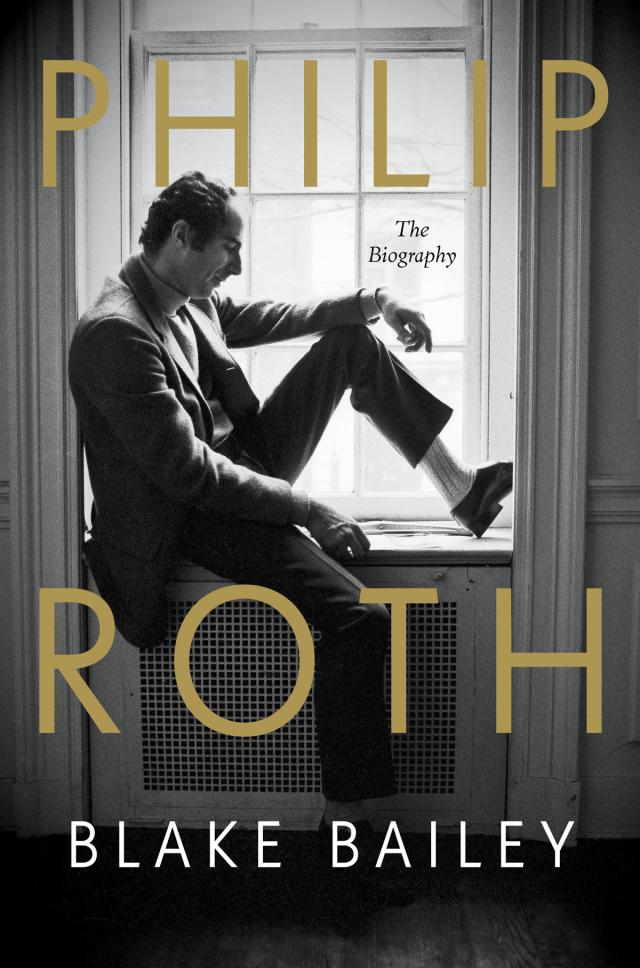
Philip roth, p.12
Philip Roth,
p.12


* Roth’s girlfriend during much of the sixties, Ann Mudge, turned out to be related to Wylie—a “jolly” man whom Roth was thrilled to meet over dinner one night in 1964.
† Et Cetera was published quarterly, but the dating of its issues was erratic. Sometimes they were dated by season (“Spring”), sometimes by month (“May”), and sometimes neither (“Mid-Year”).
‡ When Roth received the Taylor Medal in 2008, The Bucknellian tracked down its old editor, Barbara Roemer Gibb, for a comment: “There never was and there won’t be a response,” she replied, calling the attack “unprovoked.”
§ When I asked Stu Lehman to describe Herman Groffsky, he said the man bore an “incredible” resemblance to the actor who played Mr. Patimkin in the movie, Jack Klugman. I doubt Roth would have disagreed: by far his favorite scene (perhaps from any movie based on his books) was between Mr. Patimkin/Klugman and his beloved daughter, at the wedding, where he tells her she can have anything in the world she wants.
CHAPTER
Seven
ROTH WOULD OF TEN REFER TO HIS FIRST YEAR IN CHICAGO (1954–55) as the best of his life—a time when he’d pursued his “Byronic dream” of “bibliography by day, women by night.” It began with his second-ever plane trip, followed by a cab from Midway to the Windermere Hotel in Hyde Park (where he’d stay that first night only), during which he excitedly asked his old black cabbie where he might find Robie House and Oak Park (Hemingway) and so on. Finally the man glanced over his shoulder and said, “Son, if you can’t get laid in Chicago, you can’t get laid anywhere.” Guided by the novels of Nelson Algren, Roth dropped his bags at the hotel and headed to a strip bar on the corner of Dearborn and Division, where a young dancer named Pepper put a hand on his thigh and sat chatting with him while he bought her overpriced drinks out of his tiny student budget.
For the first week or two Roth took a cramped room at the International House, befriending a former ballet dancer from Panama who was fun to “pal around with,” at first, until one night he made a pass at Roth. “I wouldn’t hurt you, baby,” the man laughed at Roth’s utter astonishment. Finally, after a frantic four-day search, Roth found more suitable quarters at the Disciples Divinity House on East Fifty-seventh—a “magnificent” room, he wrote Heyman, “big, light, and full of character (Gothic as all get-out).” Most of Roth’s twenty or so housemates were Protestant divinity students, though soon enough Roth struck up friendships with a couple of Jewish boys in the English department, Barry Targan and Herb Haber, who also took rooms at the Divinity House. Haber remembered a certain amount of raillery among their Christian housemates, who debated whether Jews were heathen or pagan, properly speaking, and did they have any real chance of attaining heaven?
An excitable fourth was added to their circle in the person of Arthur Geffen, a Brooklyn prodigy who’d left high school early to enroll in Hutchins’s three-year master’s program. Geffen supported himself as a part-time bartender at the University Tavern, where he and Roth would compete to see who could make Haber and Targan fall off their stools laughing. Roth’s routines included an impersonation of Bobby Kennedy talking in a Bugs Bunny voice, as well as a more or less constant flow of improvisation with Geffen (“Alongside him I’m John Wayne,” said Roth)—long tipsy evenings when they’d play Iago and a jive-talking Othello, or speak entirely in Hemingway locutions. The university was, in short, a kind of demi-paradise for Roth: “like some highly evolved, utopian extension of the Jewish world of my origins, as though the solidarity and intimate intensity of my old neighborhood life had been infused with a lifesaving appetite for intellectual amusement and experimentation.” In the classroom, too, the friends from Brooklyn and Newark could better grapple with “the intimidating power of Henry James and literary good taste generally” by remembering that Isabel Archer was, after all, a typical shiksa.
And yet: the main thing about being an ambitious Jewish boy was keeping your nose clean. John Condor—an “arch and a bit splendid” (Roth) Wasp at the Divinity House—suddenly lit out for New Orleans in the middle of the term, and a few days later returned with a headful of happy memories. Roth, Targan, and Haber brooded about this at Jimmy’s Bar one night and abruptly decided, by god, they’d do the same thing! Piling into Targan’s ’41 Chevy, they got as far as Attica, Indiana, where they exchanged a look “and turned back into the people we really were,” said Targan. They were back in Chicago by sunrise.
Roth became closest of all to an older graduate student in English, Bob Baker, a short man with a mustache who’d met his wife, Ida, while traveling in Venice with the merchant marine. Roth doted on their little boy, Geoffrey, and loved listening to the couple chatter in Italian while Ida, an excellent cook, made dinner for everyone. Baker, a gentile from Oregon, deserves much of the credit for sending Roth to the work of Saul Bellow, and when Roth himself began writing seriously, he referred to Baker as his “Chicago Maxwell Perkins”—the first and best reader of his manuscripts.
One day Roth lay sunning himself on the Divinity House roof with Haber and Targan. “You know,” he said, rather solemnly, “this may be as good as it gets for us.” Many years later—after marriage and children and a mostly happy life—Haber remembered that moment on the roof and grasped its profundity: When indeed were they ever again so free, among good people who read books and loved to laugh? “Phil was the only one I ever knew who could see and understand that,” he said. “Talk about wisdom—I thought he had enough of it. And talent and drive to become who he was.”
BRIGHT AND EARLY, Roth would head to the commons for the same daily breakfast—two pieces of toast spread thick with marmalade and topped by three strips of bacon on each—then off to the library or an early class. That first quarter his three courses included (“hold your breath,” he wrote Heyman) Bibliography and “a dainty little thing entitled ‘History and Culture,’ ” the utility of which he accepted grudgingly at best; his other course, on Mark Twain, was more engaging. At the time the English Department was divided between young Turks like Elder Olson (“I loved his name,” said Roth) who called themselves Neo-Aristotelians—they considered New Criticism to be marred by its supposedly “subjective” emphasis on irony, metaphor, and ambiguity somewhat in general—and the old guard who approached literature in a then more traditional cultural-historical context. Walter Blair, the department chair and Roth’s Twain professor, embodied the old guard. Blair’s manner was what one might have expected from a foremost authority on American humor and the tall tale; wryly he forbade Roth to write a paper “on the structure of Tom Sawyer” because (a) “he’d rather we didn’t write ‘critical papers,’ ” so Roth noted, and (b) in 1939 Blair himself had published a paper titled “On the Structure of Tom Sawyer.” What Roth liked about Blair was his “down-to-earth appreciation of what made Twain funny. . . . He didn’t make Huckleberry Finn into what Trilling made it into,” Roth observed; “he made it into Huckleberry Finn. And I thought, God, this stuff is literature!” A leading Roth scholar, Bernard Rodgers, would someday write a paper about Walter Blair’s conception of Southwestern humor and its influence on Roth’s The Great American Novel.
Roth found much to like in the Neo-Aristotelians, too, reading Ulysses in Olson’s Form and Structure in Contemporary British Literature (“the course isn’t as pompous as all that”) and admiring the approach taken by a visiting British scholar, Joan Bennett (“a most delightful, exciting, and clear-thinking woman”), who explained that her course on the Victorian novel was also, really, on the form of the novel per se. As Roth wrote the Maurers, “For the first time in months (since the best sessions of last year’s seminar), the wheels are beginning to turn, and I’m getting that gigantic boost that comes every so often, with me, from thinking.” He was less impressed by another celebrated faculty member, Morton Dauwen Zabel, a former editor of Poetry magazine, who by 1954 was “sleepwalking . . . toward a decent retirement,” as the poet George Starbuck put it—or, as Roth informed the Maurers, “Zabel is out of his mind.” Despite the man’s tendency to lose his train of thought and stare disconcertingly into space for minutes at a time, his confidential review of Roth’s Yaddo application, three years later, was lucid enough: “[Roth] is a very decent fellow, not vivacious or notably lively in his personality, but sober, steady, well-conducted, very well-mannered and considerate.” Clearly Zabel had never observed Roth at the University Tavern with Art Geffen, riffing on Zabel’s performance in an imaginary football game played by loony academics.
The professor who would prove most important to Roth, both pedagogically and professionally, was the dean of humanities, Napier Wilt. Ted Solotaroff—who would have reasons to envy Roth, one of which was Roth’s favored status with Wilt—dismissed the dean as a lightweight (“not a scholar or a critic”): “His field was nineteenth-century American drama, whose slight significance had left him free to exercise his formidable congeniality and cunning in advancing his career. A heavy, florid man, he was a traveler, a bon vivant, discreetly gay, and every year or two he would bring a graduate student under his warm, powerful wing.” Roth was a notable instance of the latter, and he never imagined that the gruff-mannered Wilt—who drove a secondhand Rolls and lived with his mother and longtime partner, Bill—was any more gay than Roth’s own bachelor uncle, Mickey: “I just thought he was a bon vivant of the kind Henry James wrote about. He knew everybody all over Chicago.”
Wilt himself was something of a James scholar, and Roth’s first impression of his mentor was that he possessed a good deal of “Jamesian superciliousness and pomposity”: Wilt treated his second-quarter graduate students “like so much offal,” announcing in Introduction to Literary Methods (“pre-criticism,” he called the course) that he’d try to keep things as “simpleminded” as possible: “Half the class is petrified, and the other half angry,” Roth wrote. “I, Hercules-like, span the two—pissed-off in a frightened way.” Once Wilt began to thaw, though, he turned out to be a witty, unpretentious reader of the classics, which he discussed in almost personal terms, as if he were acquainted with the authors and even their characters. Roth’s favorite course that year was Wilt’s American Literature (1919–1929)—essentially a study of the Lost Generation, among whom Wilt numbered himself, having been gassed in World War I: “he’s always lecturing in terms of ‘we,’ ” Roth wrote. “—‘We all were reading Cummings in those years,’ ‘We all were excited over This Side of Paradise,’ etc.” Each student was assigned to give a cultural overview of a particular year in the twenties, and Roth got “the most terrific year”—1925—encompassing Gatsby, Manhattan Transfer, and The New Yorker’s first issue.
Since leaving Bucknell, Roth had been working hard at his own fiction—so hard, in fact, that he’d given Wilt and other professors pause. “It was felt his interest was too much in the writing of fiction, too little in graduate work,” Wilt would observe in a recommendation letter a few years later, en route to concluding that Roth had proved adept at both fiction writing and scholarship. At the time, fired by Wilt’s interest, Roth dusted off a couple of stories he’d written that summer—still oscillating between the styles of Capote and Salinger, albeit with ever more accomplished mimicry. Indeed, one might even say “The Day It Snowed” is more Capote than Capote—or, as Roth later put it, “I make Capote look like a longshoreman.” Once again the hero is a winsome, sensitive boy, Sydney, whose dawning awareness of death is treated with a kind of Southern Gothic surrealism. “Suddenly people began to disappear,” the story opens. “First it was his Aunt Wilma who looked like his mother except that her eyes were soft and pale blue, like two pieces of sky lifted from the morning horizon.” When Sydney’s stepfather also “disappears,” the boy goes worriedly looking for him and encounters a mysterious old man, who leads him to the cemetery where his family is gathered. Sydney is counterintuitively elated to learn that his stepfather and Aunt Wilma didn’t, after all, “do it on purpose,” but panics when the old man begins to depart: “ ‘Mister, Mister Man, please come back—’ but before he could reach the sidewalk, the big black hearse, like an angry whale, came charging down the left side of the road to be first in the funeral line, and it crushed the boy to the ground, like feet crush acorns, and it shattered forever his thin glass voice.” Mademoiselle had already returned the story when Roth showed it to Wilt, who laconically approved (“It’s good, Roth”) and advised him to try the prestigious campus literary magazine, the Chicago Review, where it appeared in the Fall 1954 issue, along with critical studies by Kenneth Burke and Elder Olson.
Roth was launched. “The Day It Snowed” caused a splash on campus, and the author became “a star” (Haber) among his classmates. Within a week of the story’s appearance, Dean Wilt got in touch with an editor at E. P. Dutton, William Doerflinger, who wrote Roth a note inquiring whether he was working on a novel “we could have the privilege of seeing”; Roth replied that he was happy to give Dutton first consideration on any longer work in progress, declining to mention that such a work didn’t exist. Another boon of his first Chicago Review publication would prove to be his friendship with one of the student-editors, George Starbuck, who would go on to become a distinguished poet and the editor (at Houghton Mifflin) of Roth’s first book. Urbane and good-natured, Starbuck once spotted Roth trotting up the steps of Disciples Divinity House and shouted, deploringly, “I’d rather see you entering a brothel!”
“I’m still an apprentice, and so I have a right to keep shopping around, trying things on, if only for size,” Roth wrote the Maurers that December, frankly admitting he was “currently addicted with [sic] a kind of New Yorker–J. D. Salinger prose style” and that his latest story, “The Contest for Aaron Gold,” seemed well suited for such an approach. What Roth would later describe as “the last of my ‘sensitive’ stories” began to give its author qualms (“I felt twinges at some of the cute passages”) within two months of writing it. Still, “Aaron Gold” was easily the best rendering of his (and Salinger’s) favorite subject: a sensitive and often gifted person bruised by a cruel world. Here the protagonist is an Austrian war refugee, Werner Samuelson, who takes a job teaching ceramics at a summer camp, where he’s opposed by a bullying camp director and a swimming instructor named Lefty Shulberg, a brawny philistine who once had a cameo in a Tarzan movie, fighting Johnny Weissmuller underwater. “It took hundreds of years until men saw how much happier they could be if they surrounded themselves with beautiful—beautiful objects of art,” Werner shyly tells his students, only one of whom, Aaron Gold, is receptive: While the other boys sculpt pancakes and baseballs, flying away at the first blast of Lefty’s whistle, little Aaron lingers over a “small clay figure, a knight apparently, whose chest was covered with armor and whose spindly legs wouldn’t have done him much service against a good, fast dragon.” As with that charming, resonant dragon, Salinger’s voice is heard in the frequent goddam-ing of the camp director, who suspects something improper about the potter’s relationship with the boy: “Wait’ll Lefty hears about this goddam thing,” he berates Werner. “Look at this goddam thing! . . . What kind of game are you and that little queer trying to play anyhow!” It all ends badly, but Roth himself was richly rewarded for what was, withal, a well-made story. Less than a year after his Chicago Review breakthrough, “Aaron Gold” was accepted by a little magazine at Cornell, Epoch, and later chosen by Martha Foley for her Best American Short Stories of 1956. “I feel skyrocketed into fame,” Roth exulted over the Foley triumph, “like a Nobel Prize winner.”
DURING THAT FIRST QUARTER at Chicago, the “bibliography by day” part of Roth’s “Byronic dream” was fulfilled in spades, although there was little in the way of “women by night.” “Frankly, I have seen no mermaids as yet with whom I should desire conversation, copulation, or co-habitation,” he wrote Heyman at the end of September; “even the girls who aren’t intelligent look it—intense, pale, a little neurotic, a little self-pitying.” Meanwhile he missed Mackie terribly—all the more, perhaps, given that she had plenty of dates at Cornell, and blithely told him as much during their biweekly phone chats.
Roth’s celibacy was hardly for lack of trying. He and Haber were even willing to dance to Hebrew folk songs at a Hillel mixer in hope of enticing some hearty Zionist to bed, but dancing was as far as things went. Finally, one night at Jimmy’s, Roth “picked up [his] one and only black girl” (ever)—a light-skinned Roosevelt College student whose name enchanted him: Arizona McGill. Women were no more welcome at the Divinity House than at Mrs. Purnell’s, and Roth had to smuggle her into the basement. The two dated for a short while, and Roth never forgot his meeting with Arizona’s even lighter-skinned mother, who told him that certain relatives of hers were “lost to all their people”—that is, had decided to pass as white, “never to return,” a detail that would occur to Roth forty-four years later, while writing The Human Stain.
The closest Roth came to having a steady girlfriend that year was a skittish graduate student named Pat McEnerney, who’d recently given up ballet and decided to become a teacher. Haber described her as a kind of female “mascot” for their group, a slender woman with a lovely face and slick-backed hair—rather like a prettier Olive Oyl, or the histrionic interpretive dancer in Jules Feiffer’s cartoons. Roth would sometimes evoke McEnerney’s “sweet spontaneous sensibility” by telling about the time she was secretary at Poetry magazine and met her hero, E. E. Cummings, at a party. She’d “memorized a little speech beforehand” but found herself tongue-tied in the poet’s presence, staring at him with mute adoration; finally, as he was about to depart, he suddenly returned to give her a fervent kiss on the forehead. “Thank you for your poetry,” she managed to say.