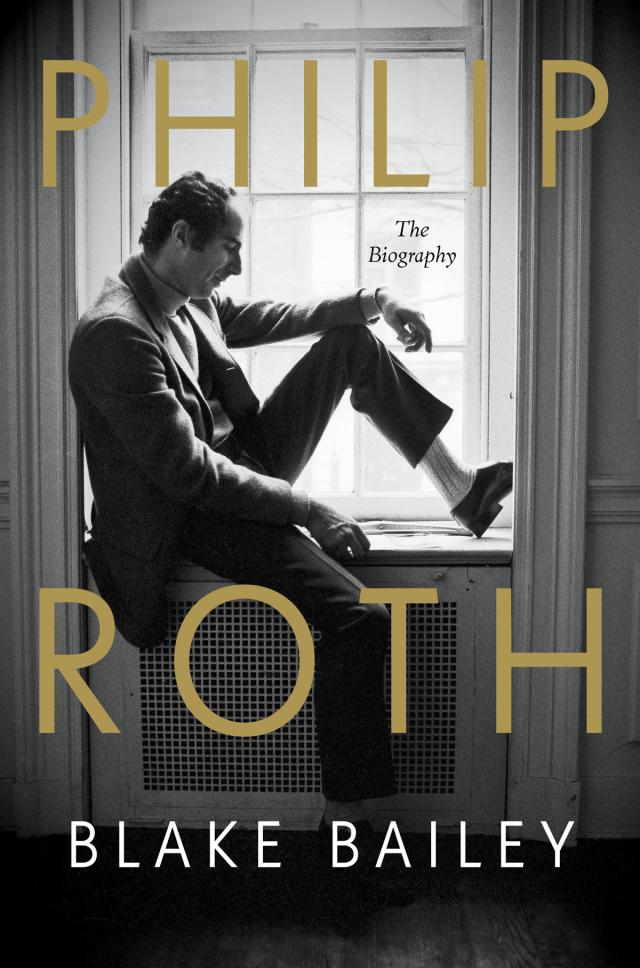
Philip roth, p.38
Philip Roth,
p.38


Less exacting or touchy critics tended to applaud the novel as not only refreshing in its gleeful obscenity, but also (contra Kazin) “painfully and playfully moving,” as Roth’s old Amagansett pal Josh Greenfeld wrote in his front-page rave for the Times Book Review, “a work that is certainly catholic in appeal, potentially monumental in effect—and, perhaps more important, a deliciously funny book, absurd and exuberant, wild and uproarious.” In the daily Times, Christopher Lehmann-Haupt kicked off his ultimately unhappy career as a reviewer of Roth’s books by declaring Portnoy “a technical masterpiece” that brought “the genre of the socalled Jewish novel . . . to an end and a new point of departure.” For the most part, though, critics were rather evenly divided between those who admired the book and those who were offended by it—sometimes grievously—a division best represented in The Saturday Review: Roth appeared on the cover of an issue featuring both an endorsement by Granville Hicks (“very much like a masterpiece”) and “A Dissent” by Marya Mannes, a former Vogue editor, who bleakly predicted that “the mixture of bile, sperm, and self-indulgence that infuses most of Portnoy’s Complaint should put it on the best-seller lists.” She was not mistaken in that respect, nor would Roth have argued much with her reasoning; he later noted that his book’s pioneering treatment of a certain “shameful, solitary addiction” had served to attract “an audience that previously had shown little interest in my writing” (an indifference to which they would return).
The main dialectic of the novel—Jewish repression versus goyish license—was somewhat inspired by Isaac Rosenfeld’s “Adam and Eve on Delancey Street,” which equates the consumption of trafe with “the whole world of forbidden sexuality, the sexuality of the goyim, and there all the delights are imagined to lie, with the shiksas and shkotzim† who are unrestrained and not made kosher.” Growing up, Portnoy comes to associate the kosher laws with the relentless strictures imposed by his family, especially his mother, who evokes the specters of polio and colitis to frighten him away from hamburgers and french fries, lest he become like the “imbecilic eaters of the execrable” who gorge on “pigs and crabs and lobsters” and enjoy the kind of squalid sex that Alex longs to have with a dream shiksa, Thereal McCoy: “Her favorite line of English prose is a masterpiece: ‘Fuck my pussy, Fuckface, till I faint.’ When I fart in the bathtub, she kneels naked on the tile floor, leans all the way over, and kisses the bubbles. She sits on my cock while I take a shit, plunging into my mouth a nipple the size of a tollhouse cookie. . . .” In a house where drinking a glass of milk is frowned on, Alex’s longing for such degradation is all the keener, and hence the more guilt-inducing: “My wang was all I really had that I could call my own,” he remarks of his main form of rebellion, most memorably with a piece of liver his mother then cooks for the family meal.
Roth’s treatment of Portnoy’s Uncle Hymie, the novel’s most vivid embodiment of small-minded Jewish insularity, was doubtless the sort of thing Kazin considered narrowly “psychological”—that is, lacking in “moral and even spiritual insight.” When Hymie’s son, Heshie, wants to marry a shiksa (a “Polack” at that), Hymie throws him to the floor and holds him there until “tears of surrender at last appeared on Heshie’s long dark Hollywood lashes. We are not a family that takes defection lightly.” Leaving nothing to chance, Hymie has already convinced his son’s fiancée that Heshie has an “incurable blood disease”—this before producing five twenty-dollar bills that the “dumb, frightened” girl accepts: “Thus proving something that everybody but Heshie (and I) had surmised about the Polack from the beginning: that her plan was to take Heshie for all his father’s money, and then ruin his life.” The pitiless—or even “savage,” as Kazin would have it—punch line comes when Heshie is killed in the war, whereupon Uncle Hymie and his wife are invariably consoled with the words “At least he didn’t leave you with a shikse wife.” When Herman (Hymie!) Roth used to tell the story of how Sender beat his son Ed to keep him from marrying “a worldly woman,” the young Philip was furious at his father’s vague approval (“They don’t have that kind of discipline anymore”) of a xenophobic brutality that had no place in American life. Like Herman, though, Kazin was the son of unassimilated Yiddish-speaking immigrants; whatever his own yearnings as an American intellectual, Kazin was sentimental about the tragic history of the Jews—going back to the shtetl and even “the desert”—in a way Roth was not.
“Doctor, what should I rid myself of, tell me, the hatred . . . or the love?” Portnoy asks, and Roth himself pointed out that “the book derives such emotional force as it has from its seesawing” between lyricism and farce. “[Portnoy’s] perspective is that of a wounded farceur, who takes delight in his own grievances—in that way (and only in that way) he is a distant relative of Mr. Sabbath.” The difference: Roth’s later hero Mickey Sabbath delights in his transgressions without a whit of Portnoy’s guilt—the guilt endemic to Nice Jewish Boys whose parents treated them “as unique as unicorns on the one hand,” and “selfish, evil little shits, little ingrates, on the other!” Portnoy remembers his mother’s friend Mrs. Nimkin, who could only think of her own sacrifice (“All the [piano] lessons we gave him”) when she finds her fifteen-year-old son Ronald hanging from the showerhead with a note pinned to his shirt: “Mrs. Blumenthal called. Please bring your mah-jongg rules to the game tonight. / Ronald.” But then, too, there was the whole tragic history to consider, and hence Kazin and the like were less impressed by Portnoy’s lyrical moments (“I fall asleep with my face against my mother’s black sealskin coat”) than by an outburst like “Do me a favor, my people, and stick your suffering heritage up your suffering ass—I happen to be a human being!” A few years later, Kazin was still musing in print over Portnoy’s awesome solipsism (“Whom do you suffer for, Alex P.? I suffer for me”), weighing the irony of all the “emancipated” Jews who relate to him: “ ‘Your book has so many readers!’ I once heard an admirer say to Roth. ‘Why,’ she continued enthusiastically, ‘you must have at least six million readers!’ ”
It was Bennett Cerf’s impression, when he addressed more than a thousand women at a Pittsburgh temple, that Roth’s detractors were outnumbered “10 to 1”—at any rate, the book was so successful that Random House could afford to take an almost jaunty tone toward readers who wrote in protest: “Difference of opinion . . . is what makes life interesting,” publicist Jean Ennis replied to Mrs. Peter J. Weiss, who’d expressed her wonder that such a respectable publisher had sullied its reputation with “this example of pornography, group defamation, exercise in a man’s abnormality,” and so on. Still, a suburban matron was one thing, and a stern Zionist intellectual like Marie Syrkin another; it’s pleasant to imagine how the affable Cerf, for one, would have parried such points as Syrkin raised in her Midstream review (“The Fun of Self-Abuse”), which treated Roth’s novel as a species of propaganda that would have gladdened the hearts of Goebbels and Streicher: “In both views the Jewish male is not drawn to a particular girl who is gentile, but by a gentile ‘background’ which he must violate sexually.”
Hard words, but hardest of all came from an even more eminent personage—the great scholar of Jewish mysticism Gershom Scholem, then president of the Israel Academy of Sciences and Humanities and one of three recipients that year of the Yakir Yerushalayim (Worthy Citizen of Jerusalem) award. “This is the book for which all anti-Semites have been praying,” Scholem wrote in the Hebrew-language daily Haaretz.
We [Jews] will pay the price, not the author who revels in obscenities. . . . I daresay that with the next turn of history, not long to be delayed, this book will make all of us defendants at court. . . . This book will be quoted to us—and how it will be quoted! They will say to us: Here you have the testimony from one of your own artists . . . I wonder what price k’lal yisrael [the world Jewish community]—and there is such an entity in the eyes of the Gentiles—is going to pay for this book. Woe to us on that day of reckoning!
Roth didn’t learn of Scholem’s review until a visit to Israel in 1984, when a Tel Aviv professor gave him the gist of it and asked what he thought: “I said that history had obviously proved Scholem wrong: more than fifteen years had passed since the publication of Portnoy’s Complaint and not a single Jew had paid anything for the book, other than the few dollars it cost in the bookstore.” “Not yet,” the professor replied; “but the Gentiles will make use of it when the time is right.”‡
In 2013, when the politician Anthony Weiner was busted a second time for “sexting” in the midst of his comeback mayoral campaign in New York, the Times published a piece—“When Politics Catches Up with ‘Portnoy’ ”—about how such scandals were exploding “outdated cultural assumptions” about the decency of Jewish men. Eliot Spitzer—whose governorship of New York had ended five years earlier, when his fondness for high-priced prostitutes was discovered—was quoted in the article as follows: “I haven’t read a novel in thirty years, I’ve lived one.” “It’s bad for the Jews,” said Erica Jong, “and it makes the anti-Semites say, ‘See, I told you they’re animals.’ ” Claudia Roth Pierpont remembered that Roth was “convulsed” by the Spitzer affair, calling her up and insisting they meet for lunch to pore over newspapers together. “I was trying to establish some hifalutin complex theory about why [Spitzer] would want to destroy himself,” said Pierpont, “why a man would act so stupidly when he had so much to lose. Is there something self-destructive inherent? And Philip just looked at me and said: ‘No, honey. It’s just cock.’ ”
* About $6,115,000 in 2020 dollars.
† An offensive term for male gentiles.
‡ In his book about the Portnoy phenomenon, Promiscuous, Roth’s friend Bernard Avishai provided this intriguing bit of trivia: “Item: The Israeli journalist Danny Rubinstein told me that his childhood friend in Jerusalem imported pornographic films in the 1960s, and one of his biggest clients was—wait for it!—Gershom Scholem.”
CHAPTER
Twenty-Five
LATER IN HIS CAREER, ROTH LIKED TO QUOTE CZESŁAW Miłosz: “When a writer is born into a family, the family is finished.” While sitting at his typewriter Roth would follow his muse wherever she led, and the impact on family and friends was something he worried about later, if at all. And so far so good, at least where his parents were concerned: “I’m bustin’ my buttons!” Herman had told everyone within earshot at the Astor ballroom when Philip won the National Book Award in 1960, and for years Bess had carefully curated scrapbooks of her son’s press coverage, the good, bad, and in-between.
Roth did worry, however, that Portnoy might expose them to a degree of undesirable scrutiny, and a few months before publication he invited them to lunch in New York. He told them the book was about a Jewish family, and, yes, he’d borrowed the odd detail from real life, but it was decidedly a work of fiction; still, there was a certain amount of obscenity and it was bound to be a big best seller, so it was likely people would want to interview Bess and Herman. “It’s perfectly okay to say ‘No, thank you,’ and hang up,” Philip told his punctilious mother, knowing how hard it was for her to hang up on even the most irksome strangers. Fourteen years after that lunch—the year after his mother’s death—he was visiting Herman in Florida, and finally learned what had happened once they parted that day. Getting into a cab, Bess burst into tears: “He has delusions of grandeur! He’s never been like this before. I can’t bear to think of how his heart is going to be broken.”
Actually, Bess handled the press with remarkable aplomb. “I think all mothers are Jewish mothers,” she’d reply, when asked whether she was indeed Sophie Portnoy. Herman told The New York Times, and others, that both his sons were “good boys and fine men” who’d recently helped him and Mrs. Roth celebrate their forty-second wedding anniversary. “The music goes round and round,” he wrote Philip in April. “Tonight at the temple across the way from us the Rabbi is reviewing the book. . . . You pushed the war and the students riot into the background.” When Herman gave a doctor friend a rubdown in the YMHA steam room, he predicted the man would someday tell his “great-great grandchildren: Portnoys [sic] father gave him a rub.” As for Bess, she might have been forgiven a little mortification when, say, the actress Mae Questel (of Betty Boop and Olive Oyl fame) cut a record titled Mrs. Portnoy’s Retort, but Bess was simply thrilled at the mark her son had made: “My Philip,” she’d sigh now and then, knitting at night.
To Howard Junker of New York, Bess had quipped that she planned to leave the country when the book came out; Philip decided that was a good idea, paying all expenses for a monthlong trip abroad that summer. After stops at luxury hotels in London and Paris, the Roths traveled on to Israel, where Philip had arranged for a friend’s family to show them around. Herman had packed a stack of Portnoy hardbacks for the trip, and aboard the ship he’d accost fellow passengers and work the conversation around to his illustrious son: “How would you like an autographed copy?” he’d say, then rush back to his cabin and return with a book inscribed “From Philip Roth’s father, Herman Roth.”
The fact was, his parents enjoyed the spotlight a lot more than Philip did, though it took a few weeks for the novelty to wear off. “It’s an odd, good time,” he wrote Solotaroff, “and it won’t happen again, thank God, though I wouldn’t have wanted to miss the once.” Being famous, he said, was like being a child (or at least a child in Weequahic): “You walk down the street and everybody knows who you are, and you don’t know who they are. . . . ‘Aren’t you Bess’s boy?’ ” If only the questions were that benign. Roth tried to be a good sport “the first fifteen times” he was approached in restaurants and asked whether he was eating liver. “I tried going to the theater last night,” he wrote Jacquie Rogers, “and as I emerged from the taxi, a cry went up (yes, my dear, a real cry, as though I had tits and was Elizabeth Taylor): ‘Portnoy!’ they screamed. I rushed off to a bar for a drink, and a man immediately materialized at my side from WNEW-TV asking if I would say a few words for the camera.” Given the nature of his notoriety, the attention was often nasty or downright menacing, as when a man yelled from across the street, “Philip Roth! The enemy of the Jews!” “I am so sorry,” said Roth, when a woman blocked his and Lurie’s path along Fifth Avenue and accused him of being the author of “that disgusting novel.” “I know I look like him,” Roth went on, “and lately this sort of thing keeps happening to me all the time!” The woman gave hasty apologies and let them pass.
Also there were galling exchanges on The Tonight Show, hosted by Johnny Carson. “I’d be interested in meeting Philip Roth,” said Jacqueline Susann, author of louche novels such as The Love Machine (tugging at Portnoy’s ankles on the best-seller list), “but I wouldn’t want to shake his hand.” A more serious provocation was brought to Roth’s attention by a sheepish dry-goods clerk in Saratoga (whither Roth had fled by then), who reluctantly owned that Truman Capote had accused Roth, on Carson the night before, of “setting up” his reviews for Portnoy.* “I am most distressed about this,” Roth wrote Fingerhood, “and want to find out exactly what was said; and then to proceed from there, according to how damaging and slanderous the statement was.” What Capote had said was part of his ongoing rant against “the Jewish Mafia” in American letters (this largely due to his bitterness about In Cold Blood, which had been passed over for all the major awards). “Bernard Malamud and Saul Bellow and Philip Roth and Isaac Bashevis Singer and Norman Mailer are all fine writers,” Capote told Playboy in 1968, “but they’re not the only writers in the country, as the Jewish literary Mafia would have us believe.”
Within four days of Roth’s request, Fingerhood forwarded an NBC transcript from the April 15 show:
CARSON: [after noting that Portnoy had received a number of good reviews from “respectable” outlets such as the Times, whereas other reviewers had said] it’s a cesspool of humor. Now, how can two people look at the same thing, literary critics and such, and draw completely two opposite views?
CAPOTE: Well, it depends on whether they’re friends of Philip Roth or not. (laughter)
CARSON: That’s it, right there.
CAPOTE: Now, I’d say—I’ll explain that remark—Philip Roth is a friend of mine and I think he is very, very talented, and he’s really one of the most gifted young American writers. But you see, there’s this whole thing in New York—it’s called the Jewish Literary Mafia, and it starts at Columbia University and it goes through all the little magazines and what-not; and I don’t mean that it’s conscious or unconscious—but they promote each other continuously. And they promote this little clique of which Philip Roth is the youngest, and in many ways, the most brilliant. And they started the drum going for this book—you know—a good year and a half ago, and it’s just appearing in the magazines. So, it was an inevitable thing that it would turn into what it has, because they were really pushing for it, and that’s what I mean by the reviews. It depends on whether or not the reviewer was a friend of Philip Roth. Mostly, they all were.
In a way, this was egregiously unfair—certain Jewish critics had been Roth’s most caustic detractors; indeed, among Capote’s not-so-secret sympathizers were New York Jewish intellectuals such as Irving Howe, who were irritated by what they perceived as the unseemly careerism of Roth et al. “When Truman Capote later attacked the Jewish writers on television,” Howe wrote, “he had the dissolute courage to say what more careful gentlemen said quietly among themselves.” After all, two of the most influential puffs for Roth’s novel—Goldman’s Life feature and Greenfeld’s rave for the Times Book Review—had been written by Jewish friends of the author. Nor was Roth above trying to put the fix in: when the Chicago Sun-Times published some mean cracks about an early Portnoy excerpt, Roth asked Dick Stern if he’d “want to rebut this argument in passing, by reviewing the whole book when it appears.” However, he didn’t always approach other Jews for such favors: “May I be so bold as to suggest that if you do find yourself interested enough to review the book,” he wrote Styron about Our Gang, “that you consider doing it for our old friend, The N. Y. Times Sunday Book Section?”