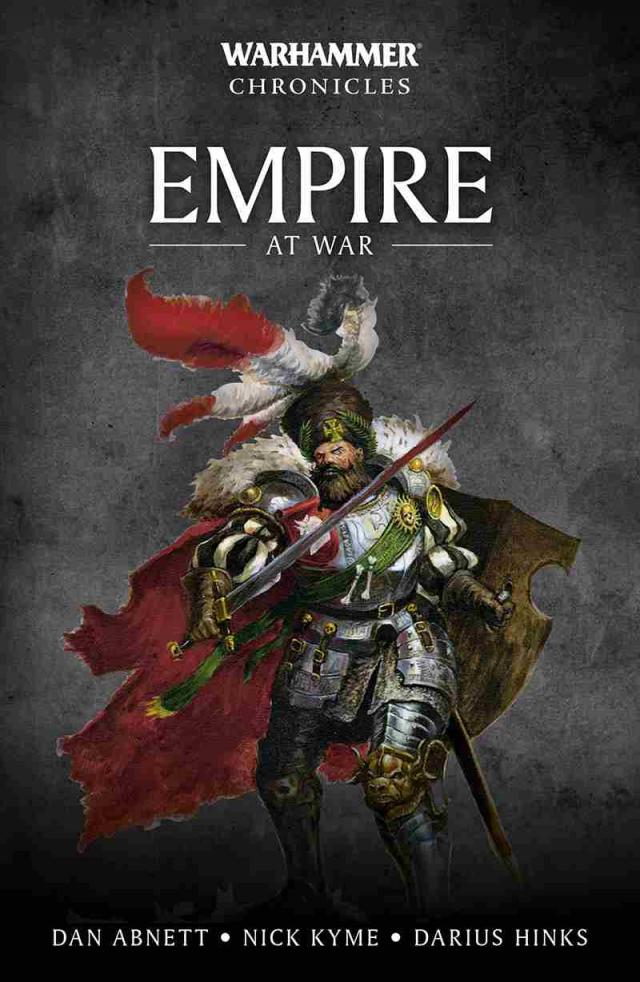
Empire at war, p.111
Empire at War,
p.111


As the rat-ogre advanced on the fatally wounded Dietrich the bell plummeted inexorably downwards. With a resounding metallic clang, the skaven artefact hit the looming beast, hurling it to the ground and crushing the rat-ogre’s skull.
Just like old times, Dietrich thought and died.
‘What do we do now?’ Pieter asked the sweating Kislevite, as the church burned beneath them.
Torben thought. What could they do now? Up until this point he had been reacting instinctively to each event as it arose with no forethought. Now they had completed what they had set out to do and they were trapped. There was no way down inside the bell-tower, now that the staircase had been destroyed by the bell and the rat-ogre, and besides, the whole building was ablaze. Parts of the roof had begun to fall in, flames licking up through the holes into the night sky. Smoke was also beginning to rise through the gaps between the planks of the belfry floor as the tower acted like a natural chimney, drawing the fire upwards. There wasn’t a suitable rope they could use to climb down the outside of the tower and to jump the one hundred feet would be suicide.
Torben peered over the parapet of the belfry, as if just to confirm his initial assessment. Then over the crackling of the flames he heard something: a distant shouting. Peering through the billowing smoke he saw at first a crowd of townspeople, standing in a semi-circle around the end of the church. Within that semi-circle three figures, illuminated by the conflagration were looking up at him and calling. The biggest was standing next to a full hay-cart, which had been brought as close to the burning building as the mercenaries could manage without it catching alight. ‘We jump,’ Torben said, and before Pieter could question him he pointed down the side of the tower, adding, ‘and try to follow my orders this time!’
Without a moment’s hesitation the two men climbed onto the ledge of the opening under the eaves and, flung themselves out into space…
The two of them hit the hay, the wind knocked out of them but otherwise unhurt and Torben, for one, had never been so glad to wind up with a face full of straw. Spiralling embers swirled around them, some landing in the hay. A crackling sound, accompanied by excited cursing from Oran, told Torben that the hay had caught alight.
As Stanislav untied the horse, Torben and Pieter scrambled down from the cart, joining the others at a safer distance from where Badenov’s band watched as the church of Morr burned.
By mid-afternoon the next day the fire had gone out, enabling the mercenaries to explore the burnt-out shell of the church. Picking their way through the mounds of blackened rat-corpses and the smouldering ruins of the roof, that now filled the nave with a forest of charred beams and fused tiles, it did not take them long to find what remained of Dietrich Hassner. Opposite the dead soldier lay the flattened, charred mass of the rat-ogre. Its pulped head was almost unrecognisable but of the bell that had killed it there was no sign.
‘I suppose it could have melted,’ Stanislav suggested, prodding the smouldering rubbish at the foot of the tower with his boot. ‘That fire was hotter than a forge.’
‘It’s possible,’ Torben considered, ‘but somehow I doubt it. I think our furry friends got what they came for in the end.’
He caught Pieter’s gaze but the sullen noblemen said nothing.
‘Come on,’ said Torben. ‘We’ve a burial to perform – with no priest of Morr or temple to perform it in – and the life of a friend to commemorate back at the Hand of Glory.’
As they made their way out of the ruined church, bearing the soldier’s body on an improvised stretcher, Torben couldn’t help feeling dejected. The usually happy-go-lucky mercenary was beginning to feel that Badenov’s band was rather down on its luck as of late, what with the deaths of Alexi and now Dietrich.
Death was their business, he knew, but death seemed to dog their path. It was as if Morr himself or some darker power had mapped out their destinies for them. They hadn’t even made enough money to replace the horses Krakov had lost all those months ago and Krakov himself had disappeared.
‘The dead and the damned,’ he suddenly found himself declaring aloud.
‘What?’ asked the younger Yuri, walking next to him.
‘The dead and the damned,’ Torben repeated. ‘It seems to me that’s all we are. One or the other, dead or damned.’
‘What’s that?’ Oran interjected. ‘You’re starting to sound like misery-guts over here,’ he said indicating Pieter, who was hanging back from the others.
‘Dietrich was an old friend. Of course you’re upset,’ Stanislav said soothingly, as they neared the inn. ‘Get some ale inside you and you’ll feel like your old self again.’
Torben managed a weak smile. ‘So the first round’s on you?’ he said.
‘See? Everything will be fine,’ pronounced the usually cynical Oran.
But despite his show of bravado somehow Torben didn’t think so.
SWORDS OF THE EMPIRE
Dan Abnett
“Two things that may be relied on – the swords of the Empire and the snows of the North.”
– Ostland proverb
I have known twenty-seven summers and twenty-six winters, and the winter that comes upon me now will be the hardest of all. With ample favour of fortune, we might weather these white months, but I have no wit to know for certain if fortune rides amongst my company in this extremity of the world. I doubt it greatly, for it has not shown us much of favour thus far along.
The provinces of the Empire wear winter like a heavy coat; they pull it around them in the latest part of the year and thuswise huddle within it, and cast it off again with a shrug at the first buds of spring. Not so here. This is the North, the high North, the wild, elder country. Here, winter comes from some profound source, and fills up the world from within, under the skin, freezing marrow to stone and slowing blood to glass. It is a foe of itself, and knows no quarter. Subarin has told me of it. He has described the cruel temper of the season, the furious storms, the aching arctic might. Men vanish, herds likewise, sometimes villages whole, lost overnight in the whiteness, marooned for months. And come the thaw, no sign remains, as if the poor, lonely places have been scraped from the hard ground by winter’s sharp claws and cast into eternity.
Against such a sorry fate, I have guarded with this account. I have made it with haste, and for this reason I ask you to pardon kindly my mistakes. I am not a scribe, and my hands are not stained from the inkhorn. I am a soldier. I have rendered this in my best practice of penmanship on two tanned goat hides that in this country are employed in the part of vellum. The ink was purchased dearly at the cost of a company horse, and is the only flask of such hereabouts. It is poor stuff, weak and much more of water than of black. The wizard has ink bottles, of course, but I will not touch his belongings. When I have writ this out, I will roll the hides in a bag of pigskin, and bury it beneath a marked cairn of rocks here by the hillside trackway where, in spring, travellers may discover it. Such a discovery may be why you are reading this now. It is my hope that fortune will be with us, and that in spring, I will dig this up myself and convey it with all urgency back to the Reik. Either way, the matter of my account remains the same.
Sigmar bless me. I owned I was no scribe! I have just run my eyes back over the first part of my testament above, and damn myself at how badly I have commenced. I have run my heart ahead of my story, and scattered the facts heedless like a flock scattered by a wolf. Subarin tells me I can use the flat of a tanner’s knife to scrape the hide clean and start again, but that seems a waste of such expensive ink. I will write on, and take heed of two lessons. Of the first, it is to cramp my hand smaller, for already I have occupied a whole shoulder of one hide with my words, and I fear the remainder of two goat-backs will not be adequate to contain this account. It is sobering indeed to realise that all that is important to me is to be measured out in goats.
Of the second, it is to start better. To make open the facts. First then, as I should have started, with my name. It is Jozef von Kassen. Let me make it again here, as I sign it – Jozef von Kassen – so that it vouches in my hand for the veracity of this account.
I have not goat enough to say more of myself in any length, and cannot set out the names of my family and lay down my lines of descent for fear of writing off the tail end of this hide onto the next. I will suffice with this: I am a knight of the Reiksguard, may Sigmar keep its light forever lit. It has been my signal honour to conduct, at the bidding of the Elector Counts, an expedition into the wastes that are known as Kislev, that is to say the barbarous sovereignty that is north of the Empire.
We left fair Altdorf on St Talve’s Eve, he that is the patron saint of lambing. I had under my command twenty men at arms of the Reiksguard, all of horse with spears unto them, and including two handgunners. We made, as I may say, a sorry sight, for we had cast aside banners and decorations so as to pass unremarked upon in the isolate tracks beyond the Empire. This was on the advice of my masters. I myself had set aside my laurels, and my full plate, and even the barding of my steed. We wore simple half-plate, leather and cloaks, and some had hauberks of good chain. Had you come upon us in the driving rain, you would have mistaken us for brigands or a sell-sword company.
In this unseemly guise, we journey north, and performed our duty. To whit, this was to guard and escort a man of great worth. His name was Udo Jochrund, and he was a great wizard of the Order of the Wise, which is to say the Order of Light.
Like all mortal men, I am uncomfortable in the company of magic. It makes me to tremble, and turns my belly to acid. Sire Jochrund had the stuff around his person like a perfume. He was tall and slender, like the white aspens that grow in profusion in the lowlands of Kislev, his scalp shaved bald, with a great bounty of moustache and beard sweeping forth from his chin, cheeks and upper lip like a waterfall. This beard hair was dark, like charcoal, and seemed to clash at odds with the waxy pallor of his skin. His eyes, under bushy black brows, were brightly the colour of a harvest moon; that is like spun gold, like full-ripened corn, like a healthy gelding’s urine. He wore long under-robes of earth-brown velvet, embroidered with many wondrous sigils and patterns in silver thread, and overtop he dressed in the long white caparison of his office and order. His hands were, in the most part of our adventure, gloved in glossy black leather, the rings worn glinting on the outside, and he carried the most curious carven staff, fully head-tall, worked in all intricacy to resemble a serpent coiled around a bough.
I have described him thus so you might know him by sight, but I have not described him at all. For it was in his manner that Udo Jochrund was known. Soft-voiced, let me start with that. Never a shout, never a bellow. His tone was as frail as a fallen leaf, dissolving in a trackway puddle, perfect in every detail yet insubstantial and fading like a spectre. Sometimes, from three furlongs distant, he had called to me, without any raising of his voice, and I had heard him most distinct. It was like he had quoth in my very head.
More so than his voice, his bearing. He was stiff and ungainly, gesturing in conversation with his elbows rather than his hands, as if he was afraid that more vital manners might cause his potent hands to write upon the air and manufacture magic unintended. More even than his voice, the smell of him. Like burned sugar-powder, but not rank. A sweet, sickly odour.
Sire Jochrund’s mission was one of learning, as may be expected of an order whose purview is knowledge, and mine was to safeguard him. Before we set out, in the early part of spring, when I had been appointed to ride as his guard commander, he brought me to supper at his house. The food was ordinary, the atmosphere unnerving. By lamplight, in the late eve, his musty lodging was a place of jumping, darting shadows that could not be explained even by the flutter of the wicks.
I profess again, I am a soldier, nothing more or less, and have no sensibility for magic. I want no part of it, and would be glad never to have to acquaint myself with its actions. But yet, I am sanguine. Without the Colleges of Magic, and the martial magicians they have bred, our Empire would not stand today. In the van of every Imperial army stands a wizard from one or other order, bent to use his arcane might to achieve victory. Thus is the legacy of Teclis, who taught Magnus the Pious that magic was a necessary art, and one to be practised and honed, even in an honest and Sigmar-fearing country like ours.
At supper, in that haunted chamber, Sire Jochrund seemed to sense my distress, and made every effort to console my mind. He explained, in basic terms, the purposes of the Colleges of Magic, the nature of the eight orders, and the pertinence of his own, the first and most lauded order. Much of what he said I already knew, but it was the way he told it to me. He spoke, I suppose, as to a child eager to learn. I was transfixed by his voice, and by the way he kept on his glossy black gloves even when using the meat fork and tearing the soda-bread.
‘I will explain the venture before us, von Kassen,’ he declared, ‘for I want you to understand it rightly, so that you will play your part unquestioningly. Magic is without–’
‘Without what?’ quoth I, in all innocence.
‘Without us!’ he cried with a tremendous laugh at the expense of my foolishness. ‘It is all around us, it permeates the world, soaks into the fibres of the land. It is a fact of life. Deny it and you deny reality. The colleges do not create magic, they tap into it, harness it, use it, and direct it. Our skills are not those of creation, they are of comprehension.’
I nodded at that, though without much of the quality in question.
Then he bade me answer this: ‘Why am I a wizard and you a soldier?’
I shook my poor head. Answers I had, in all truth, many, numbering amongst them merits of birth and demeanour, but the reply he was after was much simpler yet.
‘Because you are trained in the use of horse and lance and sword, and I am trained in the use of the arcane.’
This much I had fathomed for myself. Then he said, ‘Each order has unto itself its own discipline. For the Golden Order, alchemy. For the Grey Order, shadow. For the Amber Order, beastcraft… and such wise. The Light Order binds them all, for it is through us the knowing of their ways were divined. We scour and search, we find and collect, we catalogue and translate. We are the seekers of lore. We are the pathfinders of lost magics, or magics yet unknown to civilised man. And that is our endeavour now. A threat is rising in the North, von Kassen, a great and divisive threat that mayhap will tumble our proud Empire into dust.’
‘May Sigmar guard us!’ I said at once.
‘May he indeed,’ he agreed. ‘But we may also guard ourselves. We have wrung the byways and remote villages of the Empire dry of lore, but in the realm of Kislev, rude magic abounds. Up in that great expanse are tiny communities and forgotten towns where shamans and wise-folk daily practise routines of lore and craft unknown to us. It may be that their very proximity to the wastes of Chaos means they are more connected to the source than us.’
At his mention of the word, I shuddered. He pulled aside his white robe and showed me an eight-point star sewn in silver on his tunic.
‘Do you know this, von Kassen?’
I blanched and felt I should reach for my sword.
He saw me. He read me. He smiled. ‘The octo-point star of Chaos. Eight fiery limbs, young man. Tell me… why are there eight Colleges of Magic?’
I stammered dumbly.
‘Because,’ he sighed, ‘Chaos is the root of all magic. This much Teclis taught us. From their eight sorcerous winds, all magic derives. Be not afraid. Magic stems from Chaos, and is tainted by it, but it may be controlled and purified by a trained practitioner. Such is the purpose of the eight orders. And to discover such control is the purpose of the Light Order. In the scattered settlements of Kislev, in the tribal conclaves of the empty quarters, lore is waiting to be uncovered from the elders and shamans. Over the last nine years I have conducted seven missions to the North at the bidding of the Elector Counts. I tour the lonely stanitsas to learn new skills, new secrets, new crafts that have lain in their folk-rituals since the dawn of time.’
This, then, was our purpose. To ride north and protect Sire Jochrund as he sampled and collected, learning and borrowing and otherwise obtaining new rudiments of magic from the outlying barbarians so that the craft might be employed for the good of our Empire.
The wizard showed me the letters of permission and sealed charters from the princes that bade him do this thing. I needed no further convincing. In the Empty Quarter, this Imperial wizard might learn charms that could keep the Empire of Man standing for another thousand years, no matter what threat arose from the wild wastes.
We passed beyond the bounds of the Ostermark at the spring equinox, the rivers running hard and foamy with meltwater from the highlands. The air was brittle, like ice. Our convoy was as thus: twenty men at arms, shrouded in tan cloaks, myself, Sire Jochrund on his black gelding, besides a storewagon driven by the sire’s apprentice, Sigert.
Rain beset us for the first month, then gales that rattled the moon on its hook. By the time the gales settled, we were far into Kislev itself, crossing the grasslands and the pine barrens from village to village. Time ground over and around, like a working millstone, slow, heavy and wearing. I had been in Kislev twice before, on military tours. I knew its vastness, the open flatness of its plains, the force of its winds. I felt them again on my face and wondered how many of them were driven by the eight winds of Chaos.
To a man birthed and raised in the forests and mountains of the Empire, Kislev is a formidable country. It has an expanse that I have not experienced anywhere else, nor can truly describe. The vast sky bends over it in supplication, where the sky in Imperial lands flutters above the peaks like a banner. Even in summer, sleet and hail come down from nowhere, horizontal. It stings the skin. The sun comes out, like a phantom, and chases down over distant hills. The nights seem long, breathless.