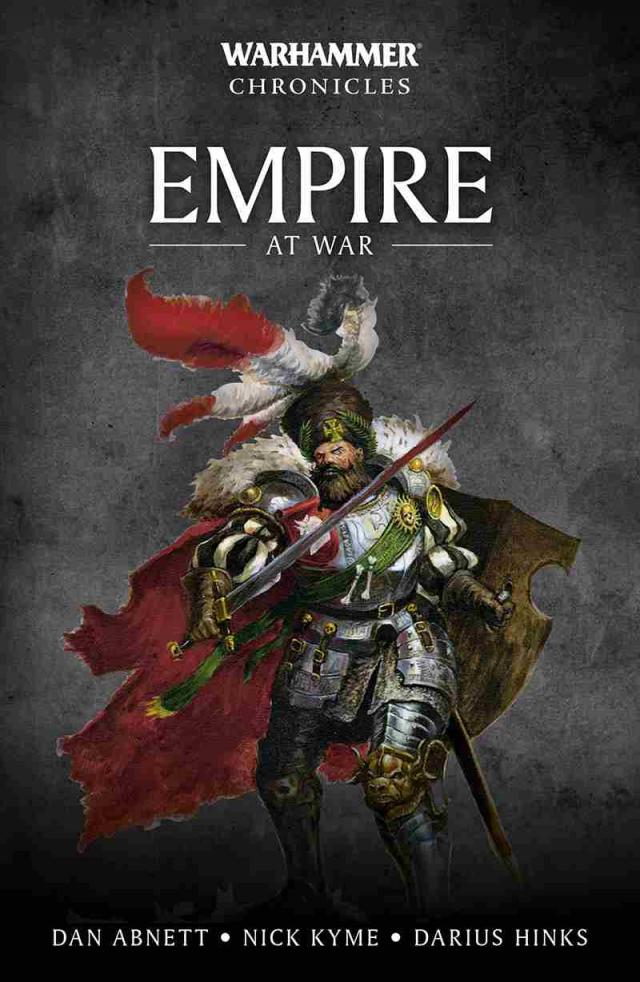
Empire at war, p.22
Empire at War,
p.22


‘Look at me, Azytzeen,’ Surtha Lenk said.
Karl slowly turned his head up. Lenk was a giant three spans tall, plated in brass and iron.
Except he was not. A twisted, deformed thing, no bigger than a swaddling child, was strapped in a harness across the breast plate of the giant. It seemed to be all swollen face, with tiny, wasted, half-formed hands and feet sprouting from it. This was Lenk: a loathsome, slack face mottled with warts and suppurating blisters. One eye was very human and brown, the other, lower in the rugose flesh of the cheek, was swollen and glazed milky blue. The mighty horned helm of the giant carrying him had no visor piercings or eye-slits.
Karl could not stifle a gasp.
Surtha Lenk laughed. His little pink slit-mouth wobbled and let out a child’s giggle.
‘I find spirit usually ebbs at the sight of me. In return for my service, Tchar has been bounteous with his gifts. Am I not beautiful?’
Karl nodded.
‘Nothing pleases the Eye of Tzeen so much as a man changed completely. Now… why will the enemy not move?’
‘B-because they have the rising ground. They would rather deny us than battle us, so they will not give up their advantage by coming down the field to look for a fight. The basis of the Empire’s might is the pike block. That strength is best used defensively. They… they will not come to us, and all the while we wait, they will stand there too, and the victory will be theirs without spill of blood, for their purpose will have been served.’
Karl’s voice trailed off. Had he said too much? Too little? Surtha Lenk took another step forward, so Karl could feel the breath of the baby-thing on his face. The horned giant nursing it slid off his left gauntlet and reached out to stroke Karl’s cheek with its bared fingers. The hand, though unnaturally large, looked human, but it moved as if the bones inside it were not solid. The palm and fingers writhed and curled fluidly like the feeling antlers of a slug.
Karl knew that it was the High Zar who was touching his face. The whole figure – giant and shrivelled thing combined – was Surtha Lenk.
‘I have considered these things too,’ Surtha Lenk whispered. ‘I have fought the Old World before, and know something of its ways. My battle-shamans augur that a delay might spook the army before us, and trick them into rash action.’
The boneless hand withdrew. ‘But Tchar speaks in you, and I am content to hear him. For I am restless and done with waiting. Spread word abroad. We will commence.’
The audience was apparently over. Uldin, plainly unnerved himself, hauled Karl out of the pavilion into the daylight.
Karl took a look back at the foul tent. He vowed he would never willingly go back inside it. He had imagined the High Zar to be that rare sort of man who commanded such power he could alter the face of the world and redirect the course of history. But he had imagined wrong. The High Zar was not any sort of man at all.
VIII
The horde stirred. A clattering ripple ran through the dark ranks as spear shafts were raised and shields knocked together. Somewhere to the left line, kettledrums began a frenzied beating, then fell silent. Then they began again and did not stop.
Karl and the zar rode back to the warband. Uldin did not speak.
As they waited in rank, Karl suddenly felt cold, and the bright sunlight abruptly dimmed. The sky above Aachden and the enemy army was still clear and blue, but when he looked to his rear, he saw broad swathes of low dark cloud spoiling in from the east. The clouds were moving with visible speed, racing in to cover the heavens with a pitchy mantle. Spears of lightning blinked above the woodland to the east. Within minutes, the light had gone and the valley was muffled in a dead twilight. The first spats of rain began to fall, tapping off armour-iron and shield-wood. A vapour that was not quite a fog breathed over the land, making it harder to see.
Up the long slope of the field, the army of the Empire had become partially obscured. Storm clouds hovered above them too now, and there was no piece of summer blue left visible. An anxious murmur seemed to stiffen the silver-steel echelons of the Reik. Karl heard distant drums start up, and cymbals clash. He smelt gunpowder and hot pitch on the wet air.
Thunder boomed overhead, and the rain began to pelt torrentially. The vapour in the air thickened. Karl glanced down the wide front line of the horde, and realised it was moving. Not fast, but creeping forward, like spilled oil seeping across a floor.
Uldin called out, and they began to walk their horses. Berlas and the other archers slid their bows from their cases and nocked shafts to the strings.
Drums were thrashing a frenetic tempo that made the pulse rise in every man. Then the warhounds were let loose.
Karl saw them as they broke out from the rolling rank and began the chase up the slope of the field. They were dark and monstrous things, hundreds of them, loping and bounding and sending up a chilling howl.
The advance speed increased, as if the Kurgan were now keen to keep up with the dogs. Horns blew all through the host, and Hzaer blasted on his carnyx. They were cantering, with spearmen from the middle ranks running forward between the horses and baying like the hounds. The horde shook the ground as it flooded towards the standing army.
The pike walls came up, bristling in a thicket three men deep. Even to trained men, pole arms and pikes were aggravating weapons to handle. The great length of the shafts meant they wobbled under marching conditions and caused discomfort, and they were too long to be easily accommodated in close woodland or town streets. Sometimes it was even hard to find space enough to stack them out in an overnight camp.
But the nuisance they caused was worthwhile. With perfect drill, they made a lethal barrier that would stop even the heaviest cavalry. The hammer might be the symbol of the Empire, but the pike was the weapon on which its reputation was built.
As they broke into a gallop, Karl began to consider the odds. Uldin’s warband was ferocious and fearless, but horse against pike had only one outcome. These pike men and halberdiers were ready and pitched square, unlike their poor brothers at Zhedevka. Kurgan blood was about to be spilled in great quantity.
And then it was spilled. There was a series of thunderclaps that was not thunder. The Imperial cannon, anchored in sets on either wing of the enemy’s battle order, had fired. Pluming cones of yellow flame and mud spray burst up amongst the charging Kurgan. The bodies of men and horses were tossed into the air. Wood and steel and bone splintered. The huge shot from mortars dropped on the horde like rocks thrown from the heavens. Shrieking fire from the great cannon and the volley guns ripped horizontally down the field and tore into the front ranks.
Then the longbows, loosed from behind the pike wall, and a wave of white-feathered shafts arced over with a rasping hiss. Kurgan toppled and fell all around, struck through the helms and pauldrons and skewered from above by the long arrows. A heartbeat later, and the second wave hissed down, followed by the first massed volley of the arquebusiers and crossbowmen laced amongst the pike men in the wall. Karl felt a ball shot burn past his ear and a quarrel cracked into slivers as it came off the iron rim of his shield. To his left, one of Uldin’s riders crashed over, horse and man together.
For a moment, Karl felt a twinge of martial pride for the culture that had raised him. The greatest army in the world. He would be content to die at its hands. He would ride his nameless nag into the pike wall and find his end.
The pike wall was right ahead now, and unmoving.
The hounds reached the pike wall. Hounds are not like horses, they do not quail and veer aside from obstruction. Whether this means horses are smarter than dogs, or dogs braver than horses, is hard to call. Hounds are unlike horses in other ways too: they are lower and smaller and fleeter, and much harder to strike with a pole blade four spans long. And they have the teeth of meat-eaters.
A few of the great hunting dogs were gashed and run through by the stalwart pikes. A few more were shot by handgun and crossbow and left yelping and lame on the mud. The bulk ran in under the pikes and into the men.
At once, the wall broke in several places. Men screamed and fell back, trying to dodge the ravening war-dogs. They crashed into the ranks behind them. Pikes dropped into the mire. Some parts of the rank unformed completely as frantic pike men turned their weapons too far and too suddenly to check the murderous hounds.
The Kurgan charge slammed into the Imperial front row and poured into the breaks and gaps. Men in white and red went down under the weight of horses or the thrust of horned spearmen. Once the enemy was in amongst them, the pike men were forced to abandon their shafts and equip themselves with hand weapons. They had no shields, and none of the Kurgans’ momentum.
Karl crashed through beside Efgul, his mare snorting and squealing. Without saddle or stirrup, he had no brace to enable him to couch his spear, so he stabbed down with it, overarm. His first thrust went through a thigh, the second clean into the side of a sallet helm. Mud splashed everywhere, churned up by the chaos, and the roaring tumult was a concussive force. Efgul was hacking with his war-axe, cutting deeper into the slowly-giving resilience of the enemy file. All around Karl, the men of Uldin’s warband, together with Kurgan spear and axe on foot, were striking and killing. A berdish axe smote down an arquebusier. A pallasz split a pike man. A crossbow bolt struck a Norther swordsman with such force his body slammed backwards and his round shield spun upwards into the air. Uldin’s man Diormac caved skulls with his heavy flail, and his black warhorse kicked out its hooves. There was no room to move in the choking press, and no possibility of seeing further than a few spans in any direction.
Gathek, another of Uldin’s men, suddenly rose above the turmoil of bodies. He was impaled on a pike that had lifted him, kicking, off his saddle. The pike shaft snapped, and Gathek’s corpse fell back into the crush.
A sword struck against Karl’s shield, and he wrenched round, burying his speartip in the swordsman’s cuirass. It wedged fast, and was tugged from his hand. He was unarmed now, and forced to weather the assault of the Imperial infantry with only a shield. His only weapon was his horse, and he drove it forward, head down, so its lashing hooves would batter and break limbs.
The rain seemed as heavy as a waterfall now. Lightning seared the dark sky and whipped down into the earth, exploding the ground amongst the Empire’s rear ranks. The storm, it seemed, fought for Surtha Lenk’s cause too; it was repaying the bombardment of the Imperial cannon.
For a moment, Karl caught sight of other shapes through the rain and vapour. Giant shadows loomed above the height of the men: bestial nightmares that howled into the deluge and tore into the Imperial forces with talons and claws. One seemed to have wings that spread from its shoulders like sails. Another, too grotesque to comprehend, had a great bird’s beak.
Karl’s shield was half shredded now, and his mare’s flanks were gashed and torn. He pushed on, trampling men underfoot, and at last broke clear into the field behind the Imperial array. Efgul, Yuskel and eight other riders came through with him, then came Lyr, Berlas and Uldin himself a moment later.
The men of the Empire were already fleeing. They could be seen scattering singly or in small groups down across the field in the direction of Aachden, weapons and armour thrown down in their wake. Loose war hounds were chasing some, and pulling those they caught down, screaming.
‘Leave them!’ Uldin bellowed. He swung the riders about as still more joined them, then drove in towards the enemy’s rear ranks.
‘Azytzeen!’ Efgul shouted. He rode up close to Karl and gave him his saddle-sword, a falchion with a wooden grip and a billed tip. Karl took it and ran his horse after Uldin’s. Hzaer’s carnyx boomed.
The warband hurtled north, crossing the breaking flight of the Imperial bodies. They despatched those that came in reach as they thundered through. Karl tested Efgul’s cutting sword on the head of a fleeing archer and found it was not wanting an edge.
An Imperial horse troop met the warband coming the other way. The Imperial commander had sent them to staunch the flow of deserters haemorrhaging from the back files. They were demilancers, their half-armour flashing and their cockades bobbing as they rode down the field, standing in their saddles. Most had lost their lances already, but they had sabres, and some had handguns.
Demilancers…
Karl-Azytzeen howled as he followed Uldin’s charge into them. Warband and horse troop met head on, at full tilt, lashing past one another. Passing cuts from pallasz and war-axes struck demilancers off their geldings. Sabres and banging wheel-locks tumbled Kurgan riders out of their saddles.
Karl lost his shield to a pistol shot, and then swiped sideways with Efgul’s sword, ripping a single, grievous wound through the neck of a lancer’s troop horse and then through the ribcage of the lancer himself. Then he was fore-on to a demilancer who was intercepting him with sabre raised across the face at the charge position. Karl struck the blade aside, and they turned about each other, yanking back the heads of their steeds for another exchange. The sabre thrust at Karl, and he turned it aside again. Then he swung his steel down through the man’s pauldron, shoulder and deep into his trunk. The demilancer convulsed, wailing, his blood spraying into the hard rain. Karl dragged his blade out, and the lancer was gone down into the waterlogged mud.
Karl glared around to engage again, horses and men crashed past him in all directions. There was a demilancer right upon him, coming from the hindquarters. This lancer had a wheel-lock raised stiffly in his left hand.
Karl saw the dog spark and the muzzle flash with fire and white smoke.
Then the shot split his head into pieces.
CHAPTER TEN
ZAMAK SPAYENYA
I
In hindsight, perhaps it had not been the wisest thing to do.
After a day’s straight gallop across the trackless steppe, Gerlach began to feel uneasy. There was nothing and no one out there. His two long rides with the rota, especially the trek to Leblya, had falsely inflated his confidence that he could cope out on the steppe and deal with its harsh extremes and painful solitude. He hadn’t realised how much he had looked to the lancers for their support. And for their expertise.
He was, by the motion of the sun at least, heading due south. But after an hour or two it occurred to him that he could only presume south was the way to go. He had no specific knowledge of Leblya’s relative location. Riding south might take him back to the Empire, but it could just as well carry him to the wilds of the Worlds Edge Mountains. He had no map, and no honed lore of the oblast. His course might run for days, for weeks, into nothing, unwittingly bypassing stanitsas just over the horizon that the lancers would have known to go to.
His hope had been to get a good start on the rota, and maybe outrun them for two or three days. Then, when they caught up with him, he would convince them to keep going with him into the south. If they didn’t kill him, that is.
But there was no sign of riders behind him all the first day, and none on the second either.
The banner became too heavy to hold, and he was forced to ride with it cradled across his knees and saddlebow. He began to feel like a shameless thief, and dearly regretted taking it. Maybe if he had just ridden off, they would have followed him anyway. They seemed to care about his welfare. That made his crime seem worse. They had been good to him – staunch allies and generous comrades – and he had robbed them of their most precious artifact.
More than once he thought of turning back. He also considered leaving the rota somewhere for them to find. Scorching sunlit days turned to bitter oblast nights. The sun glared at him contemptuously, and the stars, in their multitude, mocked him.
The fourth day came and went, then the fifth. He had never been out of sight of other humans for so long. His only company was the passing clouds, but they seemed resentful, and chose not to show him any pictures he could read.
On the sixth morning, aching and anxious, he halted Saksen and stood for a long while, watching the northern horizon for signs of movement. Surely they would be coming close by now. He kept expecting to see them rise into view: heads, shoulders, horses, shimmering in the heat haze. Several times he thought he’d seen them, but it was just the light and space playing tricks on his tired mind.
He had brought some food and water, but nothing like enough for a trek of this magnitude. Vitali – and by Sigmar, he would have been overjoyed to see that smiling warrior again! – had showed him how to dig for water, and collect dew overnight in his armour plate and helm, but it was a meagre resource, and most of it went to his gelding. Saksen was strong, but he was also used to decent, regular fodder. He was a southerner, just like Gerlach, and was not built for these conditions. The troop horse had nothing of the stamina and resilience displayed by the robust steppe ponies the lancers rode. They seemed to fare without ready water, and greedily foraged on the tough grasses when rested at camp. Saksen appeared to find the grass indigestible. But when he was with the ponies, he had seemed content to follow their lead and graze. Gerlach could not make him eat the scrub, though he tried. Saksen was ailing.
Gerlach was ailing too. Thirst and hunger oppressed him physically, and he began to feel tormented by guilt and loneliness. He had ridden out of Leblya, intent on his scheme to draw the rota back to the war. That seemed inconsequential now. The entire fate of the Empire no longer mattered to him; he wondered why he had ever cared. Why had he been so reckless to involve himself in that faraway fight? Hadn’t he realised where he was and how little he mattered?
In the late afternoon of the sixth day – maybe seventh, for he was no longer absolutely sure – he saw something in the grass ahead of him. It was nothing much, but in a place as blank and featureless, any deviation from the norm stood out.
They were bones. An untidy heap of scattered bones, old and stained pale yellow by the ministry of the wind and sun. For a while he stared at the remains, and eventually decided they belonged to a horse and a man. They had fallen here together, decayed and dried, until at last their loose bones had tumbled apart like pieces of a puzzle. How long had they been here? Years, certainly. Maybe decades, or even longer. Perhaps he was the first person to set eyes on them since the hour of their death.