

Familiaris, p.1
Familiaris,
p.1


Subscribe to our newsletter for title recommendations, giveaways, and discounts reserved only for subscribers.
Join here.
praise for
FAMILIARIS
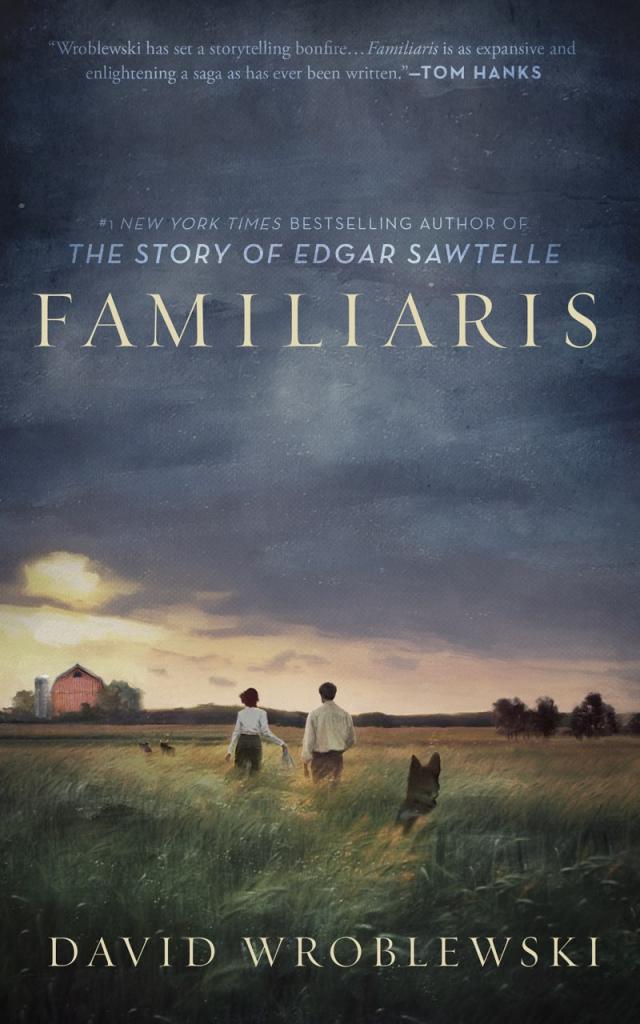
“Wroblewski has set a storytelling bonfire as enthralling in its pages as it is illuminating of our fragile and complicated humanity. Familiaris is as expansive and enlightening a saga as has ever been written.”
—TOM HANKS, Academy Award–winning actor and bestselling author
“Tender, ambitious, fierce, deeply human, and of course wonderfully canine, David Wroblewski’s second novel is an American tour de force . . . This is a big brave book that is old-fashioned in the very best sense of the word."
—COLUM MCCANN, National Book Award winner and author of Apeirogon and Let the Great World Spin
“‘Suppose you could do one impossible thing,’ John Sawtelle says in David Wroblewski’s stunning new novel Familiaris. What would you do? Clearly, what the author would do and has done is write this impossibly wise, impossibly ambitious, impossibly beautiful book.”
—RICHARD RUSSO, Pulitzer Prize winner, author of the North Bath trilogy (Nobody’s Fool, Everybody’s Fool, and Somebody’s Fool)
“A dazzling and irresistible novel. David Wroblewski is a writer of extraordinary characters, human and canine, who will take up residence in your mind and heart.”
—MARGOT LIVESEY, New York Times bestselling author of The Road from Belhaven and The Flight of Gemma Hardy
“Amply rewarding readers who have been waiting impatiently for fifteen years…this colossus of a book will own you, and you will weep to be freed.”
—KIRKUS REVIEWS (starred review)
“No writer understands the depths of dogs’ natures the way David Wroblewski does, and once again we have a vital, absorbing, and remarkable fiction fueled by this understanding. Familiaris is a rare novel, modest and epic.”
—JOAN SILBER, PEN/Faulkner Award–winning author of Secrets of Happiness and Improvement
“David Wroblewski…can create a world that the reader doesn’t merely visit but fully inhabits. And what a world it is, rich with love and joy and heartbreak . . . It has been a long wait for a new Wroblewski novel. The wait is worth it.”
—RON RASH, New York Times bestselling author of Serena, In the Valley, and The Caretaker
BOOKS BY DAVID WROBLEWSKI
Familiaris
The Story of Edgar Sawtelle
Copyright © 2024 by David Wroblewski
E-book published in 2024 by Blackstone Publishing
Cover design by Alenka Vdovič Linaschke
Author photograph by bobcarmichael.com
All rights reserved. This book or any portion thereof may not be reproduced or used in any manner whatsoever without the express written permission of the publisher except for the use of brief quotations in a book review.
Any historical figures and events referenced in this book are depicted in a fictitious manner. All other characters and events are products of the author’s imagination, and any similarity to real persons, living or dead, is coincidental.
Trade e-book ISBN 979-8-212-19431-0
Library e-book ISBN 979-8-212-19430-3
Fiction / Historical / General
Blackstone Publishing
31 Mistletoe Rd.
Ashland, OR 97520
www.BlackstonePublishing.com
For Kimberly McClintock
Adam called his house, heaven and earth; Caesar called his house, Rome; you perhaps call yours, a cobbler’s trade; a hundred acres of ploughed land; or a scholar’s garret. Yet line for line and point for point, your dominion is as great as theirs, though without fine names. Build, therefore, your own world.
—Ralph Waldo Emerson
Nature (1836)
The prime object of the Fortunate Fields project, the aim which renders it unique, is that of producing a strain of dogs which are peculiarly able to profit by instruction . . . The ideal dog representing the goal of this project would excel all known dogs, not only in sturdiness and endurance, but in sagacity, fearlessness and eagerness to work as well as play.
—Elliot Humphrey, Lucien Warner, and Alvin Brooks
Working Dogs (1934)
For we are mudstuck in time, forging gears before the great machine heaves full into view. And if those gears are wrong? No matter, make new! Live not the rabbit-life: nibbling, crouching, hoping tomorrow’s sun will rise on Whole-Before-The-Part. Such a land has never been. The machine is Life. The gear is Day. Its teeth number twenty-four.
—George Solomon Drencher
Practical Agriculture and Free Will (1897)
CONTENTS
Prologue
Part I
Chapter 1
Chapter 2
Chapter 3
Chapter 4
Chapter 5
Chapter 6
Chapter 7
Chapter 8
Chapter 9
Chapter 10
Chapter 11
Chapter 12
Chapter 13
Chapter 14
Part II
Chapter 1
Chapter 2
Chapter 3
Chapter 4
Chapter 5
Chapter 6
Chapter 7
Chapter 8
Chapter 9
Chapter 10
Part III
Chapter 1
Chapter 2
Chapter 3
Chapter 4
Chapter 5
Chapter 6
Chapter 7
Chapter 8
Chapter 9
Chapter 10
Chapter 11
Chapter 12
Chapter 13
Chapter 14
Chapter 15
Chapter 16
Chapter 17
Part IV
Chapter 1
Chapter 2
Chapter 3
Chapter 4
Chapter 5
Chapter 6
Chapter 7
Chapter 8
Chapter 9
Chapter 10
Chapter 11
Chapter 12
Chapter 13
Chapter 14
Chapter 15
Chapter 16
Part V
Chapter 1
Chapter 2
Chapter 3
Chapter 4
Chapter 5
Chapter 6
Chapter 7
Chapter 8
Part VI
Chapter 1
Chapter 2
Chapter 3
Chapter 4
Chapter 5
Epilogue
Don’t Miss…
PROLOGUE
SIXTY-THREE YARDS IN THE MIDDLE OF NOWHERE
He’d been dreaming about mary. When he woke, the new pup was standing between the Kissel’s front wheels, head cocked, inspecting the still-steaming puddle of radiator water. At nine weeks old, the pup was flop-eared and square as a bison, with stout legs and a coat of brown and black fur that stood out all over his body like some exotic canine velvet. Quivering, the pup leaned forward and dabbed one outsized paw at the perimeter of the cooked mud.
“You’ll get your nose boiled,” John Sawtelle said, yawning.
The next drip strummed a stalk of timothy and splashed into the puddle. The pup leapt backward, spun, and barreled headlong into the Kissel’s front wheel, back legs paddling even after his muzzle had squashed up against the tire. The pup collected himself and sat scratching his ear with his hind foot. Then he advanced on the puddle again.
John squinted at him. “Are you sure your name is Gus?” he said. “I always thought Gus was a name for a smart dog. Maybe you’re a— I don’t know. A Barney. A Chester.”
When he woke again, the pup lay curled against his hip, drawing long, slow breaths and making short, huffed exhalations.
He’d come north the day before with a different pup entirely: the biggest and flashiest from the litter their dog Vi had whelped in the spring, a fireball they’d dubbed Boot. Best for the best was the deal he’d made with the man, whose name was Billy Tremoux. As he’d walked off that morning cradling Gus in his arms, Boot had followed, yipping and crying. John had forced himself not to console the pup; it was better if Boot turned to Billy for comfort. But the whole business left John feeling like a betrayer and a fink. All Vi’s other pups—the ones they’d placed so far—were within twenty minutes’ drive of the house where he and Mary lived in Hartford. But Boot would be far away, at the top end of the state.
This pup, Gus, weighed upward of twenty pounds already, and the warm press of his body slowed John’s heartbeat. He untied the string connecting his belt to Gus’s collar and shifted the pup without waking him and stood and whacked the dust off his trousers and walked into the road. He leveled his hand over his eyes. No dust plume of an approaching automobile, no dark shimmer of a man on horseback. Just the road narrowing to a brown thread that disappeared beneath the long overhang of the northwoods forest.
During her geography lessons, Miss Diffy, John’s fifth-grade teacher, had impressed upon her students a trick of memory, one John habitually and almost unconsciously used on his many driving trips. Make your right hand into a plank, she’d told them, palm up, fingers straight. That’s Wisconsin. The Kissel had boiled over that morning on an unmarked dirt road near the top joint of his middle finger, twenty miles south of Lake Superior’s rocky shore and one hundred miles north of where, ten thousand years before, g
laciers had ironed the state flat. He’d had no special reason to turn down this little side road. Side roads always looked interesting to John Sawtelle. He enjoyed getting lost and he enjoyed finding his way back again.
Gus bumbled out from beneath the Kissel and sat on the toe of John’s boot, panting.
“You’re thirsty, I’m thirsty, the car’s thirsty,” John said. He tugged a leather cord to extract from his pocket the Webster chronograph he’d won in a bet. The design on its case involved hundreds of curves radiating outward from a central fleur-de-lis.
“Ten more minutes,” he told the pup. “If no one comes along by then, we’ll look for a creek.” The pup looked at him. He peered around. “All right. Make you a deal. See that rock? No, not my hand. Over there. If I can get all the way to that rock, we’ll go now. Otherwise, we wait the full ten. Shake on it? Hey, maybe you are a Gus.”
He rummaged in the back seat of the Kissel, produced a pair of work gloves, and put them on. He touched his toes. He windmilled his arms.
“The trick is—” he said. Then he pitched forward, planted his hands on the road, and let his feet rise into the air.
Gus, who in his short life had never seen anyone do a handstand, circled John, growling and trying to lick his face.
“Stop,” John gasped. He staggered about on his palms, locating his balance point. “You’re making me—Get out of the—” He wobbled through a full circle, trying to pick a reference point opposite his destination to steer by—he’d never figured out how to walk on his hands in the direction he was looking—then let his knees bend and his feet drop slightly and went teetering off with Gus following after, leaping downward and falling upward, sticking to the road with all four paws.
He meant to go straight down the middle of the road, but with Gus jumping and licking, and stones grinding into his palms, he journeyed instead toward the opposite shoulder, got a close look at a stand of upside-down milkweed, turned laboriously, and crossed two canyonlike ruts that he would rather have avoided. He wasn’t even halfway to the rock and his arms were trembling, blood was ramming his eardrums. The Webster chronograph dropped out of his pocket and began thwacking fore and aft on its cord like a metronome, hitting him in the chest, then the kidneys. Gus kept trying to grab it. Every passing second John had to dismiss the feeling that he was about to topple. He reached the rock, then passed several yards further down the road before he let his feet drop to the ground and rolled upright.
With Gus snatching at his bootlaces, he paced off the distance back to the Kissel: sixty-three yards.
He clapped the road dust off his gloves and fetched his notebook from the car, made a notation, then drew a star next to it. He looked down the road again, hoping a fellow traveler might have materialized to witness his feat.
“At least you saw it,” he told Gus. But now even the pup was gone, nosing around in the weeds across the road.
The Kissel had boiled over just two hundred yards shy of a hilltop. John set off toward it, coaxing Gus along, expecting to see only an unbroken expanse of forest beyond. But as he neared the top, a broad field opened off to the west, and from the crest of the hill he saw down below them a farmhouse and a barn surrounded by a wide green yard.
“Well what do you know?” he said to Gus.
The pup peered up at John as if pondering the question. What did he know? Not much, it had to be admitted. Just moments ago he’d thought people only walked on their feet.
The house looked unremarkable, but the barn was very large and very red. Out on the road in front of the house, a cross-plank sign leaned out of the weeds. John couldn’t quite make out what it said.
It was the last Sunday in May of the year 1919. In Charlevoix County, Michigan, a few miles outside of Petoskey, a young newspaper reporter named Ernest Hemingway—recently returned from a hospital in Milan and freshly heartbroken—hobbled through his family’s orchard pinching his shrapnel scars and counting cherry blossoms. He estimated a heavy crop that fall. In West Orange, New Jersey, Thomas Edison drew the curtains of his parlor, preparing to watch, for the seventeenth time, A Trip to the Moon, the Georges Méliès film his employees had bootlegged from a London movie house. In Los Angeles, the astronomer Edwin Hubble, having spent the previous night at the eyepiece of the one-hundred-inch Hooker telescope at the Mount Wilson Observatory, lay sleeping on his couch. He dreamt, outlandishly, of galaxies beyond the Milky Way. In a sanatorium in Scotland, W. Somerset Maugham closed the cover of Sinclair Lewis’s novel Main Street, cracked the shell of a soft-boiled egg, and wrote in his journal: “But the author of Main Street has done something more than depict with accuracy the inhabitants of a small town in the Middle-West, and I cannot make up my mind whether he has done it knowingly or by accident.” In Nova Scotia, eight-year-old Elizabeth Bishop practiced Beethoven’s Sonata no. 14 in C-sharp minor at her grandmother’s piano, recently tuned. In Far Rockaway, Queens, New York, the infant Richie Feynman, draped across his mother’s shoulder, contemplated the motion of the waves as they crawled unceasingly onto the sandy beach.
And in northern Wisconsin, in the middle of the middle of nowhere, John Sawtelle and his new pup walked down a dirt road toward a farm that would turn out to be unoccupied and, according to the cross-plank sign, for sale. All that had happened was that his car had boiled over. Now he and the pup—who would turn out to be plenty smart enough to be a Gus instead of a Barney or a Chester—were off to fetch a bucket of water so they could be on their way. He would not recognize the significance of the moment for a long time. It did not feel like the beginning of anything.
The same would be true for each of the great quests in John Sawtelle’s life.
PART ONE
ANOTHER CARNIVAL OF THE SAME GODS
CHAPTER 1
A FACTORY IS ALSO LIKE THE WORLD
The main corridor of the central office building of the Kissel Automotive Company in Hartford, Wisconsin, was long and white and high-ceilinged, which made it look narrow to anyone walking its length, though it wasn’t, particularly. Doors punctuated the south wall of the corridor at thirty-foot intervals, department names stenciled in black and gold on the glass centerpanes: sales, contracts, records, design, and so on.
Along the north wall, six tall, square-paned windows cast slant blocks of sunlight, immense and milkily opaque, across the corridor. Each time John Sawtelle stepped into one of these luminous volumes he was briefly dazzled, blinded to everything beyond, and each time he emerged, the exit doors at the end of the corridor stood closer.


