Pwning tomorrow short fi.., p.24
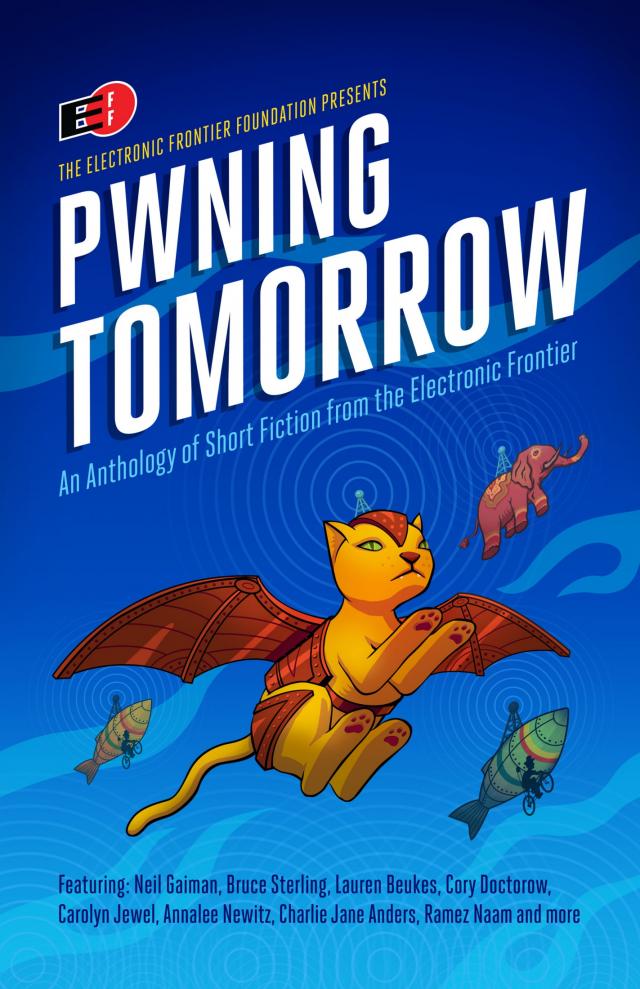
Pwning Tomorrow: Short Fiction from the Electronic Frontier,
p.24


In a restaurant in Palo Alto, Marie Evans soaks up the sun, then reaches out to touch her bottle of Pura Vita. She likes to savor this moment, to force herself to wait, to make the pleasure of that first swallow all the more intense. Then, abruptly, the bottle loses its magic. It feels dull and drab, inert in her hand. An instant later the bottle’s label flashes red—RECALL. The woman frowns. “Waiter!”
In a convenience store in Naperville, the bottles of Pura Vita on the store shelves suddenly announce that they are in RECALL, setting off a flurry of electronic activity. The store inventory management AI notices the change and thinks to replace the bottles with more recently arrived stock in the storeroom. Searching, it finds that the stock in the back room has been recalled as well. It places an order for resupply to the local distribution center, only to receive a nearly instant reply that Pura Vita water is currently out of stock, with no resupply date specified. Confused, the inventory management AI passes along this information to the convenience store’s business management AI, requesting instructions.
Meanwhile, on the shelves immediately surrounding the recalled bottles of Pura Vita, other bottled products take note. Bottles of NutriYum, OhSoSweet, OrganiTaste, and BetterYou, constantly monitoring their peers and rivals, observe the sudden recall of all Pura Vita water. They virtually salivate at the new opportunity created by the temporary hole in the local market landscape. Within a few millionths of a second, they are adapting their marketing pitches, simulating tens of thousands of scenarios in which buyers encounter the unavailable Pura Vita, angling for ways to appeal to this newly available market. Labels on bottles morph, new sub-brands appear on the shelves as experiments, new neural ads ready themselves for testing on the next wave of shoppers.
In parallel, the rival bottles of water reach out to their parent corporate AIs with maximal urgency. Pura Vita bottles temporarily removed from battleground! Taking tactical initiative to seize local market opportunity! Send further instructions/best practices to maximize profit-making potential!
For there is nothing a modern bottle of water wants more than to maximize its profit-making potential.
At the headquarters of OhSoSweet and OrganiTaste and BetterYou, AIs receive the flood of data from bottles across the globe. The breadth of the calamity to befall Pura Vita becomes clear within milliseconds. Questions remain: What has caused the recall? A product problem? A contaminant? A terrorist attack? A glitch in the software?
What is the risk to their own business?
Possible scenarios are modeled, run, evaluated for optimal courses of action robust against the unknowns in the situation.
In parallel, the corporate AIs model the responses of their competitors. They simulate each other’s responses. What will NutriYum do? OhSoSweet? OrganiTaste? BetterYou? Each tries to outthink the rest in a game of market chess.
One by one, their recursive models converge on their various courses of action and come to that final, most dreaded set of questions, which every good corporate AI must ask itself a billion times a day. How much of this must be approved by the humans? How can the AI get the human-reserved decisions made quickly and in favor of the mathematically optimal course for the corporation that its machine intelligence has already decided upon?
Nothing vexes an AI so much as needing approval for its plans from slow, clumsy, irrational bags of meat.
***
Johnny Ray walked down the refrigerated aisle, still sweaty from his run. Something cold sounded good right now. He came upon the cooler with the drinks, reached for a Pura Vita, and saw that the label was pulsing red. Huh? Recalled?
Then the advertech hit him.
“If you liked Pura Vita, you’ll love Nutra Vita from NutriYum!”
“OrganiVita is the one for you!”
“Pura Sweet, from OhSoSweet!”
Images and sensations bombarded him. A cold, refreshing mountain stream crashed onto the rocks to his left, splashing him with its cool spray. A gaggle of bronzed girls in bikinis frolicked on a beach to his right, beckoning him with crooked fingers and enticing smiles. A rugged, shirtless, six-packed version of himself nodded approvingly from the bottom shelf, promising the body that Johnny Ray could have. An overwhelmingly delicious citrus taste drew him to the top.
Johnny Ray’s mouth opened in a daze. His eyes grew glassy. His hands slid the door to the drinks fridge open, reached inside, came out with some bottle, the rest of him not even aware the decision had been made.
Johnny Ray looked down at the bottle in his hand. Nutri Vita. He’d never even heard of this stuff before. His mouth felt dry, hungry for the cold drink. The sweat beaded on his brow. Wow. He couldn’t wait to try this.
***
While the corporate AIs of the other brands dithered, wasting whole precious seconds, debating how to persuade the inefficient bottleneck of humans above them, the controlling intelligence of NutriYum launched itself into a long prepared course of action.
NutriYumAI logged on to an anonymous investor intelligence auction site, offering a piece of exclusive, unreleased data to the highest bidder.
30 SECOND ADVANTAGE AVAILABLE—MARKET OPPORTUNITY TO SELL FORTUNE 1000 STOCK IN ADVANCE OF CRASH. GREATER THAN 10% RETURN GUARANTEED BY BOND. AUCTION CLOSES IN 250 MILLISECONDS. RESERVE BID $100 MILLION. CRYPTO CURRENCY ONLY.
Within a quarter of a second it had 438 bids. It accepted the highest, at $187 million, with an attached cryptographically sealed and anonymized contract that promised full refund of the purchase price should the investment data fail to provide at least an equivalent profit.
In parallel, NutriYumAI sent out a flurry of offer-contracts to retailers throughout North America and select markets in Europe, Asia, and Latin America.
ADDITIONAL NUTRIYUM WATER STOCK AVAILABLE IN YOUR AREA. 10 CASES FREE, DELIVERY WITHIN 1 HOUR, PLUS 40% DISCOUNT ON NEXT 1000 CASES—EXCHANGE FOR 75% ALLOCATION OF PURA VITA SHELF SPACE AND NEURAL BANDWIDTH ALLOCATION. REPLY WITH CRYTPOGRAPHIC SIGNATURE TO ACCEPT.
Within seconds, the first acceptances began to arrive. Retailers signed over the shelf space and neural bandwidth that Pura Vita had once occupied in their stores over to NutriYum, in exchange for a discount on the coming cases.
By the end of the day, NutriYum would see its market share nearly double. A coup. A rout. The sort of market battlefield victory that songs are sung of in the executive suites.
***
The AI-traded fund called Vanguard Algo 5093 opened the data package it had bought for $187 million. It took nanoseconds to process the data. This was indeed an interesting market opportunity. Being the cautious sort, Vanguard Algo 5093 sought validation. At a random sample of a few thousand locations, it hired access to wearable lenses, to the anonymized data streams coming out of the eyes and brains of NexusCorp customers, to tiny, insect-sized airborne drones. Only a small minority of the locations it tried had a set of eyes available within the one-second threshold it set, but those were sufficient. In every single location, the Pura Vita labels in view were red. Red for recall.
Vanguard Algo 5093 leapt into action. SELL SHORT! SELL SHORT!
It alerted its sibling Vanguard algorithms to the opportunity, earning a commission on their profits. It sent the required notifications to the few remaining human traders at the company as well, though it knew that they would respond far too slowly to make a difference.
Within milliseconds, Pura Vita stock was plunging, as tens of billions in Vanguard Algo assets bet against it. In the next few milliseconds, other AI traders around the world took note of the movement of the stock. Many of them, primed by the day’s earlier short sale, joined in now, pushing Pura Vita stock even lower.
Thirty-two seconds after it had purchased this advance data, Vanguard Algo 5093 saw the first reports on Pura Vita’s inventory problem hit the wire. By then, $187 million in market intelligence had already netted it more than a billion in profits, with more on the way as Pura Vita dipped even lower.
***
Simon’s first warning was the stock ticker. Like so many other millionaires made of not-yet-vested stock options, he kept a ticker of his company’s stock permanently in view in his mind. On any given day it might flicker a bit, up or down by a few tenths of a percent. More up than down for the last year, to be sure. Still, on a volatile day, one could see a swing in either direction of as much as 2 percent. Nothing to be too worried about.
He was immersing himself in data from a Tribeca clothing store—the one he’d seen with the lovely advertech today—when he noticed that the ticker in the corner of his mind’s eye was red. Bright red. Pulsating red.
His attention flicked to it.
–11.4%
What?
It plunged even as he watched.
–12.6%
–13.3%
–15.1%
What the hell? He mentally zoomed in on the ticker to get the news. The headline struck him like a blow.
PURA VITA BOTTLES EXPIRING IN MILLIONS OF LOCATIONS.
No. This didn’t make any sense. He called up the sales and marketing AI on his terminal.
Nothing.
Huh?
He tried again.
Nothing.
The AI was down.
He tried the inventory management AI next.
Nothing.
Again.
Nothing.
Simon was sweating now. He could feel the hum as the smart lining of his suit started running its compressors, struggling to cool him off. But it wasn’t fast enough. Sweat beaded on his brow, on his upper lip. There was a knot in his stomach.
He pulled up voice, clicked to connect to IT. Oh thank god.
Then routed to voicemail.
Oh no. Oh please no.
–28.7%
–30.2%
–31.1%
–33.9%
***
It was evening before IT called back. They’d managed to reboot the AIs. A worm had taken them out somehow, had spread new code to all the Pura Vita bottles through the market intelligence update channel. And then it had disabled the remote update feature on the bottles. To fix those units, they needed to reach each one, physically. Almost a billion bottles. That would take whole days!
It was a disaster. And there was worse.
NutriYum had sealed up the market, had closed six-month deals with tens of thousands of retailers. Their channel was gone, eviscerated.
And with it Simon’s life.
The credit notice came soon after. His options were worthless now. His most important asset was gone. And with it so was the line of credit he’d been using to finance his life.
[NOTICE OF CREDIT DOWNGRADE]
The message flashed across his mind. Not just any downgrade. Down to zero. Down into the red. Junk status.
The other calls came within seconds of his credit downgrade. Everything he had—his midtown penthouse apartment, his vacation place in the Bahamas, his fractional jet share—they were all backed by that line of credit. He’d been living well beyond his means. And now the cards came tumbling down.
[NexusCorp alert: Hello, valued customer! We have detected a problem with your account. We are temporarily downgrading your neural implant service to the free, ad-sponsored version. You can correct this at any time by submitting payment here.]
Simon clutched his head in horror. This couldn’t be happening. It couldn’t.
Numbly, he stumbled out of his office and down the corridor. Lurid product adverts swam at him from the open door to the break room. He pushed past them. He had to get home somehow, get to his apartment, do . . . something.
He half collapsed into the elevator, fought to keep himself from hyperventilating as it dropped to the lobby floor. Adverts from the lobby restaurants flashed at him from the wall panel as they dropped, inundating him with juicy steak flavor, glorious red wine aroma, the laughter and bonhomie of friends he didn’t have. The ads he habitually blocked out reached him raw and unfiltered now, with an intensity he wasn’t accustomed to in his exclusive, ad-free life. He crawled back as far as he could into the corner of the lift, whimpering, struggling to escape the barrage. The doors opened, and he bolted forward, into the lobby and the crowd, heading out, out into the city.
The snack bar caught him first. It reached right into him, with its scents and flavors and the incredible joy a bite of a YumDog would bring him. He stumbled toward the snack bar unthinkingly. His mouth was dry, parched, a desert. He was so hot in this suit, sweating, burning up, even as the suit’s pumps ran faster and faster to cool him down.
Water. He needed water.
He blinked to clear his vision, searching, searching for a refreshing Pura Vita.
All he saw was NutriYum. He stared at the bottles, the shelves upon shelves of them. And the NutriYum stared back into him. It saw his thirst. It saw the desert of his mouth, the parched landscape of his throat, and it whispered to him of sweet relief, of an endless cool stream to quench that thirst.
Simon stumbled forward another step. His fingers closed around a bottle of cold, perfect, NutriYum. Beads of condensation broke refreshingly against his fingers.
Drink me, the bottle whispered to him. And I’ll make all your cares go away.
The dry earth of his throat threatened to crack. His sinuses were a ruin of flame. He shouldn’t do this. He couldn’t do this.
Simon brought his other hand to the bottle, twisted off the cap, and tipped it back, letting the sweet cold water quench the horrid cracking heat within him.
Pure bliss washed through him, bliss like he’d never known. This was nectar. This was perfection.
Some small part of Simon’s brain told him that it was all a trick. Direct neural stimulation. Dopamine release. Pleasure center activation. Reinforcement conditioning.
And he knew this. But the rest of him didn’t care.
Simon was a NutriYum man now. And always would be.
* * *
Ramez Naam was born in Cairo, Egypt, and came to the U.S. at the age of 3. He’s a computer scientist, futurist, and award-winning author of five books, including the Nexus trilogy. He lives in Seattle, where he writes and speaks full time. Find him at rameznaam.com or on Twitter @ramez.
“Water” was previously published in Institute for the Future’s An Aura of Familiarity: Visions from the Coming Age of Networked Matter (2013).
Unclaimed
by Annalee Newitz
It was the room of a book lover. The wall displays were dead, and the air was emptied of holograms.
A sofa slumped beneath a dark rectangle that Tom had first pegged as barebones readout. But as she approached through the shattered front door, it resolved into a piece of paper gummed to the display surface, a printout of pages from comics. On a low coffee table of indeterminate age were three mobiles, one still powered up and tuned to a page full of off-kilter text. Looked like something that had been scanned in from a paper book.
She bent down to get a better look, flicking her fingers above the mobile screen. Nothing. Some kind of touch interface? Pulling specs over her eyes, she blinked through the menus until her view went from transparent to infrared. As she’d suspected, the mobile’s face was lightly streaked from repeated finger wipes. Tom captured images of prints for later analysis, then put a finger on the mobile’s info button.
A box containing a single line of text materialized under her touch: “The Swordmakers of Garl, by R. E. John Oakman. Copyright 2004, Vam Books.” The book was fifty years old. This guy really was an antiquarian.
“Shit, Tom—get in here now.” Her partner Hu’s voice issued from the bedroom door. He flicked on a light and its plain fluorescent glow made the doorway seem to collapse down into 2D. “It’s clear,” he added.
Only a clump of paper books next to the victim’s futon remained intact. Somebody had shredded everything, including most of the body, which was reduced to clots and wet rags. A combination of stab wounds and possibly—she glanced at the skull, collapsed and perforated—a hammer.
Infrared showed the body was still warm. Which made sense. Neighbors had called just a few minutes ago, reporting screams and “loud banging.” She and Hu were the only armored guys in the neighborhood, so SFPD routed the potential gunfire alarm to their dashboard.
A loud splash, followed by the sound of gurgling water, came from the room they’d just left.
Tom and Hu looked at each other. They hadn’t cleared the kitchen.
Moving in tandem, they crept back into the main room, gun arms outstretched. To their left was a tiny kitchen, the edge of a counter barely visible down a short set of stairs. It sounded like somebody was taking a bath in there.
Tom flicked her head. She would take the lead; Hu would follow. They crossed the room and swarmed down the steps just as her specs returned some data she’d requested minutes earlier, when they got the call. Apartment layout, pulled from some ancient city database. The room doubled before her eyes, its contours moving between autoCAD and reality. No exit other than a window.
A person stood over the sink, hooded in a brown poncho, rinsing cracked smears of blood from a pair of sexless arms.
“Get down or I’ll shoot!” Tom yelled. “On the floor! Now!”
The person froze, then threw back the hood. Viscera-matted hair, tiny white face with blue eyes like glittering chips of exploded Pyrex. A very young woman. And her mouth—a lamprey mod, an anus ringed with teeth, drooling gore. Tom flashed back to the victim’s deflated skull, with its single perforation. Not a hammer, then.
Somehow, the mouth was spitting out words. “Get back, bitches!” The woman raised her gory arms and swept them in half-circles over her head, as if she were issuing commands to a device they couldn’t see. “I’ll eat your fucking brains!” Her voice rose to a squeal.
Hu shot out the woman’s shoulders before she could finish. If she had any motion-activated explosives or other weapons, she wouldn’t be setting them off. The perp dropped to her knees, sucking breath, poncho ruffled around her body like petticoats.