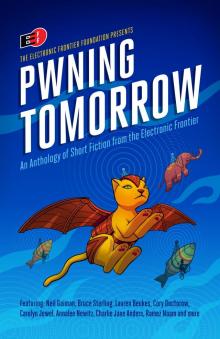
Pwning tomorrow short fi.., p.7
Pwning Tomorrow: Short Fiction from the Electronic Frontier,
p.7


“No. It was a private conversation.”
“But everyone wants to know why you got out of the car. I had someone from the Financial Times call me about splitting the hits for a tell-all, if you’ll be interviewed. You wouldn’t even need to write up the piece.”
It’s a tempting thought. Easy hits. Many click-throughs. Ad-revenue bonuses. Still, I shake my head. “We did not talk about things that are important for others to hear.”
Janice stares at me as if I am crazy. “You’re not in the position to bargain, Ong. Something happened between the two of you. Something people want to know about. And you need the clicks. Just tell us what happened on your date.”
“I was not on a date. It was an interview.”
“Well then publish the fucking interview and get your average up!”
“No. That is for Kulaap to post, if she wishes. I have something else.”
I show Janice my screen. She leans forward. Her mouth tightens as she reads. For once, her anger is cold. Not the explosion of noise and rage that I expect. “Bluets.” She looks at me. “You need hits and you give them flowers and Walden Pond.”
“I would like to publish this story.”
“No! Hell, no! This is just another story like your butterfly story, and your road contracts story, and your congressional budget story. You won’t get a damn click. It’s pointless. No one will even read it.”
“This is news.”
“Marty went out on a limb for you—” She presses her lips together, reining in her anger. “Fine. It’s up to you, Ong. If you want to destroy your life over Thoreau and flowers, it’s your funeral. We can’t help you if you won’t help yourself. Bottom line, you need fifty thousand readers or I’m sending you back to the third world.”
We look at each other. Two gamblers evaluating one another. Deciding who is betting, and who is bluffing.
I click the “publish” button.
The story launches itself onto the net, announcing itself to the feeds. A minute later a tiny new sun glows in the maelstrom.
Together, Janice and I watch the green spark as it flickers on the screen. Readers turn to the story. Start to ping it and share it amongst themselves, start to register hits on the page. The post grows slightly.
My father gambled on Thoreau. I am my father’s son.
* * *
Paolo Bacigalupi is a Hugo and Nebula Award winner and a National Book Award finalist. His latest novel is the New York Times Bestseller The Water Knife, a near-future thriller about water wars and climate change.
“The Gambler” was previously published in Fast Forward 2 (2008).
Slipping
by Lauren Beukes
1. High life
The heat presses against the cab, trying to find a way in past the sealed windows and the rattling air-conditioning. Narrow apartment blocks swoop past on either side of the dual carriageway, occasionally broken up by a warehouse megastore. It could be Cape Town, Pearl thinks. It could be anywhere. Twenty-three hours’ travel so far. She has never been on a plane before.
“So what’s the best part about Karachi?” Tomislav says, trying to break the oppressive silence in the back—the three of them dazed by the journey, the girl, her promoter, and the surgeon, who has not looked up from his phone since they got in the car, because he is trying to get a meeting.
The driver thinks about it, tugging at the little hairs of his beard. “One thing is that this is a really good road. Sharah e Faisal. There’s hardly ever a traffic jam and if it rains, the road never drowns.”
“Excellent.” Tomislav leans back, defeated. He gives Pearl an encouraging smile, but she is not encouraged. She watched the World Cup and the Olympics on TV; she knows how it is supposed to be. She stares out the window, refusing to blink in case the tears come.
The road narrows into the city and the traffic thickens, hooting trucks and bakkies and rickshaws covered in reflecting stickers like disco balls, twinkling in the sun. They pass through the old city, withits big crumbling buildings from long ago, and into the warren of Saddar’s slums, with concrete lean-tos muscling in on each other. Kachi abaadi, the driver tells them, and Pearl sounds it out under her breath. At least the shacks are not tin and that’s one difference.
Tomislav points out the loops of graffiti in another alphabet and taps her plastic knee. “Gang signs. Just like the Cape Flats.”
“Oh, they’re gangsters, all right,” the driver says. “Same people run the country.”
“You have gangsters in your government?” Pearl is shocked.
The cab driver clucks and meets her eyes in the rearview mirror. “You one of the racers?”
“What clued you in?” Dr. Arturo says, without looking up. It’s the first thing he’s said all day. His thumbs tap over the screen of his phone, blunt instruments. Pearl rubs her legs self-consciously where the tendons are visible under the joint of her knee, running into the neurocircuitry. It’s a showcase, Dr. Arturo told her when she asked him why it couldn’t look like skin. Some days she thinks it’s beautiful. Mostly, she hates seeing the inside-out of herself.
“Why do you think you’re in Pakistan?” The driver laughs. “You think anyone else would let this happen in their country?” He rubs his thumb and fingers together and flings it to the wind.
2. Packed with goodness
Pre-race. A huge +Games banner hangs above the entrance of the Karachi Parsi Institute, or KPI. It’s a colonial building that has been extended to accommodate them, the track built over the old cricket ground and into the slums. The school has been turned into the athletes’ village, classrooms converted to individual medical cells to cater to their unique needs. Pearl’s, for example, has hermetic bio-units and sterile surfaces. The window has been fused shut to prevent the polluted air from leaking in.
In the room next door, they installed extra generators for Charlotte Grange after she plugged in her exo-suit and tripped the power on the whole building. Pearl can hear her grunting through the walls. She doesn’t know what Siska Rachman has.
She sits on the end of her bed, paging through the official program while Tomislav paces the room end to end, hunched over his phone, his hand resting on his nose. “Ajda! Come on!” her promoter says into the phone, in that Slavic way, which makes the first part of the sentence top-heavy. Like Tomislav himself, still carrying his weight-lifter bulk all squeezed up into his chest and neck. He doesn’t compete anymore, but the steroids keep him in shape. The neon lights and the white sheen off the walls makes his eyes look bluer, his skin paler. “Peach,” she was taught in school, as if “peach” and “brown” were magically less divisive than “black” and “white” and words could fix everything. But Tomislav’s skin is not the warm orange of a summer fruit—it’s like the milky tea she drinks at home.
Tomislav has thick black hair up his arms. She asked him about it when they first met at the Beloved One’s house on the hill. Fourteen and too young and too angry about everything that had happened to mind her elders, even though her mother gasped at her rudeness and smacked her head.
Tomislav laughed. Testosterone, kitten. He tapped the slight fuzz over her lip. You’ve got it too—that’s what makes you so strong.
He’s made her laser all her unsightly hair since. Sports is image. Even this one.
He sees her looking and speaks louder. “You want to get a meeting, Arturo, we gotta have something to show.” He jabs at the phone dramatically to end the call. “That guy! What does he think I’m doing all day? You all right, kitten?” He comes over to take her by the shoulders, give them a little rub. “You feeling good?”
“Fine.” More than fine, with the crowds’ voices a low vibration through the concrete and the starting line tugging at her insides, just through that door, across the quad, down the ramp. She has seen people climbing up onto the roofs around the track with picnic blankets.
“That’s my girl.” He snatches the program out of her hands. “Why are you even looking at this? You know every move these girls have.”
He means Siska Rachman. That’s all anyone wants to talk about. Pearl is sick of it, all the interviews for channels she’s never heard of. No one told her how much of this would be talking about racing.
“Ready when you are,” Dr. Arturo says into her head, through the audio feed in her cochlear implant. Back online as if he’s never been gone, checking the diagnostics. “Watch your adrenaline, Pearl. You need to be calm for the install.” He used to narrate the chemical processes, the shifting balances of hormones, the nano-enhancing oxygen uptake, the shift of robotic joints, the dopamine blast, but it felt too much like being in school: words being crammed into her head and all worthless anyway. You don’t have to name something to understand it. She knows how it feels when she hits her stride and the world opens up beneath her feet.
“He’s ready,” she repeats to Tomislav. “All right, let’s get this show pumping.”
Pearl obediently hitches up her vest with the Russian energy drink logo—one of Tomislav’s sponsors, although that’s only spare change. She has met the men who have paid for her to be here, in the glass house on the hill, wearing gaudy golf shirts and shoes and shiny watches. She never saw the men swing a club and she doesn’t know their names, but they all wanted to shake her hand and take a photograph with her.
She feels along the rigid seam that runs in a J-hook down the side of her stomach, parallel with her hysterectomy scar, and tears open the Velcroskin.
“Let me,” Tomislav says, kneeling between her legs. She holds her flesh open while he reaches one hand up inside her abdomen. It doesn’t hurt, not anymore. The Velcro releases a local anesthetic when it opens, but she can feel an uncomfortable tugging inside, like cramps.
Tomislav twists off the valves on either side and gently unplugs her stomach and eases it out of her. He sets it in a sterile biobox and connects it to a blood flow. By the time he turns back, she is already spooling up the accordion twist of artificial intestine, like a party magician pulling ribbons from his palm. It smells of the lab-mod bacteria and the faintest whiff of feces. She hands it to Tomislav and he wrinkles his nose.
“Just goes to show,” he says, folding up the slosh of crinkled plastic tubing and packing it away. “You can take the meat out of the human, but they’re still full of shit!”
Pearl smiles dutifully, even though he has been making the same joke for the last three weeks—ever since they installed the new system. “Nearly there.” He holds up the hotbed factory and she nods and looks away, because it makes her queasy to watch. It’s a sleek bioplug, slim as a communion wafer and packed with goodness, Dr. Arturo says, like fortified breakfast cereal. Hormones and nanotech instead of vitamins and iron. Tomislav pushes his hand inside her again, feeling blindly for the connector node in what’s left of her real intestinal tract, an inch anda half of the body’s most absorbent tissue for better chemical uptake.
“Whoops! Got your kidney! Joking. It’s in.” “Good to go,” Dr. Arturo confirms.
“Then let’s go,” Pearl says, standing up on her blades.
3. Forces greater than you
You would have to be some kind of idiot. She told her mother it was a bet among the kids, but it wasn’t. It was her, only her, trying to race the train.
The train won.
4. Why you have me
The springkaan drone flits in front of Pearl’s face, the lens zooming in on her lips to catch the words she’s saying under her breath and transmit them onto the big screen. “Ndincede nkosi undiphe amandla.”
She bends down to grab on to the curved tips of her legs, to stretch, yes, but also to hide her mouth. It’s supposed to be private, she thinks. But that’s an idea that belonged to another girl before Tomislav’s deals and Dr. Arturo’s voice in her head running through diagnostics, before the Beloved One, before the train, before all this.
“It’s because you’re so taciturn, kitten,” Tomislav says, trying to comfort her. “You give the people crumbs and they’re hungry for more. If you just talked more.” He is fidgeting with his tie while Brian Corwood, the presenter, moves down the starters’ carpet with his microphone, talking to Oluchi Eze, who is showing off her tail for the cameras. She doesn’t know how to talk more. She’s run out of words, and the ones Dr. Arturo wants her to say are like chewing on raw potatoes. She has to sound out the syllables.
Pearl swipes her tongue over her teeth to get rid of the feeling that someone has rigged a circuit behind her incisors. It’s the new drugs in the hotbed, Tomislav says. She has to get used to it, like the drones, which dart up to her unexpectedly. They’re freakish—cameras hardwired into grasshoppers, with enough brain stem left to respond to commands. Insects are cheap energy.
Somewhere in a control room, Dr. Arturo notes her twitching back from the springkaan and soothes in her head. “What do you think, Pearl? More sophisticated than some athletes we know.” She glances over at Charlotte Grange, who is also waiting for her interview. The big blonde quakes and jitters, clenching her jaw, her exo-suit groaning in anticipation. The neural dampeners barely hold her back.
The crowd roars its impatience, thousands of people behind a curve of reinforced safety glass in the stands, raised high above the action. The rooftops are packed, and there are children climbing the scaffolding around the old church like monkeys.
The people in suits, the ones Dr. Arturo and Tomislav want to meet, watch from air-conditioned hotel rooms five kilometers away. Medical and pharmaceutical companies looking for new innovations in a place where anything goes: any drugs, any prosthetics, robotics, nano. That’s what people come for. They tune in by the millions on the proprietary channel. The drama. Like watching Formula 1 for the car crashes.
“All these people, kitten,” Tomislav says. “They don’t want you to win. They’re just waiting for you to explode. But you know why you’re here.”
“To run.”
“That’s my girl.”
“Slow breaths,” Dr. Arturo says. “You’re overstimulated.” The springkaan drone responds to some invisible hand in a control room and swirls around her, getting every angle. Brian Corwood makes his way over to her, microphone extended like a handshake, springkaans buzzing behind his shoulder. She holds herself very straight. She knows her mama and the Beloved One are watching back home. She wants
to do Gugulethu proud. “Ndincede nkosi.” She mouths the words and sees them come up on the big screens above the track in closed captions below her face.
They’ll be working to translate them already. Not so hard to figure out that she’s speaking Xhosa.
“Pearl Nit-seeko,” the presenter says. “Cape Town’s miracle girl. Crippled when she was 14 years old and now, here she is, two years later, at the +Games. Dream come true!”
Pearl has told the story so many times that she can’t remember which parts are made up and glossed over. She told a journalist once that she saw her father killed on TV during the illegal mine strikes in Polokwane, saying she covered her ears so she didn’t have to hear the popcorn pa-pa-pa-pa-pa of the gunshots as people fell in the dust. But now she has to stick to it. Grand tragedy is a better story than the reality of a useless middle-aged drunk who lived with a shebeen owner’s daughter in Nyanga so that he didn’t have to pay off the bar tab. When Pearl started to get famous, her father made a stink in the local gossip rags until Tomislav paid him to go away. You can buy your own truth.
“Can you tell us about your tech, Pearl?” Brian Corwood says, as if this is a show about movie stars and glittery dresses.
She responds on autopilot. The removable organs, the bath of nano in her blood that improves oxygen uptake. Neural connectivity blows open the receptors to the hormones and drugs dispatched by the hotbed factory. Tomislav has coached her in the newsworthy technical specs, the leaks that make investors’ ears prick up.
“I can’t show you,” she apologizes, coyly raising her vest to let the cameras zoom in on the seam of scar tissue. “It’s not a sterile environment.” “So it’s hollow in there?” Corwood pretends to knock on her stomach. “Reinforced surgical-quality graphene mesh.” She lightly drums her fingers over her skin, like in rehearsal. It looks spontaneous and showsoff her six-pack. She hears Arturo’s voice in her head. “Put the vest down now,” Arturo instructs. She covers herself up. The star doesn’t want to let the viewers see too much. Like with sex. Or so she’s been told. She will never have children.
“Is that your secret weapon?” Corwood says, teasing, because no one ever reveals the exact specs, not until they have a buyer.
“No,” she says, “but I do have one.”
“What is it, then?” Corwood says, gamely.
“God,” she says, and stares defiant at the insect cameras zooming in for a close-up.
5. Things you can’t hide
Her stumps are wrapped in fresh bandages, but the wounds still smell. Like something caught in the drain. Her mother wants to douse the bandages in perfume.
“I don’t want to! Leave me alone!” Pearl swats the teardrop bottle from her mother’s hands and it clatters onto the floor. Her mother tries to grab her. The girl falls off the bed with a shriek. She crawls away on her elbows, sobbing and yowling. Her Uncle Tshepelo hauls her up by her armpits, like she is a sack of sorghum flour, and sets her down at the kitchen table.
“Enough, Pearl,” he says, her handsome youngest uncle. When she was a little girl she told her mother she was going to marry him.
“I hate you,” she screams. She tries to kick at him with her stumps, but he ducks away and goes over to the kettle while her mother stands in the doorway and covers her face.