Pwning tomorrow short fi.., p.25
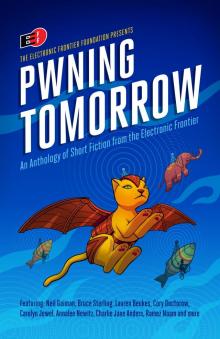
Pwning Tomorrow: Short Fiction from the Electronic Frontier,
p.25


“You are under arrest,” Tom said. “If you try to move, we’ll shoot to kill.”
The woman didn’t care. She launched herself upward at Hu, attaching that spiny tunnel of a mouth to his eye socket. There was one terrible second of silence before he started screaming. Then, just as the noise started, Tom stepped in and shot.
Tom saved Hu’s brain, but not his eyeball. Forensics found it in the woman’s stomach, along with human brains from two separate victims. They never figured out who else’s brains she’d eaten that day.
But Tom did figure out one thing. She visited Hu in the hospital to tell him that she’d quit. “I’m studying for my PI exam,” she said. “Specializing in civil suits and shit like that. I don’t want to deal with anything violent. Three years as a cop was enough.”
Hu watched her with his new implant, whose iris wandered slightly. It wasn’t quite under his control yet. “I’m quitting too,” he replied. “I want to be a protein engineer like my dad.”
***
Nick Gray sat beneath the skylight, currently reverberating with rain. He was fondling a paper business card, flipping it over in his fingers nervously. She’d seen “Leslie Tom—Private Investigator” flash in the palm of his hand five times before he spoke.
“I first heard about you when that brain eater was caught. What a bizarre case.”
Tom nodded; she’d heard that from a lot of clients. Waiting for Gray to continue, she tried to figure out how much cash this guy had spent on his shoes. Her specs said genuine leather, and a few more blinks revealed brand-new soles flecked with oil. This was somebody with money to fuel a car.
Raising her eyes to his face again, she steepled her fingers over the desk. “What can I do for you, Mr. Gray?”
He grimaced and settled one of his rich man’s shoes on a knee. “I know you left the SFPD several years ago. But I’ve come to you partly because of that case.” He toyed with her card again. “I understand that the victim was a book collector.”
Tom was surprised. Very few people knew about that aspect of the case.
In the follow-up investigation, Tom discovered the victim and perp had met through a Superpoke group for paper book collectors. The brain eater, Nelly McAuley, was convinced that she was some kind of ancient demon. She’d paid a fetish surgeon to make her look the part—apparently the lamprey look was popular among biomodders that year, so the doctor thought nothing of it. Then as her coup de grace, Nelly went on a quest to eat the brains of her Superpoke friends with her new mouth. Something to do with absorbing their arcane knowledge from old books.
Nelly had been plotting her murderous rampage for months online. Her last status update read: “The books will never disappear if I absorb them into my body, because my body will live forever.” It wasn’t as if the detectives hid this part of the investigation. It was just too boring for the crime blogs to report.
“So you’re here about a book lover?” Tom asked.
“That is what my client assumes, yes.”
A rich guy with a client meant serious money indeed. Tom relaxed the steeple of her fingers and leaned back. Now that Gray was talking she knew he wouldn’t stop.
“Have you ever heard of the Scorpion Diaries?”
“Hard not to. Didn’t they just release the fifth installment? In fact, I think—” Tom stood, walked to the window, and glanced at a billboard over the freeway. “Yes, there’s an ad for it right out there. The Sting of Time.” As Tom watched, the title pixelated into an explosion that seemed to rain fire on 17th Street. A vast, metallic scorpion emerged from the flames, a human figure riding on its back.
“Did you know the Scorpion Diaries were originally a series of novels? They were published at the turn of the century by somebody named J.J. Coal.”
Tom returned to her seat. “I guess I read that somewhere, yeah.”
“My client needs you to find Coal. Very quietly.”
“When did he disappear? Or she?”
“We’re not sure if Coal is a she or a he. The author could be as young as 90. Or have an heir.”
“An heir?”
“If we can’t find Coal, we need to find an heir. We have money for the Coal Estate.”
Usually clients wanted to get money out of the people she found, not vice versa.
“I don’t get it—who is your client?”
“I represent the Book Rights Registry. We are a consortium that deals with licensing unclaimed books.”
Tom started typing simple news queries, fingers moving over the desk in clipped motions that her specs translated into keystrokes. “What do you mean by unclaimed books?”
“Old paper books that stores scan and sell. A lot are still under copyright, but nobody can find the authors. So the Registry was created to hold author royalties on those books until somebody claims them. There are a few million unclaimed books out there that make pennies a year. But Scorpion Diaries, once it was licensed by Pixar-Disney . . .” He spread his hands in a gesture that hovered between a shrug and the pantomime for holding a very large item.
“When did Coal disappear?”
“The problem is that we don’t know. Coal never claimed those books back when they were scanned in 2007.”
“So...she’s been missing for over fifty years?” This case was getting weirder by the minute.
“We tried contacting her publisher—they’re called Vam Books. Long gone. Probably went under before the books were scanned.”
“So why do you need me?” she asked. “Why don’t you just go to the police?”
Gray stretched his lips as if he were biting the skin just inside his mouth. “This requires discretion. We’re prepared to offer you half a million up front, and another half when you find Coal.”
Tom pretended to mull over Gray’s lowball offer as she tapped out more queries, on J.J. Coal, Vam Books, the Registry, and the history of the Scorpion Diaries series. She added a few operators so her crawler wouldn’t just skim popular links. A hit on “Book Rights Registry” came back to her specs almost immediately. The text scrolled over her right lens, appearing to cascade through the air until it obscured Gray’s face. There were some news headlines too, one picked up by a major aggregator: Who Is Making Bank off the Scorpion Diaries Deal? Tom blinked through the lot in less than a minute. Now she knew why Gray wanted discretion.
“Says here the Registry is required by law to hire somebody to find the authors of unclaimed books after five years, and you waited almost 51.” She pulled a page from the Registry’s founding documents to her projector. The relevant words hung over the desk between them, a holographic accusation. “You needed to find Coal a long time ago, and this isn’t going to be easy. A million up front, and a million when I find Coal. How’s that sound?”
Gray said nothing.
“I bet there are at least a dozen networks getting ready to blast the world with news about what the Registry has been doing with all that unclaimed Scorpion Diaries money instead of finding the author’s estate.”
“Fine. Two million it is.”
***
Tom could access the public net and most law enforcement databases, but a job like this required her to go back half a century. For anything older than ten years, you needed premiere information repositories, old archives. It was time to pay a visit to Hu. His machine at Genentech Hall had access to all the obscure data collections a rich university could afford.
From the Potrero Hill bike lot on Missouri St., Tom could see the city and Bay spread out around her on all sides. The sky was full of fat, bulbous clouds floating in deep blue, and the underground mansions of Hunters Point were shadows among distant, grassy berms. She picked the nearest ten-speed, jammed unceremoniously into the wire rack between hundreds of other bikes, and listened to the freewheel purr all the way down the hill to UC San Francisco.
Hu’s office walls jiggled with springy simulations of proteins in the process of folding and unfolding. Tom moved a stack of drives off a chair and sat down. “I need to search for some really old publications in the University archives. Can I use your account?”
“Go ahead and connect.” Hu made an unlocking motion over a tiny optical pad in the wall—how she could use his account as a guest. Tom adjusted her specs, then poked her way through a few book archive searches.
Hu sat down next to her with a sigh. “I need a break from the proteome. What are you looking for?”
“An author named J.J. Coal—the person who wrote the Scorpion Diaries series. I’m trying to figure out what happened to her.” Tom had already dug up some reviews of the first Scorpion Diaries novel, Potent Venom, from an Internet snapshot taken in 1994. Two of those reviews referred to Coal as “she,” and one avoided pronouns. At least she’d figured out the author’s likely gender.
“Really? I love the Scorpion Diaries! There’s a new one coming out this Friday.” Hu walked halfway around his desk, twitching fingers over a database she couldn’t see. He stopped abruptly. “Wow, that’s weird.”
“What?”
“Do you think J.J. Coal might have been a synthetic biologist?”
Hu had Tom’s full attention. “It’s possible. What did you find?”
“Check this out.” He made a gesture like tossing a ball, lobbing a wad of documents into her specs’ range. They expanded before her eyes into a spiral of white squares covered in text. She reached out and shuffled through them.
Scientific papers, all with Justine Jacobsen-Coal listed as an author: The evolutionary development of limbs in cephalopods and arachnids; regeneration of muscle with synthetic stem cells; tissue engineering. Publication dates ranged from the 1990s to the 2040s. The dates were right but the connection was tenuous. Still, it was worth checking into a little more. Tom glanced at the author affiliations. Apparently Justine Jacobsen-Coal had worked at UC San Francisco.
“Aren’t some of the Scorpion Diaries stories set in a futuristic version of San Francisco?” she mused.
“The octopus battalions blow up the Golden Gate Bridge in the second one, so yeah.”
She deployed a crawler to do a simple text search across Exoskeleton, book two of the Scorpion Diaries. The phrase “San Francisco” occurred 44 times in the novel, mostly during the climactic battle between—she read swiftly—the hero Antoine, aided by his tank-sized scorpion cyborg, and an army of hyper-intelligent octopi. Apparently the cephalopods were getting revenge on evil scientists who had poisoned their environment. And the scientists worked at “a brooding laboratory complex on the shores of San Francisco Bay.” Just like UC San Francisco.
Tom continued to pound out queries with Hu’s access codes, but five hours later, all she’d discovered was the name of J.J. Coal’s old editor at Vam—a Les Cohen, who was apparently still alive and in New York.
Hu was eating imperial rolls out of a paper bag and looking over Tom’s shoulder, his specs’ view tethered to hers. “I don’t get it—if J.J. Coal was working here all that time, and not living in a hole somewhere, why wouldn’t she ever claim her books? Wouldn’t she have figured out they were online and wanted to get some money out of it?”
Tom shrugged. “Any number of reasons. First of all, her books never sold that well until about 10 years ago when the movies started coming out. So it wasn’t like there was much money in it for her. Plus, if Jacobsen-Coal the scientist and Coal the author really are the same person, she certainly made an effort to downplay that connection. I couldn’t find any references associating them. Maybe she just wanted to get on with her career and forget she’d ever written those books.” The detective downed the last of her coffee, briefly savoring the sweet, condensed milk aftertaste. “Gotta get back to the office and make some calls.”
***
Sunset seeped through the skylight over Tom’s desk. She’d opened a projector window to make a call, but the hologram was unnecessary. When the call went through, no video feed was offered. A man’s voice barked from the dead square over her desk: “Les Cohen, Bartleby’s Books.”
“Mr. Cohen. I’m calling about J.J. Coal, whose books you edited for Vam?”
A disgruntled snort. “Is this Wendy from Scorpionistas? I told you already that I don’t care about your fucking fanblog.”
She couldn’t read his expression, but his use of the word “fanblog” told her everything she needed to know: Les was fiercely proud to live in the past. This was information she could use. Extemporizing, she said, “I’m Leslie Tom, with the University of California. I’m trying to locate Ms. Coal for a history research project on paper books from the turn of the century.”
“Paper books, huh? Is that really a history research topic? Jesus.” Shuffling and a sigh.
“Have you heard from her recently?”
“Not since the tens. You know this whole Scorpion Diaries franchise has nothing to do with her, right?”
Now was the time to test Hu’s theory. “Do you have any idea why she tried to hide the fact that she worked as a biologist?”
“Justine wasn’t hiding anything. It was a pen name. She didn’t want people searching for her research and finding her novels.” Cohen sounded testy now.
Tom suppressed the urge to punch the air in victory.
“So you really haven’t heard from her since the tens? Nothing?”
Clicking noises and a shuffle. Sounded like he was using a touch keyboard, maybe rooting through an old mail archive. “Actually—let me see—I did get some mail from her about ten years ago, when she retired. Here it is.” A laugh, and then more clicking. “Yeah, she had a retirement party at this museum in San Francisco—Randall Museum. I never made it out.” Another laugh. “She was a weird lady.”
“What do you mean?”
“Oh, just that she really believed a lot of that stuff she wrote. You know, the coming war between humans and other species. Cyborg animals. She told me one time that she was working on a way to destroy the—how did she put it?—the binary between human and non-human. I think that’s what made her books so amazing: She really believed the future would be a fucking weird place. Nobody wanted to buy her stuff after Vam went under, though. All they wanted was that Twilight bullshit. Christ. Fucking vampires.”
Tom pulled up the site for Randall Museum. A logo surrounded by trees blotted out the dead square of her conversation with Cohen.
Now the bookseller was getting chatty. “Have you read With These Claws? I think that’s her best one. That’s where she explores what it’s like to be a cyborg. We finally see things from the scorpion’s point of view.”
“Uh huh.”
She idly flipped through old museum news releases around the time of Coal’s retirement. Nothing about her party, but there was an intriguing bulletin about how an anonymous donor had “upon retirement from the field of biology, gifted the museum with the funds to build a synthetic biology lab for kids.” A lab that was still there, and which would contain, in the bubbly language of the press release, “a sunny corner” where the retired biologist would continue doing “light research.” It could very well be Coal.
“I hope she’s dead,” Cohen said at last. “She would hate what’s happened to her books.”
***
The next morning Tom grabbed a bike on 16th Street and coasted through the chaotic smells of breakfast hour in the city. She headed for the Randall Museum, located high above the shops and bars of the Castro on a steep hill called Corona Heights. The easiest ride up was States Street, according to her specs, but after fifty yards the incline was too much. She had to give up pedaling and go it on foot.
States Street was a nervous system of cracks. Old houses along one side faced a rocky, weed-choked slope restrained by rotting anti-erosion nets. Looked like nothing much had changed here since the floods in the 30s. As the hill grew steeper, she left houses behind and the asphalt foam crumbled away into a short, muddy road. A spinal column of stairs stretched up to the weedy peak in a scoliotic curve. The summit was a shattered jawbone of stone teeth the size of dinosaurs.
Tom looked up at it, uneasy. Who the hell would build a lab here for kids?
Her eyes picked out an incongruously bright sign a few yards down the road. “Randall Kids’ Lab!” it proclaimed. Orange arrows pointed out a path that led away from the stairs, around the base of the summit, toward the side of the hill that faced the Bay. Tom locked her bike in the nearly-empty rack and, for the first time in several years, she paused to check her emergency beacon and gun.
Crunching through leaves, she followed the arrows and tried to figure out why this case was bothering her. IP investigations were her bread and butter. And this was an easy job: Find Coal or her family; give them money. She didn’t have to bust down somebody’s door looking for pirate servers, or spend months surveilling a sad old showbiz exec who sold cheats for his own company’s video games to support his drug habit.
Maybe it was because Coal was a book lover. Somebody who loved paper so much that she didn’t bother to claim her novels in any digital form. Weird. Of course, it was possible that Coal had given up fiction for science. Or maybe the author was simply dead. But something about the way Cohen described Coal made Tom think of Nelly, the antiquarian who ate brains as a bizarre form of literary preservation.
It made no sense to think about that. If she found Coal, she had nothing to do but deliver good news about a financial windfall. Still, Coal’s effort to distance herself from what had apparently been her passion raised a red flag. If there was one thing Tom had learned in all her years as a detective, it was that passions didn’t disappear—they metastasized.
She’d reached the entrance to Randall Labs, a small courtyard backed by a thick pane of glass set in the rocky body of the hillside. The labs were behind that glass, dug all the way inside Corona Heights, going down several levels beneath her feet. Nothing seemed to be open yet. Tom paused to take in a view of the Bay miles below, its cargo yards a tangle of robotic arms flexing over docks. Maybe it wasn’t such a bad place to put a lab after all. She shrugged slightly and approached the glass door cut into the glass wall.