

The case of the negligen.., p.1
The Case of the Negligent Nymph,
p.1
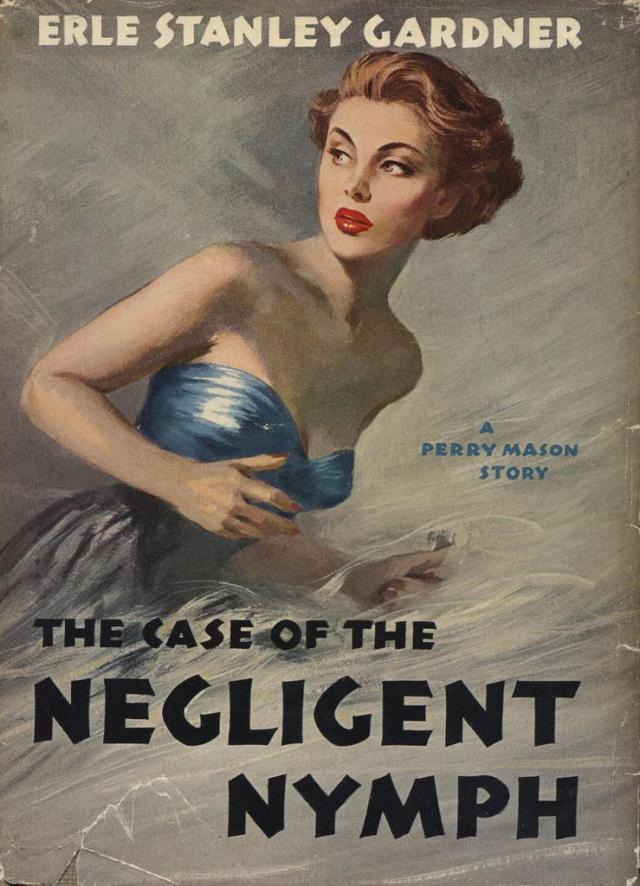


The Case of the
Negligent Nymph
Erle Stanley Gardner
Foreword
While writing “The Case of the Negligent Nymph” I was investigating two real-life murder cases, the bizarre ramifications of which rival any of the plots I have created in fiction.
Three outstanding criminologists have been associated with me in these investigations—Dr. Le Moyne Snyder, physician and surgeon, attorney-at-law, internationally known criminologist; Raymond Schindler, the famous private detective, and the late Leonarde Keeler, whose sudden and unexpected death, news of which has just reached me, has been a great shock to all of us.
Some months ago, Harry Steeger, the editor and co-owner of Argosy Magazine, accompanied me on a trip down the wild, rugged peninsula of Baja, California. During the long evenings while the blaze of our camp-fires illuminated the weird branches of the cardon trees, we discussed two of the cases I had handled during my career as a lawyer where I had befriended penniless unfortunates who had been wrongfully convicted of crime.
Steeger told me that if I ever encountered any more such cases which I wished to investigate, Argosy Magazine would co-operate with us in every way.
I realized that the only way such a national magazine could help penniless persons who had been wrongfully convicted, yet had exhausted all their legal remedies, was by having a board of experts investigate such cases. It was, of course, necessary that the men composing such a board be of such stature in their profession that their opinions would carry the greatest weight.
I approached Dr. Le Moyne Snyder, Leonarde Keeler and Raymond Schindler. These men promptly agreed to co-operate with us in every way.
To date, two cases have been fully investigated and duly reported in Argosy in a department that is called “The Court of Last Resort.” In both of these cases the magazine was able to show that the men had been improperly convicted. In one case, the man had served thirteen years on a life sentence for murder. In the other, the man had been in the penitentiary for more than five years on a sentence of manslaughter.
Both men were released by the authorities.
It is a stupendous undertaking to re-open a case after it has finally been closed and the defendant has been convicted. There is, in fact, virtually no legal way in which this can be accomplished. We are forced to find clues the authorities overlooked, and convince the pardoning powers of the true facts. To re-examine reams of musty evidence, to try to run down stale clues on a cold trail means the expenditure of enormous effort, time and money. As cases continue to pour in, we find that our time is taxed to the limit trying to make even a preliminary appraisal in order to select the most worthy cases for investigation.
Yet there is the greatest satisfaction to be derived from this work and it has a thrill and excitement all its own.
While all of us are serving without compensation, Argosy has furnished the money to pay for transcripts, depositions, traveling expenses, etc.
The work has provided us with thrills aplenty, and many the night we have paced the floor debating our best procedure, digging into huge volumes of printed transcript, debating the significance of clues which had been overlooked or misconstrued.
During the writing of this book I have been literally ‘up to my neck” in two other cases, one a case on the Pacific Coast, where I have been working with Raymond Schindler; the other a case in Michigan, where I have been working with Dr. Snyder.
The case on the Pacific Coast involves two men charged with a first-degree murder for which the District Attorney refused to prosecute them on the ground that :hey had committed no crime. Yet, special prosecutors were appointed and the men were convicted, sentenced to death, the sentence commuted to life imprisonment, and the men have been in prison for some thirteen years.
In the Michigan case, Rabbi Joshua S. Sperka of Detroit consulted us about a penniless Jewish prisoner who lad been in the Jackson penitentiary for seventeen years an a life sentence for murder. Our investigations, pubished in Argosy, caused the prosecutor to launch an independent investigation, as a result of which he has stated publicly he now believes the man was wrongfully convicted.
As I write this, the prosecutor has filed a petition in court asking that a new trial be granted this man and the entire case reopened, a move which is absolutely without precedent in the state’s history.
And because I would like to make some public acknowledgment of my thanks and appreciation to these associates of mine who have made such sacrifices, to Argosy Magazine, to Harry Steeger, editor and co-owner, and Harold Goldsmith, his partner, I am dedicating this book to Argosy’s “Court of Last Resort,” and to the men who have made it possible.
Erie Stanley Gardner
October 1949
Chapter 1
From his rented canoe Perry Mason sized up the Alder estate as a general sizes up a prospective battlefield.
The moon, a few days past the full, made a shimmering path of silver in the east, and served to illuminate Mason’s objective, an island connected with the mainland by a fifty-foot steel-and-concrete bridge.
On that island George S. Alder’s huge two-storied mansion faced the narrow channel, as a castle might look down upon its protecting moat.
Fencing off the estate from the curious eyes of passers-by on the mainland was a brick wall topped with wrought iron and studded with broken glass. On the bay side were signs warning trespassers they would be prosecuted. A long wharf ran out into the sluggish waters, a sandspit on the northern side gave a crescent-shaped bathing beach and, back of that, a well-kept lawn became a velvety green carpet, thanks to the aid of loam which had been trucked in at great expense.
Alder’s legal position seemed, at least on the surface, to be fully as impregnable as the island estate which isolated him and his wealth from the mainland. But Perry Mason was by no means an ordinary lawyer. It was never his policy to attack where the enemy expected the blow to fall. Rather, he preferred to devise some ingenious objective all his own. Hence his nocturnal survey of the place which meant more to Alder than all of the far-flung empire which he controlled.
On this particular evening Alder was entertaining, and, for the most part, his guests had evidently come from the two large, seagoing yachts which were riding their moorings a quarter of a mile offshore. Two power launches, rich with polished mahogany, gleaming with burnished brass, were tied up at the private wharf of the Alder estate. And rumor had it that beams of invisible light guarded this wharf so that the moment any craft approached within ten feet an alarm sounded automatically, floodlights blazed into brilliance, and a powerful siren sent out its piercing scream.
Mason silently paddled his canoe close to the sand-spit, studying the contours.
A hooded electric light was fastened to a board sign in such a manner that it illuminated the legend painted in red letters. These letters could be read a hundred and fifty feet away: “private property, no trespassing—beware of vicious dogs who will attack trespassers on sight. keep off!”
It was at this point in his survey that Mason suddenly became conscious of the swimmer.
Apparently the figure had not as yet seen the canoe, but was drifting along down the tide with slow, evenly timed, powerful strokes.
Mason, suddenly curious, held his canoe steady against the slowly ebbing tide and watched.
The figure landed on the sandspit within a few feet of the illuminated sign. Moonlight and the illumination from the sign were sufficient to show that the swimmer was a woman. She had apparently been swimming in the nude with a small waterproof sack tied to her back. From this sack she removed a bath towel with which she dried her slender, athletic body. Then she produced stockings, shoes, and a low-cut evening gown.
Fascinated, Mason shipped his dripping paddle into the rented canoe, took night glasses from their case and raised the binoculars to his eyes.
He could see that she was blondish, good-looking and apparently completely assured.
She was not hurrying, nor was she loitering. She was as calmly unrushed as though she had been dressing at home in front of a mirror, and, once she had adjusted the sleeveless, strapless gown, she made up her face by the aid of a compact, using the light from the warning sign to guide her.
Having completed the make-up to her satisfaction, she left the waterproof bag on the ground, draped the wet bath towel over the support which held the light above the warning sign, and started walking toward the house, following a flagstone path which wound its way across the green of the lawn.
From the house came an occasional sound of isolated shrill women’s laughter, the patter of voices, an occasional burst of general merriment.
Quite evidently the guests of George S. Alder were enjoying themselves, and it seemed equally evident that they had no reason to anticipate that an attractive guest who had arrived at the island by such surreptitious means was about to join them.
Fascinated, Mason watched through his binoculars, noticing the young woman’s smooth-hipped walk, her easy assurance as, with the long skirt of her gown draped over her arm, she calmly followed the flagstoned path until she was at length swallowed in the shadow of the house.
The lawyer sat in his canoe, binoculars ready, waiting. There was no slightest indication from the house that any untoward events were in the making.
For some fifteen minutes Mason sat watching and waiting, studying the house with his binoculars, from time to time thrusting the paddle into the wa
ter to hold the canoe against the tide while he awaited developments.
There was, of course, the possibility that this latest arrival was either an invited guest or someone who was sufficiently acquainted with the household to be certain of her welcome, but in either event she would hardly have left the waterproof bag and the towel there by the illuminated sign.
Mason glanced impatiently at the luminous dial of his wrist watch. It was getting late, and he wanted to return the canoe and get back to town. He had surveyed the accretion line of the sandspit enough to form a definite plan of action. Within the next few days George S. Alder would be given a jolt which would cause him considerable inconvenience. Yet, at the moment, the lawyer dared not leave. He could not overlook the potential possibilities inherent in this surreptitious visitor who had appeared swimming out of the darkness with the deft stroke of one who is as much at home in the water as on land. Certainly there was something …
Suddenly Mason heard the barking of a dog. It was the excited, hysterical barking of an animal lunging against his chain.
Abruptly, lights flashed on in some of the back rooms of the Alder mansion. Mason heard shouting, the renewed barking of the dog.
Balancing himself in the canoe, the lawyer studied the house through his binoculars.
The figure of the young woman appeared at one of the windows. She slid over the sill and lowered herself. The long skirt momentarily caught on the window sill, then she let go with her hands and, with a flutter of billowing skirts, dropped to the ground and started running.
First she ran toward one of the gates in the wall, then as the sound of shouting intensified in the house behind her, she veered back toward the water.
Through his binoculars, Mason could see men and women milling around in the room she had left so abruptly. Then he saw a man’s form framed against the window, heard him shout.
The words were unintelligible, but there could be no mistaking the tone of the man’s voice. It was a shout of discovery, and the tone was that which conveys understanding even to inarticulate, wild animals deeply hidden in brush, which at the sound of that note of triumphant discovery in the voice of the hunter automatically leap into startled flight.
The girl was running in a sheer panic now, coming straight toward the water, heedless of the towel and the white waterproof bag which she had left when she came ashore.
For a moment the man stood in the window, shouting, then he abruptly vanished.
The barking of the dog reached a shrill crescendo, then suddenly stopped.
Mason glanced from the running woman, who was sprinting directly toward his canoe, back to the window.
Suddenly he realized why the dog had stopped barking. The man had unchained him.
A dark streak of motion came hurtling through the window. For a moment, Mason’s binoculars clearly showed the form of a Doberman pinscher as it sailed out in a great leap. Then the animal struck the ground and wasted a few precious seconds picking up the trail of the fugitive, following scent and running toward the gate.
All at once the dog saw the fleeing figure and in powerful surging leaps, he came bounding across the lawn.
The girl splashed into the water.
Mason could see that she was holding some object in her right hand. Her left hand grabbed up the folds of her skirt. She made four or five long, splashing jumps, then, falling headlong as the water deepened, started to swim.
The dog, running silently, reached the edge of the lawn, cleared the short strip of sandy beach, made a long, flying leap into the water, and started swimming.
He was close enough so that Mason could hear the little whining noises of eagerness in the animal’s throat as it swam with shoulders high out of the water.
The frantic young woman had crossed the bow of Mason’s canoe, apparently without seeing it. The dog, in deep water, was now less sure of himself.
Thrusting the blade of his paddle into the water, Mason shot the canoe into the space between the girl and the pursuing dog. With the paddle he pushed against the dog’s shoulder, swinging him around so that the animal was pointed back toward the shore.
The dog gave a growling, angry bark, whirled and grabbed the blade of the paddle with his teeth, hung on.
Mason twisted the paddle, turning the dog over in the water, forcing him to let go his hold.
For a moment, with the water in his eyes, the dog was confused. Then he started swimming once more, powerfully, purposefully.
Again Mason pushed the dog completely around. Again the dog snapped at the blade of the paddle.
The young woman, now aware of what was going on, was using all her strength to put distance between herself and the dog.
The third time Mason pushed his paddle against the swimming animal. The dog once more grabbed the blade of the paddle. Once more, Mason twisted him over on his back, held him momentarily under water, and this time when the confused animal reached the surface he was swimming back toward the island.
Mason turned the canoe, sent it swiftly to the exhausted girl.
“Get in,” he said. “Climb in over the bow so you don’t upset us.”
She glanced over her shoulder to look at him, a swift, desperate appraisal. Then, as though realizing she had no other alternative, she raised her right hand, dropped something into the bow of the canoe. Then, catching hold of the bow with two hands, one on each side, she suddenly raised herself with a powerful thrust of strong young arms, and came over the bow, sliding along to lie momentarily flat on her stomach, kicking her legs clear of the water. Then she rolled over with a swift, lithe motion, doubled her knees in under her, pulled down her wet dress and said gaspingly, “I don’t know … who you are … but you’d better paddle like hell!”
Flashlights, flickering like fireflies, appeared on the shore, and Mason heard someone shout, “There she is! She’s swimming.”
After a second or two, another voice said, “No, it’s the dog. He’s coming back!”
The flashlights momentarily converged on the dog, then raised, and questing beams circled out over the dark waters.
One of the more powerful flashlights caught the canoe. Mason promptly ceased paddling, kept his back turned, his face down, and said to the girl, “Better keep your head down.”
“I know,” she said, her head lowered. “Damn these low necklines. I would, have to be betrayed by the styles … I feel as prominent as a silk hat at snowballing time … Wish I had something that would cover up these shoulders.”
A man’s voice from the shore shouted, “There’s a boat out there. That’s a boat, I tell you!”
For a few moments the flashlight held the canoe, then lost it, and circled blindly as the searchers failed to make allowance for the drifting tide.
Mason used the paddle once more, sending the canoe out farther from the shore and down the bay, speeding along on the tide.
“Well?” he asked, at length.
She said, “Thanks for the buggy ride. Only it’s a canoe.
“I’m afraid,” Mason told her, “it’s going to take a little more than that.”
“To do what?”
“To square things.”
“What things?”
“My conscience, for one.”
“What’s the matter with your conscience? Is it unusually tender?”
“No. Only usually tender.”
She said, “Let me get my breath and I’ll tell you all about it.”
“Where do you want to go?”
“Out to my yacht. It’s a little job, the Kathy-Kay, and I’ll have to get my bearings to … ”
Mason said, “We’ll stay here on neutral territory until we know what the situation is. I acted on impulse. The sight of that dog dashing after you with bared fangs speeded my generous impulses.”
“What do you want to know?”
“Who you are, what you were after.”
“Oh, I see. You’re willing to be a dashing knight, but you also want to be a careful knight.”
“Exactly.”
“After all, you know, I’m an international gem thief and those are the dowager’s jewels I just tossed in the bottom of the canoe.”
“Intended as a joke,” Mason said, “but since it was your idea, we’ll investigate it.”
“Oh, all right,” she said. “I’ll tell you, but give me a few seconds to catch my breath.” She remembered to exaggerate her breathlessness while she fought for time.















