

The case of the foot loo.., p.1
The Case of the Foot-Loose Doll,
p.1
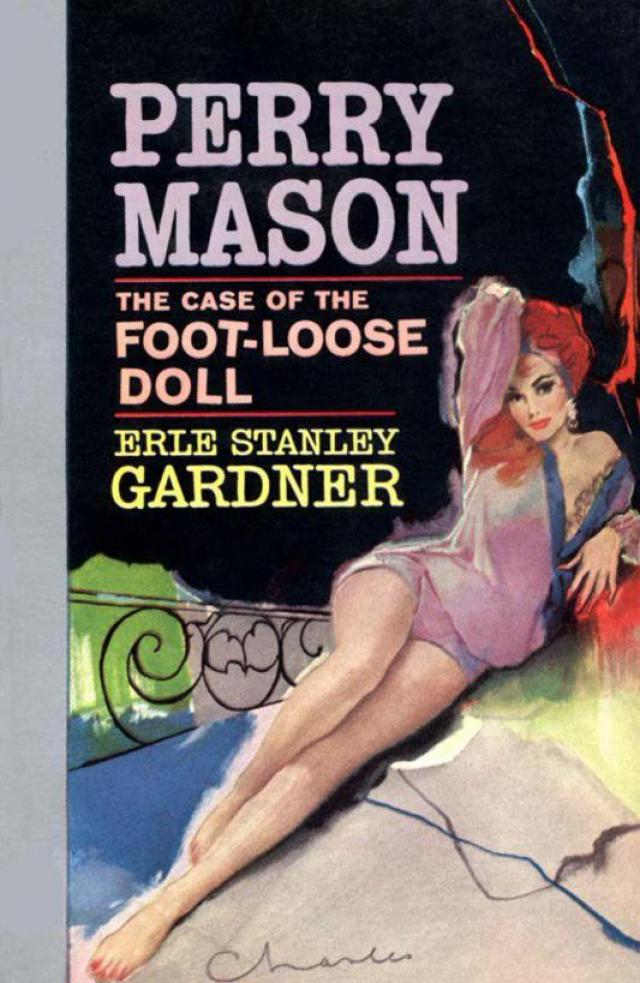


The Case of the
Foot-Loose Doll
by
Erle Stanley Gardner
Copyright © 1958 Erle Stanley Gardner. Renewed 1986 Jean Bethel Gardner and Grace Naso
Electronic Book: Copyright © 2012 by The Erle Stanley Gardner Literary Trust
All rights reserved.
Contents
Copyright
Foreword
Cast of Characters
Chapter 1
Chapter 2
Chapter 3
Chapter 4
Chapter 5
Chapter 6
Chapter 7
Chapter 8
Chapter 9
Chapter 10
Chapter 11
Chapter 12
Chapter 13
Chapter 14
Chapter 15
Chapter 16
Chapter 17
Chapter 18
About the Author
FOREWORD
Every once in a while a man comes along with a new idea. Unfortunately many of these men with new ideas are theorists. Their ideas may be sound but they are allowed to remain in the realm of theory for too long a period of incubation, and the egg spoils before the idea hatches.
Once in a blue moon a man comes along who combines a new idea with the executive ability to put it into execution before the period of incubation expires.
My friend, Theodore J. Curphey, M.D., Coroner of Los Angeles County, is such a man.
His idea is to get legal medicine put on a practical plane and made a part of the highly complex civilization of today so that it functions smoothly in a variety of fields.
Dr. Curphey points out that today over 80 per cent of law suits involve personal injuries in which the medical aspects of the cases are the deciding issue of the litigation; that in large centers of population there are far too many deaths involving criminal violence where the autopsies do not take advantage of all of the currently available scientific methods of crime detection. (The result of this is that not only do major crimes frequently escape detection, but in too many instances innocent persons are falsely charged with and convicted of crimes they did not commit.)
There is nothing startling about these basic ideas. The thing that furnishes the element of novelty is the manner in which Dr. Curphey proposes to put some of his plans into execution.
Space is not available to list these methods in detail. Suffice it to say that Dr. Curphey recognizes the swarming, teeming, heavily populated County of Los Angeles as being one of the best places in the country to demonstrate his ideas.
He accepted an appointment as Coroner of Los Angeles with the deliberate intention of getting the three medical schools in the district to unite with the law schools as well as with the police and sheriffs’ departments in planning a constructive program; of bringing legal knowledge and medical knowledge into a practical partnership; establishing an Institute of Legal Medicine; forming advisory committees to study problems dealing with industrial deaths, maternal deaths, deaths from anesthesia, problems concerning the relationship between the coroner’s office and the hospitals, and funeral directors and the coroner’s office.
Dr. Curphey also wants to have practical training for undergraduate students in the joint field of law and medicine, a better understanding of the possibilities of legal medicine by the investigative officers and a better understanding of police methods and responsibilities by members of the medical profession.
These objectives are highly important, not only to the County of Los Angeles, but as part of a general public awakening to the importance of legal medicine.
There is something in the practical, two-fisted way Dr. Curphey has accepted the challenge of the problems at the Los Angeles Coroner’s Office, has outlined his objectives, and gone about realizing those objectives, that indicates executive ability of a high order, added, of course, to highly professional competency in the intricate field of pathology and legal medicine.
So it is with great pleasure that I dedicate this book to my friend:
THEODORE J. CURPHEY, M.D.
—Erle Stanley Gardner
CAST OF CHARACTERS
MILDRED CREST—A bright young stenographer, she was envied by her friends—until she lost her engagement ring and her identity, and gained herself a charge of first-degree murder
ROBERT JOINER—An accountant with savoir-faire, he was not only the most eligible bachelor in town, but an embezzler on the side
FERN DRISCOLL—A tall, chestnut-haired secretary, she started trouble when she fell in love with the boss’s son
CARL HARROD—An opportunistic insurance investigator, he called blackmail an ugly word—but he practiced it to the letter in collecting information for a scandal magazine
PERRY MASON—The rugged criminal lawyer took on a case of misrepresentation for a five-cent fee and wound up getting more surprises than he doled out to his client
DELLA STREET—Perry’s wary-eyed secretary played with perjury charges when she followed his instructions; her arithmetic came in handy when she purchased ice picks
KITTY BAYLOR—A young graduate student with outstanding bone structure, she was unpretentious about her father’s millions but positive that a hatpin was an outmoded weapon for a woman
NELLIE ELLISTON—A tough, well-shod “wife,” she saw much to gain by going a little farther than her husband suggested
PAUL DRAKE—The long-limbed, poker-faced detective did much of Perry’s paperwork, and the answers he came up with were not always reassuring
HARRIMAN BAYLOR—A stocky, bushy-browed executive, Kitty’s father did everything in a big way, including filling up a column of Who’s Who; his arrogance was great, but his fear of a family scandal was greater
IRMA KARNES—The bespectacled counter manager at a penny arcade, she was suddenly catapulted into the public eye when she sold six ice picks on a routine night
FORRIE BAYLOR—Kitty’s wavy-haired and distinguished-looking brother, his test of true love came almost too late
Chapter 1
At fifteen minutes past two o’clock that afternoon, Mildred Crest’s world collapsed about her in a wreckage which left her so completely dazed that her mind became numb and her reasoning faculties simply failed to function.
At two o’clock that afternoon Mildred had been one of the happiest young women in the bustling town of Oceanside, California.
The expensive diamond which flashed from the ring finger of her left hand betokened her engagement to Robert Joiner, head accountant at the firm of Pillsbury & Maxwell, the big department store which had branches located in half a dozen southern California cities.
Joiner had arrived in Oceanside something over two years before. He had started in as bookkeeper and his advancement had been rapid. He had a quick, resourceful mind, was instantly adaptable to any new situation, and above all was not afraid of responsibility. He had complete confidence in his own judgment and soon his employers were sharing that confidence.
An entertaining conversationalist and a good hand at keeping the ball rolling at any party, Joiner was a social asset. He was considered by far the most eligible young bachelor in the community.
Mildred’s engagement to him had had the effect of a bombshell in social circles, and for three months she had been veritably walking on air.
Then at two-fifteen Mildred had been summoned from her secretarial desk to take a personal call.
She felt certain it was from Robert, and was mildly annoyed because he knew the management frowned on employees accepting personal calls during business hours. Not only did it detract from their efficiency, but it tied up the lines on the switchboard. However, it was like Robert Joiner to push the rules to one side.
His voice held no hint of anything portentous. He sounded as casual and glib as ever.
“Hello, babe! How’s the demon secretary?”
“Fine, Bob. Only—You know about calls here…. Only urgent matters…. I’m sorry—”
“Pay it no heed,” Robert interrupted. “That is just an idea of the big brass to emphasize their own importance. And in a way this matter is urgent.”
“Yes?” she asked.
“As of this moment,” Bob said, “our engagement is annulled, canceled, discontinued, terminated, and rescinded. You are to keep the diamond ring and any other presents, and I trust, happy memories of a glorious three months.”
“Bob, what on earth …? What are you saying? What’s the matter? What—?”
“The ponies, babe, blame it on the ponies,” he said. “You never guessed it, but I happen to be a gambler, and this was a nice gamble. I like to take chances even when they don’t work out. Let the other man go through the humdrum routine of an ordinary existence with slow, painful, plodding steps up the ladder of success! I like skyrockets, baby. I like to shoot for the high places, and I like to work fast.”
“Bob, but your family….”
“The myth of my wealthy family back East was simply a background to justify what otherwise would doubtless have been considered extravagances on the part of an accountant working on a salary. My system of playing the ponies furnished a lucrative sideline until suddenly something went sour and I’m damned if I know what it was.
“I started by borrowing from company funds and paid back when the system began to pay off. Then I got pretty deep into company funds again and suddenly realized I was up against an audit. There were a couple of suspicious circum
stances, matters of sheer carelessness on my part. So I picked up all the loose cash that was lying around, threw the system out of the window and shot the works on a hot tip at Santa Anita today. A few moments ago the goat came in fourth!”
“Robert, is this some sort of a joke?” Mildred demanded. “Is this one of your psychological tests to get people’s reactions? Because, if it is, you’ve upset me for the rest of the afternoon.”
“Let’s hope it won’t be any worse than that,” Joiner said jauntily. “I confess that I feel a twinge of conscience about you. You’ve been a sweet girl, Millie, and a wonderful pal. But realities are realities, and we may as well face them. Even if I am an embezzler with detection inevitable, I have no intention of putting on an act of tearful repentance, facing the contempt of all the dull clods who formerly looked up to me with envious admiration. I have no desire to throw myself on the mercy of the court, to ask for probation, and promise restitution.
“Since discovery is inevitable, I have decided to make my embezzlement worth while. I have taken everything around here that isn’t nailed down. I started for the bank with the stated purpose of depositing funds, and from there I made several carefully thought out maneuvers which are going to make my trail very difficult to follow. Frankly, Millie, I’m willing to bet five to one that they can’t ever put their hands on me.
“I’ll be expected back at the office momentarily, and by three o’clock they will wonder what has happened to me. This is just to tell you that, if they should call you during the afternoon, you can tell them very curtly that our engagement has been broken; that you have no knowledge as to my whereabouts and no further interest in my actions.
“Of course, something like this was inevitable sooner or later. I can’t see myself cast in the role of a dutiful husband or a fond parent making sacrifices to put brats through college. Frankly, even the last three weeks of our engagement have been a trifle irksome. You have been sweet and I have had a swell time, but essentially, I’m a roamer and I don’t want to be tied down—to anyone. So, that’s the story, and now, because the minions of the law will be barking on my trail at any moment, I have to hang up. Good-by and good luck!”
The phone clicked.
Somehow Mildred found her way back to her desk.
A sense of loyalty to her employers kept her hammering away at her typewriter until she had finished the important letter on which she was working. When she took the letter in for signature, her white face and trembling hands attracted attention. She said she felt ill and was told to go home for the rest of the day.
All she could think of was getting away for a time. She dreaded having to face the patronizing sympathy of the other girls in the office. She had a few friends who would stand by her loyally, but there were others whose noses had been put out of joint by the announcement of her engagement to Bob, and they would derive too much satisfaction from rubbing it in.
Mildred only wanted to crawl in a hole and pull the hole in after her.
Mildred went at once to the bank. She cashed the pay check she had received the day before, drew out every penny of her savings account, returned to her apartment, bathed, put on her newest traveling outfit.
At four-forty the phone rang. It was the general manager of Pillsbury & Maxwell. He was concerned about Robert Joiner.
Mildred said coldly that she knew nothing of Mr. Joiner’s whereabouts, that her engagement had been broken, that she was no longer interested in Mr. Joiner, and then suddenly in the midst of the conversation, found herself crying. After a few choking attempts to carry on the conversation, she had slipped the receiver into place, hoping that the manager would think he had been cut off.
The manager showed his sympathetic understanding by not calling back.
Mildred had no desire for dinner. The thought of meeting someone whom she knew and to whom she might have to make explanations was intolerable.
Now that the blow had fallen, she realized that for the past few weeks there had been something wrong. Looking back, she could recall a hundred things that should have warned her, but she had been too happy, too willing to accept glib explanations at face value.
Robert had never been one to talk of himself. He always kept his association with her on a plane of jaunty superiority. From the beginning she had sensed that he had an intense aversion to having anyone pry into his private affairs. He would volunteer such information as he wished to give, but resented any questions seeking additional information.
She had been so dominated by the man, his poise, his self-assurance, his clever mind, that she had simply drifted along.
Mildred wished now that she had gone directly to her boss that afternoon and told him the whole story. She wished that she had called Pillsbury & Maxwell and told them what had happened.
Because she had not, she now found herself in an impossible situation. The thought of what was bound to happen the next day threw her into a tailspin.
Dimly she realized that her mind was going around in circles, that in her present emotional state she couldn’t trust her own decisions. If she could just escape from everything. It was under such circumstances that the mind in a merciful attempt to escape too difficult problems resorted to the defense of amnesia. If she could just sink into amnesia, but she knew she couldn’t deliberately induce amnesia.
Mildred slipped on her jacket, picked up her purse, and started for the parking lot. She found her car and started driving inland, driving somewhat aimlessly, not knowing where she was going or what she was going to do.
She remembered a story she had heard about two years before from a friend who liked to tell horror stories. It was about an earthquake he had seen in South America, and a beautiful young girl, the belle of the town, who yielded to panic. She had jumped in her new automobile and taken off down the road, trying to escape the crumbling walls of the buildings and the threat of a rocky avalanche from the mountainside.
A huge crack had opened up, cutting across the road as a gaping chasm. The screaming girl and the new, shiny automobile had plunged into this cleft in the earth. Then, as though it had only been waiting for its human prey, the crack had closed with a grinding, rumbling noise. The earthquake subsided. Where the crack had been was only a pressure ridge of earth and rocks and the crumbled blocks of the paved highway.
Now Mildred almost wished that some terrific earthquake would open up a chasm in the earth directly in front of her car so that she, too, could disappear. Her one desire was to sever all connections with the past, to vanish without a trace. When you had to work to live, however, in these days of social security numbers, driving licenses and income tax returns, vanishing into oblivion was no easy matter.
Then slowly she began to realize she dared not even try to escape from her past life or to disappear. A simple disappearance would only make it appear she had been Bob Joiner’s accomplice in his embezzlements, and she must above all protect her reputation for honesty. She did not have to go back and face the music yet, however, and she needed time to build up her defenses against the sneers and laughter on the one hand and pity on the other that were surely awaiting her return to Oceanside.
After a few miles she glanced at her fuel gauge and realized she would need more gasoline. She stopped at a service station at Vista and while the attendant was filling the gas tank she noticed a young woman standing quietly by the side of the gas pumps.
At first Mildred thought she was the wife of the attendant. Then somehow she got the definite impression that something was very wrong. She felt the young woman’s eyes on her, studying her discreetly. Then the figure came forward diffidently.
“May I ask where you’re going?”
Mildred tried hard to bring her numbed mind to focus on the situation.
“I don’t know,” she said absently. “I’m just—going.”
“Could you give me a ride?”
Mildred said, “I’m sorry, but I’m not going anywhere in particular.”
“Neither am I.”
Mildred saw a woman of twenty-three or twenty-four, with brown eyes, brown hair, and about her own build. And she fancied she saw desperation and abject misery which indicated a fellow sufferer.
“Get in,” Mildred heard herself saying.















