

The case of the deadly t.., p.1
The Case of the Deadly Toy,
p.1
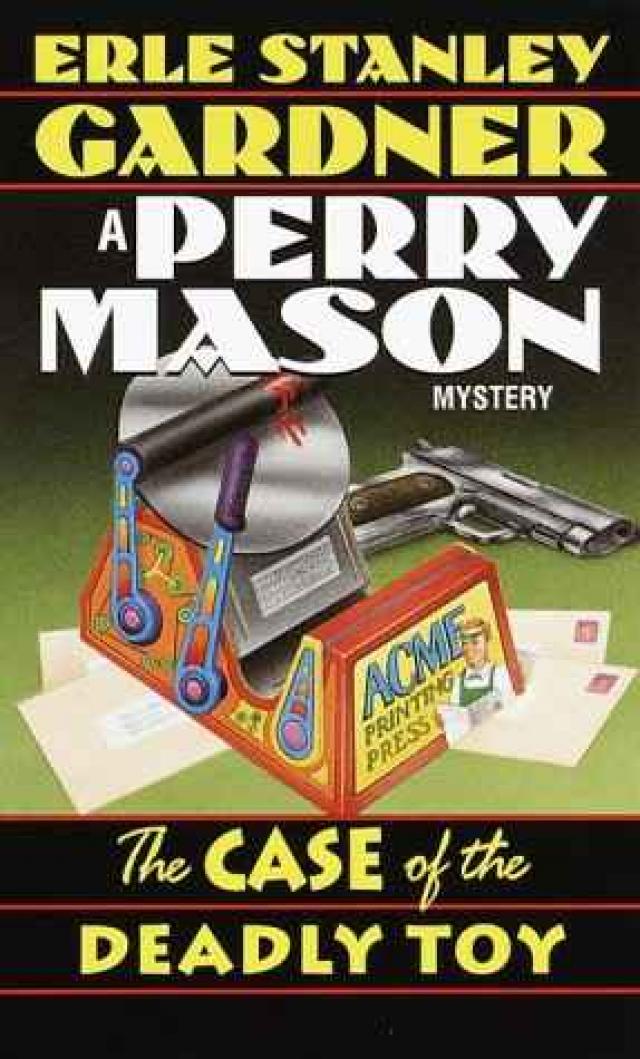


The Case of the
Deadly Toy
by
Erle Stanley Gardner
Copyright © 1959 by Erle Stanley Gardner. Renewed 1987 by Jean Bethel Gardner and Grace Naso.
Electronic Book: Copyright © 2012 by The Erle Stanley Gardner Literary Trust.
All rights reserved.
Contents
Copyright
Foreword
Cast of Characters
Chapter 1
Chapter 2
Chapter 3
Chapter 4
Chapter 5
Chapter 6
Chapter 7
Chapter 8
Chapter 9
Chapter 10
Chapter 11
Chapter 12
Chapter 13
Chapter 14
Chapter 15
Chapter 16
Chapter 17
Chapter 18
About the Author
FOREWORD
Some seven or eight years ago I met Dr. Lester Adelson when I attended a series of lectures given on legal medicine. He was then working under my good friend, Dr. Richard Ford, head of the Department of Legal Medicine at Harvard. Since that date I have watched Dr. Adelson’s career with great interest. He is at the moment with Dr. Samuel Gerber, the coroner of Cuyahoga County in Cleveland.
I can’t speak too highly of Dr. Adelson’s ability, character and achievements, but he doesn’t want me to speak of these. He wants me to tell something of the importance of legal medicine and what it means.
It is a mistake to believe that the forensic pathologist is always concerned with murder. It is a mistake to believe that autopsies are only for the dead. They are to help the living. There is another side to legal medicine. The courtroom side. It is a great mistake to let the highly partisan medical witness sway a jury to his way of thinking. The real scientist is never partisan.
When Dr. Adelson takes the witness stand it sometimes seems that the cross-examiner is scoring points. Actually he is doing nothing of the sort. Dr. Adelson doesn’t believe that simply because a doctor is subpoenaed by the prosecution or the defense, by the plaintiff or the defendant, he owes any allegiance whatever to the side that subpoenaed him.
Dr. Adelson’s creed is that an expert medical witness owes allegiance to only one master, and that is TRUTH.
As Dr. Adelson said in a letter to me, in which he discussed this problem, “Insofar as it is humanly possible, he (the medical witness) should refrain from taking sides or shading his testimony. An answer favorable to the defense during cross-examination should be given cheerfully and promptly, without equivocation or stalling.”
Quoting again from a letter in which Dr. Adelson outlined his ideas in regard to legal medicine and its importance to the public, these thoughts of his are in my opinion highly significant:
The forensic pathologist encounters many important problems not connected with a courtroom. The notion that the forensic pathologist deals only with homicide is a too narrow and obsolete view of his multifaceted day-to-day work. The modern medicolegal investigative office, whether it be called Coroner’s Office, Medical Examiner’s Office, or what you will, is in reality a public health office. Although it may appear paradoxical to equate an agency that deals exclusively with the dead with public health, basically the purpose of the office is to study the dead to help the living.
Actually today’s medico-legal office is a dynamic kinetic institution that can and should make a valuable and unique contribution to the community. While not for a moment minimizing the importance of homicide investigation, nonetheless murder and manslaughter account for but a small fraction (less than 4% in Cleveland) of the total case load. Accidental deaths of all types are equally deserving of study. They represent a tremendous wastage of human life. Post-mortem study frequently points the way towards measures which will prevent similar tragedies. This is true of traffic fatalities, industrial fatalities and lethal accidents in the home.
Suicide (self-murder, if you will) is twice as frequent as homicide and represents an equally untimely loss of human life. Study of these cases frequently yields data which indicate ante mortem tendencies towards self-destruction or furnish some explanation for the act, data which may give a measure of comfort to the bereaved family.
Sudden and unexpected death from natural causes may masquerade as suicide, homicide or accident and vice-versa. For many reasons it is essential that the true nature of these deaths be established. Moreover, sudden and unexpected natural death, whether it be the infant found in its crib or the previously apparently healthy adult stricken by coronary thrombosis, is a fertile field for research by the forensic pathologist in whose domain these catastrophic situations occur. Unsuspected infectious diseases, a threat to the community, may lead to sudden and unexpected death and thus present themselves to the forensic pathologist for consideration. Prompt and correct diagnosis leads to quick mobilization of prophylactic measures to prevent the development of other cases or finding them while there is still time for therapy.
Finally, the forensic pathologist has the responsibility of sharing his knowledge and experience and teaching those in a student status, undergraduate or postgraduate. The forensic autopsy table is probably the best point of departure for studying the effects of trauma, whether chemical, electrical, thermal or mechanical, on the human organism. Thoughtful observations in the post-mortem room point the way to rational treatment at the bedside.
In summary, the forensic pathologist studies those deaths where the public interest is involved. He is an impartial fact-finder in a most favorable position—he can rise above the partisan conflict Never should he invade the province of the jury or usurp the prerogatives of the prosecutor.
I have attended a good many murder trials. I have listened to a good many expert medical witnesses. Some of them have been fair, impartial and just; some of them partisan, clever and biased.
Unfortunately it is this latter type which is in great demand. Too many lawyers like to call expert witnesses who help them win cases. The highly articulate partisan “expert” is called again and again while the conscientious really impartial expert is left to spend his time in the laboratory.
I wish that every reader who sees these lines and who is subsequently called on to do jury duty would remember the above words of Dr. Adelson.
Whenever you hear one of these experts deliberately trying to advance one side of the case, trying to impress the jury, feeding it just as much propaganda as is possible with his testimony, think back on these words of Dr. Adelson, think back on his quiet dignity, his high standards of ethics, his devotion to truth, and his absolute fairness to both sides.
The glib partisan expert may win cases for the side that calls him, but men like Dr. Adelson are the ones who are advancing the welfare of mankind and who are slowly but surely bringing about a more dignified concept of courtroom testimony.
And so, with deep respect and admiration, I dedicate this book to my friend,
LESTER ADELSON, M.D.
—ERLE STANLEY GARDNER
CAST OF CHARACTERS
MERVIN SELKIRK—The rich son of a powerful man, he has perfect manners—and a lightly concealed sadistic streak
NORDA ALLISON—Breaking her engagement to Mervin was a good move, but soon after she begins to get very ominous letters
ROBERT SELKIRK—Mervin’s seven-year-old son, he is allowed a deadly plaything—a .22 pistol
NATHAN BENEDICT—Norda’s new suitor, he finds that their romance, and Norda’s life, are both threatened
LORRAINE SELKIRK JENNINGS—Mervin’s former wife, she desperately wants custody of her son Robert
BARTON JENNINGS—Lorraine’s new husband, he appears calm and substantial
PERRY MASON—Crack criminal lawyer whose responsibility to his client leads him into some strange byways
DELLA STREET—Mason’s confidential, executive, and private secretary—and his constant companion
PAUL DRAKE—Head of the Drake Detective Agency, and Mason’s old friend, he sends along a maiden in distress
MR. AND MRS. JONATHAN GALES—The Jennings’ next-door neighbors, they are disturbed to see Robert with a real gun—and even more disturbed by the blood on the sidewalk
LIEUTENANT TRAGG—The doughty Homicide man whose bark is worse than his bite—if he doesn’t suspect you of murder
HORACE LIVERMORE SELKIRK:—One of the most powerful men in California, Mervin’s father thought he could control anybody—until he met Perry Mason
HANNAH BASS—A babysitter with a strange notion of children’s toys
MISS M. ADRIAN—The sort of neighbor who hears all—and tells all
GRACE HALLUM—A babysitter asked to take her charge a long way—to Mexico City
MANLEY MARSHALL—Trial deputy for the district attorney’s office, he has an eye witness to a murder—but who did she see?
SERGEANT HOLCOMB—Of the police—thought his evidence was brilliant, until Mason began his cross-examination
HAMILTON BURGER—District Attorney beleaguered by Mason’s methods—and his results
MILLICENT BAILEY—A date with her boyfriend gave her a chance to see a murderer
Chapter 1
With the politeness that characterized everything he did, Mervin Selkirk said to Norda Allison, “Excuse me, please.”
Then he leaned forward and slapped the child’s face—hard.
“Little gentlemen,” he said to h
is seven-year-old son, “don’t interrupt when people are talking.”
Then Mervin Selkirk settled back in his chair, lit a cigarette, turned to Norda Allison and said, “As you were saying… ?”
But Norda couldn’t go on. She was looking at the hurt eyes of the child, and realized suddenly that that wasn’t the first time his father had slapped him like that.
Humiliated, fighting back bitter tears in order to be “a little man,” the boy turned away, paused in the doorway to say, “Excuse me, please,” then left the room.
“That’s his mother’s influence,” Mervin Selkirk explained. “She believes in discipline from a theoretical standpoint, but she can’t be bothered putting it into practical execution. Whenever Robert returns from visiting with her in Los Angeles, it’s a job getting him back on the beam.”
Suddenly in that instant Norda saw Mervin Selkirk in his true character. The indolent, smiling politeness, the affable courtesy of his manner, was a mask. Beneath the partially contemptuous, partially amused but always polite manner with which he regarded the world, was a sadistic streak, an inherent selfishness which covered itself with a veneer of extreme politeness.
Abruptly Norda was on her feet, stunned not only by her discovery, but by the clarity with which her new realization of Mervin’s character came into mental focus.
“I’m afraid I’m bushed, Mervin,” she said. “I’m going to have to leave you now. I’ve been fighting a beastly headache, and I’m going home to see if some aspirin and a little rest won’t help.”
He jumped up to stand beside her. His left hand reached out and caught her wrist in a tight grip.
“Your headache was rather sudden, Norda.”
“Yes.”
“Is there anything I can do?”
“No.”
He hesitated then, just as he had hesitated for a moment before slapping the child. She felt him gathering forces for an onslaught.
Then it came with no preliminary.
“So you can’t take it.”
“Can’t take what?”
“Disciplining a child. You’re a softie.”
“I’m not a softie, but there are ways of disciplining children,” she said. “Robert is sensitive; he’s intelligent and he’s proud. You could have waited until I had left and explained to him that it wasn’t gentlemanly to interrupt, then he’d have accepted the correction.
“You didn’t do that. You humiliated him in front of me. You undermined his self-respect, and—”
“That will do,” Mervin Selkirk said coldly. “I don’t need a lecture on parental discipline from an unmarried woman.”
“I think,” Norda said quietly, “I’m just beginning to really know you.”
“You don’t know me yet,” he told her, his eyes threatening and hard. “I want you, and what I want I get. Don’t think you can walk out on me. I’ve noticed lately that you’ve been talking quite a bit about that Benedict chap who works in the office with you. Perhaps you don’t realize how frequently you’re quoting him. It’s Nate this and Nate that—Remember this, Norda, you’ve announced your engagement to me. I won’t let any woman humiliate me. You’ve promised to marry me and you’re going through with it.”
For a moment his fingers were like steel on her wrists, his eyes were deadly. And then, almost instantly, the mask came back. He said contritely, “But I shouldn’t bother you with these things when you’re not feeling well. Come dear, I’ll take you home…. I’m really sorry about Robert. That is, I’m sorry if I hurt you. But, you see, I happen to know Robert quite well, and I think I know exactly how he should be handled.”
That night, after giving the matter a lot of thought, Norda wrote a formal letter breaking her engagement to Mervin Selkirk.
Three nights later she went out with Nathan Benedict for the first time. They went to the restaurant which Nate knew was Norda’s favorite. There was no incident. Two nights later Mervin called to ask if he might talk with her. “It won’t do any good,” she told him. “Anyway, I’m going out tonight.”
“With Nate?” he asked. “I understand you let him take you to our restaurant.”
“It’s none of your business,” she snapped and slammed the phone back into its cradle.
Later on when the phone rang repeatedly she didn’t answer it.
Nate came for her promptly at eight.
He was tall, slender in build, with wavy, dark-brown hair and expressive eyes. They went once more to the same restaurant.
There was some delay at the table reservation. It was suggested they wait in the cocktail lounge.
Norda didn’t see Mervin Selkirk until it was too late, nor could she swear afterward that he had actually thrust out his foot so that Nathan Benedict stumbled.
There were plenty of witnesses to what happened after that.
Mervin Selkirk got to his feet, said, “Watch who you’re pushing,” and hit Benedict flush on the jaw.
As Benedict went down with a broken jaw, two of Mervin’s friends, who were seated at the table, jumped up to grab his arms. “Take it easy, Merv,” one of them said.
There was a commotion, with waiters swarming around them, and eventually the police. Norda had been certain she had seen a glint of metal as Mervin Selkirk’s right hand had flashed across in that carefully timed, perfectly executed smash.
The surgeon who wired Benedict’s broken jaw was confident the injuries had been caused by brass knuckles. However, police had searched Selkirk at Norda’s insistence and had found no brass knuckles; nor were there any on the friend who was with Selkirk and who volunteered to let the police search him. The second friend who had been with Selkirk had disappeared before the police came. He had had an engagement, Selkirk explained and he didn’t want to be detained by a lot of formalities. He would, however, be available if anybody tried to make anything of it.
Selkirk’s story was quite simple. He had been sitting with his friends. His back was to the door. Benedict, in passing, had not only stepped on his foot, but had kicked back at his shin. He had got to his feet Benedict had doubled his fist. Mervin Selkirk admitted he had beat Benedict to the punch.
“What else was there to do?” he asked.
A week after that, Norda Allison began to get the letters. They were mailed from Los Angeles, sent air mail to San Francisco. They were in plain stamped envelopes. Each envelope contained newspaper clippings; sometimes one, sometimes two or three. All of the clippings dealt with stories of those tragedies which are so common in the press: The divorced husband who couldn’t live without his wife, who had followed her as she walked from the bus and shot her on the street. The jilted suitor who had gone on a drinking spree, had then invaded the apartment where his former fiancée lived and fired five shots into her body. The drink-crazed man who had walked into the office where his former girl friend was working, had said, “I can’t live without you. If I can’t have you, no one else will.” Desipite her screams and pleading, he had shot her through the head, then turned the gun on himself.
Norda, naturally, had seen such stories in the press, but since they hadn’t concerned her, she had read them casually. Now she was startled to find how many such cases could be assembled when one diligently clipped stories from the papers of half a dozen large cities.
She went to a lawyer. The lawyer called in the postal authorities. The postal authorities went to work and the letters continued to come.
It was impossible to get any proof. The person mailing the letters evidently wore gloves. There was never so much as the smudge of a fingerprint which could be developed in iodine vapor. The envelopes were mailed in drop boxes in various parts of Los Angeles. Norda Allison’s name and address had been set in type on a small but efficient printing machine, such as those frequently given children for Christmas.
At the suggestion of Norda’s lawyer, Lorraine Selkirk Jennings, Mervin’s divorced wife, who was now living in Los Angeles with her second husband, was consulted. She remembered having given Robert a very expensive printing press for Christmas the year before. Robert had taken it to San Francisco when he went to visit his father. It was still there. Mervin Selkirk had, it seemed, enjoyed the press even more than his son.
This information gave Norda’s lawyer ground for jubilation. “Now we’ll get him,” he gloated. Norda made an affidavit. Her attorney handled it from there. Police served a search warrant on Mervin Selkirk.















