

War lord of darkness, p.1
War Lord of Darkness,
p.1
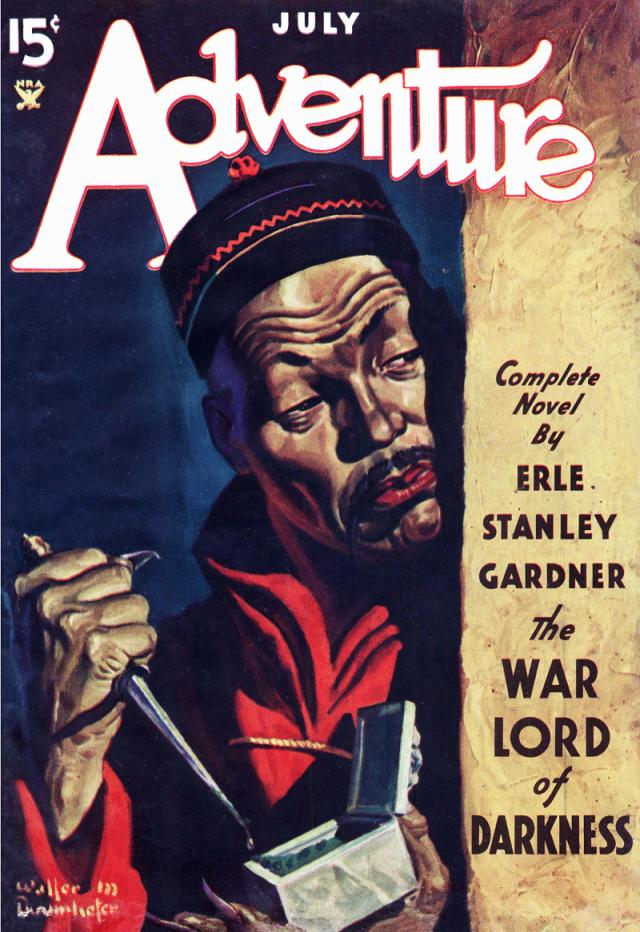


The War Lord of Darkness
ERLE STANLEY GARDNER
Threading its inert way awash among the anchored junks and sampans, a grisly memento of murder floated down a Chinese river to the sea. It was the body of a bandit victim, unknown, unmourned—but attached to one wrist was a glittering and mysterious metal object that owned the power to ruin armies and wreck a war.
The WAR LORD of
DARKNESS
Erle Stanley Gardner
A Complete Novel of Chinese Mystery
And Adventure
First Published in Adventure July 1934
"As A Complete Adventure Novel"
The War Lord of Darkness
Just opposite Canton and below Shameen the river boils into swift rapids up which the junks must stubbornly fight their way, unless their owners are affluent enough to pay the modest stipend charged by the noisy, puffing tug boats which string half a dozen junks together and pull them up to quieter waters.
Below the rapids lies a stretch of river given over to a queer confusion of traffic. There are huge unwieldy junks propelled by men plying long sweeps, assisted by polers who strain and grunt on the ends of bamboo poles. There are nervous, darting little sampans that seem barely to skim along the surface of the water. Narrow-beamed Chinese steamships, with smoke stacks that have a diameter equal to a third of the beam and a height equal to the length of the boat, bustle importantly back and forth, whistles screaming at every possible opportunity.
The hour was five-thirty P. M. It was summer. The day was insufferably hot. The western sun glinted from the river in dazzling reflection.
Along the banks of the river, many types of boats were moored. Here were the flower boats, with artistic ornamentations, where young women glanced beady-eyed invitation at the casual traveler. Here were the big amusement boats given over to banquets and parties, the square bows designed to hold banquet tables, the interiors lined with opium smoking couches, the high stems given over to cooking quarters.
A grayish object appeared in the rapids, bobbing serenely along.
The experienced eyes of the river boatman recognized it for what it was—a dead man.
Corpses awash are no unusual sight on this stretch of river. Farther upstream is a bandit-infested country, and human life yet remains the cheapest thing in China.
The body bobbed gaily down the rapids, whirled around at the bottom, then, swung by a side current, it drifted in close to the river boats which were moored at the edge of the stream.
The owner of a sampan, more venturesome than his brothers, pushed out to meet the bloated object.
Torn between fear and cupidity, he piloted his boat close to the thing which had once been a man. In a country given over to ancestor worship, there is much etiquette and some risk connected with such a maneuver. The ghost of such a man is a “homeless ghost” which is forced to wander about the world in a series of straight lines, looking for someone upon whom it may fasten itself. To become unduly attentive may result in a horrid bond with the homeless ghost.
On the other hand, it frequently happens that there is a small sum of money in the clothes of the deceased. In a country where one’s stomach feels the pinch of perpetual hunger, one is willing to take chances, even with ghosts.
But the owner of the sampan took one look and veered away. It was sufficient to show him the manner in which the man had met his death. One who has had his throat cut by the very efficient bandits of the upper river can hold out no hope of reward to a Cantonese boatman.
So the dead man bobbed along the river, dancing inertly along the sun-gilded ripples, all of the river traffic giving him clear road.
A family was holding a birthday celebration upon one of the big amusement boats. About three circular tables the diners kept up a steady din of hilarious conversation.
The bloated, inanimate thing swung sharply to one side, bore down upon the pleasure boat. One of the guests saw it and made a shrill comment.
Conversation ceased, and fifty pair of sharp eyes stared at the thing which threatened to bring ill omen upon the celebration.
Almost, the thing scraped the boat. Then, as though heeding the shrill cries of those who were imploring it to move away, it swept on past and moved again toward the center of the river.
But, as it slid along the surface of the dirty water, the sharp eyes of those on the boat caught the glitter of metal upon the right wrist. Someone cried out, and the keen ears of the owner of a sampan heard the cry.
In a country where the competition for livelihood is so keen, little things cannot be overlooked. The sampan darted. The boatman pushed down a long-handled net, swung the dead man in close to the boat, inspected the right arm for a moment, and then, with a swift flash of a knife, cut something loose from the swollen flesh.
The body, stripped of that which had glittered, was pushed once more into the current.
The venturesome boatman held in his hand an oval bit of metal upon one side of which was embossed the tower of a large building. Upon the other side appeared some printing and a number.
The boatman eyed it with avaricious appraisal. Of a certainty, this thing must be of value. It was not Chinese. It was in the language of the Bak Gwiee hoe. Therefore, the man must have secured it from some foreign devil. He would not have tied it around his wrist in this manner unless it had been of great value.
Since the thing was, obviously, the property of a white devil, the place where it would bring the largest price was in a sale to a white devil. The boatman made mental catalogue of such few white men as he knew and then, having fixed upon a plan of procedure, swung his sampan about and leaned lustily on the sculling oar.
All of which explained how it happened that Sam Mathews, of the Standard Oil Company in Canton, stared with speculative regard at an oval of metal, upon one side of which was shown the tower of the Traveler’s Insurance Company and on the other were words indicating that the owner of that tag was insured in the Traveler’s Insurance Company of Hartford, Connecticut, U. S. A., with the number of the insured’s policy.
The bit of oval retained the stench of decay. Quite obviously, this unfortunate Chinese whose throat had been so neatly split from ear to ear was not the owner of an insurance policy in the Traveler’s Insurance Company of Hartford Connecticut.
That night a messenger bore a sealed letter to the headquarters of the Standard Oil Company in Hongkong. Within twenty-four hours, cables had buzzed across the ocean, and the insurance company announced that the policy in question had been issued to one Charles Belter. That was the first authentic information which his friends in Hongkong had of the fate which had befallen Belter.
Some three weeks before, Belter had left upon an important mission to Canton. His mission required the payment of a relatively large sum of cash to certain persons who were in a position of political power. Belter had disappeared. The Cantonese politicians insisted that they had seen neither Belter nor his money. At the time, this had been taken as merely another bit of oriental wile, but now it appeared that Belter had pushed on up river, and that there something happened to him. Obviously, the floating body had been in the water for some days. In all probability, it must have come from the bandit-infested country upstream. It was reasonable to suppose that the unfortunate Chinese had met Charles Belter somewhere up river.
Where? What had happened? Where was Belter now?
The judgment of the little group in Hongkong was unanimous.
“Send for Jimmy Harder,” they said.
That night the cables buzzed with messages to Jimmy Harder at Shanghai.
With the cablegram which he had just received on the table in front of him, Jimmy Harder consulted a schedule of the shipping which was due out of the Port of Shanghai. That which he found was hardly encouraging. Two days later, one of the big Japanese boats would be sailing for the south. Three days later he could catch one of the crack Empress boats. Within two hours there sailed a Chinese coaster, the Patoma.
Harder summoned Mow Jie, a man who posed as a Chinese servant, but who was, in reality, more than a servant, a man who had shared many adventures, many dangers.
“We sail,” said Harder in Cantonese, “in two hours upon the Patoma. Do you, Mow Jie, arrange to be a deck passenger upon that boat and to take with you your two long ears.”
“For what sounds,” asked Mow Jie,
“shall I listen with these long ears?”
“To the voices of men,” Harder answered, “for therein lies wisdom.”
Mow Jie had originally had some more formal name, but in his infancy he had been seized with dangerous illness, and his parents, realizing that the evil gods were jealous of the man-child who had come to bless the parents and were intent upon taking him away, had resorted to that last Chinese expedient by which desperate parents seek to balk the malignant devils who would snatch young men-babies from their cribs.
These parents had placed the sick infant upon his side, had pierced one ear for an ear-ring, so that the evil ones might think it was a girl-child, and they had called the infant only by the name of Mow Jie, which meant “Little Cat,” so that the evil ones listening to the family conversations would never know that there was a man-child about, but would think that it was only an animal to whom the parents talked.
And by some strange whim of subconscious suggestion, Mow Jie had grown into a human cat. He had eyes that could see in the dark, ears that were abnormally acute, a sense of smell that was more than human, and he moved through the nig
ht upon feet of velvet.
“In two hours?” he asked.
“In two hours,” said Harder.
And Mow Jie left, to run upon his strangely silent feet with no further comment.
It has long been an axiom of tropical China that the white man who comes there has his choice between one of two alternatives. He can either slow down, or he can die. Jimmy Harder did neither.
A wiry man, slender and quick-moving, he was filled with dynamic energy. Despite the humidity of tropical China, he did not excessively perspire, and (therein lay the secret of his endurance.
There were various rumors about Jimmy Harder. Most of them were in direct conflict. This much was known: he was retained by some half dozen of the big firms who had large property investments in China. These firms naturally desired to pursue the even tenor of their profit-making ways. Such things as revolutions, banditry and kidnappings were bitterly distasteful to these corporations, and because China was China, and because even the most drastic steps taken by a vengeful government, seeking to secure redress for wrongs done to its nationals, are of no avail when it is impossible to find, let alone punish, the perpetrators of outrages, Jimmy Harder soon became an economic necessity.
He -had at one time been a cowpuncher. His dexterity with the braided cowhide rope which he kept in his trunk was well known. His skill with the heavy range gun, which quite frequently dangled from his hip in a low-hung holster, or was snugly concealed in a shoulder holster under his left armpit, was not so well known, but was shrewdly suspected. Not over five feet six in height, his weight somewhat under a hundred and forty, his quick motions, his springy step, his air of vibrant energy was in direct contrast to the soft drawl of his Texan speech.
Harder made the boat some fifteen minutes before sailing time, and, after relieving the sweating porters of his baggage, locked it in his stateroom and came up to the deck to get a breath of air and watch the preparations for casting loose.
She was a dirty packet, of the kind that is engaged in Chinese coastwise trade. The accommodations for first-class passengers, together with the navigating officers, were enclosed in a cage of steel bars. The general Chinese who shipped as deck-load passengers, were rigorously kept on the outer side of these bars. Only by carefully observing these precautions could a Chinese coaster continue in business. Otherwise, pirates would ship as deck passengers, watch their opportunity to overpower the navigating officers, and take the boat into some secluded bay for leisurely looting.
Harder was standing at the rail, staring moodily down into the muddy waters of the Whangpoo River, when he observed a rickshaw coolie run panting to the dock, fling himself back against the shafts of the rickshaw and come to a gasping stop.
A man of forty, fat, jovial, magnetic and perspiring, leisurely stepped from the rickshaw.
The bustle of activity which precedes the departure of a boat was already reaching its climax on the decks of the Patoma. The perspiring rickshaw coolie had evidently strained every muscle to reach the dock in time. His lean diaphragm heaved gasping breaths as he panted for air. His passenger seemed in no hurry whatever. A fat hand leisurely selected silver coins from the pocket of a sweat-soaked suit of Shantung pongee. The man dropped a single twenty cent piece of “small money” in the palm of the rickshaw coolie.
The coolie raised his voice in protest as his incredulous eyes stared at the minimum legal fee. When that protest had reached a wailing crescendo, the fat man took another silver piece from his hand, dropped it into the palm of the coolie and said simply, “Cumshaw.”
The man still continued to protest, but now his protestations had lost the edge of bitter indignation.
Another rickshaw appeared, filled with baggage. There was a similar scene of paying, of protest and of “Cumshaw.” Then porters started moving the man’s baggage to the Patoma.
The fat man leisurely strolled up the gangplank.
Ten seconds after his feet hit the deck, the gangplank was pulled in. The whistle bellowed steamy sound, and the hull of the boat shivered as the engines throbbed into quick motion.
Jimmy Harder felt eyes upon him, turned to see a young woman standing at the rail.
She was evidently American, apparently under thirty. In the States she would have been bright, alert and vivacious. But the tropics had placed its stamp upon her. Her eyes held a listless weariness. Her skin seemed tired with the effort of perpetual perspiration. But she managed a smile and said with impersonal friendliness to Jimmy, “That’s what I call cutting it close.”
Jimmy Harder removed his sun helmet from his head. He merely nodded, but the slow smile which accompanied the nod showed courteous appreciation of the comment and goodnatured agreement.
The fat man pushed his leisurely way up the stairs to the upper deck and stared at Jimmy Harder with hard, glittering eyes that seemed to have lost bubbling good nature in an attempt to make a quick readjustment of a delicate situation.
Jimmy nodded coolly, said nothing. The fat man bowed, walked to the opposite rail and placed his elbows on it. The girl moved closer.
“You know him?” she said.
“Yes, ma’am,” Harder said. “It’s been several months since I’ve seen him. He plays a good game of chess.”
“Who is he?”
“The name’s Ballinger—George Ballinger.”
“My name,” she said, “is Edith Min-ter. I’m touring the Orient with my brother. I guess the four of us are the only first-class passengers.”
“My name’s Harder,” Jimmy told her. “Where’s your brother?”
“He’s down in the stateroom trying to get the baggage in order.”
“If he waits a couple of hours,” Jimmy said, “he can breathe in the stateroom. If he ain’t careful, he’ll get a collapse, working down in a hot stateroom when the boat’s tied up at the dock.”
“You can’t reason with him,” she said. “He’s impulsive.”
Ballinger turned from the rail, came over and presented himself to Edith Minter.
He ignored Jimmy Harder, and Harder, in turn, kept his eyes on the swirling waters. After a few moments he raised his hat, bowed to Edith Minter and sought the lower deck.
She turned to Ballinger, regarded him with puzzled eyes, gave a low, nervous laugh.
“What a strange man,” she commented.
Ballinger said, “Yes, I’m going down to play chess with him in a few moments. He’s a wonderful chess player.”
“You’ve known each other?”
“For years,” Ballinger admitted, and laughed jovially. “Jimmy,” he said, “hates me with a deep and bitter hatred.”
“How interesting!” she said, a little bewildered.
“Oh, yes,” he said. “Jimmy condescends to play chess with me. Yon see, he regards me as an opponent in everything. He represents a bunch of big business interests who are trying to keep law and order in China.”
“And you?”
His laughed was booming and jovial.
“Jimmy thinks,” he said, “that I represent rather an unscrupulous firm that deals in munitions of war; that I make my own arrangements to sell and deliver these munitions and that the ultimate effect is to encourage banditry and wars.”
She stared at him searchingly.
“But doesn’t it?” she asked.
He shook his head.
“No, ma’am,” he told her gravely, “it doesn’t. It’s not the sale of munitions of war that makes for war; its underselling that causes war.”
“How do you mean?”
“If,” he said, “one force has twenty times as much munitions of war as another force has, there isn’t any fight. I sell all I can and promote peace and plenty.”
She laughed, both at his earnestness and at his sophistry.
“You’re going to be on this boat all the way to Hongkong?”
“That’s right,” he said, “and I wouldn’t doubt if we voyaged farther together.”
“You mean to Canton?”















