

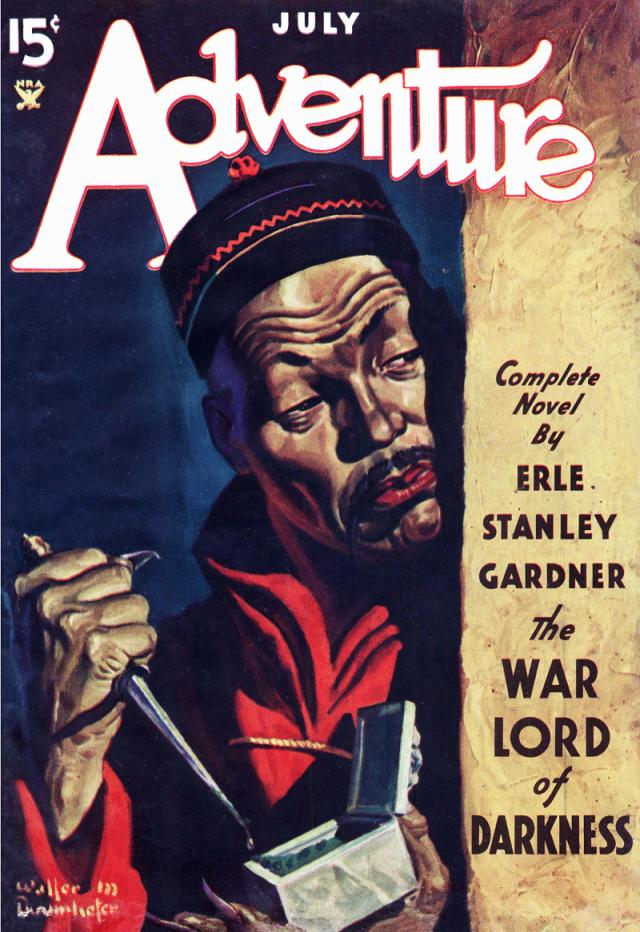
War lord of darkness, p.3
War Lord of Darkness,
p.3


“The fat swine tripped and fell,” one of the polers of the other junk reported. “Ai-i-i, ah-h-h, but they are awkward, these white devils. Fat as a larded pig, he is. He had no work to do, nothing but to sit all the day on a stool. And mark you what happened—he even fell from the stool and broke his arm. Ai-i-i, ah-h-h, but he is clumsy.”
“He goes back to Canton?” called Mow Jie, entering the conversation with the freemasonry of garrulous Chinese the world over.
“He goes back to Canton to see the white doctor in the mission. He cannot stand the pain. He is becoming quite drunk. How fortunate are these fat pigs who spend their lives sitting on stools and drinking liquor. Money he has in plenty.”
“Perhaps,” said Mow Jie cautiously, “the bandits would pay a good price for him, and then—”
“Ai-i-i, ah-h-h,” said the poler. “He is hard, this man. His left arm may be broken, but his right is not. He carries a big gun, and he knows how to us it. Moreover, who are we to deal with bandits? To be true, the bandits would give us a price for our fat pig, and then we, too, should become fat pigs made wealthy by the price that the bandits paid us. What would prevent the bandits from then cutting our throats in order to retrieve the money they had paid us?”
Mow Jie acknowledged the correctness of the other’s logic. “Blessed is poverty to the man with a full belly,” he said. “He may sleep in comfort, with no one to cut his throat.”
The polers bent to their task, urged by the sudden curses of George Ballinger, who stormed that his arm was paining him, and that ten thousand devils tortured his bones, and that the Cantonese police would levy a fine against the junk if it did not make the downstream trip to Canton before ten o’clock.
As the junks swung apart, Mow Jie’s chuckle reached Harder’s ears.
“He is very smart, this white ghost,” he said, “but he falls from his stool and breaks his arm, and now the gods of fortune have smiled upon us.”
The captain of the junk approached, clasped his hands together before his heart, agitated them gently.
“Such humble food as we have been able to prepare aboard our floating hovel,” he said, “is ready for your evening meal.”
His face perfectly expressionless, Harder said formally in Chinese, “You have prepared too much, ten times ten times too much.” Then, “and now we can eat in peace. There are no white ghosts preceding us up the river.”
The captain of the junk shook his head.
“There are two more”
Harder’s face remained impassive, but it was only because of an effort.
“Two more?”
“Yes,” said the captain, “a man and a woman. They arrived on the boat from Hongkong and went to the hotel at Shameen, but within an hour they were on their way up the river.”
Jimmy Harder turned away so that the Chinese might not see the baffled frown which creased his forehead.
To himself he swore a little in expressive English.
A moon in the first quarter, and the master of the junk kept the crew on duty until it became so dark as to make navigation hazardous. Then the junk slid in close to the bank and came to anchor. Weary men dropped at once to the hard boards of the deck, and fell instantly into slumber.
Jimmy Harder sat on a bit of bamboo matting, his legs crossed, the silken folds of his garments covering his arms and ankles against the insidious attack of the furry-winged mun jie which flew noiselessly along the deck of the junk, seldom rising more than an inch above the planks, mosquitoes that were almost invisible, utterly silent and exceedingly poisonous.
The moon went down; slid down into the darkness of the west. Night gripped the river with a veil of impenetrable blackness. Jimmy Harder put sook yen into the pewter bowl of the Chinese pipe. The oily tobacco sizzled against the hot metal, and the greasy smoke seeped from the comers of his mouth, filling the night air with a villainous odor. His mind was filled with disquieting thoughts.
A hundred yards up stream, another junk, also tied up for the night, swung slowly at the end of its anchor cable. It was too dark to see more than vague outlines, and on the rivers of China, when junks are strange to each other, it is a part of etiquette to keep a sufficient distance.
Harder’s eyes focused themselves absently upon the other junk, which showed merely as a black blotch against the grey darkness of that portion of the Western night, which, thanks to the setting moon, was not as yet completely impenetrable.
Suddenly he saw a flash from the deck of the junk, followed a moment later by the roar of a report. There were other flashes; other reports; the sound of shrill Chinese voices jabbering in terror, then the patter of bare feet on the deck, and the splash of something striking water.
A woman's scream rose high and shrill in the darkness.
Harder could have sworn that it was the scream of a white woman. He got to his feet, holding the forgotten pipe in his right hand, his eyes straining into the darkness.
There was the bellow of a man’s voice, and Harder knew at once that it was the voice of a white man. There were more flashes, and then the hubbub of rapid conversation. Harder thought for a moment that he could see a dark shape slipping silently by on the river, a shape that might have been a moving sampan covered with cloth to keep the light of the heavens from reflecting upon the polished deck of the tiny craft. There was, however, nothing tangible. He saw only a suggestion of darkness moving through darkness.
A voice spoke at his side.
“That,” Mow Jie said, “will be the man and his sister who moved on up the river.”
There had been no sound. Harder had no idea how Mow Jie had known where he was, or how he had reached his side with such silent efficiency, but he said without surprise, “Get the captain, Mow Jie. We will move up to the other junk and see what has happened.”
Sidney Minter had no idea that the Chinese silk merchant who had chartered the junk for a trip to the up-river monastery was, in reality, the white man whose chess playing had furnished him with so much interest on the trip from Shanghai to Hongkong, and so he conversed in Pidgin English, in the most approved style.
“My sister scream. I come topside. One piecee man makum shoot. I makum shoot. Two piecee men makum shoot. I shoot some more. Everybody shoot. My sister scream I go very fast place where she scream. No can find. One piecee man swing knife. I hit him my fist. Allee same knockum overboard. He make big splash. No more shots. I shout very loud no can find my sister. Somebody bring light, my sister gone. Must do something, must do something very quick.”
Jimmy Harder, squatting on the bamboo mat, puffiing meditatively upon the pipe, let his face show no faintest flicker of expression. He turned instead to Mow Jie and said in Cantonese, “Interpret to me the words of the white devil. I do not understand the meaningless rattle of the tongue against the top of his mouth.”
Mow Jie nodded and proceeded to elaborate upon the other’s speech, while Jimmy Harder’s face retained its placid repose, despite the anxious pleading scrutiny of Sidney Minter.
“Must do something,” Minter said. “My men no savee. My men very much frightened. My men say no can do. I say can do. Must do something very quick. Very much danger. Must find sister damn quick. Can do?”
Mow Jie answered him in the laconic fashion of the Chinese coolie who recognizes the utter impossibility of that which is hopeless.
“No can do.”
Harder, in Cantonese, said to Mow Jie, “Ask him why he and his sister came up the river.”
Mow Jie interpreted the question in Pidgin English.
Sidney Minter hesitated as though debating whether a falsehood was worth while. Then, apparently deciding that it was not, he said, “My uncle, Charles Belter, come up river and die. He leave big fortune, and no can get money unless can show he is dead. I get letter from one piecee man in Canton. He say come to Canton and he can show me my uncle dead.”
Mow Jie asked a direct question. “You come for money?”
Sidney Minter gave him a direct answer. “Come for money. Not see my uncle long time. I sorry he dead, but sometime he must die. Get his money now very good, wait too long for money, too many lawyers, too little money.”
Mow Jie grunted to show that he understood.
Jimmy Harder lowered his voice, and spoke in Chinese as though making a comment merely by way of suggestion.
“Wait a minute, Mow Jie, I think perhaps we have been tricked. I thought that I saw a sampan covered with a black cloth slipping along the water near our junk. My eyes are the eyes of a man, but your eyes are the eyes of a cat. What did you see?”
“I saw that which was black,” said Mow Jie, “moving upon the waters. It was a boat covered with a black cloth, passing close. My ears heard the sound of heavy breathing, the breathing which is made by a woman when a hand is held over her mouth.”
Harder said slowly, “This Fat One is very clever. He thinks of many schemes; his mind is full of trickery. I have studied him over the chess board, and I know the way he thinks. He lays traps.
“You see, we do not know that his arm was broken. He fell from a stool, and had the men tie up his arm with splints and put it in a sling. Then he told them to put back to Canton.
“After all, Little Cat, if this Fat One went to Canton, it was because he wished to go to Canton. By starting up the river, he has taken me out of Canton.”
Mow Jie grunted assent to the reasoning.
“There is danger,” Harder went on. “That danger is in Canton. This white man is as a child to China. Up the river there is safety. Where the Fat One is, is danger. Tell him that with the first coming of dawn, he is to go up the stream to look for his sister; that we will go back to Canton and report to the authorities.”
“Ai-i-i, ah-h-h, what good is it to tell the authorities of that which takes place up the river!” Mow Jie demanded. “They cannot control that which?”
“Peace,” Harder told him. “I do not tell you that which we will do, I tell you that which you are to tell the white ghost we will do.”
And once more Mow Jie’s soft amused chuckle came to Jimmy Harder’s ears.
The junk slid noiselessly down the stream like some great bat drifting through the night. Such light as came from the heavens reflected from the waters, so that it was possible to see a ribbon of greyish darkness stretching ahead of the junk—a ribbon which was surrounded by a wall of thick velvety darkness.
The big craft moved forward silently, save for occasional creaks and groanings.
Jimmy Harder continued to sit in the bow, his eyes fixed in a thoughtful stare.
All about him was darkness. He could see only that faint greying of the blackness which marked the course of the river ahead.
He heard motion in the darkness at his side, and knew that Mow Jie had sought him out with his unerring and catlike ability to find his noiseless way through the darkness.
“They will not be looking for us to turn back to Canton,” Harder said.
“Unless they continue to travel at top speed, we may catch them.”
“Have been hearing much,” said the voice of Mow Jie, “concerning this Yeah Jing Suhn, this War Lord of Darkness.”
“What have you heard?” asked Harder.
“No one knows where he is or who he is. He comes in the dark and goes in the dark. His men dress entirely in black after the sun has set, and carry out his bidding. His empire is constantly growing. It is rumored that before another moon, his men will strike in the darkness, and that the streets of Canton will run blood.”
“What does he want?” Harder asked.
“An independent South China,” said Mow Jie. “China must either divide or be doomed. Already the North of China is helpless. Within two years it will be completely under Japanese influence, and if South China remains with North China, it will be absorbed by the same process. If, however, South China separates from North China, the Japanese will be busy with North China and will neglect the South China for years.”
“Foolish,” said Jimmy Harder. “Japan does not want China. Japan wants to cement China to her in bonds of friendship and protection.”
“It is not for me,” said Mow Jie, “to dispute the words of the First Born. You have studied much of politics.”
Harder said nothing, and after a moment Mow Jie’s voice went on, speaking, “But I have studied much of the Japanese. It takes Aria to understand Asia.”
And he chuckled that peculiar dry chuckle.
Harder had trained himself to suffer necessary inactivity in patience. He retained his energy, his quick moving efficiency, but he retained it only because he knew when it was hopeless to bump his head against the brick wall of Oriental impassivity. As a result, he now sat motionless, staring with placid countenance into the darkness, his mind teeming with thoughts of political intrigue which was about to shape the history of the world.
The slow creakings of the heavy junk; the faint lap-lap-lapping of water at the bows; the warmth of the tropical night, all combined to merge his thoughts into warm drowsiness.
His eyes drooped. Once more he heard the rustle of motion at his side.
“Tell me, Mow Jie,” he said, drowsily, “does this War Lord of Darkness intend to massacre those who are opposed to him?”
The answer was in Chinese and in a strange voice. “Who are you to ask concerning Yeah Jing Suhn?”
Harder stiffened to sudden wakefulness. His right hand crept to the weapon which was under his armpit.
“Who speaks?”
“One of the darkness,” said the strange voice.
“You are one of the crew?“ Harder asked, giving great care to the tonal inflections of his voice, so that the other might not suspect he was talking with a white man.
“I am not of the crew,” said the strange Chinese. “I am not of the junk. I am of the darkness. I move in the dark, coming where I please and going where I please.”
“And why does it please you to come into my humble presence?” Harder asked, his hand slipping the blued-steel revolver from its shoulder holster.
“Because,” said the voice, “this junk was headed upstream. It anchored for the night, and now it is headed downstream. You are a silk merchant going to the monastery for the purpose of keeping vows. It would well suit the purpose of Yeah Jing Suhn to have you continue to the monastery. After all, breaking your vows to the gods is not a thing to be done lightly.”
Straining his eyes into the darkness, Harder could make out a shadowy figure, showing vaguely indistinct against the darker shadows yet unmistakable.
“It makes a difference to you, as well as to the gods?” he asked, shifting the revolver so that it was pointing directly at the center of the vaguely indistinct figure.
“It makes a difference,” said the voice. “You are Jee Mah Wei. You start up the river in your junk. You anchor for the night. You turn and start down the river. Yeah Jing Suhn does not like it.”
“You speak for the War Lord of Darkness?”
“I am the Ward Lord of Darkness, and I have come to tell you that you must enlist yourself upon my side, or you must die.”
Harder braced himself against the expected recoil of the weapon which he held in his right hand.
“You bring death?”
“I bring you an ultimatum.”
“I,” Jimmy Harder said, “join forces with no man.”
“You are,” his visitor went on, “standing in my way. You started up the river as Jee Mah Wei, a silk merchant, going to the monastery. You are not important. By turning your junk around and starting down river, you have become important. Yeah Jing Suhn says that you are to join with him and throw off the domination of all foreign nations, leaving a free China. Otherwise, you are to die.”
Harder could feel perspiration dampening his hand where he gripped the butt of the revolver. His ears were attuned to the darkness, listening intently for that faint rustle of silken garments which would inevitably precede the thrust of a knife.
He heard nothing.
His eyes, straining themselves into the darkness, seemed to play tricks upon him. At first, he felt certain he could see the outlines of the figure Then he was not so certain. The muscles of his eyes ached. There was a smarting sensation, and then he felt moisture about his eyelids.
“I join with no man,” he said, “and I do not die.”
He lunged forward with his left hand outstretched at the point where he thought he would encounter the other’s throat. The revolver was in his right hand, close to his side, ready to roar into action should he feel the bite of steel.
He toppled off balance; fell to the deck; floundered about, groping with wide swinging circles of his left arm for the legs of his adversary. His hand encountered nothing save empty darkness.
Harder got to his feet, and flattening himself against the side of the jung, listening.
He heard nothing save the creak of the junk and the lap of the waters.
He raised his voice, yelling in Chinese, “Bring light! Pirates!”
At the sound of the dread cry, men came to life all over the boat. Sleepers apparently so sunk in oblivion that they would not have heard the sound of a gun, came leaping into activity at the alarm announcing the presence of the salt water thieves.
Here and there lights flickered about the boat. The master jabbered like a monkey, running up and down the deck of the boat brandishing a huge knife and shouting instructions to the cowed boatmen.
Lights flickered in a systematic search, which showed that there was no sign of pirates; no sign of any other craft sufficiently near to the junk to be visible in the flare of the torches, but the lights showed also that Mow Jie was missing. The Cat Man had been swallowed into the darkness, as though invisible hands had lifted him from the junk.
Near the stern of the junk, lying on the platform pathway built out for the men who wielded the poles, a strange Chinese lay. He was clad entirely in garments of black silk, and his throat was cut from ear to ear, a most workmanlike job of throat cutting.















